
Last Updated on July 28, 2026 by Daniel Globe
Lazio’s historic villas range from Roman imperial ruins and Renaissance water gardens to art museums and vast public parks. The best choice depends on whether you want archaeology, paintings, architecture, formal gardens, or a quiet green space. This guide compares nine notable villas in Tivoli, Rome, Bagnaia, and the surrounding region so you can plan a realistic visit.
Quick Answer
Choose Villa d’Este or Villa Lante for water gardens, Hadrian’s Villa for Roman archaeology, Galleria Borghese or Villa Farnesina for art, and Villa Doria Pamphilj for a free outdoor escape. Tivoli suits a full-day trip, while several of Rome’s villas can be paired with nearby neighborhoods and museums.
Key Takeaways
- Villa d’Este and Villa Adriana are the essential Tivoli sites, but each requires substantial walking.
- Galleria Borghese requires a timed reservation, even though the surrounding Villa Borghese park is freely accessible.
- Villa Lante is near Viterbo and is better treated as a separate northern Lazio day trip.
- Villa Doria Pamphilj and Villa Torlonia combine historic architecture with everyday public park use.
- Hours, ticket prices, restoration areas, and exhibition schedules change, so check the official site shortly before traveling.
Note: In Lazio, “villa” may describe an ancient imperial complex, a country estate, a formal garden, a museum, or a public park. Not every property includes an accessible furnished residence.
Disclosure: As an Amazon Associate I earn from qualifying purchases. Some links on this page are affiliate links, at no extra cost to you.
Best Villas in Lazio at a Glance
At a Glance
| Best for Roman archaeology | Villa Adriana in Tivoli |
| Best Renaissance water garden | Villa d’Este in Tivoli |
| Best fine-art collection | Galleria Borghese in Rome |
| Best frescoed Renaissance interior | Villa Farnesina in Trastevere |
| Best quiet formal garden | Villa Lante in Bagnaia |
| Best free public park | Villa Doria Pamphilj in Rome |
| Best eclectic architecture | Villa Torlonia in Rome |
Experience the Water Gardens of Villa d’Este
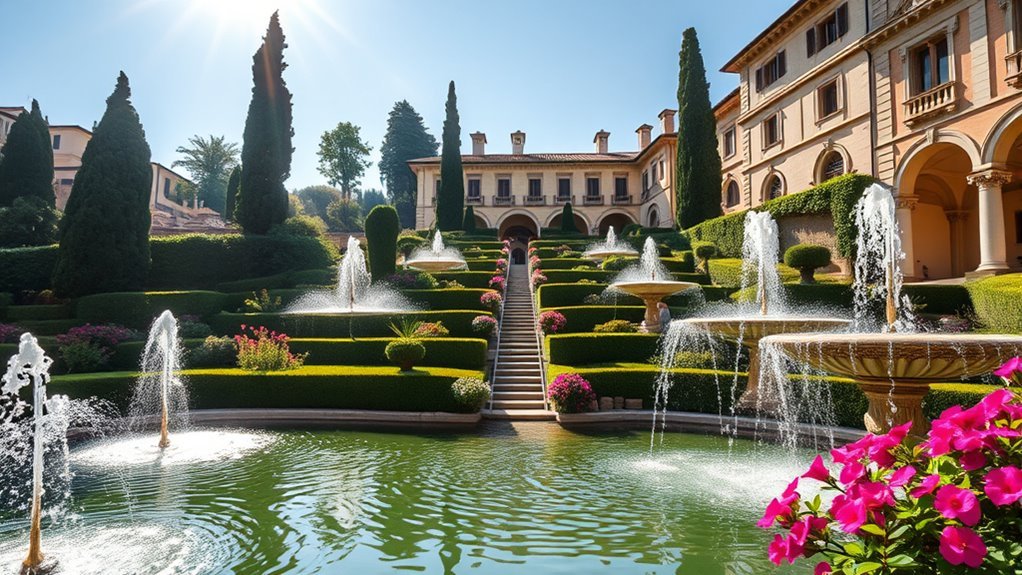
Villa d’Este in Tivoli is one of Lazio’s defining Renaissance sites. Cardinal Ippolito II d’Este commissioned the palace and gardens in the 16th century, creating a dramatic landscape of terraces, fountains, grottoes, basins, cascades, and water jets.
The water system uses the natural difference in elevation across the steep garden. UNESCO describes it as a masterpiece of hydraulic engineering and notes its influence on garden design throughout Europe. Major features include the Oval Fountain, the Hundred Fountains, the Fountain of Neptune, and the Fountain of the Organ.
Allow time for both the palace rooms and the descending garden. The many stairs, sloped paths, and damp surfaces can make the site tiring for visitors with limited mobility. Some routes may be available, but the entire historical garden is not equally accessible.
Pro Tip: Begin near the upper palace and work gradually down through the terraces. Save enough energy for the climb back toward the exit, especially on a hot afternoon.
Discover the Grandeur of Villa Adriana
Villa Adriana, also called Hadrian’s Villa, was developed for Emperor Hadrian between AD 118 and 138. Rather than a single house, it was an imperial complex containing residences, reception spaces, baths, gardens, pools, service areas, and buildings inspired by Hadrian’s travels through the Roman world.
Architectural Marvels of Villa Adriana
The protected World Heritage property covers about 120 hectares, although the public visit does not include every part of that wider area. Its best-known structures include the Maritime Theatre, the Great and Small Baths, the Pecile, and the Canopus.
The Maritime Theatre is a circular retreat built around a small artificial island. The Canopus, with its long pool and surrounding architecture, reflects the wider Mediterranean references found across the complex. It is associated with Canopus near Alexandria and should not be described simply as a reconstruction of the Nile.
Historical Significance and Legacy
Villa Adriana offers unusually detailed evidence of imperial Roman planning, engineering, landscape design, and daily life. Its combination of architectural traditions from across the ancient Mediterranean reflected Hadrian’s interests and the reach of the Roman Empire.
After the site was rediscovered and studied, its ruins influenced Renaissance, Baroque, and later architects and designers. Because the archaeological route is large and exposed, comfortable shoes, sun protection, and drinking water are more useful here than formal museum attire.
Warning: Villa Adriana has uneven stone, gravel, slopes, and long outdoor stretches. Wet weather can make some surfaces slippery, while summer heat can make an unshaded visit demanding.
Uncover the Artistic Wonders of Villa Borghese
Villa Borghese is both a large public park and the setting of several cultural attractions. Its most famous museum, Galleria Borghese, preserves works by Caravaggio, Raphael, Titian, Bernini, Canova, and other major artists.
The gallery and park should be planned separately. Entry to the park is generally free, but the museum uses timed admission and requires reservations for every ticket category. Do not arrive expecting to purchase guaranteed immediate entry.
| Feature | Details |
|---|---|
| Park size | Approximately 80 hectares |
| Main art attraction | Galleria Borghese |
| Historical character | Early-17th-century villa with later landscape and public-park additions |
| Activities | Walking, cycling, boating, museums, gardens, and family attractions |
| Museum booking | Advance timed reservation required |
Inside the gallery, Bernini’s sculptures and Caravaggio’s paintings are the central draw. Outside, the park provides paths, fountains, gardens, a lake, and access to attractions such as the National Gallery of Modern and Contemporary Art and the Bioparco di Roma.
Relax in the Formal Gardens of Villa Lante
Villa Lante stands in Bagnaia, a district of Viterbo in northern Lazio. It is one of Italy’s best-known 16th-century Mannerist gardens, with formal parterres, twin casino buildings, fountains, terraces, and a water chain descending through the wooded upper garden.
Villa Lante feels more intimate than Villa d’Este. Its design uses water to guide visitors through the landscape rather than relying only on large theatrical displays. The Fountain of the Moors, the Fountain of the Deluge, and the long central water course are among its defining features.
Note: A major restoration project involving Villa Lante’s gardens, fountains, plant systems, and vegetation began in 2025. The villa has remained open when construction conditions permit, but routes, ticket prices, or accessible areas may change. Check the official visitor notice before traveling.
Bagnaia is not close enough to Tivoli for a relaxed same-day combination. Treat Villa Lante as part of a Viterbo or northern Lazio itinerary.
Explore Renaissance Art at Villa Farnesina
In Rome’s Trastevere district, Villa Farnesina is one of the most complete examples of a Renaissance residence in the city. Banker and patron Agostino Chigi commissioned the villa from architect Baldassarre Peruzzi in the early 16th century.
The interior brings architecture and painting together. Raphael and his workshop decorated the Loggia of Cupid and Psyche, while the Loggia of Galatea contains Raphael’s famous Triumph of Galatea. Peruzzi, Sebastiano del Piombo, Giulio Romano, and Giovanni Antonio Bazzi, known as Sodoma, also contributed to the villa’s decoration.
The experience is more focused than a visit to a large archaeological site. Most travelers come for the frescoes and Renaissance rooms, then combine the villa with Trastevere, the nearby botanical garden, or a walk along the Tiber.
Pro Tip: Check the official opening calendar carefully. Villa Farnesina often has a narrower visiting window than Rome’s larger state museums, and special events or restoration work can affect access.
Explore the Museums and Park at Villa Torlonia
Villa Torlonia, northeast of Rome’s historic center, combines a public park with an unusual collection of restored buildings. The grounds evolved under several architects, producing Neoclassical, medieval-inspired, rustic, Moorish, and Art Nouveau elements.
Serene Park Atmosphere
The landscaped park contains winding paths, lawns, mature trees, ponds, garden structures, and architectural fragments. It is suitable for a slower visit than Rome’s busiest archaeological sites and can work well for families who want both outdoor space and a small museum experience.
- Walk through the landscaped park and its winding avenues.
- Visit one or more museum buildings rather than trying to see every space.
- Pause near the ponds, false ruins, obelisks, and Temple of Saturn.
- Check temporary exhibition and event listings before your visit.
- Allow extra time if you plan to visit the bunker or multiple museum interiors.
Eclectic Architectural Styles
The Casina delle Civette began as a rustic structure designed by Giuseppe Jappelli in the 19th century and was transformed in the early 20th century. Its stained glass, decorated roofs, majolica, woodwork, and owl motifs make it the most distinctive building in the complex.
The Casino Nobile offers a more formal contrast, while the Serra Moresca introduces Moorish-inspired glass, ironwork, and decorative forms. Together, the buildings show how the estate changed with the tastes of successive Torlonia owners.
Cultural Events, Museums, and 20th-Century History
Villa Torlonia later became the Rome residence of Benito Mussolini from 1925 to 1943. Today, restored museum spaces interpret the estate’s aristocratic, architectural, artistic, and 20th-century history. The park is separate from the ticketed interiors, so check which buildings and exhibitions are open on your chosen date.
- Casina delle Civette and its stained-glass collection
- Casino Nobile and the Museum of the Villa
- Casino dei Principi and temporary exhibitions
- Serra Moresca and its restored architectural setting
- The air-raid shelters and bunker, when available for visits
Marvel at the Architecture of Villa Medici
Villa Medici occupies a prominent position on the Pincian Hill above central Rome. Cardinal Ferdinando de’ Medici developed the Renaissance residence in the late 16th century, and the property has served as the home of the French Academy in Rome since 1803.
The garden-facing facade, historic rooms, painted ceilings, sculpture displays, formal gardens, and belvedere views are central to the experience. Villa Medici is also an active artists’ residence and cultural center, so temporary exhibitions, performances, festivals, and contemporary installations form part of its modern identity.
Unlike a public park that can be explored freely, many of Villa Medici’s historic areas are seen through an official guided tour. The current visitor page lists available languages, tour times, exhibitions, prices, and accessibility information.
Note: Much of a Villa Medici tour takes place outdoors. Prepare for heat or rain, and check restrictions on bulky bags, pushchairs, and access to individual rooms before arriving.
Uncover the History of Villa Lazzaroni
Villa Lazzaroni is sometimes incorrectly placed in Frascati, but the property is actually in Rome’s Appio-Latino district along Via Appia Nuova. The official city record dates it to the late 19th century, when the Lazzaroni family transformed an agricultural property and existing farmhouse into a suburban residence.
The grounds cover about 54,000 square meters and include lawns, paths, trees, fountains, recreation areas, and the former residence. The main building now houses offices of Rome’s Municipio VII, so this is not a furnished house museum comparable to Villa Farnesina or Galleria Borghese.
Villa Lazzaroni is most useful as a local green stop for travelers already exploring the Appian Way area or nearby neighborhoods. Its value lies in showing how Rome’s suburban agricultural land was reshaped into a bourgeois estate during the city’s late-19th-century expansion.
- A late-19th-century estate rather than an 18th-century Neoclassical villa
- Located in Rome, not Frascati
- Public neighborhood park with community facilities
- Main building used for municipal offices
- Best treated as a local stop rather than a major regional day trip
Experience the Scenic Beauty of Villa Doria Pamphilj
Villa Doria Pamphilj is Rome’s largest historic public villa, extending across approximately 184 hectares west of the city center. Its mixture of formal gardens, woods, open lawns, water features, historic buildings, and long paths makes it one of the city’s best places for walking, running, cycling, or picnicking.
Lush Gardens and Landscapes
The park includes Italian garden areas, broad avenues, wooded sections, meadows, a lake, fountains, and remnants of its former agricultural landscape. Mature pines, oaks, and other trees create welcome shade, although the large estate still includes exposed sections.
- Long walking and running routes
- Open lawns and picnic areas
- Historic trees, gardens, and water features
- Views of the Casino del Bel Respiro and its formal garden
- Multiple entrances serving different parts of the park
The monumental Fontanone dell’Acqua Paola is nearby on the Janiculum, but it is a separate landmark and should not be confused with the fountains inside Villa Doria Pamphilj.
Architectural Marvels and History
The estate became a major Pamphilj family country residence during the 17th century under Pope Innocent X. Its best-known building is the Baroque Casino del Bel Respiro, also called the Casino dell’Algardi, which overlooks the Secret Garden.
The Casino now serves as a representative seat of the Italian government. You can view it from the public park, but interior visits are limited to selected dates and require advance booking through the official government visit program.
Recreational Activities Available
Villa Doria Pamphilj is best experienced as a landscape rather than as a conventional museum. Its size lets you choose between a short neighborhood walk and a much longer circuit.
- Jogging along broad paths and quieter side routes
- Cycling on appropriate park paths
- Walking beneath mature trees
- Landscape and architectural photography
- Picnicking on suitable lawns
- Attending scheduled community or cultural events
Because entrances are spread around the perimeter, choose your starting point based on the section you most want to see. A route beginning near Porta San Pancrazio emphasizes the eastern historic landscape, while western entrances provide access to broader open and natural areas.
How to Plan a Lazio Villa Itinerary
Plan a Tivoli Day Trip
Villa d’Este and Villa Adriana can fit into one long day, but the experience involves extensive walking and transportation between separate sites. Villa d’Este is near central Tivoli, while Villa Adriana lies outside the town center. Check current local bus or taxi options rather than assuming the two entrances are within an easy walk.
Travelers who prefer a slower pace should give each property more time or stay overnight in Tivoli. Villa Gregoriana is another major landscape attraction in the area, but adding all three villas to one day can feel rushed.
Group Rome’s Villas by Neighborhood
- Pincian and northern central Rome: Villa Borghese and Villa Medici
- Trastevere and Janiculum: Villa Farnesina and Villa Doria Pamphilj
- Northeast Rome: Villa Torlonia
- Appio-Latino: Villa Lazzaroni, potentially combined with Appian Way sights
Keep Villa Lante for a Northern Lazio Day
Villa Lante is in Bagnaia near Viterbo, well north of Rome. Combine it with Viterbo or another nearby Tuscia attraction rather than Tivoli or multiple central Rome museums.
The most rewarding itinerary usually combines one major ticketed villa with one nearby park, neighborhood, or smaller museum—not three large estates in a single rushed day.
Essential Tips for Visiting Lazio’s Stunning Villas
Spring and fall often provide comfortable conditions for outdoor sites, but weather is never guaranteed. Summer visits require extra water and sun protection, while rain can make historic stone, garden stairs, and archaeological paths slippery.
Reservation rules vary. Galleria Borghese requires timed booking, while Villa Medici tours, special exhibitions, and limited-access institutional buildings may also need advance reservations. Public parks such as Villa Doria Pamphilj can generally be entered without a museum ticket.
| Tip | Details |
|---|---|
| Best general seasons | Spring and fall for milder outdoor conditions |
| Advance booking | Essential for Galleria Borghese and advisable for tours or limited-access interiors |
| Footwear | Supportive shoes with grip for stairs, gravel, stone, and archaeological terrain |
| Photography | Follow each site’s rules; flash, tripods, filming, or temporary-exhibition photography may be restricted |
| Accessibility | Contact the property in advance because historic stairs, slopes, gravel, and restoration work can limit routes |
| Current conditions | Recheck official hours, prices, closures, exhibitions, and restoration notices shortly before visiting |
Warning: Do not rely only on old blogs or map listings for opening hours. Historic properties may close individual rooms, fountains, gardens, or museum buildings for restoration, weather, security, or institutional events.
Frequently Asked Questions
What are some less-crowded villas and gardens in Lazio?
Villa Lante in Bagnaia can feel calmer than Rome’s busiest museums, especially outside peak weekends. In Rome, Villa Torlonia offers a mix of park space and smaller museums, while Villa Lazzaroni is a neighborhood park rather than a major tourist attraction. Crowd levels still vary by season and events.
Which part of Italy is best for historic villas?
There is no single best region. Lazio is especially strong for Roman imperial sites, Renaissance gardens, papal estates, and villa museums near Rome. Lombardy is known for lake villas, Veneto for Palladian villas, and Tuscany for Medici estates and country residences.
Is Lazio worth visiting beyond Rome?
Yes. Tivoli offers Villa d’Este and Villa Adriana, while northern Lazio includes Villa Lante, Viterbo, lakes, gardens, and medieval towns. These destinations add Roman archaeology, Renaissance landscapes, and smaller historic centers to a Rome-based trip.
What is a beautiful village near Rome to combine with a villa trip?
Calcata is a popular choice for its dramatic hilltop setting, medieval lanes, and artistic community, but “most beautiful” is subjective. Tivoli is the more practical base for Villa d’Este and Villa Adriana, while Bagnaia pairs naturally with Villa Lante and nearby Viterbo.
Can you visit Villa d’Este and Villa Adriana in one day?
Yes, but plan a full day and confirm transportation between the two sites. Villa d’Este is near central Tivoli, while Villa Adriana is outside the center. Begin early, reserve enough time for walking, and avoid adding another major attraction unless you are comfortable with a fast pace.
Which Lazio villas require advance reservations?
Galleria Borghese requires a timed reservation for all ticket categories. Guided visits at Villa Medici and limited openings of the Casino del Bel Respiro also require booking. Other sites may sell walk-up tickets, but advance purchase can still be useful during busy periods.
Conclusion
Lazio’s villas reveal several layers of the region’s history. Villa Adriana represents the scale and ambition of imperial Rome, while Villa d’Este and Villa Lante show how Renaissance designers shaped water, architecture, and landscape. Galleria Borghese and Villa Farnesina reward art lovers, and Rome’s public villas provide room to slow down between museum visits.
Choose properties that match your main interest and group them by location. One carefully planned villa, paired with a nearby neighborhood or park, usually creates a better day than rushing between distant estates. Check each official website before departure, reserve timed visits where required, and leave enough time to enjoy the gardens and buildings at a comfortable pace.
Sources
- UNESCO World Heritage Centre — Villa d’Este — Renaissance garden design, hydraulic engineering, and World Heritage significance
- UNESCO World Heritage Centre — Villa Adriana — construction period, protected area, architecture, and historical influence
- Galleria Borghese Official Website — collection, exhibitions, tickets, and visitor planning
- Italian Ministry of Culture — Villa Lante — location, garden history, and cultural significance
- Villa Farnesina Official Website — Agostino Chigi, Renaissance architecture, and fresco decoration
- Sovrintendenza Capitolina — Villa Lazzaroni — correct location, date, size, and present municipal use
