

Last Updated on July 27, 2026 by Mason Reed
When a normal tent stake slides out of loose sand, powdery snow, or crumbly soil, a deadman anchor spreads the load across a much larger buried object. The technique is simple, but a secure setup depends on anchor size, burial depth, orientation, pull angle, and firm packing. This guide focuses on deadman anchors for tent and shelter guylines, not climbing, rescue, vehicle recovery, or supporting a person’s weight.
Quick Answer
A deadman anchor holds a tent by burying a broad object perpendicular to the guyline and loading it near the midpoint. Pack the sand, snow, or soil firmly, then tension and test the line. In snow, current USAP guidance shows about 18 inches as an average and 24 inches or more in very soft conditions.
Key Takeaways
- Place a rigid deadman horizontally and perpendicular to the direction of pull, with the guyline or sling loaded near the anchor’s midpoint.
- There is no universal burial depth. Anchor size, sand or snow density, wind exposure, and pull angle all affect holding power.
- For rigid T-slot anchors, rig the midpoint before backfilling. A sandbag with an accessible attachment loop may be tied to the guyline after the bag is buried.
- Use the tent’s line tensioner, a trucker’s hitch, or a taut-line hitch where the knot remains accessible for retensioning.
- Proof-test every anchor, recheck it as conditions change, and never rely on an improvised tent deadman for climbing, rescue, vehicle recovery, or suspended-human loads.
At a Glance
| Time Required | Several minutes per anchor; longer in frozen, rocky, or very loose ground |
| Difficulty | Beginner-friendly technique; winter backcountry use requires additional site-selection and weather skills |
| Tools Needed | Small shovel or trowel, guyline, and a broad anchor such as a snow/sand stake, sturdy bag, rock bag, or rigid stick where local rules allow |
| Cost | $0 when using suitable gear you already carry; otherwise varies by anchor type |
Disclosure: As an Amazon Associate I earn from qualifying purchases. Some links on this page are affiliate links, at no extra cost to you.
Understanding Deadman Anchors
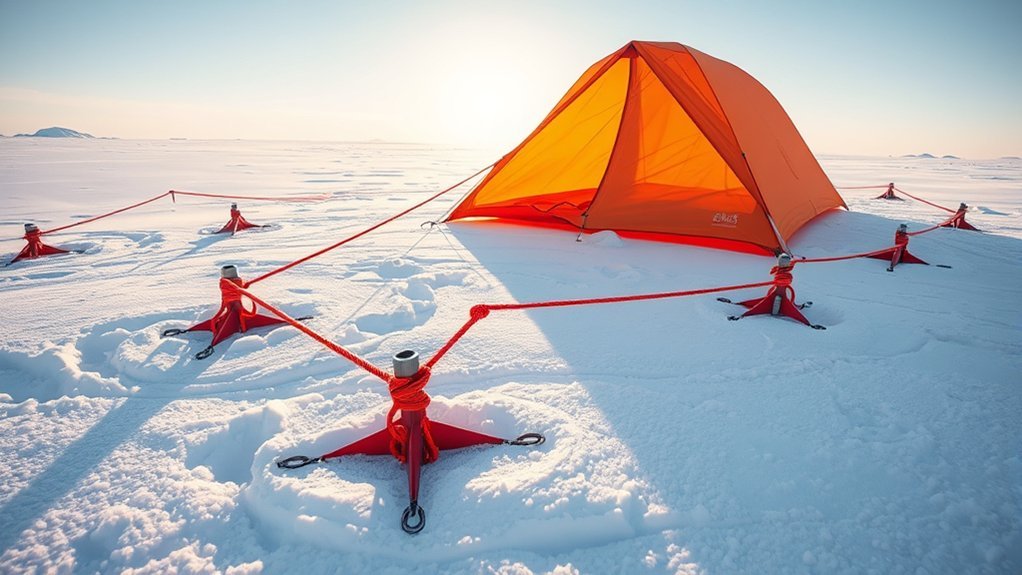
A deadman anchor secures a tent by burying a broad object so the surrounding sand, snow, or soil resists the pull of the guyline. A narrow stake in weak material can rotate or pull through the substrate. A horizontal deadman spreads that force across a larger area and has more material above and in front of it to resist movement.
For a rigid deadman, the basic layout is a T-shape: the anchor forms the crossbar of the T, perpendicular to the direction of pull, while a narrow slot lets the guyline run straight back toward the tent. Current United States Antarctic Program field guidance uses this same arrangement in soft snow and attaches the guyline at the anchor’s midpoint.
A strong deadman is not defined by one magic depth. A broad anchor, center loading, a low pull angle, firm packing, and a successful load test all matter.
Materials Needed for Deadman Anchors
You do not need a special commercial anchor for every campsite, but the object you bury should be broad enough for the substrate, strong enough not to snap, and easy to recover. Purpose-built snow/sand stakes and fabric anchors are convenient because their shape and attachment points are designed for loose ground.
Essential Materials Overview
- Broad anchor: A wide snow/sand stake, sturdy stick, short piece of wood, rock bag, or fabric bag filled with local sand or snow.
- Guyline: Use the line supplied with the shelter when possible, or another durable, low-stretch cord suitable for tent guying.
- Digging tool: A small shovel, trowel, snow shovel, or entrenching tool makes it easier to create a clean trench without disturbing a large area.
- Optional retrieval line: A short, brightly colored loop can help locate and rotate a buried rigid stake during removal.
- Optional abrasion protection: A sacrificial sleeve or smooth protective piece can keep line from rubbing directly on sharp rock.
Nylon paracord can work as an emergency guyline, but it is not the same as a low-stretch, low-water-uptake tent cord. Nylon can take up moisture and stretch, so check and retension it after rain, snow, or temperature changes.
Alternative Anchoring Options
A stuff sack, purpose-built fabric snow/sand anchor, or carried rock bag is usually a better improvised choice than brittle household plastic. Old CDs and thin plastic lids can crack and become litter, while drilling or screwing hardware into natural driftwood is unnecessary. Where regulations permit the use of loose sticks or rocks, use only what you need, never cut live vegetation, and restore the site when you leave.
Pro Tip: Carrying one lightweight stuff sack or purpose-built fabric anchor gives you a dependable container for sand, snow, or small rocks without relying on whatever fragile material happens to be at the campsite.
Core T-Slot Deadman Method
- Choose the direction of pull. Follow the tent manufacturer’s guy-out layout. Place the deadman far enough from the tent that the line approaches it at a relatively low angle instead of pulling sharply upward.
- Dig the cross trench. Make it wide enough for the complete anchor. A rigid anchor should lie horizontally and perpendicular to the guyline.
- Cut a narrow guyline slot. Run this slot from the center of the anchor trench toward the tent. Avoid destroying the undisturbed material in front of the deadman.
- Rig the center of the anchor. Attach a loop or sling near the midpoint of a rigid stake, stick, or picket before backfilling. For a fabric bag, use its designed attachment loop or secure closure.
- Backfill and pack firmly. Replace sand, soil, or snow around and above the anchor. Compact it without yanking the anchor out of position.
- Tension the guyline. Use the shelter’s tensioner, a trucker’s hitch, or a taut-line hitch where it remains accessible.
- Proof-test it. Apply firm, steady tension and watch the ground. If the anchor rises, rotates, creeps, or loosens the surrounding material, reset it deeper, farther away, or with a larger anchor.
Warning: These instructions are for tent and lightweight shelter guylines. An improvised camping deadman is not a rated climbing, rescue, vehicle-recovery, or human-suspension anchor.
Creating a Deadman Anchor in Sand

In sand, use either a broad rigid deadman or a bag-style anchor. A current Kodiak Canvas tent owner’s manual gives approximately 12–18 inches as guidance for burying a horizontal piece of wood in soft sand or snow. Treat that as a practical starting range, not a universal guarantee. Dry, loose sand may require a larger or deeper anchor, while firm damp sand may pass a load test with less excavation.
For a bag-style anchor, fill a durable bag with enough sand to make a broad, dense bundle. Bury the bag fully and let only its attachment loop or a narrow line channel lead toward the tent. There is no dependable universal rule such as “20–40 pounds”; the amount needed changes with bag area, substrate, tent size, wind exposure, and guyline angle.
For a rigid sand/snow stake, connect near the center or through a lower attachment point intended for buried use. The current REI Co-op Snow Stake is designed for snow and sand and can be tied through a lower hole with the cord buried. Follow the particular stake manufacturer’s instructions rather than assuming every stake should be tied the same way.
Warning: Do not use “tie only after burial” as a universal rule. A rigid T-slot deadman is normally rigged at its midpoint before backfilling. A bag with an exposed attachment loop may be connected after burial. In both cases, center loading and the pull angle matter more than the sequence alone.
If you use a loose stick or piece of driftwood where local regulations allow it, choose a sound piece with enough length and thickness to spread the load. Do not cut vegetation, alter living trees, or leave the anchor buried after camp.
Building a Deadman Anchor in Loose Soil
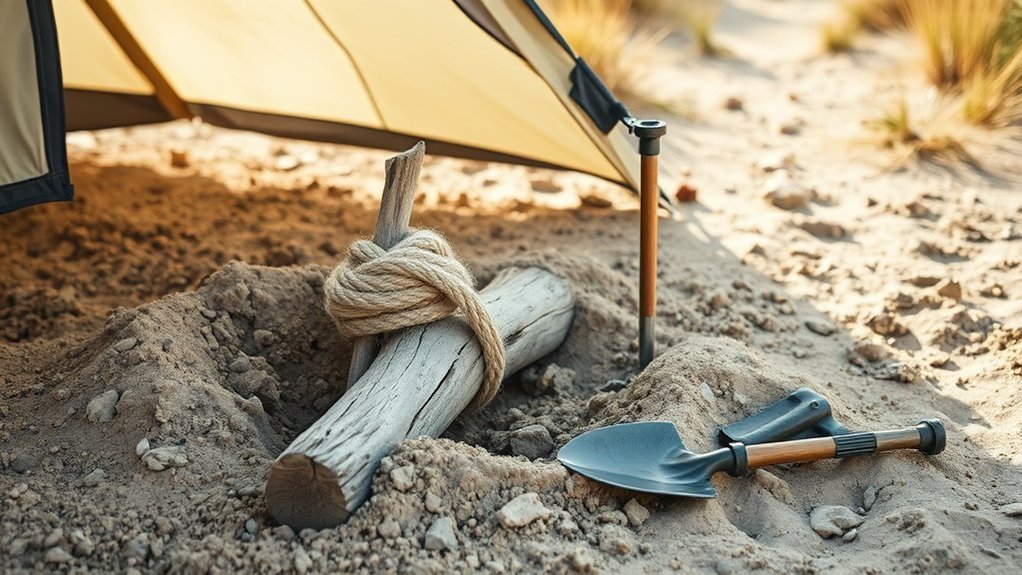
Loose or crumbling soil can be treated much like sand, but rocks may provide a stronger and easier-to-recover anchor. A buried rock, a rock-filled bag, or a modified “big rock/little rock” setup can work when a normal stake keeps pulling through the soil.
| Step | Description |
|---|---|
| Choose the anchor | Use a broad, heavy rock, rock bag, or rigid object that will not break under guyline tension. |
| Orient it | Lay a rigid anchor across the pull direction rather than pointing it at the tent. |
| Rig the center | Run a loop or sling around the midpoint and route the guyline through a narrow channel toward the tent. |
| Backfill and pack | Replace the soil without disturbing the material directly in front of the anchor, then compact it firmly. |
| Test and reinforce | Apply steady tension. If it moves, use a larger anchor, greater depth, a lower pull angle, or additional rocks where permitted. |
Sharp rocks introduce another problem: abrasion. The USAP Peninsula Field Manual warns that a guyline can wear where it exits rocky ground. Inspect that contact point and use a smooth protective sleeve or redirect the line if necessary.
Establishing a Deadman Anchor in Snow
In soft snow, a T-deadman is one of the standard ways to anchor a shelter. The rigid anchor lies perpendicular to the pull, with the guyline attached near the midpoint and routed through a straight slot toward the tent.
Current USAP field guidance illustrates an 18-inch average burial depth based on snow conditions for a deadman snow picket. It also states that in very soft snow, the deadman should be buried 2 feet or more. Those numbers are much more useful than treating 12–30 inches as a universal range because they explicitly tie the depth to snow condition.
In winter, a secure anchor is only one part of shelter safety. Site selection, weather, avalanche exposure, adequate insulation, and the ability to repair or re-anchor the tent matter just as much.
- Choose a safe campsite first: Stay out of avalanche slopes and avalanche tracks, and follow local winter-camping rules and forecasts.
- Choose the anchor: Use a wide snow stake, picket, sturdy rigid object, or suitable fabric anchor.
- Dig the T-slot: Set the cross trench perpendicular to the pull and leave enough distance from the tent for a low guyline angle.
- Attach at the midpoint: Girth, loop, or otherwise secure the line at the center of a rigid deadman so one end is not levered upward.
- Backfill and compact: Pack snow firmly around and above the anchor without changing its orientation.
- Tension and monitor: Keep the adjustable hitch or tensioner above the snow where possible, and recheck the line as snow settles, warms, refreezes, or drifts.
Note: Incorrect shelter anchoring can become a serious problem in exposed winter conditions. The National Park Service winter-safety guidance also warns campers to avoid avalanche slopes and avalanche tracks. Practice snow anchoring in a controlled setting before depending on it in remote terrain.
Best Practices for Installation and Removal
| Installation Techniques | Removal Strategies |
|---|---|
| Place rigid anchors perpendicular to the pull. | Fully release guyline tension before extraction. |
| Load a rigid anchor near its midpoint. | Use a retrieval loop to rotate a rigid stake only if the stake design allows it. |
| Keep the pull angle low by placing the anchor far enough from the tent. | Excavate frozen or stubborn anchors instead of damaging the line or stake. |
| Pack the surrounding material firmly and proof-test the anchor. | Recover every bag, cord, stake, and piece of hardware. |
| Inspect and retension guylines as weather and substrate change. | Refill holes and restore the campsite surface before leaving. |
Pro Tip: A brightly colored retrieval loop can save time when a snow stake disappears under drifted snow. Keep the retrieval line separate from the load-bearing guyline so pulling it does not change the anchor’s working angle during use.
Adapting to Different Soil Types
- Rocky Terrain: When digging is impossible, use a rock bag or modified rock anchor instead of forcing a stake between rocks. Protect the guyline from sharp edges.
- Dry, Loose Sand: A horizontal wood deadman in the 12–18 inch range is a useful starting point from manufacturer guidance, but increase depth or anchor area if a steady load test causes movement.
- Damp or Compact Sand: It may need less depth than dry loose sand, but do not depend on a fixed 8-inch rule. Bury the anchor completely and test it under realistic tension.
- Loose or Loamy Soil: Use a broader anchor than a normal stake and adjust burial depth to soil density, moisture, roots, and the required guyline load.
- Settled Snow: USAP illustrates about 18 inches as an average deadman-picket depth based on conditions.
- Very Soft Snow: USAP calls for 24 inches or more. Increase anchor area as well as depth when the snow has little cohesion.
- Firm Snow or Hardpack: A long conventional snow stake or other manufacturer-approved method may be faster than excavating a deadman.
Troubleshooting a Deadman Anchor That Will Not Hold
| Problem | Likely Cause | Fix |
|---|---|---|
| Anchor rotates upward | Load is too close to one end or the guyline angle is too steep | Reload the midpoint and move the anchor farther from the tent. |
| Anchor creeps through sand or snow | Too little depth, too little surface area, or poorly packed material | Dig deeper, use a broader anchor, and repack firmly. |
| Guyline repeatedly loosens | Cord stretch, knot slippage, settling snow, or shifting sand | Retension the line and use a suitable adjustable hitch or manufacturer tensioner. |
| Line frays at ground level | Abrasion against rock or a sharp stake edge | Add abrasion protection, smooth the exit path, or reroute the line. |
| Snow anchor freezes in place | Melt/refreeze cycle or heavily compacted snow | Release tension, use the retrieval line if available, or carefully excavate the anchor. |
Beach, Snow, and Leave No Trace Safety
On a beach, anchor technique does not matter if the campsite itself is in the wrong place. Olympic National Park advises beach campers to know the tides and camp above the high-tide water line. Other beaches may prohibit camping entirely or restrict access near dunes, vegetation, nesting areas, or wildlife closures, so check local rules before digging.
Avoid anchoring into dune grass, plant roots, biological soil crusts, or other sensitive vegetation. Use established or bare durable sites where required, disturb the smallest practical area, and refill every deadman trench when you leave.
For winter camping, check weather and avalanche conditions before choosing the tent site. A perfectly buried deadman cannot make an avalanche path or highly exposed campsite safe.
Warning: Never leave a buried stake, bag, cord, sharp object, or improvised plastic anchor behind. Besides being litter, hidden hardware can injure other campers or wildlife after the surface changes.
Creative Solutions and Community Tips
| Technique | Best Use | Key Caution |
|---|---|---|
| Stuff Sack or Fabric Anchor | Sand or soft snow | Inspect the fabric and attachment loop before loading it. |
| Wide Snow/Sand Stake | Loose sand or snow where a narrow stake pulls out | Use the manufacturer’s recommended tie point and orientation. |
| Rock Bag | Rocky ground or sites where digging a rigid deadman is difficult | Do not place sharp rock directly against the tent fabric or guyline. |
| Big Rock / Small Rock | Hard or rocky terrain where stakes cannot penetrate | Use only where moving loose rocks is allowed and restore them afterward. |
| Rigid Stick or Wood | Sand, snow, or soft soil | Use only loose material where permitted; never cut live vegetation. |
Frequently Asked Questions
Can deadman anchors be used for other outdoor gear?
Yes, they can secure tent, tarp, and lightweight canopy guylines when the anchor is sized and tested for the load. Do not assume an improvised tent deadman is safe for a hammock, climbing system, rescue anchor, vehicle recovery, or any setup supporting a person.
How deep should I bury a deadman anchor?
There is no single depth for every material. A 12–18 inch horizontal wood deadman is useful manufacturer guidance for soft sand or snow, while current USAP snow guidance illustrates about 18 inches as an average and requires 24 inches or more in very soft snow. Always increase depth or anchor area if the anchor moves during a firm load test.
How much wind can a deadman anchor handle?
There is no universal wind-speed rating for an improvised deadman. Holding power changes with anchor area, burial depth, substrate density, guyline angle, tent shape, exposure, and installation quality. Test each anchor, use every important guy-out in strong wind, and follow the shelter manufacturer’s weather guidance.
Are there alternative materials for creating deadman anchors?
Yes. Suitable options include purpose-built snow/sand stakes, fabric anchors, stuff sacks, rock bags, and strong rigid sticks where collecting loose natural material is allowed. Avoid brittle plastic, sharp scrap, or anything you might accidentally leave buried.
How do I know if my deadman anchor is secure?
After backfilling and tensioning, apply firm, steady load while watching the surface and guyline. The anchor should not rise, rotate, creep, or loosen the surrounding material. If it moves, reset it deeper, use a broader anchor, improve the pull angle, or choose a firmer site before relying on it overnight.
What knot should I use for a deadman anchor?
For tensioning the guyline, a trucker’s hitch or taut-line hitch works well, and the tent’s built-in tensioner is often even easier. A rigid buried anchor should be loaded near its midpoint using a connection appropriate for that anchor, such as a loop or girth-style attachment. Follow the stake manufacturer’s instructions when it provides a specific center or lower tie point.
Sources
- United States Antarctic Program — Peninsula Field Manual 2026 — midpoint loading, T-slot geometry, snow burial depth, rock bags, guyline adjustment, and abrasion guidance
- Kodiak Canvas — Owner’s Manuals — manufacturer guidance for horizontal deadman anchoring in soft sand or snow
- MSR — Tents and Shelters Setup and Use Manual — tent anchoring, specialized stakes, guylines, and tensioning
- REI Co-op — Snow Stake — current snow/sand stake design and buried lower-hole attachment option
- Olympic National Park — Ozette Loop — beach camping, tide planning, and camping above the high-tide line
- North Cascades National Park — Winter Safety — winter campsite and avalanche-terrain precautions
Conclusion
A deadman anchor can turn loose sand, soft snow, or weak soil into a usable tent-anchoring surface, but the technique depends on more than burying something heavy. Place a rigid anchor perpendicular to the pull, load it near the midpoint, keep the guyline angle low, pack the substrate firmly, and proof-test every anchor before trusting it.
Use roughly 12–18 inches as practical manufacturer guidance for a horizontal wood deadman in soft sand or snow, while recognizing that current USAP snow guidance uses about 18 inches as an average and 24 inches or more in very soft snow. When the anchor moves, the answer is not a stronger knot alone: use more depth, more surface area, better packing, a better pull angle, or a more suitable campsite. Recover every anchor and restore the ground when you leave.
