
Last Updated on September 11, 2026 by Ethan Caldwell
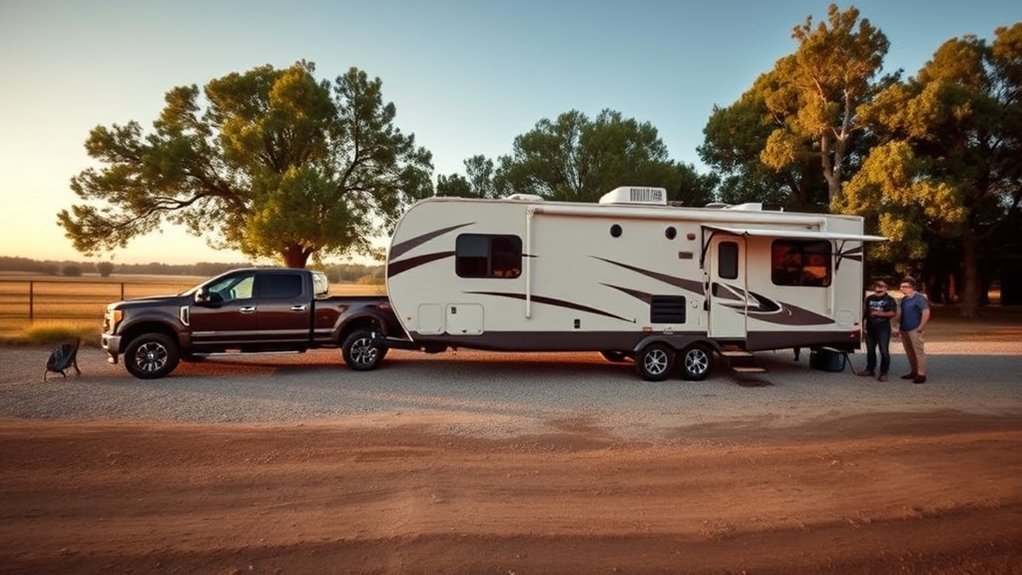
A travel trailer can be compact enough for a small campsite or long enough to include several sleeping areas, slide-outs, and residential-style features. Length also affects storage, route planning, turning, and campsite access. The key is knowing which measurement you are looking at, because body length, listed overall length, and your trailer’s actual parking footprint may not be the same.
Quick Answer
Most current travel trailers are about 16 to 40 feet long overall, although compact campers can be shorter and destination or specialty models can exceed 40 feet. For storage and campsite planning, measure from the front of the hitch coupler to the farthest rear point, then account for any protruding accessories.
Key Takeaways
- A useful shopping range is roughly 16 to 40 feet overall, but specialty and destination trailers may be longer.
- Overall trailer length normally includes the hitch coupler, while body or box length does not.
- The length on a label or spec sheet may exclude certain ladders, spare tires, racks, and removable accessories.
- Trailer length does not replace weight ratings. Check GVWR, payload, hitch limits, axle limits, and the tow vehicle’s official trailer rating.
- Campground limits vary by site. Confirm whether a listing refers to the trailer, RV, parking pad, or complete vehicle-and-trailer combination.
Disclosure: As an Amazon Associate I earn from qualifying purchases. Some links on this page are affiliate links, at no extra cost to you.
How Long Is a Travel Trailer?
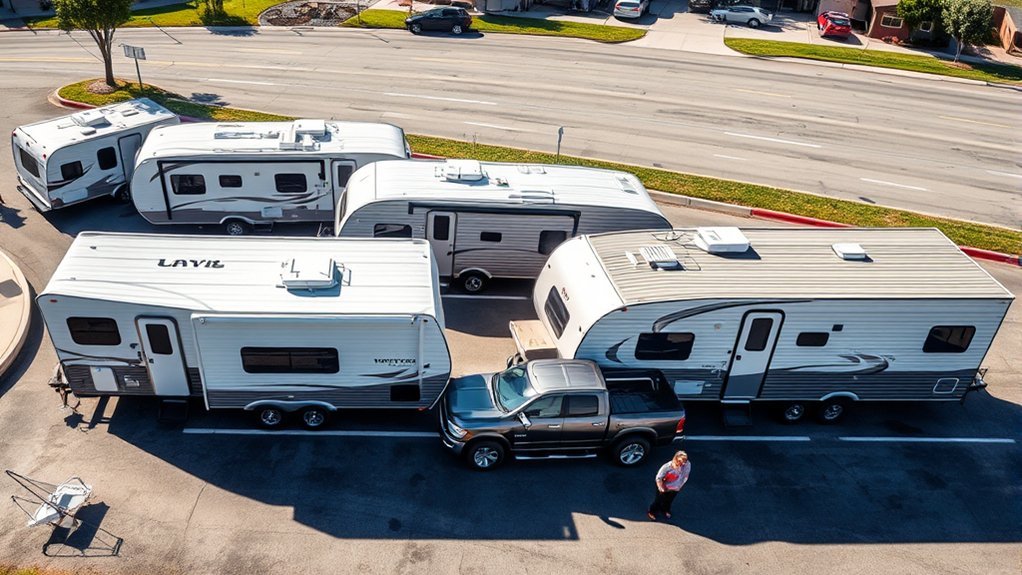
A practical range for many current travel trailers is about 16 to 40 feet overall. Compact single-axle campers often sit near the lower end, while bunkhouse trailers, toy haulers, and large multi-slide models can approach 40 feet. Destination trailers built mainly for long stays may exceed 40 feet.
There is no single industry size that represents every travel trailer. For example, Airstream describes its current lineup as ranging from a 16-foot Bambi to a 33-foot Classic. At the larger end, Jayco lists a current destination travel trailer at 41 feet 6 inches. These examples show why a fixed 12-to-35-foot range is too narrow for the full market.
The number that matters depends on the decision: use overall length for comparison, actual maximum footprint for storage and parking, and combined vehicle length when a campground or law requires it.
| General size group | Approximate overall length | Common use |
|---|---|---|
| Compact | About 16–22 ft | Couples, solo travel, smaller campsites, and lighter floorplans |
| Midsize | About 23–29 ft | Couples or small families wanting more storage and living space |
| Large | About 30–40 ft | Families, bunkhouses, multiple slide-outs, and extended stays |
| Destination or specialty | Around 40 ft or more | Long-term placement, residential-style layouts, and specialty use |
These groups are shopping guides, not official legal classes. Always use the exact specification for the model and floorplan you are considering.
Travel Trailer Lengths by Common Type
Travel trailer size often follows the way the trailer is designed to be used. Compact single-axle units focus on easier storage and simpler campsites. Midsize models add bathrooms, larger kitchens, fixed beds, or small slide-outs. Large trailers may include bunk rooms, multiple slides, outdoor kitchens, and separate living areas.
Common Travel Trailer Sizes
| Trailer type | Typical size pattern | What to check |
|---|---|---|
| Teardrop or micro camper | Usually among the shortest towable campers | Sleeping space, standing height, storage, and whether it has a bathroom |
| Compact travel trailer | Often around 16–22 ft overall | Payload, tank size, bed layout, and tow-vehicle rating |
| Midsize travel trailer | Often around 23–29 ft overall | Slide clearance, loaded tongue weight, and campsite access |
| Large bunkhouse or couples trailer | Often around 30–40 ft overall | Turning room, tow-vehicle payload, hitch setup, and campground limits |
| Toy hauler or destination trailer | May be wide, tall, heavy, and longer than 40 ft | Cargo loading, total height, route limits, and whether frequent towing is practical |
Measuring Trailer Body Length
Body length, sometimes called box length or cabin length, measures the enclosed living structure rather than the complete trailer. It normally excludes the A-frame and hitch coupler at the front. A manufacturer may publish both body length and overall exterior length, as current Jayco specification pages do.
Body length is useful when comparing interior floorplans, but it is not the best number for a garage, storage lot, ferry, campsite, or parking space. Those decisions require the overall length or the trailer’s actual maximum footprint.
Does the Model Number Show the Trailer’s Length?
A trailer’s model number may resemble its floorplan or box length, but it does not reliably show the exact overall length. For example, a model containing “17” can measure more than 21 feet overall once the hitch and rear structure are included. A model containing “24” may measure about 27 feet overall.
Note: Never use a floorplan code or model name to book a site. Open the manufacturer’s specification page and look for “exterior length,” “overall length,” or a similarly defined measurement.
How Travel Trailer Length Is Measured
The RV Industry Association’s standardized method measures a travel trailer from the leading front edge of the hitch coupler to the rearmost extremity of the trailer, such as the bumper, rear wall, or rear cap. However, the standardized label can exclude certain appurtenances, including exterior ladders, spare tires and carriers, and some hitch or cargo accessory receivers.
That means you may need more than one measurement:
- Listed overall length: Use the manufacturer’s specification or RV length label for basic model comparison.
- Body or box length: Measure the enclosed living structure when comparing floorplans.
- Actual maximum footprint: Measure from the farthest front point to the farthest rear point, including anything that remains attached during storage or parking.
- Combined length: Measure the tow vehicle and connected trailer when a campground, ferry, storage facility, or state rule asks for the complete combination.
How to Measure Your Trailer Accurately
- Park the tow vehicle and trailer on a level, straight surface.
- Use a long tape measure or laser measuring tool suitable for outdoor use.
- Measure overall trailer length from the front edge of the coupler to the rearmost structural point.
- Measure again to the farthest attached item, such as a rack, spare tire, storage box, or ladder, to record your actual footprint.
- Measure body length separately from the front wall to the rear wall if you need to compare interior space.
- Record travel height from level ground to the highest fixed point, usually an air conditioner, vent cover, antenna, or solar component.
- Record body width with slide-outs closed and setup width with every slide fully extended.
Pro Tip: Keep a dimension card in your tow vehicle showing overall length, actual footprint, travel height, body width, deployed width, GVWR, and the complete hitched length. Check it before entering fuel stations, parking areas, tunnels, ferries, or unfamiliar campgrounds.
Why Listed Length and Real Length Differ
The length shown in a brochure can differ from the space your trailer occupies for several reasons:
- The brochure may show body length instead of overall exterior length.
- The standardized RV length label may exclude specific appurtenances.
- A dealer-installed bike rack, cargo carrier, storage box, or spare-tire system can extend the rear footprint.
- An aftermarket tongue-mounted storage system may change the front footprint.
- A model code may refer to a floorplan rather than an exact measurement.
- Specifications can change between model years or optional equipment packages.
For this reason, use the current manufacturer specification when shopping, but measure the exact trailer before committing to a garage, covered storage space, ferry reservation, or tightly limited campsite.
How Trailer Length Affects Towing

A longer trailer generally needs more room for turning, lane changes, parking, and backing. It can also expose more side area to crosswinds and passing trucks. However, length alone does not tell you whether a trailer is safe for a particular vehicle.
Check all relevant ratings and use the lowest applicable limit:
- UVW or unloaded vehicle weight: The trailer’s published empty weight before normal cargo and personal equipment are added.
- GVWR: The maximum permitted loaded weight of the trailer.
- CCC: The cargo carrying capacity available for water, food, clothing, batteries, options, and other equipment.
- Hitch or tongue weight: The portion of the loaded trailer weight carried by the tow vehicle at the hitch.
- Payload: The weight the tow vehicle can carry, including people, cargo, accessories, and trailer tongue weight.
- GAWR: The maximum load allowed on each axle system.
- GCWR: The maximum combined loaded weight of the tow vehicle and trailer.
- Trailer weight rating: The maximum trailer weight the vehicle manufacturer allows under stated conditions.
Do not replace these ratings with a rule that the tow vehicle must weigh a certain multiple of the trailer. Follow the tow vehicle owner’s manual, trailer documentation, hitch rating, tire limits, brake requirements, and any weight-distribution instructions.
Warning: Published dry weight is not the trailer’s ready-to-camp weight. Water, propane, batteries, dealer-installed options, food, clothing, and equipment can add substantial weight. Weigh the loaded combination when possible and confirm that GVWR, payload, axle, tire, hitch, and combined-weight limits are not exceeded.
How Trailer Length Affects Turning and Parking
Turning and parking usually become more demanding as trailer length increases. A long trailer follows a tighter path than the tow vehicle through a turn, while its rear overhang may swing outward in the opposite direction.
- Make wider turns while staying within your lane and watching the trailer wheels.
- Allow more distance before merging back after passing.
- Enter fuel stations only when you can identify a clear exit route.
- Back slowly and use small steering corrections.
- Watch the trailer’s front corners, wheels, rear swing, roof, and slide-out side.
- Use a spotter when available, but stop if the spotter leaves your mirrors.
Practice in an open area before your first trip. Learn where the trailer wheels track, how quickly the trailer responds while backing, and how much space the rear needs during a turn.
Which Travel Trailer Length Fits Your Campsite?
The right campsite depends on more than the trailer’s advertised length. You may also need space for the tongue, tow vehicle, stabilizers, slide-outs, steps, awning, utility connections, and safe movement around the trailer.
Campsite Length Limits
Read the individual site description rather than relying on a campground-wide assumption. The National Park Service notes that maximum trailer and RV lengths can differ because back-in sites have different turning and maneuvering limits. In Yosemite Valley, only a small number of sites accommodate the park’s largest permitted trailers, while many more sites accept shorter equipment.
Campground listings may use one of several measurements:
- Maximum trailer length
- Maximum RV length
- Maximum combined vehicle length
- Parking-pad length
- A general equipment category rather than an exact pad measurement
If the definition is unclear, contact the campground before booking. Ask whether the tow vehicle must remain on the same pad and whether slide-outs, awnings, or rear racks create additional restrictions.
Trailer Plus Tow
Your complete setup includes the trailer, the connected tow vehicle, and any equipment that extends beyond either one. This combined length matters when entering ferries, using pull-through sites, parking at roadside stops, or following state combination-length rules.
Do not assume that a campground’s “35-foot site” accepts a 35-foot trailer plus any tow vehicle. Some parks publish a trailer-only limit, some use the complete combination, and others provide separate parking for the tow vehicle.
Leave Extra Clearance
Extra room makes setup easier, but there is no universal rule that every site must be exactly 10 feet longer than the trailer. The space you need depends on the site layout and how the campground defines its limit.
Before booking, check:
- The site’s exact equipment-length definition
- Whether the tow vehicle stays on the same parking pad
- Back-in or pull-through access
- Trees, posts, rocks, slopes, and sharp access-road turns
- Slide-out and awning clearance
- Location of electrical, water, and sewer connections
- Space for the tongue jack, steps, stabilizers, and rear accessories
Travel Trailer Width and Height Basics
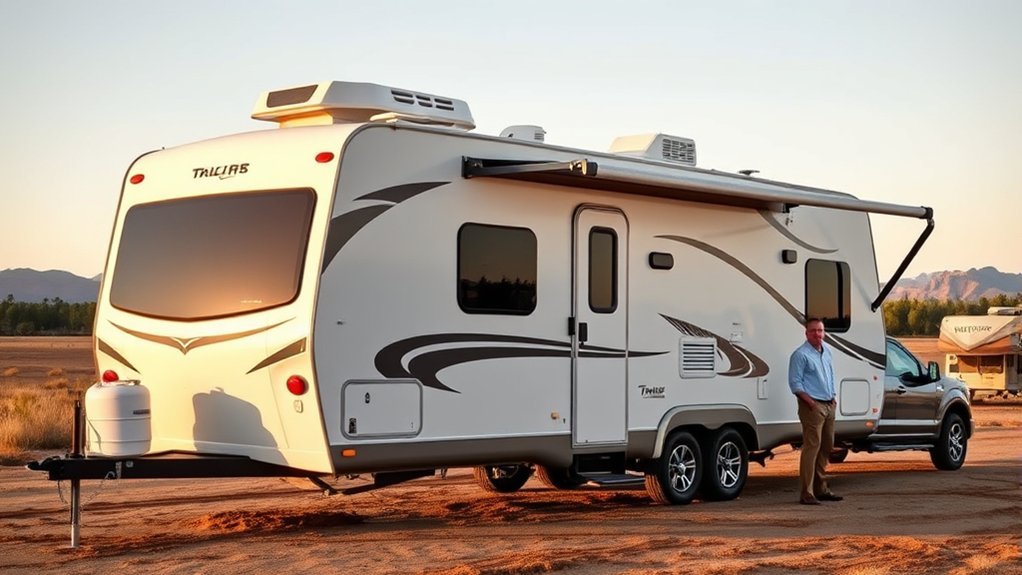
Width and height can restrict a route or campsite even when the trailer’s length fits. Many conventional travel trailers are about 8 feet wide, while some wide-body, toy-hauler, and destination models are approximately 8 feet 6 inches wide. Travel height can range from around 9 feet for a compact unit to roughly 13 feet for a tall specialty or destination trailer.
| Measurement | Common pattern | Why it matters |
|---|---|---|
| Body width | Often about 8–8.5 ft | Road, gate, storage, and campsite access |
| Travel height | Often about 9–13 ft, depending on type | Bridges, tunnels, branches, canopies, and covered storage |
| Deployed width | Varies by slide-out number and extension | Trees, posts, neighboring sites, and utility access |
Measure height from level ground to the highest fixed component while the trailer is in normal travel condition. Do not rely only on the wall or roofline measurement because the air conditioner, vent cover, antenna, or solar equipment may sit higher.
Warning: Do not treat six inches as a guaranteed safe overhead margin. Posted clearance, road resurfacing, dips, crowns, snow, and approach angle can reduce the space available. Avoid any route whose listed clearance is close to your measured travel height.
Check State and Route Length Limits
There is no single federal recreational-vehicle length rule that applies to every private travel-trailer combination in the United States. The Federal Highway Administration explains that recreational vehicles are not commercial motor vehicles covered by its federal commercial size regulations.
Length, width, height, brake, lighting, license, and towing rules can vary by state. Before a long trip, check the DMV or transportation department for every state on your route. Also check local restrictions, mountain passes, park roads, ferries, tunnels, and roads with posted weight or clearance limits.
Common Travel Trailer Measurement Mistakes
- Using the model number as the length: Floorplan codes may not equal exterior length.
- Confusing body length with overall length: Body length normally excludes the hitch assembly.
- Ignoring excluded accessories: The labeled length may not include every ladder, spare tire, receiver, or carrier.
- Measuring with an accessory removed: Record the footprint in the condition you normally store or travel with.
- Using roofline height: Measure to the highest fixed roof component.
- Ignoring slide-outs: Closed width applies while traveling, but deployed width determines setup clearance.
- Forgetting the tow vehicle: Some sites and laws use total combined length.
- Relying on an old brochure: Verify the exact model year and floorplan.
- Using dry weight for towing decisions: Calculate with realistic loaded weight and actual payload use.
Measurements to Record Before Buying or Booking
Keep the following information in one place:
- Manufacturer-listed overall exterior length
- Actual maximum length with attached accessories
- Body or box length
- Travel height to the highest fixed point
- Body width with slide-outs closed
- Maximum setup width with slide-outs extended
- Tow-vehicle length
- Complete hitched combination length
- Trailer GVWR, UVW, CCC, and published hitch weight
- Tow-vehicle trailer rating, payload, GVWR, GAWR, and GCWR
- Hitch, receiver, tire, and brake ratings
Sources
- RV Industry Association: Standardized RV Length Labels — explains how travel-trailer length is measured and which appurtenances may be excluded.
- Airstream: 2026 Travel Trailer Comparison — provides current examples ranging from compact to large travel trailers.
- Jayco: 2026 Jay Flight Bungalow 40DLFT Specifications — supports the dimensions of a current trailer longer than 40 feet.
- Toyota Owner’s Manual: Trailer Towing — explains trailer weight rating, combined weight, axle limits, and tongue weight.
- National Park Service: Yosemite RV and Trailer Camping — shows how trailer limits and RV limits vary by campsite and turning space.
- Federal Highway Administration: Federal Vehicle Size Regulations — clarifies that recreational vehicles are not covered by federal commercial-vehicle size rules.
Frequently Asked Questions
What Is the 3-3-3 Rule for RVs?
The 3-3-3 rule is an informal trip-planning guideline. A common version suggests traveling no more than 300 miles in a day, arriving by about 3 p.m., and staying for three nights. It is not a law or official towing standard, and travelers may adjust it for weather, road conditions, fatigue, and experience.
How Is the Length of a Travel Trailer Determined?
Standardized overall travel-trailer length is measured from the leading front edge of the hitch coupler to the rearmost trailer extremity. Certain appurtenances may be excluded from the label, so you should also measure the farthest attached accessory when checking storage, parking, or campsite fit.
Does Travel Trailer Length Include the Hitch?
Overall travel-trailer length normally includes the hitch coupler. Body or box length normally excludes the hitch. Check the label used by the manufacturer because some specification tables publish both measurements.
What Is the 4-4-4 Rule for RVing?
The 4-4-4 rule is another informal pacing guideline, and its definition varies. One version uses a maximum of 400 miles, arrival by 4 p.m., and a four-night stay. Other travelers substitute a four-hour driving limit. It should be treated as a flexible comfort rule, not an official safety requirement.
What Is the 2-2-2 Rule for RV Travel?
A common version of the 2-2-2 rule suggests traveling about 200 miles, arriving by 2 p.m., and staying for two nights. Some travelers instead use the second “2” as a reminder to stop every two hours. The goal is to reduce fatigue, but the rule has no single official definition.
How Much Extra Campsite Space Does a Travel Trailer Need?
There is no universal number. You need enough room for the trailer, tongue, tow vehicle if it remains on the site, stabilizers, steps, slide-outs, awning, hookups, and safe movement. Confirm how the campground defines its listed maximum before booking.
Conclusion
Travel trailer length affects storage, towing, route planning, turning, and campsite access, but one number cannot answer every question. Use body length to compare living space, manufacturer-listed overall length to compare models, actual maximum footprint for parking and storage, and combined length when a site or regulation requires the complete setup.
Before buying or booking, verify the exact model-year specifications, measure attached accessories, record the trailer’s travel height and deployed width, and confirm every towing rating. Those checks will help you choose a trailer that fits both your vehicle and the places you plan to visit.

