
Last Updated on July 29, 2026 by Mason Reed
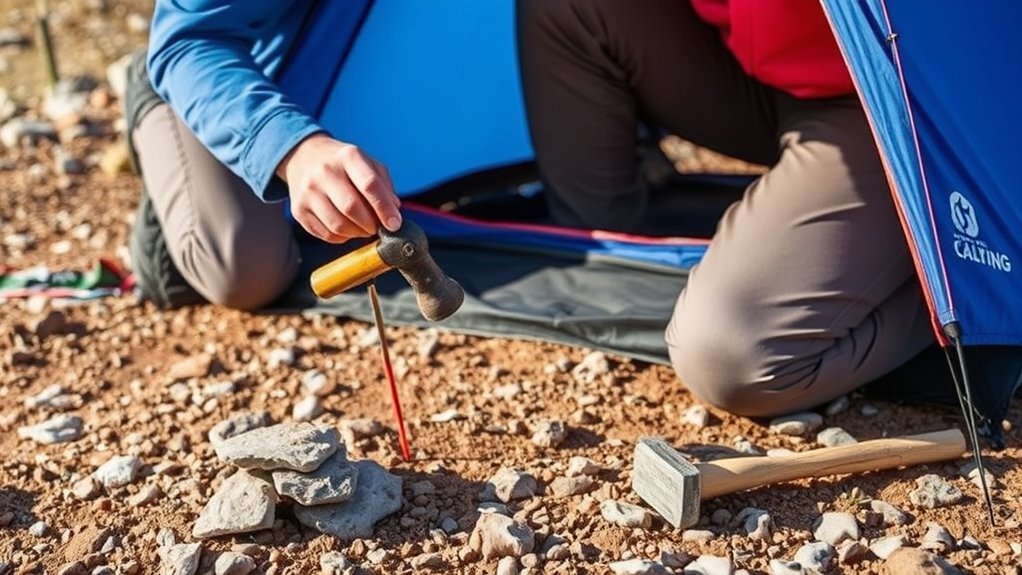
Hard or rocky ground can stop ordinary tent stakes before they are deep enough to hold. Instead of forcing a lightweight stake until it bends, first look for a nearby spot where the ground is easier to penetrate. When moving the tent is not practical, a properly built stick-and-rock anchor can provide a temporary, non-penetrating tie-out without damaging your stakes.
Quick Answer
To stake a tent on hard ground without bending stakes, attach the guyline to the center of a sound fallen stick, place the stick across the direction of pull, and secure both ends with stable rocks. Keep the cord clear of sharp edges, test the anchor firmly, and use a stronger solution if it shifts.
Key Takeaways
- Do not keep hammering a lightweight stake after it stops penetrating the ground.
- Use a separate cord extension so rough rocks do not damage the tent’s original guyline.
- Place the stick roughly perpendicular to the guyline and load it near the center.
- There is no universal rock weight; test the complete anchor in the direction of pull.
- Follow campground rules and restore any loose rocks or sticks before leaving.
At a Glance
| Time Required | About 5–10 minutes per improvised anchor |
| Difficulty | Easy to moderate; careful testing is required |
| Tools Needed | Spare cord, a sound loose stick, stable loose rocks, and gloves; hard-ground stakes and a stake mallet are optional alternatives |
| Cost | No added cost when permitted loose materials and spare cord are already available |
Disclosure: As an Amazon Associate I earn from qualifying purchases. Some links on this page are affiliate links, at no extra cost to you.
Understanding the Stick-and-Rock Anchoring Method
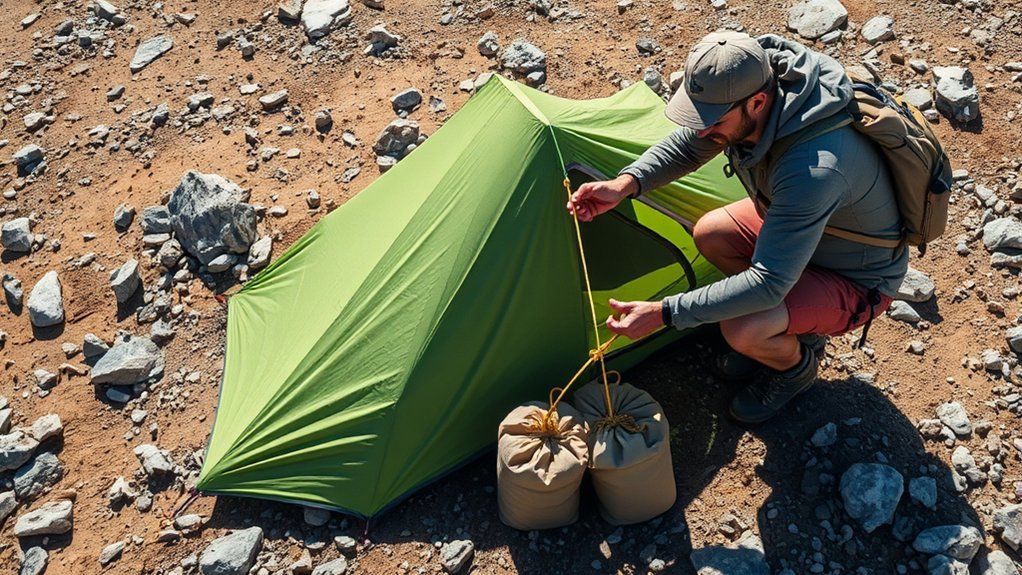
The stick-and-rock method is an improvised anchor for ground that cannot accept an ordinary tent stake. A sound stick acts as a toggle, while rocks provide ballast that resists the guyline’s pull. The same basic idea can be used at a tent corner, vestibule, or rainfly guy-out point.
The anchor works best when the guyline pulls toward the middle of the stick and the stick lies roughly perpendicular to that pull. This spreads the load across both sides of the anchor instead of pulling on one end. A separate cord extension should connect the tent’s guyline to the stick so the original line does not rub against rough or sharp rocks.
This is not a guaranteed replacement for stakes. Coleman notes that a tent can be tied to rocks or other stable objects when hard ground causes stakes to bend, but describes the approach as a temporary fix. Follow your tent manufacturer’s instructions whenever they require specific stakes, guy-out locations, or anchor strength.
Warning: Do not rely on loose or improvised anchors in severe wind, on a steep slope, beneath unstable rock, or where a failed anchor could collapse a non-freestanding shelter. If the anchor shifts during testing, move the tent or use a stronger anchoring system.
Benefits and Limits of Using a Stick for Anchoring
A stick-and-rock anchor can help when compacted soil, bedrock, a wooden platform, or a hardened tent pad prevents normal stake placement. It avoids repeatedly striking a lightweight aluminum stake and gives you more freedom to position a guyline around shallow rock or other obstructions.
The stick also creates a clear attachment point that can be adjusted without retying the tent’s permanent guyline. When a separate cord extension is used, you can replace the extension if it becomes worn instead of replacing a line sewn or tied directly to the tent.
The method has limits. It depends on suitable loose materials, a level location, and enough friction to stop the ballast from sliding. It can also take longer than using the correct stake. Large family tents, trekking-pole tents, tarps under high tension, and shelters exposed to strong wind may require purpose-built anchors or a different campsite.
An anchor is not secure because the rocks look heavy. It is secure only when the complete system stays still during a firm test in the same direction the wind and guyline will pull.
Step-by-Step Setup Process
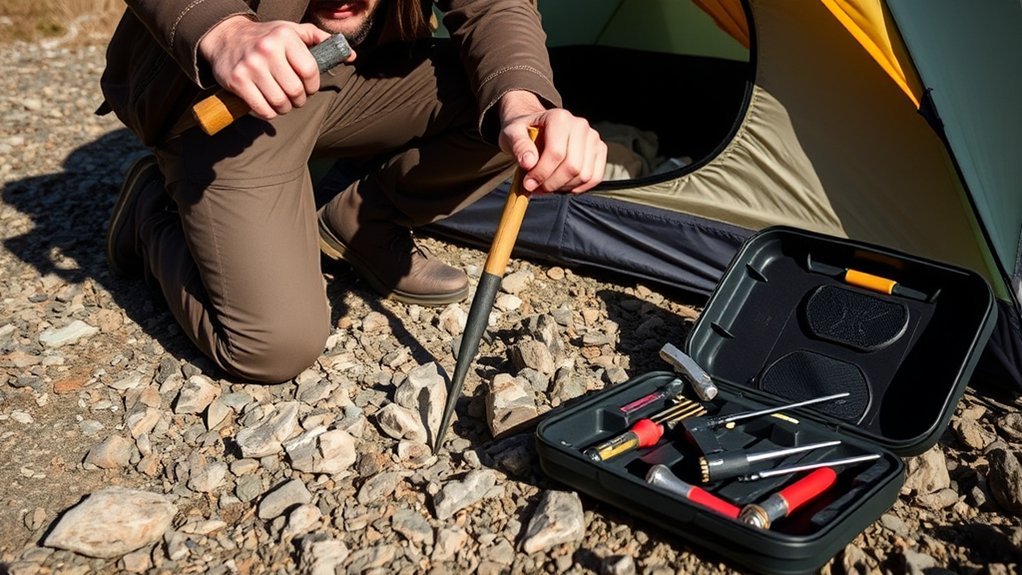
Use this process only after confirming that the campsite permits loose natural materials to be moved. Keep the rocks close to where you found them so you can restore the site during teardown.
- Try a better stake position first. Move the stake a few inches to either side to avoid buried rock. Do not keep hammering if the stake stops or begins to bend.
- Choose the anchor location. Extend the guyline in the direction needed to support the tent panel. Keep the anchor away from walkways, doors, and cooking areas.
- Add a cord extension. Attach a length of low-stretch cord to the tent’s guyline or tie-out loop. The extension should be long enough to reach the anchor without passing under a sharp rock edge.
- Attach the stick. Tie the cord near the stick’s center. A girth hitch works when the cord has a closed loop; a secure clove hitch with a stopper knot is another option for users familiar with that knot.
- Set the geometry. Lay the stick across the direction of pull, not lengthwise toward the tent. The cord should lead from the tent to the stick’s center in a clean, straight line.
- Add ballast. Place stable rocks over or against both ends of the stick. Keep the cord from being crushed or dragged across rough stone.
- Tension gradually. Tighten the guyline only until the tent is correctly shaped. Excessive tension can strain fabric, seams, poles, and tie-out loops.
- Test the anchor. Pull firmly in the same direction as the guyline. Watch for sliding, rolling, tipping, stick flex, knot movement, and cord abrasion.
- Recheck the whole shelter. Tension the remaining guy points, then test the anchor again because adjusting one side of a tent can change the load on another.
Select an Appropriate Stick
Choose a loose, fallen stick that is sound rather than rotten, split, hollow, or sharply pointed. Do not cut a live branch or break one from a standing tree. A straight branch approximately 18–24 inches long often leaves enough room for ballast on both sides, but this is a practical starting point rather than a fixed rule.
Strength matters more than exact length. The stick should not crack, flatten, or flex sharply when you pull on the attached cord. A thicker stick may be needed for a large tent or a heavily loaded guy point. Avoid a branch with sharp knots that could damage the cord.
Secure the Stick With Rocks
Use stable, flat-sided rocks that sit securely instead of round rocks that can roll. Place ballast on both sides of the cord attachment so the stick remains balanced. Additional weight can be placed across the stick when needed, but the cord must remain free and protected from abrasive edges.
There is no reliable universal rock weight. Required ballast changes with the rock shape, surface friction, guyline angle, tent size, and expected wind. Add or rearrange ballast until the anchor passes a firm pull test without movement.
Pro Tip: Pack a few short lengths of spare guyline. A replaceable extension lets you reach around buried rock, tie to a stable object, or build an improvised anchor without exposing the tent’s original line to abrasion.
How to Form a Girth Hitch Around the Stick
A girth hitch, also called a lark’s head, requires a closed loop. Tie a fixed loop in the end of the cord extension, wrap that loop around the center of the stick, and pass the standing part of the cord through the loop. Pull the hitch snug before adding rocks.
Keep the hitch near the center of the stick. If it slides toward one end during the pull test, reposition it and improve the ballast. Do not cut a deep notch into a natural branch merely to hold the cord.
Protect the Guyline From Abrasion
Rock can quickly wear through thin cord when wind makes the line vibrate. Route the cord through a smooth gap and inspect every place where it touches stone. Use the extension cord as the sacrificial section and keep the original guyline away from sharp edges.
If contact cannot be avoided, pad the cord with a folded cloth, a piece of durable webbing, or another item that will not become litter. Recheck the contact point after the line has been tensioned.
Enhancing Flexibility and Adjustability
An adjustable guyline makes it easier to move an anchor around shallow bedrock, roots, and compacted patches. It also lets you retension the shelter after nylon fabric relaxes in damp conditions or after the wind changes direction.
When a Shorter Stick Can Work
A shorter stick may work when space is limited and the guyline load is modest. It still needs enough length for secure ballast on both sides of the cord. If the rocks crowd the knot, pinch the cord, or make the stick tip easily, choose a longer or thicker piece.
Short sticks do not automatically require lighter rocks. The amount of ballast depends on the load and surface, not simply the length of the stick.
Fine-Tune Guyline Tension
Tighten the line enough to remove slack and support the tent’s shape. Do not pull until the poles bow unnaturally or the fabric is distorted. The goal is balanced tension across the shelter, not maximum tension at one point.
After all corners, vestibules, and guylines are adjusted, walk around the tent and compare them. A line that becomes suddenly loose may indicate that an anchor has shifted. A line that becomes unusually tight may signal changing wind, wet fabric, or movement elsewhere in the shelter.
Note: Big Agnes recommends using guylines because they work with the tent poles to maintain structural integrity. In windy conditions, orient the lower or narrower end of the tent into the prevailing wind when the tent’s design and manufacturer instructions support that position.
Best Practices for an Effective Setup
- Follow the tent manual first. The number and position of anchors vary by model.
- Use every critical guy point. Do not expect one heavily loaded anchor to compensate for several unused guylines.
- Face the tent into the wind correctly. Many tents perform best with the narrower or lower end toward the prevailing wind.
- Keep lines visible. Use reflective cord or mark low guylines so campers do not trip over them.
- Keep the pull centered. The cord should load the middle of the stick rather than dragging one end sideways.
- Prevent rolling. Do not use round rocks on sloped or smooth surfaces.
- Test before dark. It is much easier to rebuild an anchor while you can clearly see every contact point.
- Recheck after weather changes. Wind shifts and rain can change both the direction of pull and the holding power of nearby soil.
Choosing the Right Stick, Rocks, and Cord
The best materials are sound, stable, and legal to use. Do not take branches from live trees, dismantle a fire ring or navigation cairn, move embedded rocks, or disturb fragile lichen-covered desert pavement. Use previously impacted campsites and loose surface materials only when local rules permit it.
| Component | Choose | Avoid |
|---|---|---|
| Stick | Sound, fallen, fairly straight, and thick enough not to flex sharply | Live branches, rotten wood, split pieces, or sharp projections |
| Rocks | Loose, stable, flat-sided rocks that can be returned to their original positions | Round, loose-on-slope, embedded, lichen-covered, culturally significant, or stacked trail-marker rocks |
| Cord | Low-stretch spare cord in good condition with enough length for adjustment | Frayed cord, very thin line over sharp rock, or knots that cannot be inspected |
| Anchor location | Level, outside traffic paths, and aligned with the intended guy point | Steep slopes, drainage channels, unstable ledges, doorways, and cooking areas |
| Finished anchor | Balanced, centered, abrasion-free, and motionless during a firm pull test | Sliding, rocking, tipping, flexing, cutting into cord, or relying on one unstable stone |
Better Alternatives for Different Types of Hard Ground
Use Purpose-Built Hard-Ground Stakes
If the ground can still be penetrated, a stronger steel nail-style stake or a suitable Y- or V-profile stake may be more reliable than an improvised anchor. MSR, for example, describes its Y-beam Groundhog stake as suitable for a wide range of soil conditions. Match the stake to the ground and follow the tent and stake manufacturer’s instructions.
Drive a conventional stake at the angle recommended by the manufacturer. A common setup places the stake at about 45 degrees, with the top leaning away from the tent and the buried point angled toward it. Stop immediately if the stake begins to bend.
Tie to a Stable, Permitted Object
A large immovable rock, a designated platform anchor, or another fixed object may provide a cleaner tie-out. Confirm that attachment is permitted and that the line will not damage vegetation, bark, campground fixtures, or other property.
Never tie a tent to a vehicle without accounting for the risk that someone could move it. Do not attach to dead standing trees, loose boulders, railings where tying is prohibited, or objects that could fail under load.
Use a Modified Deadman Anchor
Where a stick is unavailable, a smaller stable object can act as the toggle while a larger rock provides ballast in front of it. Use a cord extension so the original guyline does not run beneath the rock. The same centered-load and pull-test rules apply.
Move the Tent
Relocation is often the safest answer. A move of only a few feet may provide compact soil that accepts a stake while preserving the tent’s orientation and drainage. Choose an established or durable surface and avoid expanding the campsite into vegetation.
Common Mistakes to Avoid
- Forcing a stake after it stops. Repeated heavy strikes can bend the shaft, mushroom the head, or damage the tent loop.
- Pouring water onto the ground. This can create mud, weaken soil, and unnecessarily alter the campsite.
- Drilling or digging without permission. Tent pads, platforms, archaeological areas, and protected ground may not be altered.
- Using one rounded rock. A rock that can roll or pivot is not dependable ballast.
- Pinching the cord beneath a sharp edge. Movement can cut the line even when the anchor itself stays in place.
- Placing the stick lengthwise. This concentrates the load at one end and makes the anchor easier to tip.
- Using a rotten branch. A hidden split can fail suddenly after the tent has been tensioned.
- Overtightening the guyline. Excessive tension can distort the tent and overload the tie-out.
- Skipping the pull test. Visual inspection cannot show how the anchor will respond under load.
- Assuming rain improves anchoring. Wet soil may become easier to penetrate, but it may also provide less holding strength.
- Ignoring trip hazards. Low lines and rocks around a tent entrance are easy to hit at night.
Troubleshooting an Unstable Anchor
| Problem | Likely Cause | Fix |
|---|---|---|
| The whole anchor slides | Too little friction or ballast | Move to a flatter surface, use more stable ballast, or choose another anchor method |
| One end of the stick lifts | Off-center cord or uneven ballast | Center the hitch and rebalance both ends |
| The cord becomes fuzzy or flattened | Abrasion or pinching | Reroute or pad the cord and replace damaged extension line |
| The line loosens overnight | Anchor movement, knot slip, or wet fabric stretch | Inspect the anchor and knot before simply tightening the line |
| The tent deforms when tensioned | Anchor is misaligned or one guyline is too tight | Realign the anchor with the intended guy point and balance all lines |
| Wind direction changes | The anchor is loaded from a new angle | Reorient or rebuild the affected anchors and use additional manufacturer-provided guy points |
Maintenance and Regular Stability Checks
Inspect each anchor after the tent is fully pitched, before going to sleep, and after strong gusts or rain. Check that the rocks have not shifted, the stick is not splitting, the cord is not rubbing, and the knot has not moved.
Do not correct every loose guyline by tightening it. First determine why it became loose. An anchor that has moved should be rebuilt rather than hidden by extra tension.
During teardown, release tension before moving the rocks. Keep hands and feet clear of any downhill path the rocks could follow. Return loose natural materials as close as practical to their original positions, remove every cord and marker, and leave the campsite without a new rock pile or structure.
Frequently Asked Questions
Can I use any type of stick for anchoring?
No. Use a sound, loose fallen branch that is thick enough to resist the expected load. Avoid rotten, hollow, split, sharply pointed, or flexible pieces. Never cut a live branch or damage standing vegetation to make an anchor.
How do I know whether the rocks are heavy enough?
Build the complete anchor and pull firmly in the same direction as the guyline. The rocks must not slide, roll, tip, or lift, and the stick must not flex sharply. There is no universal weight because the required ballast changes with the surface, tent, wind, and anchor geometry.
Is this method suitable for every tent?
No. Freestanding tents may remain upright while an anchor is adjusted, but many trekking-pole and non-freestanding shelters depend on continuous anchor tension. Follow the tent manual and use purpose-built anchors or move to another site when an improvised system cannot provide dependable support.
What should I do if I cannot find a suitable stick?
Try a purpose-built hard-ground stake, tie a cord extension to a permitted stable object, use a modified deadman arrangement with another safe toggle, or move the tent to a surface that accepts normal stakes. Do not cut vegetation or dismantle an existing rock structure.
How do weather conditions affect this anchoring method?
Wind increases and changes the load on every guy point. Rain may reduce friction or soften nearby soil, while wet tent fabric can sag and require retensioning. Inspect the anchor after weather changes and relocate if the system cannot remain stable.
Should I pour water on hard ground before driving a stake?
No. Pouring water can create mud, weaken holding power, and unnecessarily alter the campsite. Move the stake slightly, use a stake designed for hard ground, switch to a non-penetrating anchor, or relocate the tent.
Can I leave the rocks and stick in place after camping?
No. Remove the cord and dismantle the improvised anchor. Return loose rocks and the fallen stick as close as practical to where they were found, unless a land manager gives different instructions. Do not leave a new cairn, structure, or trip hazard.
Conclusion
A stick-and-rock anchor can help you stake a tent on hard ground without sacrificing lightweight stakes, but its success depends on careful geometry and testing. Attach the guyline near the stick’s center, place the stick across the direction of pull, use stable ballast on both sides, and protect the cord from abrasion.
Treat the method as an improvised solution rather than a guarantee. Use the tent manufacturer’s recommended stakes whenever possible, inspect every anchor as conditions change, and move the shelter if it cannot be secured. Use only permitted loose materials and restore the campsite when you leave.
Sources
- Coleman Tent Care Guide — supports using guylines tied to rocks or other stable objects as a temporary option when stakes bend in hard ground.
- Big Agnes Tent Setup Tips — supports proper guyline use, wind orientation, stake placement, and regular shelter tension.
- MSR Groundhog Tent Stakes — documents a purpose-built Y-beam stake designed to penetrate and hold in varied soil conditions.
- Leave No Trace: Travel and Camp on Durable Surfaces — supports durable campsite selection and minimizing disturbance to rocks, gravel, soil, and vegetation.
- Leave No Trace: Leave What You Find — supports avoiding unnecessary campsite alterations and restoring displaced surface materials.
- National Park Service: Leave No Trace in Denali — supports not damaging vegetation, not cutting plants, and replacing moved rocks or logs before leaving.
