
Last Updated on July 28, 2026 by Daniel Globe
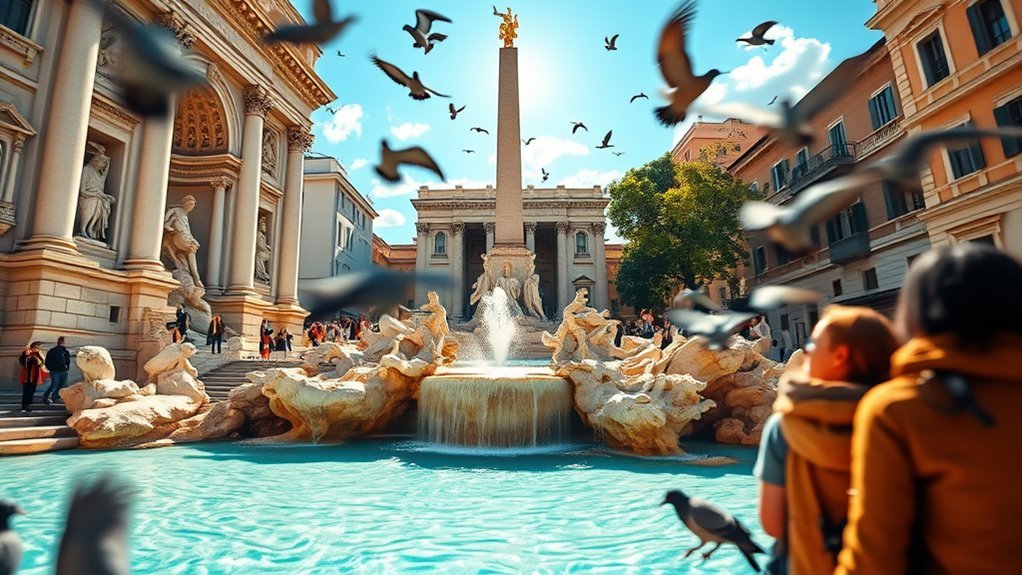
Rome’s fountains are more than decorative landmarks. They reveal how the city combined aqueduct engineering, papal ambition, mythology, sculpture, and public life across many centuries. From the theatrical Trevi Fountain to the quieter Turtle Fountain, the best fountains in Rome can form an easy historic-center walk, with an optional climb to the panoramic Fontanone dell’Acqua Paola.
Quick Answer
Rome’s must-see fountains include the Trevi Fountain, Bernini’s Fountain of the Four Rivers and Triton Fountain, the Neptune and Moor fountains in Piazza Navona, the Turtle Fountain, the Pantheon Fountain, and the Fontanone dell’Acqua Paola. Most are free to view, but the Trevi lower basin now costs €2 for many visitors.
Key Takeaways
- The Trevi Fountain is the most famous stop, but its controlled lower basin has a €2 tourist admission charge during staffed hours.
- Piazza Navona contains three major fountains: the Fountain of the Four Rivers, Neptune Fountain, and the Moor Fountain.
- The Turtle Fountain and Pantheon Fountain add Renaissance history and are easy to include in a central walking route.
- The Fontanone dell’Acqua Paola sits farther away on Janiculum Hill but rewards the climb with broad city views.
- Drink from Rome’s nasoni unless a sign says the water is not potable, but never drink from or enter a decorative monument basin.
At a Glance
| Time Required | About 3–5 hours for the central fountains; allow extra time and transport for Janiculum Hill |
| Difficulty | Easy to moderate; expect cobblestones, crowds, and a steep climb if visiting Acqua Paola |
| Tools Needed | Comfortable walking shoes, refillable bottle, phone or map, sun protection, and camera |
| Cost | Most fountains are free to view; the controlled Trevi lower basin generally costs tourists and non-residents €2 from 9 a.m. to 10 p.m. |
Disclosure: As an Amazon Associate I earn from qualifying purchases. Some links on this page are affiliate links, at no extra cost to you.
Best Rome Fountain Walking Route
A practical route begins at the Triton Fountain in Piazza Barberini, continues to the Trevi Fountain, and then heads toward the Pantheon Fountain. From there, walk to Piazza Navona to see the Fountain of the Four Rivers, Neptune Fountain, and the Moor Fountain together.
Continue southeast to the Turtle Fountain in Piazza Mattei. You can end the central walk there or cross the Tiber and climb toward the Fontanone dell’Acqua Paola on Janiculum Hill. The Janiculum extension is less compact and includes a noticeable uphill section, so a bus or taxi may be more comfortable for some visitors.
Warning: Do not enter, bathe in, climb on, sit on, or damage Rome’s historic fountains. Remain behind barriers and follow instructions from staff or police. Rome’s municipal rules allow substantial fines for misusing or damaging monumental fountains.
Trevi Fountain: Rome’s Iconic Landmark
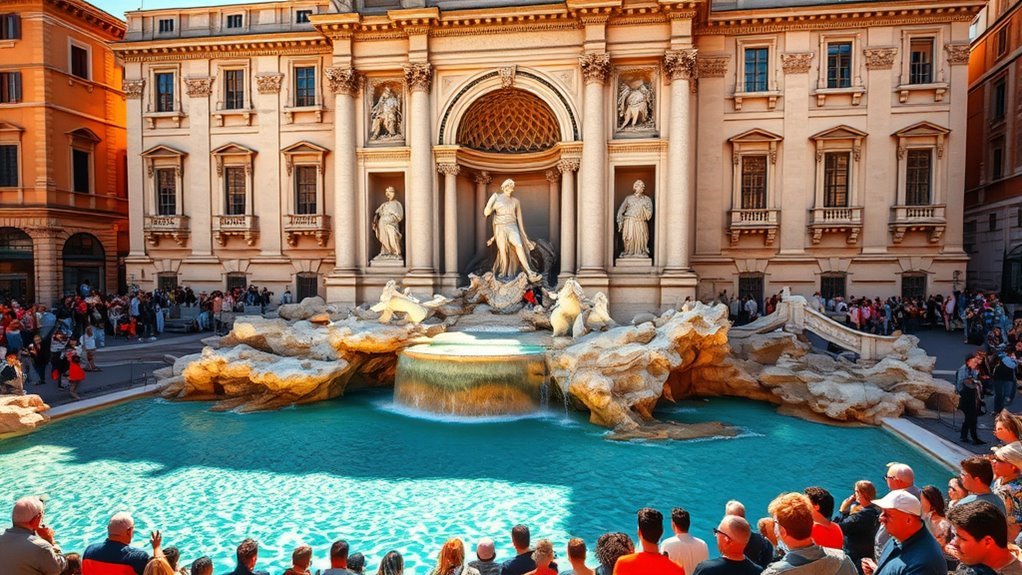
The Trevi Fountain is Rome’s best-known fountain and one of its grandest works of Baroque design. Pope Clement XII chose Nicola Salvi’s proposal in 1732, and Giuseppe Pannini completed the project in 1762 after Salvi’s death. The monument rises about 26 meters and extends roughly 49 meters across the rear façade of Palazzo Poli.
At the center, Ocean drives a shell-shaped chariot pulled by two contrasting horses—one calm and one restless—guided by tritons. The side figures represent Abundance and Health, while reliefs above them refer to the discovery of the spring and the construction of the ancient Aqua Virgo.
Trevi Fountain Tickets and Access
Since February 2, 2026, tourists and non-residents generally need a €2 ticket to enter the controlled lower basin area closest to the monument. According to the official Rome visitor information, ticketed access normally operates daily from 9 a.m. to 10 p.m.
Residents of Rome and the Metropolitan City of Rome, children under age 5, and qualifying visitors with disabilities and their caregivers receive free access with the required proof. The surrounding square still provides views of the fountain without entering the controlled lower section. Hours can change for maintenance, security, or special events, so check the official page shortly before visiting.
Pro Tip: Visit shortly after sunrise for easier photographs and return after dark to see the fountain illuminated. The controlled basin may be closed outside staffed hours, but the monument remains visible from the square unless temporary restrictions are in place.
The Trevi Coin Tradition
Tradition says that tossing one coin into the fountain while facing away helps ensure a return to Rome. The familiar custom is to throw the coin over the left shoulder. It is a legend rather than a guarantee, but the collected money supports real social programs.
Caritas Roma reported that Trevi coin funds totaled about €1.86 million in 2025. The money supports food assistance, solidarity markets, health services, housing programs, help for older adults, and other anti-poverty work throughout Rome.
Trevi’s coin tradition generates far more than a memorable photograph: Caritas Roma reported approximately €1.86 million in funds for social programs in 2025.
Fountain of the Four Rivers: Bernini’s Masterpiece
Standing at the center of Piazza Navona, the Fountain of the Four Rivers, or Fontana dei Quattro Fiumi, was designed by Gian Lorenzo Bernini for Pope Innocent X Pamphilj and completed in 1651. Bernini planned and directed the full composition, while several sculptors in his workshop carved the individual river figures.
A hollow-looking travertine rock supports the Agonale Obelisk, a Domitian-era granite monument nearly 17 meters high. The obelisk came to Piazza Navona from the Circus of Maxentius on the Appian Way. A dove and olive branch, associated with the Pamphilj family, crown the monument.
The four large figures represent rivers from the continents recognized by Europeans at the time:
- Danube: Europe.
- Nile: Africa.
- Ganges: Asia.
- Río de la Plata: the Americas.
Animals, plants, rock formations, and flowing water connect the figures into one theatrical scene. The result is not simply a group of statues; it is a carefully staged Baroque environment intended to look active from every side.
Triton Fountain: A Symbol of Baroque Art
The Triton Fountain, or Fontana del Tritone, stands in the center of Piazza Barberini. Bernini created it between late 1642 and the first half of 1643 for Pope Urban VIII Barberini.
Four dolphins rise from the basin and support a giant shell. Above them, Triton leans backward and blows into a spiral shell from which the water emerges. Barberini bees and papal coats of arms appear between the dolphins, connecting the fountain to its patron.
The open center beneath the sculptural group was technically and visually unusual for its period. Instead of appearing to rest on a heavy central column, the figures seem to balance over an empty space. Bernini later expanded this idea in the rocky base of the Fountain of the Four Rivers.
Note: Piazza Barberini carries heavy traffic. Use marked crossings and view the Triton Fountain from the pedestrian areas rather than stepping into the roadway for a photograph.
Neptune Fountain: The Northern End of Piazza Navona
At the northern end of Piazza Navona, the Neptune Fountain, or Fontana del Nettuno, began as a basin designed by Giacomo della Porta in 1574. It remained largely undecorated for about three centuries.
Following a municipal competition in the 19th century, Antonio Della Bitta created the central scene of Neptune fighting an octopus. Gregorio Zappalà added the surrounding nereids, sea horses, cupids, and dolphins. This later sculptural program gives the fountain the energetic appearance visitors see today.
| Feature | Description | Why It Matters |
|---|---|---|
| Location | Northern end of Piazza Navona | Completes the piazza’s three-fountain layout |
| Original Basin | Designed by Giacomo della Porta in 1574 | Shows the fountain’s Renaissance foundation |
| Central Sculpture | Neptune fighting an octopus by Antonio Della Bitta | Adds the dramatic scene that gives the fountain its name |
| Supporting Figures | Nereids, sea horses, cupids, and dolphins by Gregorio Zappalà | Creates movement around the central figure |
The edges of Piazza Navona can sometimes feel calmer than the center surrounding the Four Rivers Fountain, making this a useful place to study the sculptures more closely. Crowd levels still vary by season, time, and events in the square.
Discovering the Turtle Fountain
The Turtle Fountain, or Fontana delle Tartarughe, sits in the smaller Piazza Mattei near Rome’s historic Jewish Quarter. Built between 1581 and 1588 from a design by Giacomo della Porta, it combines marble basins with bronze figures created by Taddeo Landini.
- Four bronze youths rise above dolphins and reach toward the upper basin.
- The turtles were added in 1658 and are associated with a later Baroque alteration traditionally credited to Bernini.
- The fountain supplied public water while also serving as a refined work of civic art.
- Piazza Mattei is smaller and quieter than Trevi or Piazza Navona, although tour groups can still arrive during busy periods.
Viewers sometimes associate turtles with longevity or wisdom, but that interpretation is not part of the fountain’s documented construction history. Its real importance lies in the balance between della Porta’s design, Landini’s bronze figures, and the later turtle additions.
Fountain of the Pantheon: Ancient Meets Renaissance
The Fountain of the Pantheon stands in Piazza della Rotonda directly in front of the Pantheon. Giacomo della Porta designed it in 1575, and sculptor Leonardo Sormani executed the original work after the restoration of the Acqua Vergine aqueduct.
The fountain changed several times. In 1711, Pope Clement XI ordered the addition of the ancient red-granite Macuteo Obelisk, originally erected in Egypt under Ramses II and later brought to Rome. Filippo Barigioni created the sculptural base supporting it. Nineteenth-century copies later replaced the original masks, which are now preserved in the Museum of Rome.
| Element | Description | Significance |
|---|---|---|
| Original Design | Giacomo della Porta, 1575 | An important work of Renaissance Rome |
| Original Sculptor | Leonardo Sormani | Executed della Porta’s design |
| Obelisk | Macuteo Obelisk added in 1711 | Connects ancient Egypt, imperial Rome, and papal Rome |
| Location | Piazza della Rotonda | Places the fountain beside one of Rome’s best-preserved ancient buildings |
| Atmosphere | Busy square with cafés and constant foot traffic | Shows how monumental history remains part of daily city life |
The fountain is especially attractive in the early morning, when the piazza is quieter and the Pantheon façade can form a cleaner background for photographs.
Fontanone dell’Acqua Paola and Janiculum Views
High on Janiculum Hill, the Fontanone dell’Acqua Paola marks the monumental end of the restored Trajan Aqueduct. It is also called the Mostra dell’Acqua Paola or, informally, the Janiculum Fountain.
Pope Paul V commissioned the fountain, which was built between 1610 and 1614 by architects Giovanni Fontana and Flaminio Ponzio, with sculptural work by Ippolito Buzio. Its façade has five arches, not three. Carlo Fontana later altered the design and replaced the original smaller basins with the large semicircular basin seen today.
Highlights include:
- Panoramic views: The terrace near the fountain overlooks rooftops, domes, and much of central Rome.
- Five-arch façade: Columns, inscriptions, papal emblems, and reused ancient stone create a monumental front.
- Aqueduct history: The fountain celebrated the restored water supply commissioned by Pope Paul V.
- Public viewing: The front is normally visible free of charge, while access to the garden behind it may require advance booking.
The climb is steeper than the central fountain route. Wear shoes with good traction, carry water in warm weather, and consider public transport if stairs or hills are difficult.
How to Identify the Four River Figures
The Fontana dei Quattro Fiumi is easiest to understand when you walk around it slowly. Each river figure has plants, animals, objects, and poses linked to its continent. Bernini created the overall concept, while Antonio Raggi, Claude Poussin, Giacomo Antonio Fancelli, and Francesco Baratta carved the principal figures under his direction.
Symbolic River Representations
- Danube: Represents Europe and appears with a horse. The figure reaches toward the papal coat of arms.
- Nile: Represents Africa. Its head is covered because Europeans had not yet identified the river’s source when the fountain was made.
- Ganges: Represents Asia and holds a long oar, indicating that the river was navigable.
- Río de la Plata: Represents the Americas and appears with an armadillo. Its raised arm has inspired several later legends.
The popular story that the Nile covers its face to avoid seeing Borromini’s church is chronologically impossible: the fountain was designed before the present façade of Sant’Agnese in Agone. It is an entertaining Roman legend, not the reason for the veil.
Architectural Brilliance of Bernini
Bernini made the heavy obelisk appear to rest over a pierced rock formation with open spaces beneath it. Water, animals, figures, plants, and the obelisk work as one composition rather than separate decorations.
The movement is deliberately uneven. One figure twists, another leans, water disappears through gaps, and animals emerge from the rock. This changing appearance encourages visitors to circle the fountain instead of viewing it from only one side.
Ideal Viewing and Relaxation Spot
Piazza Navona is a lively public space rather than a quiet garden, but benches, café seating, and the broad pedestrian area make it possible to pause nearby. To enjoy the fountain responsibly:
- Walk around the full monument to identify all four rivers.
- Look upward to separate the nearly 17-meter obelisk from the fountain base.
- Visit early or later in the evening for fewer tour groups.
- Keep food, drinks, bags, and feet away from the fountain structure.
Moor Fountain: Renaissance and Baroque Layers
The Moor Fountain, or Fontana del Moro, stands at the southern end of Piazza Navona. Its history began in 1575 with a marble basin designed by Giacomo della Porta.
Pope Innocent X later commissioned Bernini to renovate the fountain. The central figure, installed in 1655, was carved by Giannantonio Mari from Bernini’s design. It depicts a muscular figure grappling with a dolphin, surrounded by tritons and other marine forms.
| Element | Correct Detail |
|---|---|
| Original Designer | Giacomo della Porta, 1575 |
| Baroque Redesign | Gian Lorenzo Bernini under Pope Innocent X |
| Central Figure | Carved by Giannantonio Mari from Bernini’s design and installed in 1655 |
| Location | Southern end of Piazza Navona |
The Moor Fountain is therefore not purely a Bernini work. Its appearance combines a Renaissance basin, a Baroque redesign, later copies of some decorative figures, and centuries of restoration.
Drinking Fountains in Rome: Nasoni
Rome’s small cast-iron drinking fountains are known as nasoni, meaning “big noses,” because of their curved metal spouts. They are different from decorative monuments such as Trevi or the Fountain of the Four Rivers.
ACEA reported about 2,800 nasoni in Rome in March 2024. They provide free public drinking water and can reduce the need to buy single-use plastic bottles.
To drink from a typical nasone, place a finger over the main downward-facing outlet. Water should rise through the smaller hole on top of the spout, creating a drinking stream. Refill bottles directly from the main flow and avoid touching the outlet with your mouth.
- Check the sign: Water is normally potable unless the fountain is marked “acqua non potabile.”
- Use the correct fountain: Never assume water from a decorative basin is safe to drink.
- Carry a reusable bottle: Nasoni are especially useful during Rome’s hot summer months.
- Find nearby water: ACEA’s free Acquea app, the evolution of Waidy Wow, maps public water points and is available in several languages.
Practical Tips for Visiting Rome’s Fountains
Best Time to Visit
Early morning usually provides the lightest crowds and the cleanest photographs. Evening visits offer cooler temperatures in summer and attractive illumination, but famous squares can remain busy well after sunset.
Photography Tips
- Use a wide lens or panorama mode at Trevi because the square is narrow.
- Walk around the Four Rivers Fountain instead of photographing only its most crowded side.
- Use the Pantheon façade as a background for the Piazza della Rotonda fountain.
- At Acqua Paola, photograph both the five-arch façade and the view across Rome.
- Do not cross barriers, enter traffic, climb monuments, or block pedestrian routes for a photograph.
Accessibility and Walking Conditions
Central Rome has uneven cobblestones, narrow sidewalks, curb changes, and crowded pedestrian spaces. Piazza Navona is broad and comparatively level, while Trevi’s lower viewing area can be congested. Janiculum Hill is the most demanding stop because of its incline.
Travelers using wheelchairs, mobility aids, or strollers should check the official Accessible Rome information and current construction notices before setting out. Conditions can change during restoration, security controls, and major events.
Frequently Asked Questions
What is the most beautiful fountain in Rome?
Beauty is subjective, but the Trevi Fountain is the most common choice because of its scale, cascading water, Baroque façade, and detailed central composition. The Fountain of the Four Rivers is a strong alternative for visitors who prefer Bernini’s sculpture and symbolism.
What is the most photographed fountain in Rome?
The Trevi Fountain is generally regarded as Rome’s most photographed fountain. Arrive near sunrise for fewer people, use a wide-angle setting, and stay within the designated public areas.
What are the most iconic fountains in Rome?
The most iconic choices are the Trevi Fountain, Fountain of the Four Rivers, Triton Fountain, Neptune Fountain, Moor Fountain, Turtle Fountain, Pantheon Fountain, Barcaccia Fountain, and Fontanone dell’Acqua Paola.
Which five Rome fountains should first-time visitors see?
Start with the Trevi Fountain, Fountain of the Four Rivers, Triton Fountain, Turtle Fountain, and Fontanone dell’Acqua Paola. You will also see the Neptune and Moor fountains while visiting Piazza Navona.
Is the Trevi Fountain free to visit?
You can view the fountain from the surrounding square, but since February 2, 2026, tourists and non-residents generally pay €2 to enter the controlled lower basin area from 9 a.m. to 10 p.m. Exemptions apply to certain residents, young children, and qualifying visitors with disabilities and their caregivers.
Can you drink from Rome’s fountains?
You can normally drink from Rome’s nasoni unless a sign says “acqua non potabile.” Do not drink from decorative monument basins such as Trevi, Neptune Fountain, or the Fountain of the Four Rivers.
Conclusion
Rome’s fountains turn a walk through the city into a journey across ancient engineering, Renaissance planning, Baroque sculpture, and modern public life. The Trevi Fountain may be the headline attraction, but the Four Rivers, Triton, Neptune, Moor, Turtle, Pantheon, and Acqua Paola fountains each reveal a different part of Rome’s story.
Plan the central fountains as a walking route, add Janiculum Hill when time and mobility allow, and carry a reusable bottle for the city’s nasoni. Most importantly, admire the monuments without entering or touching their basins so they remain intact for future visitors.
Sources
- Turismo Roma — Trevi Fountain admission — current €2 lower-basin ticket, hours, and exemptions.
- Caritas Roma — Trevi Fountain coin funds — 2022–2025 revenue and social-program use.
- Turismo Roma — Fountain of the Four Rivers — Bernini’s design, workshop sculptors, figures, animals, and obelisk.
- Turismo Roma — Fountain of the Pantheon — designer, sculptor, obelisk, and restoration chronology.
- Turismo Roma — Fontanone dell’Acqua Paola — architects, five-arch façade, aqueduct history, and visitor access.
- ACEA — Rome’s nasoni network — public drinking-fountain history and the reported citywide count.
