
Last Updated on July 28, 2026 by Daniel Globe
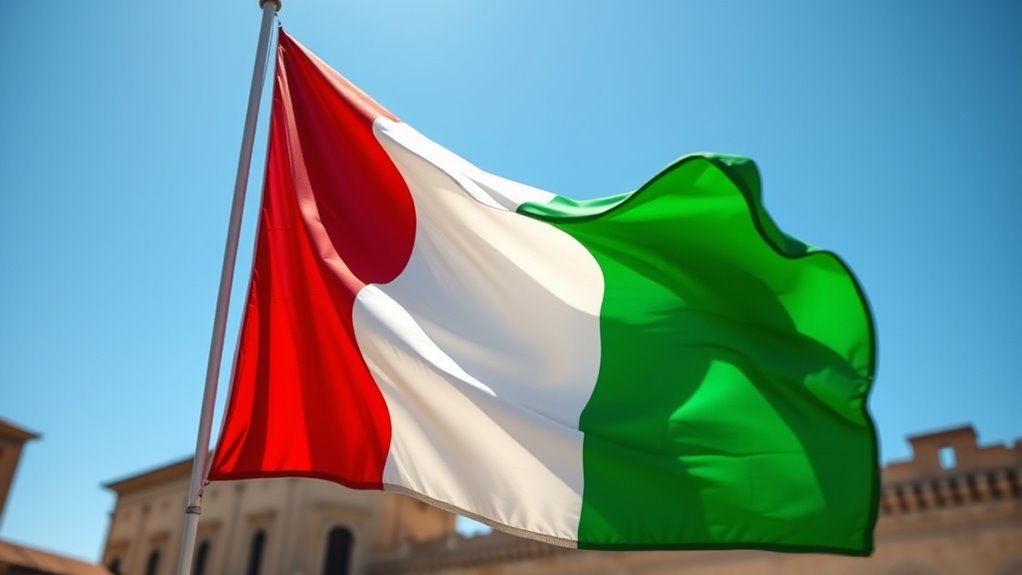
The Italian flag, known in Italian as Il Tricolore, is one of Europe’s most recognizable national symbols. Its green, white, and red colors first became the flag of an Italian state in 1797 and later followed the country through revolution, unification, monarchy, war, and the creation of the modern republic. Popular traditions give the colors moral and geographic meanings, but those interpretations should not be confused with the flag’s official constitutional definition.
Quick Answer
The Italian flag has three equal vertical bands of green, white, and red, with green at the hoist. Italy’s Constitution does not assign an official meaning to the colors. Hope, faith, charity, valor, landscapes, and wartime sacrifice are popular later interpretations rather than legally defined symbolism.
Key Takeaways
- The first green-white-red national flag was adopted by the Cispadane Republic on January 7, 1797.
- The modern order of three vertical bands was formally used by the Cisalpine Republic in 1798.
- Green for hope, white for faith, and red for charity or valor are traditional interpretations, not official constitutional meanings.
- The Kingdom of Italy was proclaimed in 1861; Rome joined in 1870.
- Article 12 of the Italian Constitution defines the current flag as three equal vertical bands of green, white, and red.
Disclosure: As an Amazon Associate I earn from qualifying purchases. Some links on this page are affiliate links, at no extra cost to you.
The Colors of the Italian Flag: What They Represent
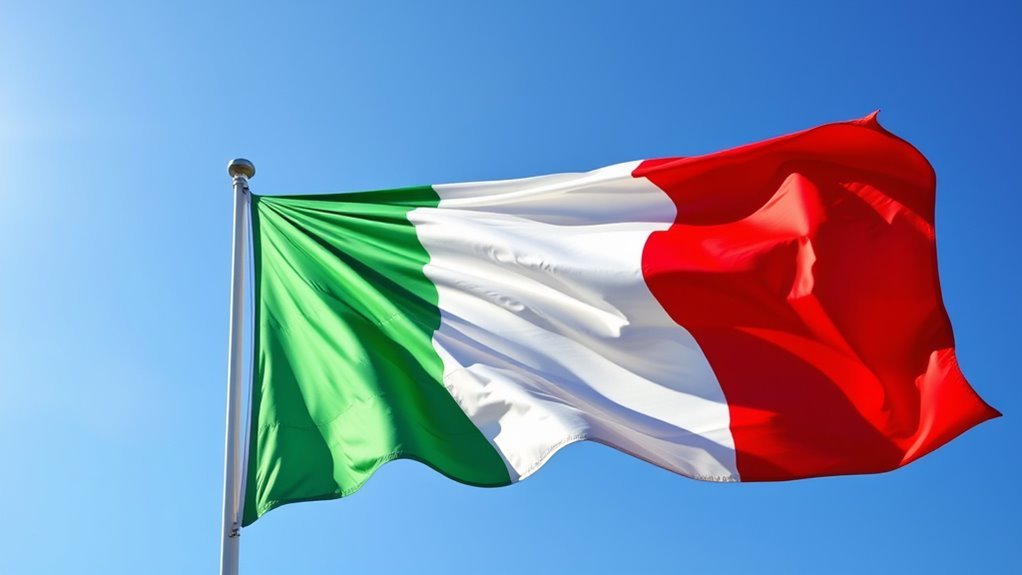
The official design is direct and precise. Article 12 of the Italian Constitution identifies the flag as the Italian tricolor: green, white, and red in three vertical bands of equal size. Green is placed at the hoist, meaning the side attached to the flagpole.
| Official name | Bandiera della Repubblica Italiana; commonly called Il Tricolore |
| Design | Three equal vertical bands: green, white, and red |
| Hoist side | Green |
| Standard proportion | 2:3, with the height equal to two-thirds of the length |
| Official textile colors | Green 17-6153, white 11-0601, and red 18-1662 in the government’s Pantone textile specification |
| Constitutional basis | Article 12 of the Constitution, effective January 1, 1948 |
Do the Italian Flag’s Colors Have Official Meanings?
The Italian Constitution does not say that green means hope, white means faith, or red means valor, charity, or bloodshed. Those are widely repeated poetic interpretations. Another popular reading connects green with Italy’s plains, white with the snow of the Alps, and red with the blood shed during the wars for independence.
These interpretations can express genuine patriotic feeling, but they are not part of the flag’s legal definition. The documented historical explanation is more practical: red and white were long associated with Milan’s civic arms, while green appeared in the uniforms of Milan’s civic guard. French revolutionary tricolors also influenced the three-band design.
Note: Hope, faith, charity, valor, Alpine snow, green landscapes, and wartime sacrifice are best described as traditional or poetic meanings. Italy’s official sources define the colors and design but do not assign one mandatory symbolic meaning to each band.
Officially, the Tricolore is defined by its colors, their order, and three equal vertical bands—not by a legally assigned moral meaning.
The Italian Flag’s Birth and French Revolutionary Influence
The Italian flag emerged during the political upheaval that followed the French Revolution and Napoleon Bonaparte’s campaigns in the Italian peninsula. Revolutionary governments often adopted three-color flags modeled on the French tricolor because the design had become associated with new republics, citizenship, and opposition to the old dynastic order.
According to the Presidency of the Italian Republic, the Tricolore became the national flag of the Cispadane Republic in Reggio Emilia on January 7, 1797. Deputy Giuseppe Compagnoni proposed making green, white, and red the republic’s universal colors.
The first Cispadane flag did not look exactly like the present flag. It used horizontal red, white, and green bands and displayed the republic’s emblem in the white band. Even so, its adoption was historic because an Italian sovereign state had formally chosen the three colors as a national flag.
The choice also drew on regional traditions. White and red appeared in Milan’s ancient civic arms, while green had been used in the uniforms of Milan’s civic guard. Military units such as the Lombard Legion and Italian Legion had already carried standards using the three colors.
The Evolution of the Italian Flag Through History
The Tricolore did not move in a straight line from 1797 to the modern republic. Its bands changed direction, emblems were added and removed, and the flag disappeared from official use during periods of political restoration. Its repeated return helped turn it from the banner of one small republic into a national symbol.
Early Adoption of the Colors
In 1797, the Cispadane and Transpadane republics became part of the Cisalpine Republic. On May 11, 1798, the Cisalpine government issued a decree stating that its flag would contain three bands parallel to the staff: green next to the staff, followed by white and then red.
This 1798 Cisalpine design established the vertical green-white-red order recognized today. In practice, early versions still varied in shape and arrangement.
Influence of Revolution
The early tricolor drew from French revolutionary visual culture, but it soon developed an Italian meaning of its own. It came to represent political liberty, popular government, and the hope that the peninsula’s divided territories might form a nation.
After the Congress of Vienna and the restoration of older rulers, official use of the Tricolore was suppressed. It continued to appear in the uprisings of 1831, Mazzinian movements, revolts in the Papal States, and other campaigns against foreign or dynastic rule.
Symbol of Unification Efforts
During the Risorgimento, the Tricolore gave different independence movements a shared visual identity. Giuseppe Mazzini’s republican movement and Giuseppe Garibaldi’s campaigns helped connect it with the goal of a united Italy.
The revolutions of 1848 marked a decisive point. The flag appeared in uprisings from Milan and Venice to Rome, Palermo, and other cities. It no longer represented only one short-lived republic; it had become a widely recognized emblem of the Italian national cause.
The Flag’s Role in Italy’s Unification Movement
On March 23, 1848, King Charles Albert of Piedmont-Sardinia announced that his troops would carry the Italian tricolor with the Savoy shield placed over it. A blue border was added around the shield so its red and white elements would remain visible against the flag’s white and red bands.
The main milestones that followed were:
- 1848: The green-white-red flag with the Savoy shield became associated with Piedmont-Sardinia’s war against Austrian rule.
- March 17, 1861: The Kingdom of Italy was proclaimed. Its flag continued to be the Tricolore with the Savoy shield, although the national design was initially followed by custom rather than a comprehensive civilian flag law.
- 1870: Italian forces entered Rome, and the city was incorporated into the Kingdom. This was a major final stage of territorial unification, but the Kingdom of Italy had already existed since 1861.
- 1925: Legislation formally defined models for the national and state flags of the monarchy.
- June 19, 1946: Following the referendum that created the republic, a presidential legislative decree established a plain green-white-red flag without the Savoy arms as the provisional national design.
- March 24, 1947: The Constituent Assembly approved the wording that became Article 12.
- January 1, 1948: The Constitution entered into force, confirming the plain tricolor as the flag of the Italian Republic.
Italian Flag Day: A Celebration of the Tricolore
Italian Flag Day, commonly called Festa del Tricolore or the National Flag Day, is observed on January 7. The date remembers the Cispadane Republic’s adoption of the first national green-white-red flag in Reggio Emilia on January 7, 1797.
Historical Significance
Law No. 671 of December 31, 1996 declared January 7 the National Flag Day as Italy prepared to mark the bicentenary of the Tricolore. The observance connects the flag’s revolutionary origin with its later roles during the Risorgimento, the Kingdom of Italy, the resistance to Fascism, and the Italian Republic.
The principal national ceremony is closely associated with Reggio Emilia, where the 1797 vote took place. The President of the Republic and other institutions also use the anniversary to reflect on constitutional values such as unity, liberty, democracy, and social cohesion.
Celebration Activities and Traditions
Activities vary from one city and institution to another. They may include official flag-raising ceremonies, military honors, speeches, museum programs, concerts, school lessons, and public discussions about Italian history and citizenship.
Government buildings and other public institutions display the flag in accordance with national rules. Reggio Emilia’s Sala del Tricolore and Museo del Tricolore have particular importance because they preserve the history of the flag’s birth.
Note: January 7 is a national civil observance, but it is not a general public holiday on which all businesses and offices automatically close.
How the Italian Flag Influences Culture and Cuisine
The Tricolore appears throughout Italian public life. It is displayed at government institutions, diplomatic offices, military ceremonies, sporting events, national commemorations, and international competitions. Athletes and supporters often use green, white, and red clothing, ribbons, face paint, and banners to express a shared Italian identity.
The colors also appear as a visual theme in food. Tomato, mozzarella, and basil create a green-white-red arrangement in dishes such as pizza Margherita and Caprese salad. Chefs may use the word tricolore for pasta, salads, desserts, or plated foods arranged in the national colors.
That visual resemblance should not be taken to mean that the flag created Italian cuisine as a whole. Italy’s regional food traditions are much older and more varied. The Tricolore is better understood as a later patriotic motif that cooks, restaurants, and celebratory menus can use.
Legal Protections for Displaying the Italian Flag
Article 12 gives the Tricolore constitutional status, but it does not contain detailed display rules or criminal penalties. Those issues are addressed through separate laws and regulations.
Law No. 22 of February 5, 1998 and Presidential Decree No. 121 of April 7, 2000 regulate the use of the Italian and European Union flags by state administrations and public bodies. The rules identify public buildings where flags must be displayed and require flags to be kept in good condition and properly unfurled.
The Italian government’s flag protocol FAQ confirms that private citizens may display the national flag without a special authorization system. Anyone displaying it should preserve its dignity, use a flag in good condition, and avoid adding writing, letters, or unrelated images to the flag or its staff.
Separate criminal-law provisions may apply to serious intentional public conduct. The government’s guidance cites Penal Code Article 292, under which intentionally and publicly destroying, defacing, damaging, or rendering the national flag unusable can be punished by imprisonment of up to two years.
Note: This is a general summary of Italian flag rules, not legal advice for a specific event, dispute, or prosecution. Formal ceremonies should follow the latest instructions from the Italian State Ceremonial Office or the relevant local authority.
Italian Flag Display Customs and Protocols
Respectful display begins with the flag’s correct design and condition. Rules for an official building or diplomatic ceremony are more detailed than the practices expected of a private household.
Displaying the Flag Properly
- Keep green at the hoist: The green band must be nearest the flagpole, followed by white and red.
- Keep the bands vertical: Do not turn the standard design into horizontal stripes with green on top.
- Use the proper proportion: The government specifies a height-to-length proportion of 2:3.
- Check its condition: Replace a flag that is badly faded, torn, dirty, or unable to open properly.
- Do not alter it: Official protocol does not permit writing, letters, logos, or other figures to be added to the flag or its staff.
- Use one flag per staff: Official public displays place only one flag on each staff.
- Follow public-building hours: Covered public institutions generally raise flags after sunrise and lower them at sunset. A flag may remain displayed at night when the location is adequately illuminated.
Pro Tip: On an ordinary horizontal or angled flagpole, look at the edge attached to the pole. That edge should be green. The bands themselves should still run vertically across the flag.
Ceremonial Use Guidelines
In official settings, the Italian flag receives the position of honor. However, that position is not captured by a simple rule saying that it is always “on the right.” Placement changes according to the number of flags, whether the display is indoors or outdoors, and the direction from which the arrangement is viewed.
- When two flags are displayed outside a building, the national flag’s ceremonial “right” is determined from the viewpoint of a person facing outward from the building. A person looking from the street will therefore see it on the left.
- When several flags are used, the Italian flag may occupy a central or first position according to the official arrangement.
- Italian and European Union flags are displayed together at many covered public institutions.
- During official public mourning, exterior flags may be flown at half-mast. Black mourning ribbons may be used in circumstances defined by protocol.
- The national flag should remain clearly visible, properly opened, and no lower in dignity than other flags in the same official display.
Warning: Do not rely on a blanket “Italian flag goes on the right” rule for a formal event. The correct side changes with the viewing direction and number of flags. Use the Italian government’s official display guidance for ceremonial arrangements.
Flags Like the Italian Tricolore: A Comparison
Several national flags use green, white, and red or a similar three-band design. The color order, stripe direction, and presence of an emblem make them easier to distinguish.
| Flag | Design | Key Difference |
|---|---|---|
| Italy | Vertical green, white, and red | Plain white center with no coat of arms |
| Mexico | Vertical green, white, and red | National coat of arms appears in the white band |
| Ireland | Vertical green, white, and orange | The final band is orange rather than red |
| Côte d’Ivoire | Vertical orange, white, and green | Orange is at the hoist and green is at the fly |
| Hungary | Horizontal red, white, and green | The bands are horizontal and appear in a different order |
10 Fun Facts About the Italian Flag You Probably Didn’t Know
- It has a well-known nickname. Italians commonly call the flag Il Tricolore, meaning “the tricolor.”
- Its national history begins in Reggio Emilia. The Cispadane Republic adopted green, white, and red as its national flag on January 7, 1797.
- The first national version had horizontal bands. The Cispadane flag placed red above white and green and included a central republican emblem.
- The familiar vertical order appeared in 1798. The Cisalpine Republic formally placed green next to the staff, followed by white and red.
- The colors have roots in Milan. Red and white appeared in Milan’s civic arms, while green was used in the uniforms of its civic guard.
- The flag survived political suppression. Even when the Tricolore was prohibited during the Restoration, it continued to appear in uprisings and nationalist movements.
- A royal emblem once filled the white band. From 1848 through the monarchy, the Savoy shield was placed at the center of the tricolor.
- Italy used it before fully regulating it. The Kingdom adopted the Savoy version by custom in 1861, but statutory national and state flag models were not defined until 1925.
- The republic removed the royal shield. The plain green-white-red design returned in 1946 and was confirmed by Article 12 of the Constitution.
- Its birthday has a national observance. January 7 is Italy’s National Flag Day. January 7, 2026 marked 229 years since the Cispadane adoption.
Frequently Asked Questions
What do the colors of the Italian flag officially mean?
Italy’s Constitution does not assign an official symbolic meaning to green, white, or red. Hope, faith, charity, valor, landscapes, Alpine snow, and blood shed for independence are popular poetic interpretations rather than legal definitions.
When was the Italian flag created?
The national history of the Tricolore begins on January 7, 1797, when the Cispadane Republic adopted green, white, and red. The vertical order used today was formally specified by the Cisalpine Republic on May 11, 1798.
How old is the Italian flag?
As of January 7, 2026, 229 years had passed since the first national green-white-red flag was adopted in 1797. The current plain republican form dates from 1946 and was constitutionally confirmed when the Constitution took effect in 1948.
Why does the current Italian flag have no coat of arms?
The monarchy used a tricolor bearing the Savoy shield. When Italy became a republic in 1946, the dynastic shield was removed. Article 12 defines the republican flag as three equal, plain vertical bands of green, white, and red.
How can you tell the Italian, Mexican, and Irish flags apart?
Italy uses plain vertical green-white-red bands. Mexico uses the same color order but places its national coat of arms in the white band. Ireland uses green-white-orange, so its final band is orange rather than red.
Can private citizens display the Italian flag?
Yes. Italian government guidance says private citizens may display the national flag without a special authorization system. The flag should be kept in good condition, correctly unfurled, and treated with the dignity expected of a national symbol.
Conclusion
The Italian flag is more than a familiar arrangement of green, white, and red. Its history links the revolutionary republics of the 1790s, the campaigns of the Risorgimento, the Kingdom of Italy, and the democratic republic established after World War II.
Its most reliable meaning comes from that history and from its constitutional role as a symbol shared by the nation. Traditional explanations about hope, faith, charity, landscapes, or sacrifice can add cultural meaning, but they should be presented as interpretations. The official Tricolore remains a plain, carefully defined flag whose three equal bands represent the Italian Republic wherever it is displayed.
Sources
- Presidency of the Italian Republic: The Tricolore — official history from the Cispadane Republic through the modern republic.
- Italian Senate: Constitution, Article 12 — constitutional definition of the flag’s colors and equal vertical bands.
- Museo del Tricolore: From the Cispadane to the Cisalpine Republic — the May 11, 1798 decree establishing vertical green-white-red bands.
- Italian State Ceremonial Office: Displaying the Flag — public-building display, condition, illumination, mourning, and precedence rules.
- Italian State Ceremonial Office: Flag Protocol FAQ — private display, proportions, official textile colors, position of honor, and legal guidance.
- Gazzetta Ufficiale: Law No. 671 of December 31, 1996 — establishment of January 7 as Italy’s National Flag Day.
