

Last Updated on September 10, 2026 by Daniel Globe
Keeping a travel pillow clean is simple once you know what it is made from. The safest method is not the same for every pillow: a removable fabric cover may be machine washable, while a memory-foam insert may only tolerate a damp-cloth wipe-down. Start with the care label, clean off visible dirt first, and use a soft-surface sanitizer only when its label allows it.
Quick Answer
Check the care label first. Remove and wash a machine-washable cover as directed, but do not submerge memory foam unless the manufacturer specifically allows it. Wipe non-washable inserts with a damp cloth and mild soap. If sanitizing fabric, use a product labeled for soft surfaces, follow its required wet time, and let everything dry completely.
Key Takeaways
- The care label comes first because memory foam, fiberfill, microbeads, inflatable pillows, and wrap-style travel pillows can require different cleaning methods.
- Cleaning removes dirt and many germs. A product may disinfect hard surfaces while only sanitizing soft fabric, so read the antimicrobial label carefully.
- Never assume that alcohol, bleach, vinegar, essential oils, or another household chemical is safe for the pillow material.
- Memory-foam inserts generally should not be submerged when the manufacturer says to wipe them clean instead.
- Dry every layer completely before reassembly or storage because lingering moisture encourages musty odors and mold growth.
At a Glance
| Time Required | About 10–20 minutes of hands-on cleaning, plus drying time that may take several hours |
| Difficulty | Easy |
| Tools Needed | Mild detergent, soft cloth, clean towel, optional washing machine, optional vacuum with upholstery attachment, and a soft-surface sanitizer when appropriate |
| Cost | Usually $0–$10 if you already have basic laundry and cleaning supplies |
Disclosure: As an Amazon Associate I earn from qualifying purchases. Some links on this page are affiliate links, at no extra cost to you.
Why Cleaning and Sanitizing Your Travel Pillow Matters
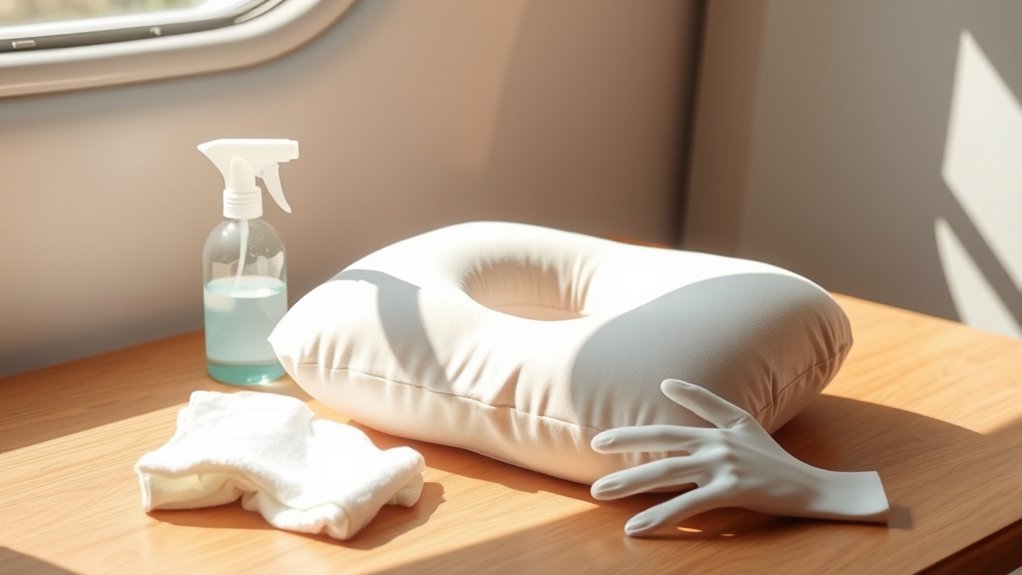
Your travel pillow comes into contact with your skin, hair, luggage, airplane seats, car interiors, and other surfaces during flights and road trips. Over time, sweat, skin oils, makeup, dirt, crumbs, and odors can collect on the cover.
That makes regular cleaning worthwhile, but cleaning and disinfection are not the same thing. The CDC explains that cleaning with soap or detergent removes dirt and many germs and that routine disinfection is not necessary in every situation. Extra sanitizing or disinfecting is more useful when someone has been sick or when a product’s labeled use calls for it.
For most routine travel-pillow care, cleaning is the first priority. If you use an antimicrobial product, match its label to the exact surface and follow the full contact time.
Cleaning vs. Sanitizing vs. Disinfecting
These terms are easy to mix up:
- Cleaning removes dirt, oils, debris, and many germs with detergent, soap, water, wiping, or laundering.
- Sanitizing reduces specified microorganisms to the level described by the product’s approved directions.
- Disinfecting uses an antimicrobial product with a verified disinfectant claim for the specified surface and organisms.
This distinction matters with fabric. For example, current Clorox Disinfecting Mist directions describe disinfection on hard, nonporous surfaces while giving separate soft-surface sanitizing directions. The product must remain visibly wet for the stated contact time to achieve the label claim.
Note: A bottle with “disinfectant” on the front is not automatically approved to disinfect every fabric, foam, or pillow filling. Check the back label for the exact surface and application method.
How to Remove Covers and Prepare for Cleaning
Before cleaning your travel pillow, identify how it is constructed. Look for a removable cover, zipper, hook-and-loop closure, inflatable bladder, plastic support, foam insert, or loose filling. Then read the care label for the parts that can be washed.
Check Care Instructions
The care label should decide whether a part can go in the washing machine, be hand washed, be tumble dried, or only be wiped clean. Do not assume every removable cover uses the same temperature or dryer setting.
Manufacturer instructions demonstrate why this matters. Cabeau’s current Evolution S3 instructions, for example, allow the fabric cover to be machine washed on a cool setting while instructing users not to wash the memory-foam insert. It should instead be wiped with a damp cloth and allowed to air dry.
Detach Pillow Cover
If your travel pillow has a removable cover, unzip or unfasten it carefully. Do not pull hard against seams, straps, toggles, or internal supports. Many travel pillows, including Cabeau models, are specifically designed with a removable washable cover.
Once the cover is off, inspect both sides for stains, sweat marks, hair, crumbs, or debris. Check the insert separately before choosing its cleaning method.
Note: Do not machine wash, tumble dry, or fully soak a memory-foam insert when its manufacturer tells you to wipe-clean it. Excess water can be difficult to remove from thick foam and may leave the interior damp for a long time.
Cleaning Method by Travel Pillow Type
| Pillow Type | Safest Starting Method |
| Memory foam | Remove and wash the cover if permitted. Wipe the foam with a lightly damp cloth and mild soap when the manufacturer specifies wipe-cleaning. Do not submerge unless the care instructions explicitly permit it. |
| Polyester/fiberfill | Machine or hand wash only if the care label allows the complete pillow to be washed. Use the temperature and drying method listed on the tag. |
| Microbead | Use the manufacturer’s instructions. When no full-wash instruction is provided, spot cleaning is the safer default because seams and filling can be damaged by aggressive washing. |
| Inflatable | Close the valve and wipe the exterior with a material-compatible cleaner. Avoid soaking the valve or putting the inflatable bladder in a washer unless specifically approved. |
| Wrap/support style | Remove the rigid or flexible internal support before washing when the manufacturer instructs you to do so. Some Trtl models, for example, are machine washable after the internal support is removed. |
What to Do After Removing Covers
After removing the cover, deal with loose debris first. Brush it away or use a vacuum with a clean upholstery attachment on fabric that can tolerate vacuuming.
For a wipe-clean insert, mix a small amount of mild soap with water and dampen a clean cloth. The cloth should be damp rather than dripping. Blot or wipe the soiled area, then follow with another cloth lightly dampened with plain water if needed to remove soap residue.
Do not pour water directly onto foam. Press a dry towel against the cleaned area to absorb moisture, then leave the insert exposed to moving air until it is dry all the way through.
For lingering odor, a light layer of baking soda may help absorb smells on compatible dry fabric. Let it sit briefly, then remove it thoroughly with a vacuum or brush. Baking soda is a deodorizer here, not a substitute for a sanitizer.
Pro Tip: Clean the cover and insert separately. The cover often dries much sooner, so putting it back on early can trap moisture inside the pillow.
How to Hand Wash Your Travel Pillow
Only hand wash the complete pillow if its care instructions allow full immersion. This is especially important for memory foam, molded foam, pillows with internal supports, and inflatable designs.
If full hand washing is permitted:
- Fill a clean basin with the water temperature specified on the care label.
- Add a small amount of mild detergent.
- Gently work the detergent through the washable fabric or filling without aggressive twisting.
- Rinse thoroughly until the water is clear and detergent residue is gone.
- Press the pillow between clean towels to remove excess water. Do not wring it unless the manufacturer specifically permits that treatment.
- Reshape it as needed and air dry completely.
For a memory-foam pillow whose label says wipe-clean only, skip the basin entirely and use the damp-cloth method described above.
Machine Washing: When and How to Do It
If the cover or complete travel pillow is labeled machine washable, machine washing is convenient and effective for removing sweat, skin oils, and ordinary dirt.
- Remove any foam, inflatable bladder, rigid support, or other component the manufacturer says should come out first.
- Close zippers or fasteners as directed to reduce snagging.
- Use the cycle, water temperature, and detergent recommended on the care tag.
- Do not add chlorine bleach unless the pillow’s care instructions specifically permit it.
- Air dry or machine dry only according to the label.
For example, Cabeau currently recommends a cool machine wash and low tumble dry for the removable covers on several of its memory-foam pillows while specifically telling owners not to wash the foam insert.
Warning: Never store or reuse a pillow while the interior is still damp. Moisture supports mold growth, and thick foam or filling may remain wet long after the outside feels dry.
What Disinfectants or Sanitizers Work Best for Your Pillow?
The best antimicrobial product is one whose label specifically allows use on the material you need to treat. The EPA advises following registered-product directions, including the surface type, application method, precleaning requirements, and contact time.
The label matters more than the ingredient name: the fabric must stay wet for the full contact time stated for the soft-surface claim.
- Soft-surface sanitizer: Use an EPA-registered antimicrobial product only when its directions name fabric, textiles, upholstery, or another applicable soft surface.
- Clorox Disinfecting Mist: The current Multi-Surface product gives separate directions for sanitizing soft surfaces. It instructs users not to saturate the fabric and to keep it visibly wet for the specified contact time.
- Clorox Free & Clear Disinfecting Mist: Its current soft-surface directions likewise require the material to remain visibly wet for the stated period before air drying.
- Alcohol products: Do not apply isopropyl alcohol merely because it has a particular concentration. Use it on a pillow only when the product directions and pillow manufacturer both permit that use.
- Essential oils: Tea tree oil or other DIY essential-oil mixtures should not be presented as equivalent to a registered soft-surface sanitizer. They may also leave fragrance or cause skin sensitivity.
- Patch testing: When the antimicrobial label permits the surface, test a small hidden area first if the pillow manufacturer recommends doing so.
How to Use a Soft-Surface Sanitizer Correctly
- Clean visible dirt from the fabric first when the sanitizer label requires precleaning.
- Check that the label lists the type of soft surface you intend to treat.
- Apply from the distance stated on the bottle.
- Wet the surface as directed without saturating foam or filling.
- Keep the fabric visibly wet for the entire contact time listed on the label.
- Allow it to air dry as instructed before the pillow touches your face or neck again.
Do not spray antimicrobial chemicals directly onto an exposed memory-foam core unless both the pillow manufacturer and the chemical label say that application is appropriate.
What Not to Use Without Specific Approval
- Chlorine bleach on foam or colored fabric unless the care label expressly permits it
- Undiluted alcohol or other solvents
- DIY essential-oil mixtures marketed as substitutes for registered sanitizers
- Large amounts of vinegar on foam or fabric without manufacturer approval
- Steam or very hot water on heat-sensitive foam
- A microwave, oven, clothes dryer, or other heat source that the pillow was not designed to tolerate
Tips for Air Drying Your Pillow Effectively
After cleaning or sanitizing your travel pillow, give every component enough time to dry before reassembly. Lay the insert in a well-ventilated area and expose as much surface area as possible to moving air.
- Remove the cover so air can reach the insert directly.
- Press a clean dry towel against damp areas before air drying.
- Turn the pillow periodically so both sides are exposed.
- Do not put a damp pillow into its travel bag.
- Use a dryer only when the care label allows it.
- Keep memory foam away from high heat unless its manufacturer gives different instructions.
The EPA identifies moisture control as the key to preventing mold growth, so complete drying is one of the most important parts of the process.
How Often Should You Clean or Sanitize a Travel Pillow?
There is no universal “every few weeks” schedule that fits every traveler. A practical routine is to clean the cover whenever it is visibly dirty, sweaty, stained, or starting to smell and to follow the manufacturer’s maintenance instructions.
After a typical trip, laundering a washable cover is often enough. More thorough cleaning is sensible after heavy use, spills, or contact with dirty surfaces. If someone using the pillow has been sick, clean it first and then use an appropriate antimicrobial treatment if the product and pillow labels support that application.
The CDC notes that routine cleaning is sufficient in many circumstances and that additional disinfection is especially relevant when someone is sick or has recently been sick.
How to Keep Your Pillow Cleaner on Future Trips
To keep your travel pillow cleaner on future trips, use a washable protective cover whenever the pillow design allows it.
The easiest travel-pillow maintenance strategy is to keep the removable outer layer washable and keep the inner foam or support dry.
- Keep the pillow off restroom counters, airport floors, and other visibly dirty surfaces.
- Wash a removable cover after a trip when needed or according to its care instructions.
- Air the pillow out before packing it away.
- Use a soft-surface sanitizer between washes only when its label supports the application.
- Store the pillow clean and completely dry.
- Use baking soda for compatible-material odor control rather than treating it as a disinfectant.
How to Spot Mold or Mildew Early
Check your pillow if it develops a persistent musty smell, remains damp inside, or shows fuzzy or discolored growth. Do not simply cover visible mold with fragrance or disinfectant.
For washable covers, follow the care label and wash and dry them thoroughly. A porous foam insert with established mold can be much harder to clean completely. EPA guidance notes that absorbent materials with mold growth may need to be discarded when they cannot be adequately cleaned and dried.
If mold appears deep inside a foam pillow, returns after cleaning, or covers a substantial area, replacing the insert or pillow is the safer practical choice.
Warning: Do not continue using a visibly moldy pillow against your face and neck while trying to mask the smell. Address the moisture source and clean or replace the affected porous material.
Frequently Asked Questions
Can I use bleach to disinfect my travel pillow?
Only if the pillow’s care instructions and the bleach product directions specifically allow that material and use. Many memory-foam travel pillows should not be bleached or soaked. For example, Cabeau says not to bleach the removable cover on several of its memory-foam models and not to wash the foam insert.
How often should I disinfect my travel pillow?
You usually do not need to disinfect it on a fixed schedule. Clean a washable cover when it becomes dirty, sweaty, stained, or smelly and follow the manufacturer’s instructions. Additional sanitizing is more useful after illness or when you have another reason to reduce microbial contamination and the product label supports use on the pillow’s fabric.
Is it safe to use essential oils for disinfection?
Do not rely on a homemade essential-oil mixture as a substitute for a registered sanitizer with a verified soft-surface claim. Essential oils can also leave residue, affect some materials, or irritate sensitive skin. Follow the pillow maker’s care instructions instead.
Can I use a microwave to disinfect my pillow?
No. Unless a manufacturer explicitly designs a product for microwave heating, do not put a travel pillow in a microwave. Foam, synthetic fabric, internal supports, zippers, fasteners, and other components may melt, deform, overheat, or create a fire hazard.
What if my pillow has a strong odor?
Wash a removable cover according to its label and air out the insert. On compatible dry fabric, baking soda can help absorb odor before being thoroughly removed. Avoid combining random household chemicals in an attempt to disinfect the pillow. A persistent musty odor can indicate trapped moisture or mold and deserves closer inspection.
Can I spray disinfectant directly on memory foam?
Do not do so unless both the foam-product manufacturer and the antimicrobial-product label allow that use. A safer default for memory foam is to remove and wash the cover as directed, then wipe the foam lightly with a damp cloth and mild soap when the manufacturer recommends that method.
How should I clean a travel pillow after being sick?
Clean washable parts with detergent according to the care label and dry them completely. If you want an additional antimicrobial step, choose a product whose label permits use on the specific soft surface and follow its full application and contact-time directions.
Conclusion
Cleaning a travel pillow safely comes down to matching the method to the material. Wash removable covers according to their labels, keep non-washable memory foam from becoming saturated, and use antimicrobial sprays only when their directions cover the specific soft surface. Most importantly, let every component dry completely before putting the pillow back together or packing it away. That routine removes the dirt and odors that build up during travel without shortening the life of the pillow.
Sources
- CDC — Cleaning and Disinfecting — explains the difference between routine cleaning and situations where additional disinfection is useful.
- U.S. EPA — Selected EPA-Registered Disinfectants — supports label-first antimicrobial use, surface compatibility, and required contact times.
- U.S. EPA — The Key to Mold Control Is Moisture Control — supports thorough drying and moisture-control guidance.
- Cabeau — Evolution S3 Neck Pillow — provides current manufacturer instructions for washing the removable cover and wipe-cleaning the memory-foam insert.
- Clorox Disinfecting Mist — Multi-Surface — provides current hard-surface disinfection and soft-surface sanitizing directions.
- Clorox Free & Clear Disinfecting Mist — provides current soft-surface sanitizing directions and contact-time guidance.
