
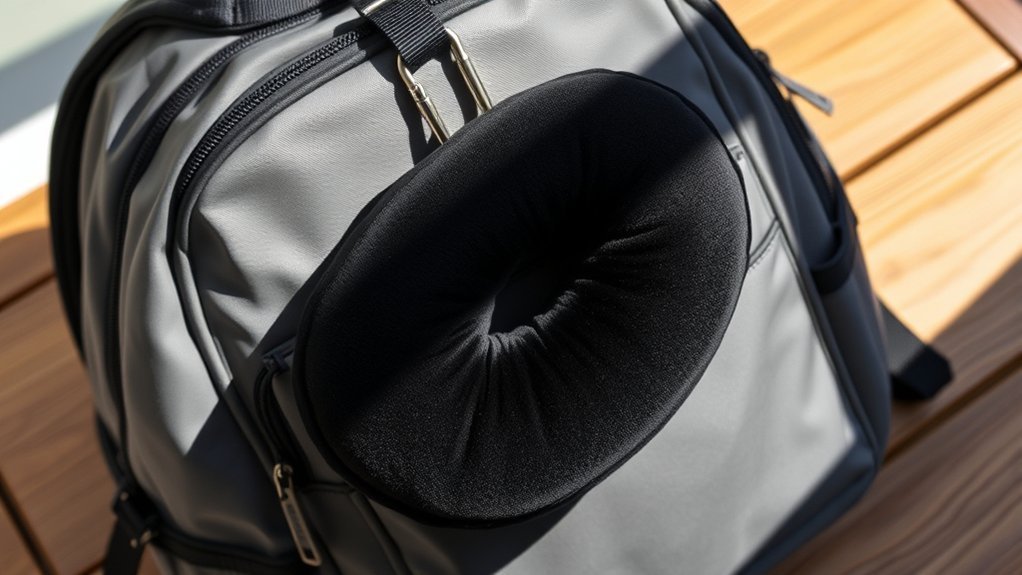
Last Updated on July 27, 2026 by Caleb Warren
Wrangling a bulky travel pillow while your hands are already full of boarding passes and coffee gets old fast. The easiest fix is to give the pillow one secure attachment point on your backpack, remove enough slack that it cannot swing around, and keep it where you can detach it quickly when you board.
Quick Answer
The easiest way to attach a travel pillow to a backpack is to clip its built-in loop or carrying case to a sewn webbing loop, daisy chain, or compression strap with an accessory carabiner or quick-release clip. Cinch out excess slack so the pillow stays close to the bag instead of swinging while you walk.
Key Takeaways
- Use a sewn backpack loop, daisy chain, compression strap, or sturdy carry handle instead of a zipper pull.
- A carabiner or quick-release clip is fastest for pillows with a loop or carrying case.
- Keep the pillow close to the backpack so it cannot swing into doors, seats, or other travelers.
- Compress memory foam only as the pillow manufacturer recommends; do not assume vacuum sealing is safe for every pillow.
- TSA allows pillows through security, but individual airlines decide how an attached pillow counts toward their baggage allowance.
At a Glance
| Time Required | About 1–2 minutes once you have a suitable loop, strap, clip, or carrying case |
| Difficulty | Easy — no tools required |
| Tools Needed | Built-in loop or strap; optional accessory carabiner, quick-release clip, luggage strap, or manufacturer-approved carrying case |
| Cost | $0 if your pillow and backpack already have compatible loops or straps; otherwise the cost depends on the attachment accessory or carrying case you choose |
Disclosure: As an Amazon Associate I earn from qualifying purchases. Some links on this page are affiliate links, at no extra cost to you.
Why You Need a Travel Pillow for Comfort
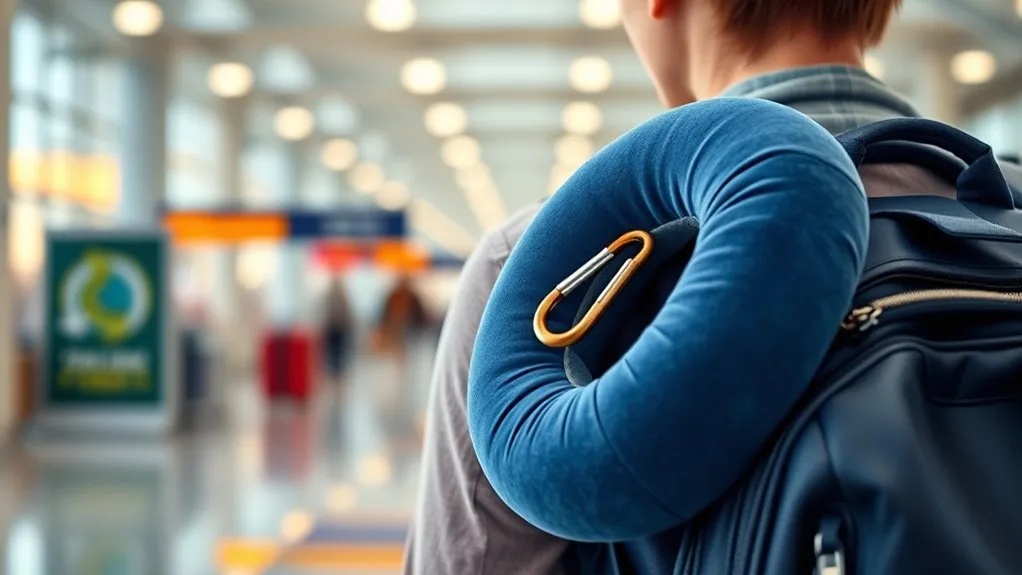
A travel pillow can make upright rest more comfortable by supporting your head or limiting how far it falls to one side. The benefit depends on the pillow’s shape, height, firmness, and how well it fits you rather than simply whether you carry one.
Research on pillows more broadly has found that pillow design can influence neck symptoms and support, although the evidence does not mean that every travel pillow prevents neck pain or post-flight stiffness. The practical goal on a plane, train, or bus is simple: choose a pillow that feels supportive without forcing your head into an awkward position.
Essential Features of a Comfortable Travel Pillow
The pillow’s construction affects both comfort and how easily you can attach it to a backpack.
- Memory foam: Supportive but usually the bulkiest option. A fitted carrying case with a strap or clip is often easier to manage than hanging the bare pillow outside your pack.
- Inflatable: The easiest type to pack because you can deflate it and place it inside your backpack or a small pouch.
- Microbead or compressible fill: Flexible enough to squeeze into a bag, although the final packed size varies by model.
- Wrap-style pillow: Often lighter and easier to fold or wrap around a handle, depending on its fastening system.
Also look for a removable or washable cover, a secure closure, and a built-in loop, strap, or carrying case. Washability is product-specific, so check the care label rather than assuming the whole pillow can go into a washing machine.
Best Methods to Secure Your Pillow to a Backpack
Four attachment methods cover most travel-pillow and backpack combinations:
- Quick-release clip or carabiner: Clip a pillow loop or carrying-case loop to a sturdy external webbing point on the backpack.
- Adjustable strap or bungee: Wrap the strap around the packed pillow and pass it through a backpack loop or compression strap.
- Trolley sleeve: If you are also using a rolling suitcase, slide a pillow case with a trolley sleeve over the extended luggage handle instead of hanging it from your backpack.
- Compression or carrying case: Pack the pillow into a case approved for that pillow, then attach the case rather than the loose pillow.
How to Attach a Travel Pillow to a Backpack Step by Step
- Inspect the pillow. Find its built-in loop, strap, clasp, or carrying case. If it has none, place it in a secure drawstring or carrying bag first.
- Choose a strong backpack attachment point. Use sewn webbing, a daisy-chain loop, a compression strap, or a sturdy carry handle.
- Compress only if appropriate. Deflate an inflatable pillow or pack a compressible pillow according to its manufacturer’s instructions.
- Clip or strap it on. Connect the pillow loop or case to the backpack and close the clip fully.
- Remove excess slack. Shorten adjustable straps until the pillow sits close to the bag rather than dangling several inches away.
- Do a shake test. Pick up the backpack, walk a few steps, and gently shake it. Make sure the pillow cannot fall off, block a zipper, hit your legs, or interfere with the shoulder straps.
Best Backpack Attachment Points
The best attachment point is usually a part of the bag designed to take repeated pulling:
- Daisy-chain webbing: Excellent for clips because you can choose the loop that keeps the pillow closest to the pack.
- Side compression straps: Useful for holding a soft pillow tightly against the bag instead of letting it swing.
- Sewn accessory loops: Good for lightweight pillow cases and clips.
- Top carry handle: Works when the pillow is light and the handle remains comfortable to grab.
Warning: Avoid attaching a pillow to a small zipper pull, loose decorative cord, or damaged webbing. Keep dangling straps short and tucked away so they cannot catch on seats, escalators, moving walkways, or other luggage.
How to Stop a Travel Pillow From Swinging
A pillow that hangs from one long clip can bounce against your back or legs with every step. The cure is to shorten the connection or add a second point of contact.
For example, clip the pillow case to one side loop and run an adjustable strap around a nearby compression strap. You do not need to pull it tight enough to crush the pillow; you only need enough tension to stop side-to-side movement.
How to Use Straps and Loops for Attachment
Many travel pillows have a built-in loop or come with a carrying case that can attach directly to a backpack. Feed an adjustable strap through a sewn backpack loop, close the buckle or clip, and shorten the strap until the pillow rests against the bag.
For pillows without an integrated strap, a carrying case can provide a better attachment point. Cases such as Cabeau’s travel cases, for example, are designed with attachment straps or clips so the packed pillow can connect to luggage.
Pro Tip: Clip the pillow to your backpack’s daisy chain, side loop, or compression webbing instead of the main zipper pull. A zipper pull is designed to operate the zipper, not to act as a repeated external load point.
Alternative Attachment Methods for Your Pillow
If your pillow does not have a convenient built-in loop, you still have several workable options.
Luggage Tag Attachment Method
A sturdy luggage-tag strap can work as a secondary attachment point, provided the strap and buckle are strong enough for repeated handling.
- Loop the luggage-tag strap through the pillow’s carrying loop or case handle.
- Fasten the other end around a backpack handle or sewn webbing point.
- Pull on the connection by hand before wearing the backpack.
- Make sure the tag and pillow cannot cover a zipper or swing against your legs.
The tag also provides identification if the pillow becomes separated from your bag. Avoid thin decorative tag straps that can pop open when pulled.
Snap Tag Secure Options
A snap-style luggage strap or quick-release clip is useful when you want to detach the pillow quickly at the gate or after you sit down. Choose one that closes positively and fits completely through the pillow loop and backpack webbing.
For a loose U-shaped pillow, attaching the clip to a carrying case usually works better than clipping directly to soft fabric, where the connection may stretch or pull on a seam.
Use of Compression Bags
A compression or fitted carrying case can make a bulky pillow easier to attach, but the pillow’s construction matters.
- Inflatable pillow: Deflate it fully and fold it into its pouch.
- Compressible-fill pillow: Use the supplied stuff sack or a compatible compression bag.
- Memory-foam pillow: Follow the manufacturer’s packing instructions. Some travel pillows are specifically designed to be rolled into a compact case.
- Microbead pillow: Use gentle compression only if the maker permits it; forcing it into an undersized bag can stress seams.
Note: Do not assume a vacuum-seal bag is safe for every memory-foam or filled travel pillow. Use the pillow’s own case or the compression method specified by its manufacturer.
Keeping Your Pillow Accessible
Place the pillow on the side or upper front of the backpack when you expect to use it during the trip. That keeps it within reach without forcing you to unpack the main compartment.
A quick-release clip works well for short airport transfers because you can remove the pillow in seconds. If you are switching to a rolling suitcase, a carrying case with a trolley sleeve can move the pillow from your backpack to the suitcase handle without repacking it.
Keep the attachment compact. The Federal Aviation Administration advises travelers to tuck in carry-on straps because loose straps can become a tripping hazard, and anything you bring aboard must ultimately be stowed as directed by the airline or cabin crew.
Does an Attached Travel Pillow Count as a Carry-On or Personal Item?
TSA permits pillows in both carry-on and checked baggage, but that only answers the security-screening question. Your airline decides how many items you can bring aboard and whether an attached pillow is treated as another item.
For example, American Airlines currently publishes an allowance of one carry-on plus one personal item and lists specific exemptions without a general pillow exemption. Spirit’s current baggage guidance is more explicit: neck and head pillows can be carried aboard as long as they fit completely inside the personal-item bag.
Note: The safest plan is to make sure your travel pillow can fit inside your permitted personal item or carry-on before boarding. Do not rely on the fact that it is clipped to the backpack to make it automatically exempt from an airline’s item limit.
How to Pack Your Pillow for Easy Attachment
To keep your travel pillow ready to grab and go:
- Use the pillow’s supplied carrying case when it has one, especially if that case includes an attachment strap or clip.
- Deflate inflatable pillows completely before placing them in their pouch.
- Roll or compress memory-foam models only according to the manufacturer’s directions.
- Clip the packed pillow to a sturdy backpack loop and shorten any adjustable strap.
- Position the pillow so it does not cover the backpack’s main zipper, water-bottle pocket, or boarding documents.
- Before entering the aircraft, tuck away loose straps and be ready to place the pillow inside your permitted baggage if the airline requires consolidation.
Ensuring Your Pillow Stays Clean While Traveling
Use Protective Covers
A carrying case does more than make attachment easier. It also keeps the pillow from rubbing against airport floors, seat backs, luggage belts, and the outside of your backpack.
- Use the supplied case: A fitted case provides the cleanest attachment point and protects the pillow in transit.
- Use a removable pillow cover: Wash it according to the care label after the trip.
- Keep the pillow off the floor: Shorten the attachment so it cannot drag when you set the backpack down.
- Label the case: Add your name or luggage tag so a loose pillow is easier to identify.
Cleaning instructions vary by construction. For example, Cabeau instructs owners of compatible memory-foam models to machine-wash the removable fabric cover on a cool setting while wiping the foam insert with a damp cloth rather than putting the foam itself in the washer.
Store in Dry Place
Let the pillow and its cover dry fully before sealing them in a carrying or compression bag. Storing damp fabric or foam in an enclosed case can trap moisture and create odors.
If the pillow gets wet during a trip, remove it from the case when practical and let it air-dry. Once home, follow the care label for washing and drying rather than applying one cleaning method to every pillow material.
Troubleshooting Common Pillow Attachment Problems
If your pillow will not stay put, match the problem to the fix:
- The pillow swings while you walk: Shorten the strap, move it closer to the backpack, or add a second securing strap.
- The clip keeps opening: Replace it with a properly closing quick-release clip or accessory carabiner that fits the backpack loop.
- The pillow blocks the zipper: Move it from the top handle to a side loop or daisy-chain point.
- The bare pillow has nowhere to clip: Put it in a drawstring or fitted carrying case with a loop or strap.
- The pillow is too bulky: Deflate it if inflatable or use its manufacturer-approved packing method. Do not force memory foam into an excessively small vacuum bag.
- The attachment pulls on the pillow seam: Stop clipping directly to the fabric and use a carrying case or built-in reinforced loop.
- The pillow catches on things: Shorten dangling straps and position the pillow against the body of the backpack.
- The airline asks you to consolidate: Remove the pillow and place it inside your permitted carry-on or personal item if it fits.
Whatever method you use, check the attachment before every travel day. Clips can work loose, straps can stretch, and a pillow that was stable on an empty backpack may sit differently once the bag is fully packed.
Frequently Asked Questions
Can I attach multiple travel pillows to my backpack?
Yes, but use separate secure attachment points and keep both pillows close to the backpack. Make sure they do not block zippers, interfere with the shoulder straps, or make the bag too wide to move comfortably through crowded spaces.
Will attaching a pillow affect my backpack’s weight distribution?
A lightweight travel pillow usually has little effect on overall load, but a bulky pillow can swing and make the pack feel awkward. Keep it close to the backpack instead of hanging it from a long strap, and place heavier gear inside the pack where it belongs.
Are there specific travel pillows designed for easy attachment?
Yes. Inflatable pillows pack into small pouches, while some memory-foam pillows are sold with carrying cases that include clips or adjustable straps. A case designed for the pillow is often easier to attach than the bare pillow itself.
How do I clean my travel pillow while traveling?
Follow the care label. A removable fabric cover may be washable, while a memory-foam insert may require only a damp cloth and air drying. Keep the pillow in a clean carrying case between uses and let every part dry fully before closing the case.
Can I use a strap to attach my pillow to a suitcase?
Yes. Loop an adjustable strap around a sturdy suitcase handle or use a pillow case with a trolley sleeve. Tighten the connection enough that the pillow rests against the suitcase instead of swinging loose while you walk.
Does a travel pillow clipped to my backpack count as another carry-on item?
It can. TSA allows pillows through security, but airlines set their own baggage allowances. Do not assume clipping the pillow to your backpack makes it exempt. Check your airline’s current rules and be prepared to place the pillow inside your permitted bag before boarding.
Can I vacuum-seal a memory-foam travel pillow?
Only if the pillow manufacturer says that method is suitable. Some memory-foam travel pillows are designed to be rolled into a fitted compression case, but that does not mean every foam pillow should be heavily vacuum-compressed. Follow the packing instructions for your specific model.
Conclusion
A travel pillow earns its spot in your bag when a long trip leaves you trying to rest upright. For most backpacks, the simplest setup is a built-in pillow loop or carrying case clipped to sturdy sewn webbing, with the strap shortened enough to stop the pillow from swinging.
Use a fitted case or manufacturer-approved compression method for bulkier pillows, keep loose straps tucked away, and remember that TSA permission does not override your airline’s baggage allowance. Set the attachment up before you leave home, give it a quick shake test, and you can move through the airport without carrying the pillow in your hands.
Sources
- Transportation Security Administration — Pillows — confirms pillows are permitted in carry-on and checked baggage.
- Federal Aviation Administration — Carry-On Baggage Tips — guidance on airline carry-on limits, safe stowage, and tucking in loose bag straps.
- American Airlines — Carry-On Bags — current carry-on and personal-item allowance and listed exemptions.
- Spirit Airlines — Bag Info — current personal-item rules and specific guidance for neck and head pillows.
- Cabeau — Deluxe Travel Case — manufacturer guidance for attaching, packing, and caring for compatible travel pillows.
- Clinical Biomechanics — Systematic Review of Pillow Designs — evidence on pillow design, neck symptoms, support, and the importance of pillow shape and height.
