
Last Updated on July 28, 2026 by Mason Reed
Getting your trekking pole height right makes hiking feel more natural and keeps you from reaching too high or hunching over your poles. Start with the classic elbow test on level ground, use a manufacturer size chart as a reference, then make small adjustments for climbs, descents, and sidehills.
Quick Answer
On level ground, set trekking poles so your elbows bend about 90 degrees when the tips rest beside your feet. For fixed-length poles, a common starting chart is 100 cm under 5’1″, 110 cm at 5’1″–5’7″, 120 cm at 5’8″–5’11”, and 130 cm at 6’+. Shorten adjustable poles about 5–10 cm for sustained climbs and lengthen them 5–10 cm for descents.
Key Takeaways
- Use a roughly 90-degree elbow bend on level ground as your main trekking-pole fit check.
- Treat height charts as starting points because arm length, body proportions, pole design, and manufacturer sizing can change the best setting.
- Shorten adjustable poles about 5–10 cm for long climbs and lengthen them about 5–10 cm for long descents.
- On a sidehill traverse, shorten the uphill pole and lengthen the downhill pole as needed.
- Fit your poles while wearing the hiking boots you normally use, and check that every adjustment lock is secure before putting weight on the poles.
At a Glance
| Time Required | 2–5 minutes |
| Difficulty | Easy |
| Tools Needed | Trekking poles; tape measure optional |
| Cost | $0 if you already own the poles |
Disclosure: As an Amazon Associate I earn from qualifying purchases. Some links on this page are affiliate links, at no extra cost to you.
What Is the Right Trekking Pole Height?
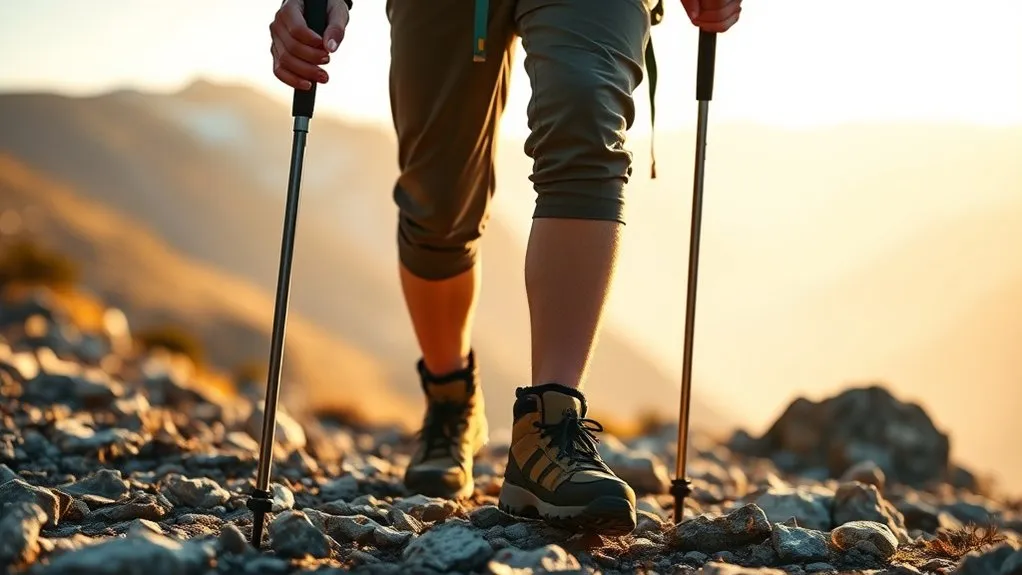
The right trekking pole height is the length that lets you stand naturally on level ground with the pole tip beside your foot and your elbow bent to roughly 90 degrees. Your shoulders should stay relaxed rather than lifted, and you should not need to lean toward the grip.
A height chart can get you close, but it is only a starting point. REI’s fixed-length trekking-pole guide suggests 100 cm for people under 5 ft 1 in, 110 cm for 5 ft 1 in through 5 ft 7 in, 120 cm for 5 ft 8 in through 5 ft 11 in, and 130 cm for 6 ft and taller. Individual manufacturers can use smaller size increments or different recommendations, so check the chart for the pole you are buying.
You may also see advice to multiply height in centimeters by 0.68. Do not treat that as a universal trekking-pole formula. The 0.68 ratio is widely used for Nordic walking, while trekking-pole manufacturers commonly rely on their own sizing charts and the elbow-angle test. For trekking, the way the pole fits your body matters more than forcing your height into one formula.
On level ground, the best starting point is simple: relaxed shoulders, pole tip beside your foot, and an elbow bend of about 90 degrees.
How to Measure Trekking Pole Height
To measure trekking pole height, put on the footwear you normally hike in and stand upright on a flat surface. Set the pole tip beside your foot, take the grip naturally, and adjust the shaft until your forearm is roughly parallel to the ground and your elbow is close to a right angle.
- Wear the shoes or boots you normally use on the trail.
- Stand upright with your shoulders relaxed.
- Place the pole tip on the floor beside your foot.
- Hold the grip normally without reaching or shrugging.
- Adjust the pole until your elbow forms roughly a 90-degree angle.
- Lock every adjustable section securely and press down lightly to check for slipping.
- Note the centimeter marking so you can return to the same setting later.
LEKI’s pole length advisor also asks for body height while wearing the shoes used for the activity, then treats its recommendation as a starting point rather than an absolute measurement.
Pro Tip: Fit and test your poles while wearing the hiking boots you will actually use on the trail. Then save or remember the centimeter setting instead of recalculating it before every hike.
Adjustable vs. Fixed-Length Poles
Adjustable poles are easier to fine-tune because you can change their length for terrain. With a three-section pole, REI recommends setting one adjustment around the middle of its usable range and using the other section to reach your normal 90-degree fit. That leaves room for quick trail adjustments.
Fixed-length poles require more care when buying because you cannot correct the fit later. Use the brand’s size chart first, then choose the size that most closely gives you the correct elbow position. Black Diamond, for example, sells some fixed poles in 5 cm increments, so its recommendations are more precise than a four-size general chart.
The Elbow Test for a Proper Fit
The elbow test is more dependable than a one-size-fits-all formula. Stand on level ground, put the pole tip beside your foot, and hold the grip with a relaxed wrist. Your elbow should bend to about 90 degrees and your forearm should sit roughly level.
The grip does not need to sit 6 to 8 inches above your elbow. That rule conflicts with the normal trekking-pole fit shown by REI and manufacturers such as Black Diamond. Instead, look for three simple signs:
- Your shoulders stay down and relaxed.
- Your wrist can hold the grip without an awkward bend.
- Your forearm is close to horizontal on flat ground.
If your shoulders rise or your elbows are pushed too far outward, the poles are probably too long. If you hunch forward or your hands sit noticeably below a comfortable forearm position, the poles may be too short.
Check the Wrist Straps Too
After setting pole height, adjust the straps so your hands can rest naturally on the grips. REI recommends bringing your hand up through the bottom of the strap and then settling your palm onto the grip. A properly adjusted strap supports the heel of the hand and lets you avoid squeezing the handle all day.
Trekking Pole Height by Body Size
For fixed-length trekking poles, the following REI sizing chart is a practical starting reference. Confirm the final size with the elbow test because body proportions vary.
| Body size | Starting pole length | Final check |
|---|---|---|
| Under 5 ft 1 in | 100 cm | About 90° at elbow |
| 5 ft 1 in–5 ft 7 in | 110 cm | About 90° at elbow |
| 5 ft 8 in–5 ft 11 in | 120 cm | About 90° at elbow |
| 6 ft+ | 130 cm | About 90° at elbow |
Some brands offer 5 cm increments, so someone near the edge of a height range may fit better in an intermediate size. Pole material and grip type affect weight and feel, but they do not replace proper sizing.
Note: In snow or soft mud, use the basket designed for those conditions. Wider baskets help keep pole tips from sinking deeply. Adjust length by feel if needed rather than automatically adding a fixed number of centimeters.
How to Set Pole Height for Uphill Trails
For a long uphill section, shorten adjustable poles about 5–10 cm from your normal level-ground setting. REI recommends more shortening as the slope becomes steeper. The goal is to plant the pole securely without lifting your shoulders or reaching awkwardly.
You do not need to stop and change the poles for every small rise. The adjustment matters most on sustained climbs where the normal length starts pushing your shoulders upward.
Uphill Pole Shortening
| Trail grade | Typical change | Fit cue |
|---|---|---|
| Moderate sustained climb | About -5 cm | Shoulders stay relaxed |
| Steep sustained climb | About -10 cm | No upward reach |
| Very steep or irregular terrain | Fine-tune as needed | Secure pole plants |
The 5–10 cm range is guidance, not a rule that must be followed exactly. If shortening the pole makes you crouch or forces an awkward wrist position, move it back toward your normal setting.
Terrain-Based Fine Tuning
Terrain changes faster than a sizing chart can account for. Use the centimeter markings as a repeatable reference, then adjust based on posture and pole placement.
- Short climb: Your normal setting is usually fine.
- Long climb: Shorten both poles about 5–10 cm.
- Long traverse: Shorten the uphill-side pole and lengthen the downhill-side pole.
- Large step-ups: A shorter grip position or lower extended grip can be faster than changing the shaft for one obstacle.
How to Set Pole Height for Downhill
For a sustained downhill section, lengthen adjustable trekking poles about 5–10 cm from your level-ground setting. The extra reach can help you plant the pole lower on the slope while keeping your torso more upright.
Do not chase an exact 90-degree elbow angle during every downhill pole plant. The 90-degree test establishes your neutral setting on flat ground; downhill terrain changes the relationship between your hands and the ground.
Downhill Height Adjustment
| Check | What to do |
|---|---|
| Length | Add about 5–10 cm for a sustained descent |
| Posture | Stay upright without reaching excessively |
| Pole plant | Place the tip securely before loading it |
| Terrain change | Return toward your normal setting as the trail flattens |
Warning: Before a steep descent, check every lock and shaft section. Never extend a telescoping pole beyond the manufacturer’s marked usable range, and stop using a pole if a lock slips, a shaft is bent or cracked, or a component is damaged.
Knee Strain Reduction
Correctly used trekking poles can shift some work from the lower body to the arms and poles during descents. That does not guarantee protection from knee injury, but laboratory research supports a reduction in some lower-extremity loads.
In a small 1999 laboratory study of eight men walking down a 25-degree ramp, hiking poles were associated with roughly 12–25% lower peak or average values for several measured knee-loading variables. A later study of 15 experienced male hikers also found reductions in several joint moments and lower-extremity loading measures during downhill hiking with poles.
- Set your downhill length before a long or steep descent.
- Plant each tip securely before transferring force through the pole.
- Keep your grip relaxed instead of hanging your full body weight from the handles.
- Readjust when the slope changes.
Pole technique is only one part of comfortable descending. Foot placement, speed, footwear, pack weight, trail conditions, and your own joints also matter.
Hiking Staff Height by Body Size
A hiking staff is a single recreational pole rather than a pair of trekking poles. REI recommends the same basic fit principle for an adjustable hiking staff: on level ground, choose a length that lets your elbow bend to roughly 90 degrees while the tip rests near your foot.
The familiar 100/110/120/130 cm trekking chart can provide a rough purchasing reference, but it should not override the actual fit of an adjustable hiking staff.
| Body size | Rough starting reference |
|---|---|
| Under 5 ft 1 in | Around 100 cm; verify elbow fit |
| 5 ft 1 in to 5 ft 7 in | Around 110 cm; verify elbow fit |
| 5 ft 8 in to 5 ft 11 in | Around 120 cm; verify elbow fit |
| 6 ft or taller | Around 130 cm or an adjustable staff with sufficient maximum length |
If you are taller than about 6 feet, REI suggests checking that an adjustable trekking pole or hiking staff can extend to at least about 51 inches (130 cm). For shorter users, most adjustable models have enough shortening range, but the manufacturer specifications should still be checked before buying.
How to Choose the Right Hiking Staff Length
To choose the right hiking staff length, stand upright on level ground with the staff tip near your foot. Adjust the shaft until your elbow bends to roughly 90 degrees and your shoulders stay relaxed. That physical fit is more useful than measuring several inches above your elbow.
- Start with the manufacturer’s recommended range for your height.
- Adjust the staff until your forearm sits roughly level on flat ground.
- Shorten an adjustable staff for sustained climbs when the normal length makes you reach upward.
- Lengthen it for sustained descents when more reach helps you plant the tip comfortably downhill.
- Check the lock before leaning on the staff.
Note: A recreational hiking staff is not the same thing as a medical cane. If you need a walking aid for weakness, injury, balance impairment, or everyday mobility, use a properly fitted medical device rather than relying on trekking-pole sizing.
Trekking Poles vs. Nordic Walking Pole Length
Trekking and Nordic walking poles look similar, but their sizing advice should not be mixed without context. Nordic walking emphasizes a repeated propulsion technique on relatively even surfaces, and a common Nordic-walking calculation is height in centimeters × 0.68.
Trekking poles are used on changing trail grades, where adjustable length and secure placement matter more. For that reason, trekking guidance from REI, LEKI, and Black Diamond centers on an appropriate elbow position, manufacturer sizing, and terrain-specific adjustment.
If you are shopping specifically for Nordic walking poles, follow the Nordic-walking manufacturer’s sizing instructions. If you are sizing trekking poles for hiking or backpacking, use the trekking guidance in this article.
How to Adjust Poles on a Sidehill Traverse
A long traverse places one foot higher on the slope than the other, so using identical pole lengths can make one shoulder rise and the other drop. REI recommends shortening the pole on the uphill side and lengthening the downhill-side pole as needed.
You do not need a fixed centimeter difference. Adjust only enough to keep your torso balanced and your pole plants comfortable. When the trail levels out, return both poles to your normal setting.
Common Trekking Pole Height Mistakes
One of the most common trekking pole mistakes is setting the poles from a formula and never checking how they actually fit. Your normal level-ground setting should let you stand naturally with relaxed shoulders and an elbow bend near 90 degrees.
- Using height × 0.68 as an absolute trekking rule: That ratio is common in Nordic walking. Trekking-pole charts vary by manufacturer.
- Choosing poles that are too long: Raised shoulders and awkwardly high hands are common warning signs.
- Choosing poles that are too short: You may hunch forward or lose useful reach.
- Never adjusting for terrain: Sustained climbs, descents, and sidehill traverses often benefit from different lengths.
- Ignoring the adjustment range: A pole that barely reaches your neutral setting may not leave enough length for descents.
- Extending beyond the safe markings: Stay within the manufacturer’s usable range.
- Skipping the lock check: A slipping telescoping section can cause a sudden loss of support.
- Using the wrong baskets: Snow and mud baskets help reduce excessive sinking in soft surfaces.
Fit is ultimately personal within a safe range. Two hikers of the same height can prefer slightly different settings because their arm length, posture, technique, and pole design differ.
Frequently Asked Questions
How Do I Know What Height Walking Stick I Need?
For a recreational hiking staff, stand on level ground with the tip near your foot and adjust it until your elbow bends roughly 90 degrees. A medical cane is different: medical guidance normally places the handle around wrist-crease height with only a slight elbow bend, so do not use trekking-pole sizing for a cane prescribed as a mobility aid.
What Height Should Walking Poles Be for Seniors?
For recreational trekking poles, age does not create a separate sizing rule: start with relaxed shoulders and roughly a 90-degree elbow bend on flat ground. If the poles are being used because of weakness, injury, significant balance problems, or a medical need for weight-bearing support, a properly fitted cane, walker, or other mobility aid may be more appropriate.
How Tall Should a Walking Stick Be for a 5’4″ Woman?
For a recreational trekking pole or hiking staff, about 110 cm is a reasonable starting point at 5’4″. Manufacturer charts can vary, so confirm the final setting by checking for roughly a 90-degree elbow bend on level ground. A medical cane uses a different fitting method.
How Long Should Hiking Poles Be if You Are 5’5″?
Around 110 cm is a common fixed-length starting point for a 5’5″ hiker, although brands that offer 5 cm increments may recommend a nearby size. Use the model’s own chart and choose the length that gives you a comfortable elbow bend near 90 degrees.
Should Trekking Poles Be Longer Going Uphill or Downhill?
For sustained hiking grades, adjustable trekking poles are normally shorter uphill and longer downhill. A common starting change is 5–10 cm shorter for climbs and 5–10 cm longer for descents, followed by small adjustments for comfort and slope.
Is the 0.68 Trekking Pole Formula Accurate?
It should not be treated as a universal trekking-pole rule. Height × 0.68 is commonly used in Nordic walking. Trekking-pole brands use their own charts, and the most useful practical check is whether the pole gives you a comfortable elbow bend of about 90 degrees on level ground.
Conclusion
Getting your hike stick height right does not require a perfect formula. Start on level ground with relaxed shoulders and an elbow bend near 90 degrees. Use the manufacturer’s chart to choose a fixed-length pole, then shorten adjustable poles for sustained climbs, lengthen them for descents, and adjust each side independently on long traverses.
Most importantly, separate trekking advice from Nordic-walking formulas and medical-cane fitting. A well-sized recreational pole should feel natural, stay securely locked, and help you move across changing terrain without forcing your shoulders, wrists, or posture into an awkward position.
Sources
- REI Co-op — How to Choose Trekking Poles and Hiking Staffs — 90-degree elbow fit, fixed-length size chart, adjustable-pole guidance, and hiking-staff distinctions.
- REI Co-op — How to Use Trekking Poles and Hiking Staffs — uphill, downhill and traverse adjustments, straps, baskets, and trail technique.
- LEKI — Pole Length Advisor — manufacturer sizing guidance based on activity, height with footwear, and personal adjustment.
- Black Diamond — Trekking Pole Sizing Guide — manufacturer-specific size increments and 90-degree elbow guidance.
- PubMed — Knee Joint Forces During Downhill Walking With Hiking Poles — laboratory evidence on downhill knee-loading changes with hiking poles.
- MedlinePlus — Using a Cane — medical-cane fitting guidance and the distinction from recreational trekking-pole sizing.
