
Last Updated on September 27, 2026 by Caleb Warren
Can you take an electric scooter on a train in the UK? The answer depends on the operator, but most major rail companies prohibit them because of battery-fire concerns. Folding your scooter does not automatically make it acceptable luggage. Here are the rules, named operator restrictions, and practical alternatives for your journey.
Quick Answer
Most UK train operators do not allow electric scooters on their trains or within their stations. This includes major operators such as GWR, Avanti West Coast, Northern, and ScotRail. National Rail leaves carriage decisions to individual operators, so a folding scooter is only acceptable where the company’s policy expressly permits it.
Last checked: 28 September 2026. Dates and figures were verified against official sources.
Disclosure: As an Amazon Associate I earn from qualifying purchases. Some links on this page are affiliate links, at no extra cost to you.
Are Electric Scooters Allowed on UK Trains?
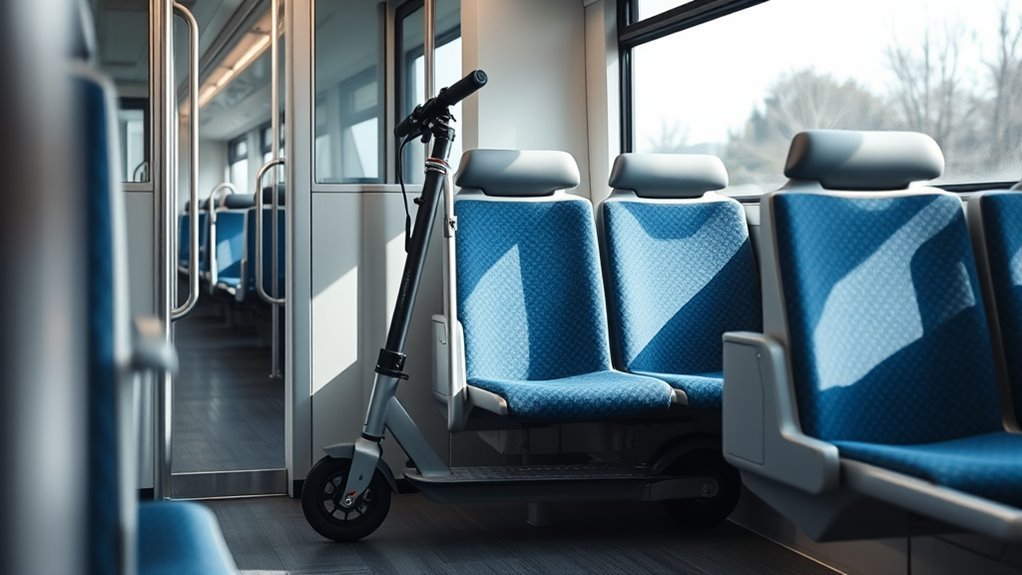
Most UK rail operators prohibit electric scooters, including folding models. Their restrictions generally cover the complete device, not just riding or charging it on board.
However, there is an important distinction between a nationwide law and an individual railway company’s carriage policy.
The National Rail luggage guidance states that e-scooters may be prohibited by individual train companies. Where an operator permits them, they must be folded and meet the normal luggage requirements.
This means you cannot assume that a scooter accepted by one operator will be accepted by another.
For example, an itinerary involving two different train companies requires you to satisfy both companies’ conditions. Permission for the first service does not override restrictions on the second.
Does Folding an Electric Scooter Make It Permitted?
No. A folding mechanism does not override an operator’s e-scooter ban.
Where a company prohibits electric scooters, putting yours in a carrying bag or folding its handlebars does not turn it into an ordinary non-electric scooter.
Similarly, a staff member’s informal approval should not be treated as a guaranteed exception to a published prohibition.
If an operator expressly permits folded electric scooters, you must follow its luggage conditions and keep the device clear of doors, aisles, and wheelchair spaces.
Which UK Train Operators Ban E-Scooters?
Many major UK train companies explicitly ban electric scooters. Some also prohibit hoverboards, electric skateboards, and electric unicycles.
The following operator policies explain the restrictions travellers need to understand.
| Train operator | Electric scooter policy |
|---|---|
| Avanti West Coast | Not permitted on trains or at stations. |
| Northern | E-scooters and most other powered transport devices are prohibited. |
| TransPennine Express | E-scooters, hoverboards, and electric skateboards are prohibited. |
| East Midlands Railway | E-scooters and specified personal mobility devices are prohibited on trains and within stations. |
| LNER | E-scooters are prohibited. |
| Great Western Railway | E-scooters are prohibited on trains and at stations, including folded models. |
| ScotRail | Lithium-ion-powered micro-mobility devices are prohibited on trains and in stations. |
| Transport for London | E-scooters are prohibited across TfL services, whether folded or unfolded. |
Great Western Railway
Great Western Railway is not an exception to the e-scooter ban.
Under the GWR scooter policy, passengers have been prohibited from bringing e-scooters onto its trains and stations since 21 May 2023.
The operator says passengers arriving with an electric scooter will be asked to leave.
This restriction is separate from GWR’s mobility scooter policy, which permits qualifying mobility aids under specific conditions.
Avanti West Coast, Northern, and TransPennine Express
These operators also prohibit electric scooters, although their published rules differ in scope and wording.
Avanti West Coast’s bicycle guidance confirms that e-scooters are not permitted on trains or anywhere at its stations.
The Northern powered transport policy excludes e-scooters and other specified powered devices. It permits electric bikes that satisfy the Electrically Assisted Pedal Cycle requirements.
Meanwhile, the TransPennine Express e-scooter policy explicitly includes hoverboards and electric skateboards in its ban.
East Midlands Railway and ScotRail
East Midlands Railway prohibits electric scooters and other specified personal mobility transport devices because of battery-fire concerns.
Its official e-scooter guidance distinguishes these devices from non-electric scooters, approved mobility aids, and electric bikes.
ScotRail introduced its restrictions on 1 June 2023. Its published policy covers e-scooters, electric unicycles, hoverboards, and electric skateboards.
Qualifying mobility scooters, powered wheelchairs, and legal pedal-assisted electric bikes are not covered by this prohibition.
Transport for London
Transport for London applies an explicit ban to electric scooters across its services.
The TfL cycle carriage rules confirm that e-scooters are not allowed, whether folded or unfolded.
This covers services including the Tube, buses, London Overground, the Elizabeth line, and the DLR.
It also means that a scooter allowed on a particular National Rail journey cannot automatically be carried onto a connecting TfL service.
Why Are E-Scooters Banned on Trains?
The main reason is the potential fire risk associated with lithium-ion batteries. Operators are particularly concerned about faulty, damaged, or poorly regulated battery systems in enclosed railway environments.
A lithium-ion battery can enter a process called thermal runaway. This happens when internal heat triggers further chemical reactions, causing temperatures to rise rapidly.
A serious battery failure can produce flames, intense heat, and hazardous smoke. On a crowded train, passengers may have limited space to move away from the affected device.
Train operators also have to consider how quickly staff can identify an incident, protect passengers, and arrange a safe response.
Other relevant factors include:
- Differences in battery manufacturing quality and product safety standards.
- Potential damage to batteries located close to the ground.
- The difficulty of checking every passenger’s device individually.
- Limited space for carrying larger personal transport devices safely.
These concerns explain why some companies adopt blanket restrictions rather than deciding whether individual scooters appear safe.
Nevertheless, not every lithium-ion-powered device is prohibited. Legal electric bikes and regulated mobility aids are generally treated under separate railway policies.
Is It Illegal to Own or Ride an Electric Scooter in the UK?
Owning a private electric scooter is not itself illegal, but riding one in public is generally prohibited.
Under the government’s electric scooter rules, privately owned e-scooters may only be ridden on private land with the landowner’s permission.
They cannot legally be ridden on public roads, pavements, or in public parks.
There is an exception for approved rental scooters operating within official trial schemes. These may be used on permitted roads and cycle lanes, subject to the scheme’s conditions.
However, permission to ride a rental scooter in an approved trial area does not automatically grant permission to carry it onto a train.
Warning: Do not ride a privately owned e-scooter along public roads or pavements to reach a railway station. Even if your intended rail operator permits carriage, public-road riding is a separate legal issue and can result in penalties or seizure.
Are Electric Bikes Allowed on Trains?
Yes. Road-legal electric bikes are generally allowed on most UK trains, although carriage conditions vary by operator.
The key distinction is whether the bike qualifies as an Electrically Assisted Pedal Cycle (EAPC).
Under the UK electric bike regulations, a qualifying EAPC must meet these requirements:
- It must have pedals capable of propelling the bicycle.
- Its motor must have a maximum continuous rated power of 250 watts.
- Its motor must stop providing assistance above 15.5 mph (25 km/h).
The 15.5 mph limit applies to motor assistance, not the bicycle’s total possible speed when pedalled or travelling downhill.
Certain throttle-operated models also require the appropriate vehicle approval.
Road-legal e-bikes are treated differently from unregulated electric scooters because they must satisfy established vehicle requirements.
What Are the Train Rules for Folding Electric Bikes?
Folding electric bikes are often easier to carry because operators can treat them as folded cycles rather than full-size bicycles.
According to National Rail’s bicycle guidance, folding bikes are generally carried free of charge, although some operators require them to be covered or stored as luggage.
Full-size bikes may need advance reservations, and some services restrict bicycle carriage during busy periods.
You should also avoid charging an electric bike on board unless the operator explicitly provides an approved facility.
Transport for London has additional restrictions: folded e-bikes are accepted on most services, while non-folding e-bikes are prohibited on most of its network.
What About Mobility Scooters and Electric Wheelchairs?
Mobility scooters and powered wheelchairs are treated differently from recreational e-scooters.
They can travel on many UK rail services, subject to the operator’s accessibility requirements.
The National Rail mobility scooter guidance provides operator-specific information about size, weight, and permit requirements.
Some train companies require a mobility scooter permit before travelling. Others impose restrictions based on the dimensions of the scooter or available boarding facilities.
If you use a mobility aid, contact Passenger Assist or the relevant train company before your journey to arrange the support you need.
What Are the Best Alternatives to E-Scooter Travel?
If your train company prohibits electric scooters, a legal folding bicycle or e-bike is often a practical replacement.
Other options include public bike hire, walking, local buses, and direct road transport.
| Alternative | Why it helps |
|---|---|
| Foldable e-bike | Can combine rail travel with longer station-to-door journeys, subject to carriage rules. |
| Bike hire | Provides local transport without carrying a bicycle on the train. |
| Walking | Free and practical for short journeys near stations. |
| Carpool or rideshare | Offers direct transport when rail connections are inconvenient. |
Combine Rail Travel With Local Bike Hire
Bike-sharing services can solve the problem of travelling between a station and your final destination.
Instead of transporting your own electric scooter, you can use a bicycle available near the station.
This is particularly convenient when your journey involves several train operators with different cycle policies.
Use an Approved Rental E-Scooter Where Available
An official rental e-scooter can be another option for a short journey within an approved trial area.
However, you must use the scooter within the permitted operating area and follow the rental scheme’s conditions.
You will also need the appropriate driving licence and must avoid riding on pavements.
Rental scooters are not a substitute for train-approved luggage. Where a railway operator prohibits e-scooters, use the rental device before or after your train journey rather than carrying it aboard.
Plan Your Journey Before Leaving Home
A short transport check can prevent problems at the station.
- Identify every train operator involved in your journey.
- Confirm the carriage policy for your specific device.
- Check whether the restriction also applies to station buildings, platforms, and cycle storage.
- If travelling with an e-bike, confirm whether a bicycle reservation is required.
- Arrange a permitted alternative for the parts of your journey where your device cannot travel.
If you are travelling with a recreational electric scooter, do not assume it can be left at the station. Some operators specifically prohibit storing these devices on railway premises.
Frequently Asked Questions
Are E-Scooters Allowed on Trains in the UK?
Most major UK train operators prohibit electric scooters because of battery-fire concerns. National Rail allows individual companies to set their own carriage conditions, but you should not assume that folding your scooter makes it acceptable luggage.
What Happens if You Get Caught With an E-Scooter in the UK?
Railway staff may refuse boarding or ask you to leave if your scooter breaches the operator’s policy. Illegal public riding is a separate offence. Riding without insurance can result in a £300 fixed penalty and six licence points. Police may also seize the scooter. Simply carrying one is not automatically the same offence as riding it illegally.
Why Are Electric Scooters Illegal in the UK but Not Electric Bikes?
Private e-scooters generally cannot be ridden in public because they are treated as motor vehicles and do not meet the requirements for ordinary road use. Qualifying electric bikes have a separate legal category with defined pedal, power, and assistance limits. Approved rental e-scooters are permitted in designated trial areas.
Can I Bring a Folded E-Scooter on a Train?
Only if the train operator expressly permits it. Folding an e-scooter does not override a ban, and a carrying bag does not change the device’s classification. Where carriage is permitted, the scooter must satisfy the operator’s luggage requirements.
Are Mobility Scooters Banned From UK Trains?
No. Mobility scooters and powered wheelchairs are treated separately from recreational electric scooters. Many operators allow them, subject to size, weight, accessibility, and permit requirements. Contact the railway company or Passenger Assist if you need help arranging travel with a mobility aid.
Can You Take a Rental E-Scooter on a Train?
An approved rental scooter is not automatically allowed on trains. Legal permission to ride it within an official trial area does not override railway carriage restrictions. Most major operators prohibit electric scooters, including those that can be folded.
Conclusion
You generally cannot take an electric scooter on a train in the UK because most major operators prohibit them over fire-safety concerns.
Folding your scooter does not override these restrictions, and GWR is not an exception. Legal electric bikes and qualifying mobility scooters are treated differently.
Before travelling, confirm your operator’s policy and arrange an approved transport alternative if your scooter cannot be carried.
Sources
- National Rail — Luggage: Operator discretion, luggage conditions, and folding requirements.
- Avanti West Coast — Taking Your Bike on the Train: Electric scooter restrictions.
- Northern — E-Scooters and Powered Transport: Prohibited devices and electric bike exceptions.
- TransPennine Express — Travelling With an E-Scooter: Prohibited devices, fire concerns, and carriage rules.
- East Midlands Railway — E-Scooter Restrictions: Train and station restrictions and permitted alternatives.
- Great Western Railway — Travelling With GWR FAQs: Electric scooter ban effective from 21 May 2023.
- ScotRail — E-Scooters: Restrictions on lithium-ion-powered micro-mobility devices.
- Transport for London — Cycles on Public Transport: E-scooter and electric bike carriage restrictions.
- GOV.UK — Riding an Electric Scooter: The Rules: Private scooter restrictions and approved rental schemes.
- GOV.UK — Riding an Electric Bike: The Rules: EAPC power, pedal, and assistance requirements.
- National Rail — Train Travel With Bicycles: Folding bicycle and electric bike carriage conditions.
- National Rail — Mobility Scooter Restrictions: Operator-specific accessibility and mobility scooter requirements.
