Last Updated on September 27, 2026 by Caleb Warren
You can take an electric scooter on some trains, but permission depends on the railway, scooter type, and route. Amtrak and several US commuter systems accept qualifying e-scooters, while other operators prohibit them entirely. Before traveling, check the folding requirements, battery restrictions, storage arrangements, and whether your particular service accepts the scooter.
Quick Answer
Yes, many US trains allow electric scooters when they meet the operator’s size, weight, battery, and storage rules. Amtrak accepts qualifying folding electric scooters, and Caltrain permits certain non-folding models. However, some services, including London’s TfL network and Eurostar, prohibit recreational e-scooters. Always confirm your specific carrier’s policy before bringing one aboard.
Disclosure: As an Amazon Associate I earn from qualifying purchases. Some links on this page are affiliate links, at no extra cost to you.
Can You Take an Electric Scooter on a Train?
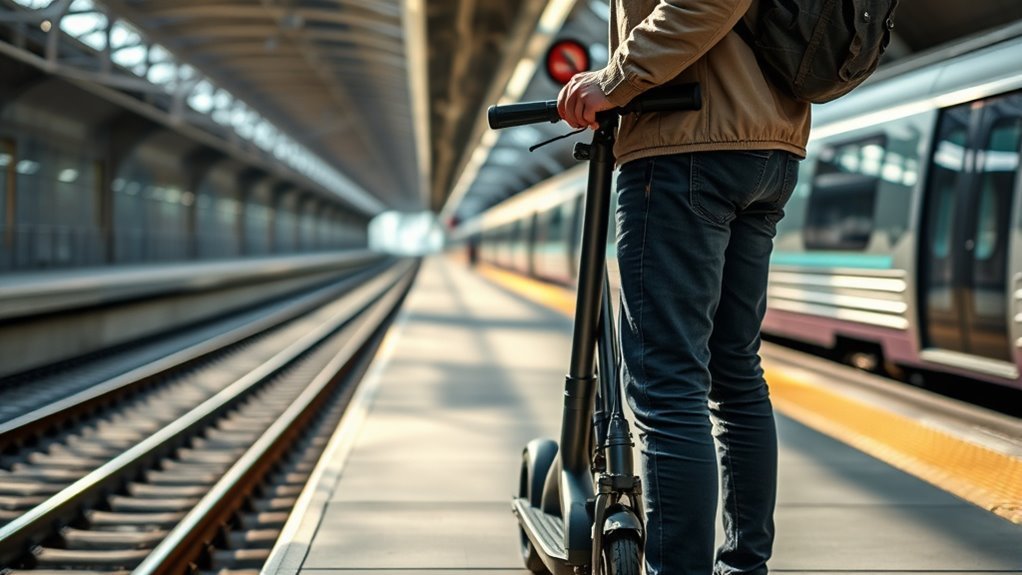
Yes, provided your train operator accepts recreational electric scooters and your model meets its requirements. There is no single rule covering every railway, and a folding scooter that is accepted on one service may be prohibited on another.
For example, Amtrak permits electric scooters that meet its published transport requirements. Caltrain accepts both folding and non-folding electric scooters, while Washington Metro also allows qualifying electric scooters.
However, a scooter’s ability to fold does not automatically make it acceptable luggage. Some operators restrict electric scooters because of battery-fire risks or other safety concerns.
Before traveling, identify the company operating each train on your journey. A connecting service may have different rules, even if both trains depart from the same station.
Also, distinguish between a recreational electric scooter and a powered mobility scooter used by someone with a disability. These devices often fall under different transport policies.
What Rules Apply to E-Scooters on Trains?
Train operators generally assess whether a scooter can be transported safely without restricting passenger movement. Requirements may cover its size, weight, battery certification, folding mechanism, and designated storage area.
Some operators also impose restrictions during crowded periods or require passengers to handle their own equipment.
Size And Weight Limits
There is no universal 50-pound weight limit for electric scooters on trains. However, Amtrak uses that limit for qualifying recreational electric scooters, while other systems publish different requirements.
Here are examples from official operator policies:
| Check | Published requirement | Why it matters |
|---|---|---|
| Amtrak weight | Up to 50 lb | Determines scooter eligibility |
| Amtrak tire width | Generally 2 inches maximum, with specified route exceptions | Affects acceptance |
| Washington Metro dimensions | Smaller than 80 x 48 x 22 inches | Determines whether the scooter fits the system’s limits |
| Caltrain folding | Folding and non-folding scooters accepted | Determines storage location |
| Peak service | Operator-dependent restrictions | Crowding may affect boarding |
These are examples, not interchangeable standards. A scooter that satisfies Washington Metro’s dimensions may still fail Amtrak’s weight or tire-width requirements.
Battery And Storage Rules
Electric scooters usually contain lithium-ion batteries. Operators may restrict these devices, require safety certification, or prohibit charging during transportation.
For example, Amtrak requires qualifying electric vehicles and their batteries to have certification from a nationally recognized testing laboratory. Its policy also requires the vehicles to remain powered off.
Storage rules are equally important. A folded scooter may fit beneath your seat, between your legs, or in a designated luggage space. Larger scooters may need a bike car or checked-baggage service.
Never assume that a standard baggage allowance automatically permits an electric scooter. A railway may classify it separately from ordinary luggage.
Size, Weight, and Folding Limits
Measure and weigh your scooter before making travel arrangements. Use its actual folded dimensions rather than the manufacturer’s general product dimensions.
Include permanently attached accessories when checking whether your scooter fits the railway’s requirements.
Folded Size Limits
A folding scooter must fit the space assigned by the operator without blocking aisles, doors, stairs, or emergency equipment.
Measure the scooter in its fully folded position, including the handlebars, wheels, and any parts that extend beyond the frame.
Amtrak publishes dimensions of 34 x 15 x 48 inches for folding bicycles. However, that bicycle allowance should not be treated as a universal electric-scooter size limit.
For scooter-specific requirements, use the operator’s actual policy. If the stated limits are unclear, provide the company with your model’s folded dimensions.
Make sure the folding latch locks securely. A scooter that unfolds unexpectedly can create a hazard while you carry or store it.
Weight Restrictions
Your scooter’s weight affects both its eligibility and your ability to handle it safely.
Amtrak accepts qualifying electric scooters weighing up to 50 pounds. Other rail systems may use different limits or focus primarily on whether you can move and store the device safely.
Check the scooter’s actual weight, including the battery and attached accessories.
If you cannot lift or maneuver it safely, do not assume train staff will handle it for you. Caltrain, for example, requires scooter passengers to load and unload their own devices.
Use elevators where available rather than trying to carry a heavy scooter onto an escalator.
Non-Folding Exceptions
Non-folding electric scooters are accepted by some railways, but they often require a different storage arrangement.
Caltrain explicitly permits electric and manually operated non-folding scooters. Riders must place them in the bike car, parallel to the bike racks, and secure them with a bungee cord.
Caltrain also requires a visible destination tag on non-folding scooters so other passengers can organize the storage area around their stops.
Amtrak generally handles non-folding recreational scooters differently. They are not accepted as ordinary carry-on baggage and are accepted only where the relevant checked-baggage service is available, subject to its published exceptions.
Therefore, a non-folding scooter is not automatically prohibited everywhere. Its acceptance depends on the train’s equipment and the operator’s specific policy.
Battery Safety and Charging Rules
Battery safety is one of the most important considerations when transporting an electric scooter. Lithium-ion batteries can present a fire hazard when damaged, improperly modified, or used with incompatible equipment.
There is no universal railway rule allowing every scooter with a battery below 300 watt-hours (Wh). Battery-capacity limits, where applicable, must come from the individual carrier’s policy.
Before leaving home, inspect the scooter and battery for visible damage.
Warning: Do not transport or use a scooter with a swollen, leaking, unusually hot, smoking, or visibly damaged battery. If you notice smoke, heat, or unusual battery behavior during the journey, alert train staff immediately. Do not attempt to open or repair the battery onboard.
The US Consumer Product Safety Commission’s micromobility guidance recommends using properly certified products, manufacturer-approved batteries, and compatible chargers.
Amtrak’s electric bike and scooter policy specifically requires:
- The scooter and battery to meet its certification requirements.
- The vehicle to remain powered off during transportation.
- No charging onboard or on Amtrak property.
- No riding or operating the scooter in stations, on platforms, or onboard trains.
- The scooter to remain in an approved location without blocking passenger access.
Keep your scooter’s model information and relevant certification details available in case staff need to inspect it.
Do not remove or disconnect the battery merely to get around an operator’s restrictions. Follow the carrier’s battery-handling requirements and the manufacturer’s instructions.
Note: If your battery has been damaged or modified, seek guidance from the manufacturer or a qualified battery-service professional before transporting or using it again.
Where to Store Your Scooter Onboard
Store your electric scooter in the location assigned by the railway. The correct space depends on its size, whether it folds, and the train’s layout.
On some trains, a compact folded scooter can remain beside you. Other services require it to stay in a luggage rack or designated bike area.
Follow these practical steps:
- Fold the scooter before boarding if the operator requires it.
- Switch off the power and secure the folding mechanism.
- Use the designated storage area rather than placing the scooter wherever space appears available.
- Keep aisles and exits clear throughout the journey.
- Secure the scooter where required so it cannot roll or fall when the train moves.
- Keep the scooter under your control and follow instructions from train staff.
Never place a scooter on a passenger seat or in an accessible space reserved for someone who needs it.
If it is wet or dirty, wipe it down before boarding. Some operators require dirty scooters to be enclosed in a bag to protect the train and other passengers.
During crowded journeys, storage space may become unavailable even when the scooter itself meets the published requirements.
Traveling outside busy commuting periods can make loading and storage easier, but it does not override a restriction that applies throughout the day.
How Policies Vary by Carrier and Route
Electric-scooter policies differ substantially between railway systems. Some accept recreational scooters as luggage, while others treat them as restricted battery-powered vehicles.
The following examples show why checking the actual carrier matters.
Amtrak
Amtrak accepts qualifying recreational electric scooters weighing up to 50 pounds, subject to its published tire-width, certification, and storage requirements.
Folding scooters must be folded before boarding. Non-folding models are generally limited to services that accept them as checked baggage, with specific California-route arrangements.
Additional fees may apply depending on the transport service. Confirm any reservation or checked-baggage requirement for your journey before departure.
Caltrain
According to the official Caltrain scooter rules, passengers may bring folding and non-folding electric scooters without an additional scooter charge.
Small folding models may fit beneath a seat. Non-folding scooters belong in the designated bike car and must be secured appropriately.
Passengers must handle their own scooters, and conductors may restrict transportation when crowding or safety conditions require it.
Washington Metro
Washington Metro permits electric scooters smaller than 80 inches long, 48 inches high, and 22 inches wide.
There is no additional charge for bringing a qualifying scooter on Metrorail.
Passengers must not ride scooters inside stations, on platforms, or onboard trains. Metro may also restrict bicycle access during special events or periods of heavy passenger traffic.
UK National Rail Services
UK railway rules are not identical across all operators. Some train companies prohibit recreational e-scooters, while others may permit qualifying folded devices under their luggage policies.
National Rail’s luggage guidance directs passengers to the operating company’s policy for electric scooters.
Where a scooter is permitted, it must meet the applicable luggage and storage requirements.
Transport for London
Transport for London prohibits recreational e-scooters on its services, including folded models.
This restriction applies to services such as the Underground, London Overground, Elizabeth line, and DLR.
Folding the scooter or carrying it instead of riding it does not create an exception.
Eurostar
Eurostar does not accept recreational electric scooters on its trains.
Its official bicycle and scooter guidance also prohibits hoverboards and electric unicycles.
Eurostar has separate arrangements for certain bicycles and mobility aids, so do not assume those permissions also apply to recreational e-scooters.
Are Mobility Scooters Treated Differently?
Yes. A powered mobility scooter used by a passenger with a disability is not necessarily governed by recreational e-scooter luggage rules.
For example, Amtrak’s wheeled mobility-device policy accommodates qualifying powered mobility devices and provides boarding assistance for eligible passengers.
Its published standard specifications include devices no more than 27.5 inches wide and 48 inches long when occupied, with a minimum 2-inch ground clearance and a combined occupied weight of 600 pounds or less.
Some train equipment can accommodate larger devices.
If you use a powered mobility scooter because of a disability, contact the railway’s accessibility team rather than relying on general recreational-scooter luggage information.
How to Prepare Your Electric Scooter for Train Travel
Preparing the scooter before reaching the station reduces the chance of boarding problems. Focus on its transport eligibility, physical condition, and the space it will occupy.
- Identify every train operator: Include connecting trains rather than checking only the first service.
- Check your model’s specifications: Record its weight, folded dimensions, tire width, and battery details.
- Confirm the transport category: Determine whether the scooter qualifies as carry-on luggage, a bike-car item, or checked baggage.
- Check the battery: Inspect its condition and confirm any certification required by the operator.
- Review boarding arrangements: Find out whether your station and train provide suitable loading and storage facilities.
- Prepare the scooter: Clean it, fold it where required, and secure loose accessories.
- Arrive with enough time: Locate the correct carriage and complete any required baggage arrangements before departure.
If your scooter does not meet the published requirements, arrange an alternative way to transport it rather than assuming staff will grant an exception at the platform.
Frequently Asked Questions
Can You Carry an Electric Scooter on a Train?
Yes, you can carry an electric scooter on trains whose operators permit it. The scooter may need to be folded, powered off, and stored in an approved area. Some railways prohibit recreational electric scooters entirely, so meeting ordinary luggage dimensions does not guarantee acceptance.
Can I Take an Electric Scooter on Amtrak?
Yes, Amtrak accepts qualifying electric scooters weighing up to 50 pounds, subject to its tire-width, certification, and storage requirements. Folding scooters must be compacted before boarding. Non-folding models are accepted only under the applicable checked-baggage or designated California-route arrangements.
Can You Travel With an Electric Scooter?
Yes, but transport rules depend on the carrier and travel method. Train operators may impose folding, battery, weight, and storage restrictions. A scooter accepted on a local commuter train may not be accepted on an international rail service, so assess each part of your journey separately.
Can I Bring an E-Scooter on a Train?
You can bring an e-scooter on a train only when the operator allows that type of device. Folding, switching it off, or placing it in a bag does not override a ban. Confirm the carrier’s specific policy before arriving at the station.
Can You Charge an Electric Scooter on a Train?
Do not charge an electric scooter on a train unless the operator expressly permits it. Amtrak prohibits charging recreational electric scooters onboard and on its property. Charge your scooter safely before departure using the manufacturer-approved equipment.
Are Electric Scooters Allowed on UK Trains?
Some UK train companies may accept qualifying electric scooters, but many restrict them. Transport for London and Eurostar prohibit recreational e-scooters, including folded models. Other National Rail services have operator-specific policies, so check the company operating your train.
Conclusion
You can take an electric scooter on many trains, but permission is never universal. Amtrak, Caltrain, and Washington Metro have published scooter allowances, while TfL and Eurostar prohibit recreational e-scooters.
Before traveling, confirm your operator’s requirements, measure your scooter, inspect its battery, and arrange suitable storage. These simple checks can help you avoid being refused boarding and make your journey safer for everyone.
Sources
- Amtrak — Special Items in Baggage: Electric scooter eligibility, weight, tire width, certification, charging, and storage rules.
- Caltrain — Scooter Rules: Folding and non-folding scooters, storage requirements, passenger responsibilities, and charges.
- Washington Metropolitan Area Transit Authority — Bikes on Metro Rail: Electric scooter dimensions, passenger restrictions, and transportation rules.
- National Rail — Train Travel with Luggage: UK luggage requirements and operator-specific e-scooter restrictions.
- Transport for London — Cycles on Public Transport: E-scooter restrictions and distinctions involving mobility devices.
- Eurostar — Travelling with Your Bike: Electric scooter and other personal electric vehicle restrictions.
- US Consumer Product Safety Commission — Micromobility Safety: Battery certification, charger compatibility, and safe handling.
- Amtrak — Wheeled Mobility Device Services: Accessibility provisions and specifications for powered mobility devices.