
Last Updated on July 23, 2026 by Caleb Warren
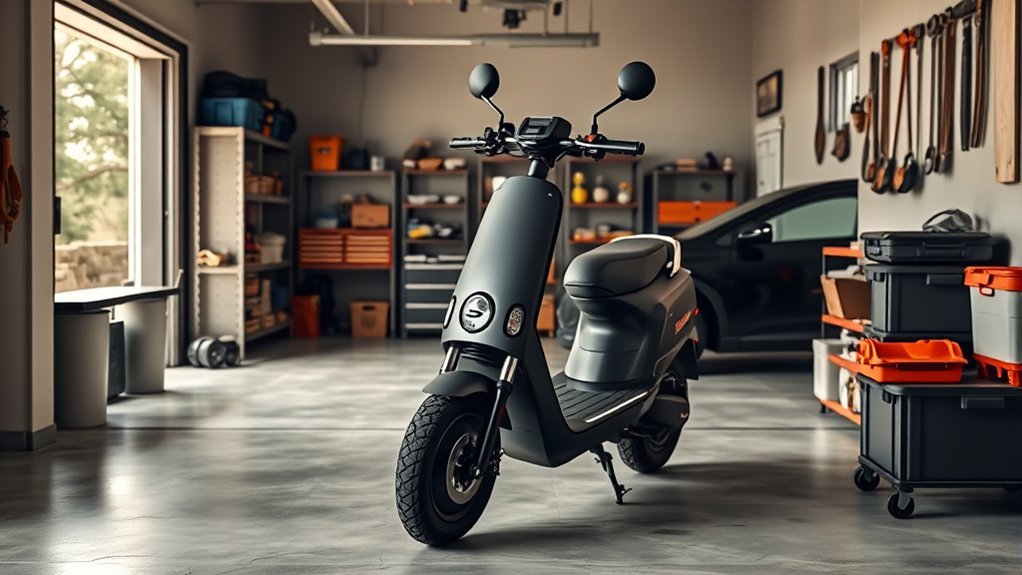
Yes, you can store an electric scooter in a garage, provided the space is dry, secure, reasonably cool, and within the storage limits listed in your scooter’s manual. Good preparation protects the battery, tires, brakes, electronics, and frame. The most important precautions are keeping the scooter away from moisture and extreme heat, inspecting the battery for damage, and following strict charging-safety rules.
Quick Answer
A garage is usually a suitable place for an electric scooter if it stays dry, secure, and within the manufacturer’s approved temperature range. Clean and dry the scooter, check the battery and tires, store it at the manual’s recommended charge level, and never charge it unattended, near flammable materials, or while it is extremely cold.
Key Takeaways
- Use your scooter’s manual for the correct storage charge, temperature range, and battery-check schedule.
- Store the scooter in a dry, stable area away from direct sunlight, heaters, fuels, paint, solvents, and flood-prone floors.
- Use only the supplied or manufacturer-approved charger, remain present while charging, and unplug it when charging is complete.
- Do not charge a battery that is wet, swollen, cracked, unusually hot, leaking, hissing, smoking, or giving off an unusual odor.
- Before riding after long storage, check the battery, tires, brakes, lights, folding mechanism, fasteners, and controls.
At a Glance
| Time Required | About 15–30 minutes for cleaning, inspection, tire checks, and secure placement |
| Difficulty | Easy |
| Tools Needed | Soft cloth, mild cleaner approved by the manufacturer, tire gauge and pump for pneumatic tires, approved charger, breathable cover, and a strong lock |
| Cost | Usually no added cost with existing supplies; more if you need a lock, stand, cover, tire pump, or moisture monitor |
Disclosure: As an Amazon Associate I earn from qualifying purchases. Some links on this page are affiliate links, at no extra cost to you.
Why Store Your Electric Scooter in a Garage
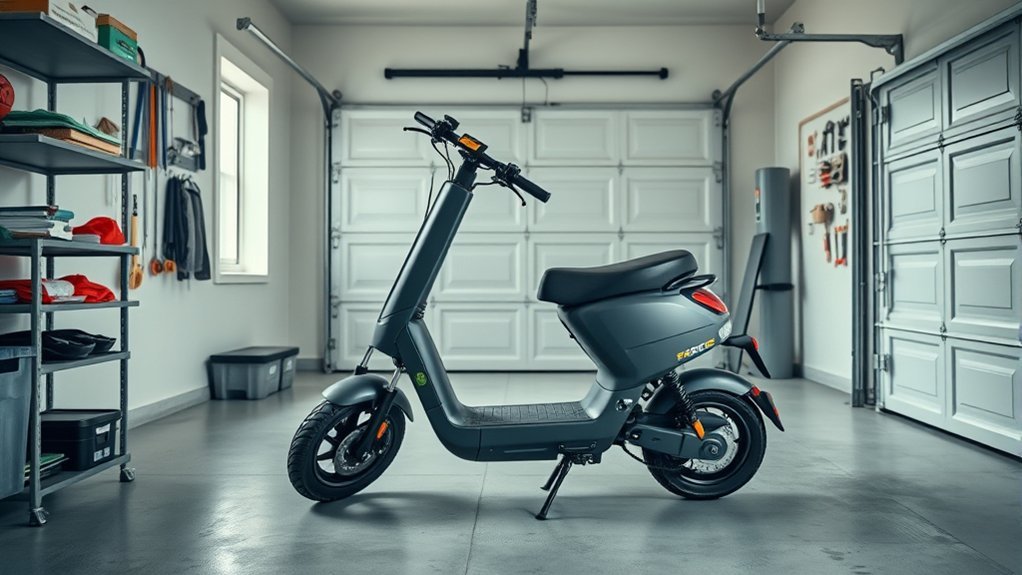
Storing an electric scooter in a garage can protect it from rain, snow, direct sunlight, road dirt, accidental damage, and theft. Indoor storage also makes routine battery, brake, tire, and fastener checks easier.
However, a garage is only suitable when its conditions match the scooter manufacturer’s instructions. A damp, flood-prone, extremely hot, or extremely cold garage may be worse for the scooter than a dry indoor storage area.
Use This Garage-Suitability Checklist
- Dry: The roof, walls, and floor should not leak or collect standing water.
- Within the approved temperature range: Check both the storage-temperature and charging-temperature limits in the manual.
- Away from direct heat: Do not place the scooter beside a furnace, boiler, space heater, radiator, or sun-heated garage door.
- Away from flammable materials: Keep it separated from gasoline, propane, paint, solvents, oily rags, paper, cardboard, and other easy-to-ignite materials.
- Clear of exits: The scooter and charging cable must not block a doorway, escape route, or path to the garage door.
- Stable: Park it upright on its stand or an approved storage rack where it cannot fall onto a vehicle, child, pet, or sharp object.
- Secure: Lock the scooter to a fixed anchor and keep the garage door, windows, and side entrance secured.
Note: Storage and charging limits are not always the same. A scooter may tolerate a wider temperature range while switched off than it does while charging. The model’s manual takes priority over general advice.
How to Prep Your Scooter for Storage
Prepare the scooter before leaving it unused, especially after riding in rain, mud, road salt, or dusty conditions. This reduces corrosion, protects electrical connections, and makes problems easier to find before the next ride.
1. Read the Manual and Check for Safety Notices
Find the storage, charging, cleaning, tire-pressure, and battery-maintenance instructions for your exact model. In the United States, you can also review the CPSC Micromobility Information Center for current safety alerts and recalls.
2. Clean the Scooter Carefully
Switch the scooter off and disconnect the charger. Wipe the frame, deck, wheels, fenders, controls, and exposed fasteners with a soft cloth. Remove road salt and grime promptly because they can encourage corrosion.
Do not submerge the scooter or spray it with a pressure washer unless the manufacturer specifically permits that cleaning method. Water-resistant ratings do not mean the scooter is waterproof.
3. Dry Every Surface
Let the scooter dry fully before covering or storing it. Pay attention to the charging port, deck seams, folding joint, brake components, wheel hubs, and display. Close the charging-port cover after confirming that the port is dry.
4. Inspect the Battery and Electrical System
Look for cracks, swelling, leakage, impact damage, melted areas, discoloration, unusual heat, loose wiring, or an unusual chemical odor. Test the display, throttle, brake light, headlight, and other electrical features before long storage.
Warning: Do not charge or continue using a battery that is swollen, cracked, leaking, unusually hot, hissing, smoking, discolored, water-damaged, or giving off a strong unusual odor. Keep people away and contact the manufacturer or local hazardous-waste authority. If there is smoke, fire, rapid heating, or an immediate danger, evacuate and call your local emergency number.
5. Check the Tires
For pneumatic tires, inflate them to the pressure specified in the scooter manual or on the tire. Do not guess or use a pressure listed for another model. Inspect the tread, valve stems, sidewalls, and self-sealing layer if fitted.
Solid and honeycomb tires do not need inflation, but they should still be checked for deep cuts, separation, missing chunks, or deformation.
6. Check the Brakes, Folding Joint, and Fasteners
Confirm that the brakes engage smoothly, cables are not frayed, the folding latch closes securely, and visible bolts are not loose. Do not apply lubricant to brake rotors, brake pads, tire tread, or electrical connectors.
7. Set the Correct Storage Charge
Use the battery percentage stated in your model’s manual. Current manufacturer guidance varies. For example, Apollo recommends approximately 50–70% for extended storage, while Xiaomi recommends approximately 80% for some current models.
If the manual is unavailable, avoid storing the scooter completely empty or leaving it plugged in indefinitely. A moderate partial charge is generally safer than a deeply discharged battery, but the exact target and recharge schedule remain model-specific.
The best storage percentage is the one specified for your exact scooter, not a universal number copied from another brand.
8. Park, Lock, and Cover It
Turn the scooter off, engage any electronic lock or alarm, and secure the frame to a fixed anchor with a strong physical lock. Use a breathable dust cover rather than wrapping the scooter tightly in plastic, which can trap moisture against the frame and electrical parts.
How to Charge an Electric Scooter Safely in a Garage
Charging requires more care than passive storage. The U.S. Consumer Product Safety Commission advises owners to follow manufacturer instructions, use only an approved charger, remain present while charging, and unplug the device when charging is complete.
- Use the charger supplied with the scooter or one specifically approved by the manufacturer for that model.
- Do not use a “universal” charger merely because its plug fits. Voltage, current, connector wiring, and battery-management requirements may differ.
- Charge while you are awake, at home, and able to check the scooter.
- Do not charge overnight or while everyone is sleeping.
- Place the scooter on a stable, dry surface away from gasoline, propane, paint, solvents, cardboard, fabrics, vehicles, and other combustible items.
- Keep the scooter and charging cable away from doors and escape routes.
- Plug the charger directly into a suitable wall outlet unless the manufacturer says otherwise. Avoid extension cords, power strips, and multiplug adapters.
- Do not cover the charger or battery while charging.
- Allow the battery to cool after a ride before charging if the manual requires a waiting period.
- If the scooter has been in a very cold garage, let it return naturally to the manual’s approved charging-temperature range before connecting the charger.
- Stop charging if the battery or charger becomes unusually hot, begins swelling, makes abnormal sounds, produces smoke, or gives off an unusual odor.
- Disconnect the charger when charging is complete according to the manufacturer’s instructions.
Pro Tip: Store the charger beside the scooter in a dry, labeled container, but do not leave it connected. Keeping the original charger separate from look-alike chargers reduces the chance of using an incompatible unit.
How Garage Temperature and Moisture Affect Battery Health
Lithium-ion batteries generally store best in a cool, dry, room-like environment, but the approved limits depend on the scooter. Some Apollo models specify 50°F–77°F for storage, while some Segway models recommend approximately 50°F–86°F and list a wider absolute storage range.
Heat can accelerate battery aging, while severe cold can reduce temporary performance. The greater cold-weather concern is charging. Research on lithium-ion cells shows that low-temperature charging can increase the risk of lithium plating, especially when charging conditions exceed what the cell can safely accept. Do not assume that a cold battery is ready to charge merely because the scooter turns on.
| Garage condition | Likely effect and response |
|---|---|
| Cool, dry, and within the manual’s storage range | Generally suitable for short- and long-term storage |
| Below the manual’s charging-temperature minimum | Do not charge until the battery warms naturally into the approved range |
| Very hot or exposed to direct sunlight | Can accelerate battery aging and may exceed safe storage limits |
| High humidity or repeated condensation | Can encourage corrosion on fasteners, contacts, brakes, and other metal parts |
| Wet or flood-prone floor | Move the scooter to a raised, dry location and do not charge a water-damaged battery |
A hygrometer can be useful in a garage that regularly feels damp, but you do not need one for every storage space. More important steps include repairing leaks, improving ventilation, keeping the scooter off wet concrete, removing road salt, and preventing rapid temperature swings that create condensation.
Should You Remove the Battery?
Remove the battery only if the scooter was designed with a user-removable pack and the manual explains how to remove and store it. Do not open the deck, dismantle a sealed battery enclosure, disconnect internal wiring, or attempt to separate battery cells yourself.
If removal is approved, store the battery in the manufacturer’s recommended position and environment. Protect its terminals from metal objects and keep it away from children, pets, heat, direct sunlight, and combustible materials.
How to Keep Your Scooter Safe in the Garage
A closed garage reduces casual exposure, but it does not guarantee theft protection. Scooters are compact and easy to carry, so secure the frame even when the garage door is locked.
- Lock the scooter frame to a wall anchor, floor anchor, or other fixed structural point.
- Use a lock that resists cutting and prying.
- Do not rely only on an app lock or electronic immobilizer.
- Keep the garage door opener secure and close the door fully after entering or leaving.
- Repair weak side doors, windows, latches, and garage-door emergency releases.
- Use motion-activated lighting or a camera where appropriate.
- Keep the scooter out of direct view from street-facing windows.
- Record the serial number and retain the receipt and clear photographs.
- Keep keys, chargers, and removable displays inside the home when practical.
- Prevent children and pets from playing around the scooter, charger, or battery.
Leave enough space around the scooter to inspect it without moving heavy items. Do not stack boxes, tools, or vehicle parts against the battery compartment or charging port.
How to Winterize an Electric Scooter for Long Storage
Winter storage requires more than parking the scooter and forgetting it. Cold garages, road salt, deep battery discharge, tire pressure loss, and condensation can all create problems over several months.
- Review the model’s winter-storage instructions. Confirm the recommended battery percentage, storage-temperature limits, charging-temperature limits, and inspection schedule.
- Clean away mud and road salt. Wipe the deck, wheels, fenders, frame, fasteners, and brake components, then dry everything fully.
- Inspect the battery. Do not store or charge a battery showing swelling, impact damage, leakage, unusual heat, odor, or water intrusion.
- Set the manual’s storage charge. Do not automatically use 50%, 60%, 70%, 80%, or 100% unless your model’s instructions support it.
- Check pneumatic tires. Inflate them to the specified pressure and inspect them periodically. Use a stable stand if the manufacturer permits it and you want to reduce prolonged loading on one part of the tire.
- Store in a stable location. Avoid exterior sheds or unheated areas when their temperatures fall outside the permitted range.
- Keep it dry and uncovered until fully cooled and dry. Then use a breathable dust cover.
- Inspect it on schedule. Check the charge level, tire condition, corrosion, moisture, pests, and battery condition at the interval stated in the manual.
How Often Should You Check the Battery?
There is no single interval for every scooter. Current manufacturer guidance commonly ranges from monthly checks to charging every one or two months. Follow your manual and set a calendar reminder so the battery does not quietly fall into deep discharge.
If the charge has fallen below the recommended storage range, recharge it using the approved charger while you are present. Do not leave the scooter permanently connected to the charger unless the manufacturer specifically designed and approved that method.
What to Check Before Riding After Storage
Do not immediately ride at full speed after weeks or months of storage. Complete a careful inspection first.
- Look for battery swelling, cracks, leakage, corrosion, unusual odor, or heat.
- Confirm that the charging port is clean, dry, and undamaged.
- Charge the scooter according to the manual while remaining present.
- Check pneumatic tire pressure and inspect every tire for cracks, cuts, flat spots, or deformation.
- Test the front and rear brakes at walking speed.
- Confirm that the folding latch and stem are secure.
- Check the throttle, display, headlight, brake light, indicators, horn, and app connection where fitted.
- Inspect visible cables, connectors, fasteners, suspension parts, and the kickstand.
- Listen for scraping, clicking, grinding, or rubbing sounds.
- Take a slow test ride in a clear, dry area before returning to normal traffic.
If the scooter will not turn on or charge, do not repeatedly connect different chargers, bypass the battery-management system, or open the battery pack. Check the manual’s troubleshooting steps and contact an authorized service provider.
Frequently Asked Questions
Can I leave my electric scooter in the garage?
Yes, provided the garage is dry, secure, away from flammable materials, and within the storage-temperature limits in your scooter’s manual. Do not leave the battery deeply discharged, and do not charge the scooter unattended or while you are sleeping.
Are scooters good for autistic kids?
A scooter is not automatically suitable or therapeutic because a child is autistic. Needs vary by age, balance, coordination, judgment, sensory profile, and scooter type. The American Academy of Pediatrics recommends that children under 16 not operate or ride motorized e-scooters. For non-motorized scooter activities used as part of a movement or therapy plan, ask the child’s pediatrician, occupational therapist, or physical therapist and use close supervision and suitable protective equipment.
What happens if an electric scooter is not used for a long time?
The battery can self-discharge, pneumatic tires can lose pressure, exposed metal can corrode, and unnoticed damage or pests may create problems. Prepare the scooter properly, keep it within the approved temperature range, and inspect the battery and tires at the schedule listed in the manual.
Where should you store your e-scooter?
Choose a cool, dry, secure, and well-ventilated location that stays within the manufacturer’s permitted storage range. Keep the scooter away from direct sunlight, heaters, fuels, paint, solvents, wet floors, exits, and places where children or pets can knock it over.
Can I charge an electric scooter in the garage?
Yes, if the garage and battery are within the approved charging-temperature range and the area is dry and clear of combustible materials. Use only the approved charger, plug it into a suitable wall outlet, stay present, keep exits clear, and unplug it when charging is complete.
Can I store an electric scooter in an unheated garage?
Only when the garage remains within your model’s approved storage range. If the battery becomes colder than its permitted charging range, let it warm naturally in a safe, dry location before charging. Do not place it beside a heater or use direct heat to warm it quickly.
Should I remove the battery before garage storage?
Remove it only if the manufacturer designed the battery to be user-removable and provides instructions. Do not open a sealed deck or battery pack. An approved removable battery may be stored in a more temperature-stable area, provided its terminals and casing are protected.
What should I do with an old or damaged scooter battery?
Do not place a lithium-ion battery or a scooter containing one in household trash or curbside recycling. Contact the manufacturer, a certified electronics or battery recycler, or your local household hazardous-waste program. Damaged, defective, or recalled batteries may require special handling.
Conclusion
Storing an electric scooter in a garage can protect it from weather, dirt, accidental damage, and theft, but the garage must be suitable for the scooter and its lithium-ion battery. Keep the area dry, secure, clear of flammable materials, and within the model’s approved temperature range.
Before long storage, clean and dry the scooter, inspect the battery, check the tires and brakes, and set the battery to the charge level specified in the manual. During storage, check it on the manufacturer’s schedule. When charging, use only the approved charger, remain present, keep exits clear, and stop immediately if you notice heat, swelling, smoke, leakage, unusual sounds, or odor.
Sources
- U.S. Consumer Product Safety Commission: Micromobility Information Center — charging, approved batteries and chargers, inspections, recalls, and fire prevention
- U.S. Fire Administration: Lithium-Ion Battery Safety — cool and dry storage, exit access, damaged batteries, and emergency response
- U.S. Environmental Protection Agency: Used Lithium-Ion Batteries — recycling, damaged-battery handling, and disposal precautions
- Apollo Scooters: Charging Best Practices — model-specific partial-charge and long-storage guidance
- Xiaomi Electric Scooter 5 Max FAQ — model-specific storage charge, temperature, and recharge guidance
- American Academy of Pediatrics: Why Children Should Not Ride E-Scooters — pediatric age and riding-safety guidance
