

Last Updated on July 27, 2026 by Mason Reed
Navigating open mountain ridges, rocky desert plateaus, or dense alpine fog requires paying close attention to small details on the landscape. When dirt paths disappear across bare bedrock, small piles of stacked stones known as rock cairns become your primary visual guide through hazardous terrain.
Quick Answer
A cairn is an officially constructed pile of rocks used to mark a wilderness hiking trail where traditional paths, signs, or trees are absent. Cairns guide hikers across bedrock, alpine zones, and scree fields. Read them in a connected series to confirm direction, never build your own, and leave existing cairns untouched.
Key Takeaways
- Official cairns mark safe routes across exposed bedrock, scree fields, and alpine terrain above the treeline.
- Always sight cairns as a connected visual sequence rather than evaluating a single isolated stack.
- Never build, move, alter, or disassemble cairns — unauthorized rock stacking causes trail confusion and damages delicate ecosystems.
- Official markers are engineered by park rangers to specific standards; decorative stone stacks built by visitors are unauthorized false markers.
- Always carry offline GPS maps, a paper topographic map, and a compass, as weather or snow can obscure physical markers.
At a Glance
| Primary Purpose | Route navigation across exposed bedrock, alpine tundra, and desert washes |
| Primary Rule | Leave No Trace — Never build new stacks, add rocks, or knock down existing markers |
| Key Identification | Engineered, broad-based stone structures placed at logical trail transitions |
| Essential Backup | Offline topographic GPS map app, magnetic compass, and physical map |
Disclosure: As an Amazon Associate I earn from qualifying purchases. Some links on this page are affiliate links, at no extra cost to you.
What Cairns Mean on Trail

Cairns are more than just tidy piles of stones—they’re trail markers that guide you through rocky, confusing, or pathless terrain where traditional signs or painted blazes are missing. When you spot one, you’re seeing an intentional human-made signal pointing toward the safest route, especially above the treeline or in high alpine country where soil tracks easily fade. Cairn history stretches back centuries, carrying the legacy of ancient mountain travelers, shepherds, and trail builders who navigated unforgiving landscapes.
While travelers historically added stones to trail markers, modern wilderness ethics have evolved. Under Leave No Trace principles, hikers must never add or remove rocks from cairns. Proper cairn construction by land managers relies on choosing stable, interlocking rocks designed to withstand harsh mountain weather. Respecting official maintenance keeps the path readable and protects surrounding environments from erosion and micro-habitat disruption.
Note: One historic design, the Bates cairn, was developed at Acadia National Park in 1896 by trail-mapper Waldron Bates. Built with two base stones, a horizontal mantelpiece, and a prominent top pointer stone, Acadia continues to maintain this unique design on its east-side trails.
Why Cairns Matter for Hikers
When a dirt trail fades into exposed bedrock, snowfields, or a maze of boulder fields, cairns can be the difference between moving forward with confidence and wandering into dangerous terrain. Hikers rely on them as quiet waypoints in high alpine country where wooden posts or painted blazes cannot be easily installed. At splits and confusing junctions, cairns help you stay oriented, easing the fear of wrong turns and steering foot traffic away from hazardous cliffs or steep drop-offs.
However, navigation guidance must be balanced with conservation. The ecological impact of moving rocks is significant. Unearthing stones exposes fragile soils to rapid rain and wind erosion while destroying micro-habitats for insects, amphibians, and rare alpine flora like lichen and moss. Land management agencies, including the National Park Service, strictly advise hikers to leave cairns undisturbed to preserve trail clarity and protect the surrounding landscape.
How to Read Cairns Correctly
You can spot official cairns by looking for stacked, engineered stones that stand out deliberately from the natural surrounding rock. Read their direction by sighting the next cairn in the sequence before moving forward, using nearby map features or compass bearings to confirm your position. Never trust random, decorative stone stacks.
Spotting Official Cairns
Official cairns stand out because land managers build them with structural purpose. You’ll notice intentional cairn construction: stacked stones that look balanced, compact, and deliberate, rather than loose, artistic towers. Key identifying features include a broad, stable base and a location where the trail naturally weakens, splits, or disappears across solid rock. In dense fog or heavy weather, these official markers act as essential visual anchors. Trust markers that show clear trail engineering, and leave them untouched so they remain accurate for every hiker who follows.
Reading Trail Direction
To navigate effectively, follow cairns as a continuous line rather than evaluating them in isolation. A sequence of cairns provides a trustworthy visual corridor across featureless terrain. Watch how each stone stack leads visually into the next, especially near sharp trail turns, ridge lines, or dry creek crossings.
Pro Tip: Always download an offline topographic trail map or GPS track before starting your hike. Cairns can be knocked down by wildlife, buried in winter snowpack, or obscured by dense alpine fog.
What to Do If You Lose the Cairn Trail
If you reach a point where you cannot visually locate the next cairn, follow these step-by-step navigation actions:
- Stop Immediately: Do not continue walking forward blindly, hoping to stumble across the path.
- Perform a 360-Degree Scan: Stand still and carefully scan the horizon for the distinct silhouette of a stacked rock pile. Look for subtle shifts in terrain or distant trail blazes.
- Backtrack to the Last Known Marker: If you cannot see the next cairn, retrace your exact steps back to the last official cairn you successfully passed.
- Verify with Tools: Once back at the last confirmed marker, consult your topographic map, magnetic compass, or offline GPS navigation app to establish the true heading before moving again.
Avoiding False Markers
Not every stone stack on a trail is a legitimate navigational aid. Decorative rock stacking by visitors creates “false cairns” that endanger other hikers. To identify authentic markers:
- Look for broad, stable bases rather than precarious single-rock towers.
- Confirm that the marker lines up with marked trail junctions or known map paths.
- Cross-reference the location with physical terrain clues like worn rock tread or painted blazes.
- Never alter or build stone piles yourself.
If a rock pile looks overly artistic, unstable, or out of place in brush, treat it as a false marker, slow down, and verify your position using navigation tools.
Common Types of Cairns & Terminology
Understanding the physical construction of official cairns helps you separate legitimate navigational aids from unauthorized stone stacks:
- Conical Cairns: The most common traditional style, constructed in a pyramidal or conical shape with a broad base tapering to a single top stone. Designed to withstand high winds and heavy precipitation.
- Bates Cairns: Unique historical markers developed at Acadia National Park. Built with two base stones supporting a flat horizontal mantelpiece rock, crowned by a pointing stone that directs hikers toward the next waypoint.
- Trail “Ducks”: A colloquial term for smaller cairns consisting of a basic rock stack topped with a single, elongated “beak” stone pointing in the direction of the trail.
Where Cairns Are Most Useful
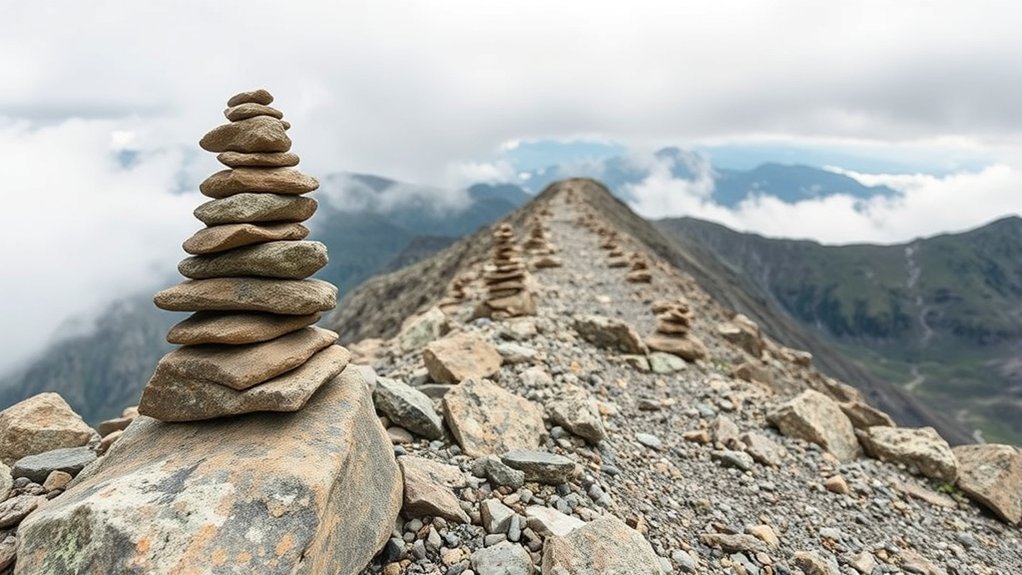
Cairns are most useful in exposed, pathless landscapes where traditional dirt tracks cannot form. You’ll find them on vast bedrock slabs, high alpine ridges above the treeline, scree fields, and desert washes. In these environments, trees are absent, making painted blazes or wooden posts impossible to install. When foggy weather, snow squalls, or whiteouts obscure distant landmarks, cairns provide a crucial visual thread to guide hikers safely from point to point.
When Cairns Count as Official Markers
Cairns are considered official trail markers only when authorized land management agency personnel or official trail stewards construct and maintain them.
- Bedrock and Alpine Ridges: Managed cairns guide hikers across exposed rock surfaces where dirt trails cannot wear into the ground.
- Complex Intersections: Official cairns clarify direction changes at confusing wilderness trail splits.
- Designated Wilderness Areas: Rangers place cairns sparingly to maintain a natural wilderness feel while preventing dangerous disorientation.
- Historic Routes: Centuries-old cairns are maintained as historic waypoints, preserving original trail mapping traditions.
Why You Shouldn’t Build Cairns
Building rock cairns as souvenirs or trail art causes serious harm to wild landscapes. The National Park Service strongly prohibits unauthorized rock stacking because moving stones disrupts fragile habitats. Disturbing rocks exposes delicate topsoil to wind and rain erosion, destroys shelter for small mammals and reptiles, and disrupts aquatic life when rocks are pulled from stream beds.
Unauthorized cairns also create severe navigation hazards. When visitors build random stone piles, other hikers can easily mistake them for official trail markers and wander off course into dangerous terrain. Furthermore, amateur stone stacks are structurally unsafe; research highlighted by Friends of Acadia noted that about one-third of cairns on a single trail were altered every five days due to unauthorized tampering. Leaving rocks exactly where they lie keeps ecosystems healthy and navigation clear for everyone.
“About one-third of the cairns on a single Acadia trail were altered every five days over a six-week study period — showing just how much unauthorized tampering wild trails absorb.”
Leave No Trace Rules for Cairns

Practicing Leave No Trace principles means respecting cairns purely as functional navigation tools, never as artistic canvasses or personal souvenirs.
- Leave Existing Cairns Undisturbed: Never add rocks, remove rocks, or kick over established stone stacks.
- Do Not Build New Stacks: Refrain from creating decorative rock piles, art installations, or personal markers.
- Protect Natural Habitats: Never gather rocks from riverbeds, moist soil, or delicate alpine tundra where plants grow.
- Rely on Navigation Tools: Carry an offline map or GPS so you do not rely solely on physical markers.
Warning: Regulations regarding rock cairns vary across public lands. While rangers in mountain parks like Yosemite encourage hikers to disassemble obvious decorative rock stacks on clear trails, desert parks like Arches and Canyonlands instruct visitors never to dismantle cairns, as hikers may accidentally destroy critical trail markers. Report questionable cairns directly to park rangers.
Frequently Asked Questions
Who originally started using cairns on hiking trails?
Cairns originated with ancient civilizations, nomadic herders, Indigenous peoples, and early mountain explorers who built stone stacks to mark burial sites, territorial borders, and travel routes across featureless landscapes.
Are cairns used in winter or snowy conditions?
Yes, cairns remain useful in winter, though heavy snowpack can submerge them completely. Hikers in winter conditions should always carry and rely on GPS tracks, topographic maps, and magnetic compasses.
How do cairns differ from trail blazes?
Cairns are three-dimensional, stacked stone structures used on rocky, open ground. Trail blazes are painted symbols or plastic markers attached directly to trees or rocks along forested paths.
Can weather damage or remove cairns?
Yes. Severe weather—including freeze-thaw cycles, rockslides, heavy snow accumulation, high winds, and torrential rainfall—can shift or collapse cairns, which is why land managers perform routine trail maintenance.
What should you do if a cairn looks unstable or knocked down?
Do not attempt to repair or rebuild an unstable cairn yourself. Leave it undisturbed and report its location and condition to park rangers or the local land management agency after your hike.
What if I’ve already built or added to a cairn in the past?
There is no need to return to dismantle past stone stacks unless directed by official park signage. Moving forward, commit to Leave No Trace principles by leaving all rocks and cairns undisturbed.
Conclusion
Cairns serve as crucial waypoints across exposed terrain, but they should never be your sole navigation method. When hiking, read the landscape alongside your map and navigation tools, as individual stone piles can be damaged, displaced, or obscured by severe weather. By reading cairns properly, respecting Leave No Trace guidelines, and leaving rocks untouched, you ensure wild trails remain safe, legible, and protected for every hiker who follows.
Sources
- National Park Service — Rock Cairns Guidelines — official land management rules on cairn navigation and conservation
- National Park Service — I Didn’t Know That: Rock Cairns — Leave No Trace principles regarding stone stacking
- Friends of Acadia — Why We Care About Cairns — historical research on Waldron Bates cairns and trail tampering study data
- Appalachian Mountain Club — Leave No Trace Guidelines — ecological impacts of rock removal and backcountry ethics
- Backpacker — National Park Service Cairn Policies — regional park guidelines and false cairn management policies
