
Last Updated on September 27, 2026 by Daniel Globe
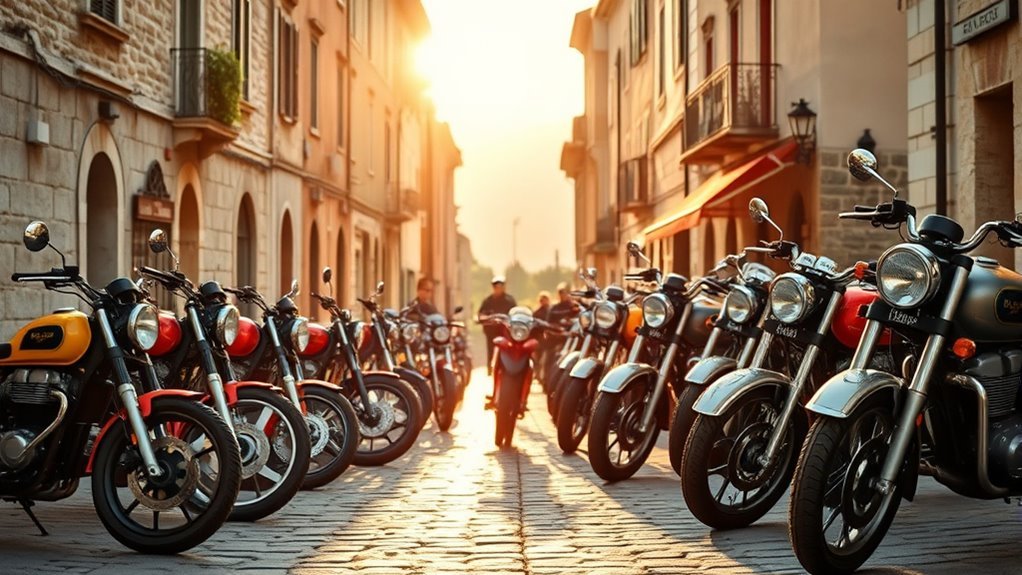
The best Italian motorcycle brands combine distinctive engineering, racing history, and design. Ducati, Aprilia, MV Agusta, and Moto Guzzi lead the conversation, while Bimota and Benelli offer different approaches to performance and everyday riding. Italy’s motorcycle heritage also includes iconic scooters and electric motorcycles, so you have options beyond traditional sportbikes.
Quick Answer
Ten notable Italian motorcycle brands are Ducati, MV Agusta, Aprilia, Moto Guzzi, Bimota, Benelli, F.B. Mondial, Energica, Piaggio, and Vespa. Ducati and Aprilia are known for high-performance sportbikes, while Moto Guzzi offers distinctive V-twins. Piaggio and Vespa specialize in scooters. Energica represents Italy’s electric motorcycle heritage, although its production and dealer availability require confirmation.
Last checked: September 28, 2026. Key specifications, historical dates, and manufacturer announcements were checked against official sources.
Key Takeaways
- A brand’s racing history does not automatically make every motorcycle suitable for beginners or daily commuting.
- Piaggio and Vespa belong to the same corporate family but operate as distinct scooter brands.
- Italian heritage does not guarantee Italian manufacturing; production locations vary by brand and model.
- Dealer access, maintenance requirements, riding position, and parts availability matter as much as engine performance.
- Historical horsepower figures should never be compared without checking model year, market, and measurement conditions.
Disclosure: As an Amazon Associate I earn from qualifying purchases. Some links on this page are affiliate links, at no extra cost to you.
Why Italian Motorcycle Brands Stand Out

Italian motorcycle manufacturers are known for combining mechanical character with recognizable styling. Their history includes Grand Prix racing, experimental chassis designs, touring motorcycles, and some of the world’s most familiar scooters.
Ducati and Aprilia show how racing development can influence road motorcycles. Moto Guzzi emphasizes its unusual engine layout and long manufacturing history, while MV Agusta treats motorcycle design as a central part of its identity.
However, these brands do not all serve the same rider. A Ducati superbike, a Moto Guzzi V7, and a Vespa scooter offer very different experiences.
Some Italian marques also operate under international ownership. That distinction matters when you’re comparing manufacturing origins, service networks, and parts availability.
Italian Motorcycle Brands Compared
This comparison covers ten notable Italian motorcycle and scooter marques. It is a practical overview rather than a sales ranking.
| Brand | Main Identity | Representative Models | Riding Focus |
|---|---|---|---|
| Ducati | Racing and performance | Panigale, Monster, Multistrada | Sport, street, and touring |
| MV Agusta | Exclusive design and racing heritage | F4, Brutale, Dragster | Sport and performance street riding |
| Aprilia | Track-focused engineering | RSV4, RS 660, Tuareg | Sport and adventure |
| Moto Guzzi | Transverse V-twins and heritage | V7, V85 TT, V100 Mandello | Road riding and touring |
| Bimota | Boutique chassis engineering | Tesi H2, KB4, KB998 Rimini | Specialist performance |
| Benelli | Historic marque with modern international production | TRK 502, TRK 702 | Adventure-style road riding |
| F.B. Mondial | Revived racing heritage | HPS, SMX, Piega | Lightweight road and sport riding |
| Energica | Electric performance | Ego, Eva Ribelle, Experia | Electric sport and touring |
| Piaggio | Practical urban mobility | Liberty, Beverly, MP3 | Commuting and urban travel |
| Vespa | Classic Italian scooter design | Primavera, Sprint, GTS | City and leisure riding |
Ducati: The Top Italian Superbikes
Ducati is one of Italy’s most recognizable motorcycle manufacturers, especially in racing and high-performance road bikes. Its Panigale superbikes, Monster naked motorcycles, and Multistrada touring models show how widely the brand’s engineering philosophy extends.
Ducati Racing Heritage
Ducati’s motorcycle history began with the Cucciolo bicycle engine after World War II. The Ducati 60 emerged in 1949 as a complete lightweight motorcycle, while racing activity with Cucciolo-powered machines had already begun.
The brand’s official Cucciolo history records an early racing victory by Mario Recchia in February 1947.
Racing later became central to Ducati’s identity. Ducati Corse represents the manufacturer in MotoGP and the Superbike World Championship, where competition has helped develop engine technology, electronics, aerodynamics, and chassis systems.
One signature feature is desmodromic valve control. Instead of relying only on conventional valve springs, the system uses mechanical components to open and close engine valves.
Ducati introduced the Panigale family with the 1199 Panigale, unveiled in 2011 for the 2012 model range. It continued the company’s focus on lightweight construction and track-oriented performance.
Iconic Superbike Models
Ducati’s superbike history includes several machines that marked important changes in engine and chassis design.
- 748 R: Introduced in 2000, this racing-focused model used a V-twin engine, trellis frame, and Öhlins suspension. The original article cites approximately 106 hp.
- 999 R: The 999 generation replaced the 916 family and introduced a different approach to styling and chassis design. The 999 R used a 998cc V-twin.
- Desmosedici RR: A limited-production road motorcycle inspired directly by Ducati’s MotoGP machinery. Its 989cc V4 made it an unusual departure from Ducati’s traditional superbike engine layout.
- Panigale V4: Introduced in 2018, it brought a road-going V4 engine to Ducati’s mainstream superbike family.
- Streetfighter V4: Introduced as a naked performance motorcycle, combining V4 power with more upright ergonomics than the fully faired Panigale.
The Desmosedici RR’s quoted output of approximately 197.3 hp reflects historical specifications. It should not be treated as directly comparable to newer motorcycles without considering measurement methods and configuration.
Performance And Design
The Panigale V4 combines a 1,103cc V4 engine with aerodynamic bodywork and advanced electronic controls. Its equipment is intended to help riders manage acceleration, braking, and traction.
Current Ducati Panigale V4 specifications list 216 hp for the international version and 209 hp for the US, Canadian, and Mexican markets.
These differences matter when comparing published horsepower figures. Emissions requirements, engine calibration, and market specifications can affect the numbers.
For collectors, the earlier Superleggera V4 shows Ducati’s approach to reducing weight. Its 998cc engine produces 224 hp in road configuration, while its carbon-fiber construction contributes to a quoted dry weight of 159 kg.
That figure is dry weight, not the motorcycle’s ready-to-ride weight with fluids and fuel.
If you prefer a less extreme riding position, the Monster family offers a more upright alternative. The Multistrada range adds touring comfort and luggage options.
MV Agusta: Racing Heritage and Exotic Design
MV Agusta combines historic Grand Prix success with distinctive Italian motorcycle design. Its motorcycles often emphasize styling, detailed construction, and performance.
The company introduced its first motorcycle, the MV 98, in 1945. According to MV Agusta’s official history, Franco Bertoni secured the brand’s first racing victory in 1947 at Carate Brianza.
MV Agusta later became one of Grand Prix racing’s defining manufacturers. It won 17 consecutive 500cc riders’ championships between 1958 and 1974 and accumulated 37 riders’ world titles across its historic racing career.
Its association with Giacomo Agostini remains especially important. Agostini helped establish the marque’s reputation during motorcycle racing’s classic era.
The F4, designed by Massimo Tamburini, brought the brand’s styling identity into modern superbike production. Its inline four-cylinder engine and distinctive bodywork became closely associated with MV Agusta.
The Brutale and Dragster families take a different approach, using exposed mechanical components and aggressive naked-bike styling.
For example, the Dragster RR has been offered with a three-cylinder engine producing approximately 140 hp.
MV Agusta is worth exploring if you value design and mechanical character alongside performance. However, the availability of authorized service and replacement parts deserves attention before purchasing a less common model.
Aprilia: Track-Focused Performance
Aprilia is known for translating racing development into production motorcycles. Its RSV4 superbike and RS sportbike families emphasize handling, aerodynamics, and electronic rider assistance.
The RSV Mille, introduced in 1998, established Aprilia in large-capacity sport motorcycles. It used a 998cc V-twin producing approximately 128 bhp.
The later RSV4 introduced a compact 65-degree V4 engine and became closely associated with Aprilia’s World Superbike success.
Its electronic systems include traction control, wheelie control, selectable engine settings, and riding modes. These features allow riders to adjust how the motorcycle responds to different conditions.
The Aprilia RSV4 specifications list a 1,099cc engine producing 220 hp at 13,000 rpm.
This is higher than the 217 hp associated with earlier RSV4 versions, so the model year matters.
The limited RSV4 X demonstrates Aprilia’s more specialized racing engineering. Introduced in 2019, it produced 225 hp and weighed 165 kg, with production limited to ten examples.
For a rider seeking a different balance, the RS 660 provides a middleweight sportbike alternative. The Tuareg 660 extends Aprilia’s engineering into adventure riding.
Aprilia is particularly relevant if you enjoy precise handling and performance-oriented technology. Before choosing an RSV4, consider its riding position, maintenance requirements, and the experience needed to manage a powerful superbike.
Moto Guzzi: Classic Italian V-Twins
Moto Guzzi is one of Italy’s historic motorcycle manufacturers, founded in 1921. Its modern identity centers on a transverse 90-degree V-twin engine and distinctive shaft-drive motorcycles.
The brand combines traditional styling with modern engineering through models such as the V7, V85 TT, and V100 Mandello.
Iconic V-Twin Heritage
Moto Guzzi’s famous transverse V-twin was introduced in 1967, rather than at the company’s founding in 1921. Earlier Moto Guzzi motorcycles used other engine designs.
The 90-degree configuration places the cylinders across the motorcycle, with the cylinder heads projecting outward on each side.
This gives Moto Guzzi motorcycles their recognizable appearance, engine sound, and mechanical character.
The California touring family is a notable example. Its later 1,380cc V-twin produced approximately 96 hp and 121 Nm of torque.
Four characteristics help explain the appeal of this engine layout:
- A recognizable mechanical appearance.
- Strong low- and mid-range torque delivery.
- A distinctive engine sound and response.
- A direct connection to decades of Moto Guzzi motorcycle design.
The company also has a substantial racing history, including 14 Grand Prix world championships.
Engineering And Innovation
Moto Guzzi’s engineering history extends beyond its V-twin engines. The company experimented with motorcycle aerodynamics, racing engines, and practical mechanical improvements.
Its historic achievements include the development of a motorcycle wind tunnel and the extraordinary 1955 V8 racing motorcycle.
The company’s early practical innovations also included center-stand designs, which made parking and routine maintenance easier.
Modern models retain the transverse V-twin while adding electronic fuel injection, advanced braking systems, and improved suspension technology.
The V100 Mandello takes a more modern approach than the traditional V7. It uses a liquid-cooled engine and adaptive aerodynamics, with movable deflectors that adjust according to speed and riding mode.
This shows how Moto Guzzi can preserve its signature engine layout while developing motorcycles for modern road and touring use.
Modern Moto Guzzi Models
The current Moto Guzzi range offers several interpretations of the brand’s V-twin character.
- V7 Special: A retro-inspired road motorcycle with an 853cc transverse V-twin, modern electronics, and shaft drive.
- V7 Sport: Adds a more performance-oriented chassis and electronic equipment. The current engine produces 67.3 hp.
- V85 TT: An adventure-style motorcycle with an 853cc engine and approximately 80 hp.
- V100 Mandello: Combines sport-touring capability with a modern liquid-cooled V-twin and adaptive aerodynamic technology.
The official Moto Guzzi V7 range includes the Stone, Special, and Sport versions.
Its shaft drive is another practical distinction. Unlike a chain, it does not need regular cleaning, lubrication, or tension adjustments, although the final-drive assembly still requires maintenance.
Moto Guzzi is worth considering if you prefer a recognizable engine character and a more relaxed road-riding experience. Choose the specific model based on your comfort, touring needs, and preferred riding position.
Piaggio and Vespa: Scooter Icons
Piaggio and Vespa are closely connected Italian scooter brands. Piaggio is both a manufacturer and the parent company behind Vespa, while Vespa operates as a separate brand with its own design identity.
Piaggio was founded in 1884 and expanded into motorized two-wheelers after World War II. Vespa followed in 1946, becoming one of Italy’s most recognizable transport and design icons.
Piaggio: Practical Urban Mobility
Piaggio scooters emphasize everyday usability, maneuverability, and commuting convenience.
The Piaggio scooter range includes several different approaches to urban travel:
- Liberty: A high-wheel scooter intended for practical city riding.
- Beverly: A larger scooter designed to combine urban agility with greater road capability.
- Medley: A compact, high-wheel scooter with commuting-focused features.
- MP3: A distinctive three-wheeled scooter with two front wheels.
- Piaggio 1: An electric scooter for urban mobility.
These models suit different commuting distances, storage needs, and riding preferences. Local licensing requirements may also differ between scooter categories and markets.
Vespa: Classic Italian Scooter Design
Vespa’s original 1946 design made practical transport into a recognizable cultural product. Its enclosed bodywork and distinctive silhouette helped establish a scooter identity that remains familiar today.
Vespa sold more than one million units during its first decade, showing that its appeal extended well beyond appearance.
Modern models include the Primavera, Sprint, and GTS families. The GTS range includes larger-capacity versions intended for riders who want more performance than a small urban scooter provides.
Vespa celebrated its 80th anniversary in 2026. Anniversary-related updates include special model details and commemorative badges on vehicles produced during the year.
For city travel, Vespa offers a combination of recognizable styling and convenient scooter ergonomics. Piaggio provides a wider selection of practical designs, including its distinctive MP3.
Although they belong to the same corporate family, comparing Piaggio and Vespa as separate marques makes sense because their model ranges and design priorities differ.
Bimota: Boutique Engineering and Style
Bimota is an Italian specialist known for unusual chassis designs and limited-production motorcycles. Founded in 1973, the company developed its identity by combining distinctive frames and suspension systems with engines sourced from established manufacturers.
Its approach is especially attractive to riders interested in mechanical design, engineering experimentation, and motorcycles produced in smaller numbers.
Boutique Chassis Craftsmanship
Bimota became known for developing lightweight chassis around engines from other manufacturers, particularly Japanese brands.
This approach allowed the company to focus on handling, frame construction, and suspension geometry without developing every major component independently.
Its motorcycles have used materials such as aluminum and carbon fiber to reduce weight and support distinctive structural designs.
Examples include:
- Precisely machined aluminum chassis components.
- Lightweight bodywork and specialized construction techniques.
- Unusual suspension and steering layouts.
- Limited-production motorcycles with a strong focus on engineering detail.
Historic models such as the KB1 helped establish the company, while later motorcycles continued its reputation for distinctive design.
For prospective owners, the appeal comes with practical considerations. Specialist parts, limited production, and unusual chassis systems can make maintenance more involved than it is on mainstream motorcycles.
Japanese Engine Pairings
Bimota has a long history of using engines from major manufacturers rather than designing every engine internally.
Its historical partnerships have included Kawasaki and other Japanese brands, while certain models also used Ducati engines.
The KB4 combines Kawasaki power with Bimota chassis design. The Tesi 3D, by contrast, used a Ducati engine.
More recent Bimota models include the KB998 Rimini, KB4, Tesi H2, and Tesi H2 TERA.
The KB998 Rimini demonstrates the brand’s modern performance focus, while the Tesi family continues Bimota’s long-running interest in unconventional steering systems.
This engineering approach gives riders access to established engine technology in motorcycles with a more specialized chassis and design identity.
Iconic Tesi Innovation
The Bimota Tesi is best known for its hub-center steering system. Instead of using conventional telescopic front forks, it separates steering and suspension functions through a distinctive front-end arrangement.
The system is intended to manage braking forces and steering geometry differently from a conventional motorcycle fork.
Its main features include:
- Hub-center steering that separates steering and suspension functions.
- A distinctive front swingarm and linkage arrangement.
- Specialized chassis components using lightweight materials.
- A recognizable design associated with limited-production motorcycles.
The Tesi 3D used Ducati power, while the later Tesi H2 combined this engineering concept with a supercharged Kawasaki engine.
Although the system has clear engineering goals, it does not automatically make every Tesi easier to ride than a conventional motorcycle. Handling depends on the complete chassis setup, tires, suspension, and rider.
If you are considering a used Tesi, inspect its steering linkages and confirm that a qualified workshop can service the specific model.
Benelli and Mondial: Revived Italian Brands
Benelli and F.B. Mondial show how historic Italian motorcycle names can return through modern manufacturing and new product development.
Both companies retain recognizable Italian heritage, but their ownership, production arrangements, and model ranges differ from those of their original racing eras.
Benelli: Italian Heritage and Modern Production
Benelli began in Pesaro in 1911, when Teresa Benelli established a workshop for her six sons. The business later moved from repairs into motorcycle manufacturing and racing.
The company became part of China’s Qianjiang Group in 2005. Qianjiang subsequently joined Geely Holding Group in 2016.
Benelli’s Italian identity remains connected to its design and development activities in Pesaro, while its modern manufacturing structure is international.
The official Benelli history explains the company’s early development and its continuing connection to Pesaro.
The TRK 502 helped establish Benelli’s modern adventure-style motorcycle range. It combines an upright riding position with touring-oriented styling and practical road capability.
The TRK 702 family extends that approach with a larger engine.
Benelli is worth exploring if you want adventure-style ergonomics without choosing a race-focused motorcycle. However, weight, seat height, and dealer availability should guide the final decision.
F.B. Mondial: A Historic Name Returns
F.B. Mondial built its reputation through lightweight racing motorcycles. Its history includes a 125cc world championship won by Nello Pagani in 1949 and further success during the following decade.
The manufacturer also achieved major results in the 1957 world championship season.
Its modern revival began in 2015, when the company presented the HPS 125. The HPS name is associated with the Hipster series, which combines retro styling with contemporary motorcycle components.
According to the official F.B. Mondial history, the modern range expanded to include models such as the SMX and Piega.
F.B. Mondial appeals to riders interested in distinctive styling and smaller-capacity motorcycles. Before buying, confirm the exact model’s local availability, service support, and replacement parts.
Energica: Italy’s Electric Motorcycle Brand
Energica represents Italy’s contribution to high-performance electric motorcycling. Founded in 2014, the company developed electric sport and touring motorcycles using technology connected to its earlier racing projects.
Its history includes the Ego superbike, Eva Ribelle naked motorcycle, EsseEsse9, and Experia electric tourer.
The Ego demonstrates the brand’s performance focus. Historical specifications include approximately 169 hp and a quoted top speed of 240 km/h.
Selected configurations also claimed urban riding ranges approaching 400 km. Actual range depends heavily on speed, temperature, riding conditions, and battery configuration.
Electric Racing and Motorcycle Technology
Energica supplied motorcycles for the FIM MotoE series from 2019 through 2022.
That involvement helped establish the company as a specialist in electric motorcycle performance.
Its motorcycles used liquid-cooled electric powertrains and large battery packs. Unlike combustion engines, electric motors can provide strong torque from very low rotational speeds.
However, electric motorcycle ownership requires different planning. Charging access, battery condition, software diagnostics, and specialist service support become important factors.
Energica’s Business Status and Availability
Energica entered judicial liquidation in October 2024 after financial difficulties. That event interrupted its normal business operations and created uncertainty for existing owners.
The company later announced efforts to restart the business with new investment.
In an official Energica announcement, the manufacturer described 2026 as the beginning of its return.
Its stated priorities have included restoring spare-parts support and resuming production of its existing motorcycle models.
However, a restart announcement does not establish that every model is currently available for immediate delivery.
Note: Before purchasing an Energica motorcycle, obtain written confirmation of parts availability, battery warranty coverage, diagnostic support, and authorized service access. This is especially important for used motorcycles and vehicles imported from another market.
Energica remains an important name in Italian electric motorcycle history. Its future appeal depends not only on performance but also on the restoration of reliable production and after-sales support.
How to Choose the Right Italian Motorcycle Brand
Choosing an Italian motorcycle starts with understanding how you intend to ride. A motorcycle that feels exciting on a racetrack may be uncomfortable in traffic or unsuitable for a new rider.
Compare specific models rather than choosing only by brand reputation.
Match the Motorcycle to Your Riding Style
Start with your usual riding conditions and the amount of experience you have.
- Sport and track riding: Explore Ducati’s Panigale and Aprilia’s RSV4 families.
- Performance street riding: Consider Ducati’s Monster, Aprilia’s middleweight models, or MV Agusta’s Brutale family.
- Classic road riding: Moto Guzzi’s V7 offers recognizable styling and a distinctive engine layout.
- Long-distance touring: Compare the Multistrada, V85 TT, V100 Mandello, and adventure-oriented Benelli models.
- Urban commuting: Piaggio and Vespa provide scooter options designed for everyday travel.
- Specialist engineering: Bimota offers unusual chassis designs and limited-production motorcycles.
- Electric performance: Energica is relevant, provided service and purchasing support are confirmed.
These categories help narrow your search, but individual motorcycles can serve more than one purpose.
Check Fit, Comfort, and Control
A motorcycle should fit your body and skill level before you consider maximum horsepower.
When sitting on a motorcycle, check whether you can comfortably reach the handlebars, clutch, brake, and foot controls.
You should also be able to support the motorcycle securely when stopped.
Pay attention to seat height, overall weight, turning clearance, and riding position. A bike that feels manageable while moving may still be difficult to control during parking or slow turns.
The Motorcycle Safety Foundation recommends choosing a motorcycle that fits your size and strength. It also encourages beginning riders to complete an appropriate training course.
Warning: High-performance superbikes require considerable skill and precise control. Electronic assistance cannot overcome poor judgment, unsuitable tires, or unsafe road conditions. New riders should build experience on a manageable motorcycle before considering extreme-performance models.
Understand Maintenance and Ownership Costs
Maintenance requirements vary considerably between Italian motorcycle models.
Some Ducati engines use desmodromic valve systems, while many Moto Guzzi models use shaft drive. Their routine service procedures are therefore different.
Before buying, compare:
- Scheduled servicing and valve-clearance inspection requirements.
- Replacement tire and brake costs.
- Authorized dealer and workshop access.
- Parts availability and expected delivery times.
- Insurance, registration, and financing costs.
- Warranty coverage and any exclusions.
For a specialist model, the distance to a qualified workshop may matter more than a small difference in purchase price.
Check Manufacturing Origin and Dealer Support
Italian motorcycle heritage does not mean every motorcycle is fully manufactured in Italy.
Benelli, for example, has Italian design and development connections alongside manufacturing operations in China.
Bimota combines Italian chassis engineering with engines sourced from established manufacturers.
Before purchasing, confirm the manufacturing location of the specific motorcycle rather than relying on the brand’s nationality alone.
For used motorcycles, inspect maintenance records, ownership documents, accident history, and any modifications. A pre-purchase inspection by a qualified motorcycle technician can help identify expensive problems.
Finally, take a proper test ride when possible. A motorcycle’s weight, vibration, heat, and riding position often tell you more about everyday suitability than its published horsepower.
Are Italian Motorcycles Reliable?
Reliability depends on the manufacturer, model, production year, maintenance history, and how the motorcycle is used.
It is inaccurate to assume that Ducati, Moto Guzzi, and Aprilia are automatically the three most reliable motorcycle brands.
A historical Consumer Reports motorcycle reliability survey found lower predicted failure rates among Yamaha, Suzuki, Honda, and Kawasaki motorcycles than among several European manufacturers.
The research covered older motorcycles and should not be treated as a reliability ranking for current models.
For a more useful comparison, investigate the exact motorcycle’s service history, known model-specific problems, maintenance schedule, and parts support.
Frequently Asked Questions
What Is the Best Italian Motorcycle?
The Ducati Panigale V4 is a strong option for experienced riders seeking superbike performance. However, the right motorcycle depends on your intended use. A Moto Guzzi V7 may better suit relaxed road riding, while a Multistrada or V85 TT offers greater touring versatility. Compare comfort, performance, and ownership needs before deciding.
What Is the Best Italian Bike Brand?
Ducati is widely recognized for racing and performance motorcycles, while Aprilia offers a similarly strong sporting identity. Moto Guzzi emphasizes traditional engine character, and MV Agusta is known for distinctive design. No single brand suits every rider, so your preferred motorcycle type, available service network, and budget should guide the choice.
What Bike Is Called the Widowmaker?
The Kawasaki H2 Mach IV 750 is commonly associated with the Widowmaker nickname. This Japanese two-stroke motorcycle became famous for powerful acceleration and demanding handling. The nickname refers to its historical reputation, not an Italian motorcycle. It should also not be confused with Kawasaki’s much newer supercharged H2 models.
What Are the Top 3 Most Reliable Motorcycle Brands?
Historical reliability research has generally favored Japanese manufacturers, including Yamaha, Honda, Suzuki, and Kawasaki. However, older survey results cannot establish a current top three for every motorcycle category. Reliability varies by model, year, maintenance, and usage. Check model-specific ownership records instead of relying on a universal brand ranking.
Are Piaggio and Vespa the Same Brand?
Piaggio owns Vespa, but they operate as separate scooter brands. Piaggio offers practical models such as the Liberty, Beverly, and MP3. Vespa focuses on its recognizable classic styling through models such as the Primavera, Sprint, and GTS. Both share Italian heritage and belong to the same corporate group.
Can You Still Buy an Energica Motorcycle?
Energica announced plans to return in 2026 following its 2024 liquidation. However, that announcement does not guarantee that every motorcycle is available for immediate purchase. Before ordering, confirm current stock, delivery arrangements, battery warranty coverage, spare-parts supply, and authorized service support directly with the responsible seller.
Conclusion
Italian motorcycle brands offer a wide range of riding experiences, from Ducati and Aprilia superbikes to Moto Guzzi V-twins and Vespa scooters. Bimota, Benelli, F.B. Mondial, and Energica add further variety through specialist engineering, revived heritage, and electric performance.
Start with the motorcycle type that matches your riding needs. Then compare fit, maintenance requirements, local support, and the exact model’s specifications before making your choice.
Sources
- Ducati Heritage: Cucciolo history and early motorcycle development.
- Ducati Panigale V4 Specifications: Engine displacement, horsepower, and regional specifications.
- MV Agusta Official History: Company origins and racing achievements.
- Aprilia RSV4 Specifications: Modern engine and performance specifications.
- Moto Guzzi V7 Range: Current V7 models, engine details, and technology.
- Piaggio Official Website: Scooter range and model categories.
- Vespa Official News: 2026 model updates and anniversary information.
- Bimota Official Website: Motorcycle range and engineering specifications.
- Benelli Official History: Brand origins and company development.
- F.B. Mondial Official History: Racing heritage and modern revival.
- Energica Motor Company: Manufacturer announcement concerning its return.
- Consumer Reports: Historical motorcycle reliability survey.
- Motorcycle Safety Foundation: Motorcycle selection, fit, and beginner training guidance.

