

Last Updated on August 25, 2026 by Caleb Warren
Electric scooters rely primarily on brushless DC (BLDC) hub motors integrated directly into the wheel assemblies. These motors dominate the modern micro-mobility market because they eliminate mechanical contact brushes, delivering electrical efficiencies between 85% and 92%, virtually maintenance-free operation, and whisper-quiet power delivery. While entry-level or legacy budget models occasionally feature brushed DC motors or external belt drives, advanced commuters and performance models utilize single or dual BLDC hub systems configured for optimal torque, thermal dissipation, and hill-climbing power.
Quick Answer
Most electric scooters use brushless DC (BLDC) hub motors positioned inside the wheel hub. They provide higher efficiency (85–90%+), longer operational lifespan, and lower maintenance than brushed motors. Everyday commuter scooters typically feature a single 250W–500W hub motor, while high-performance and off-road models utilize dual motors ranging from 1,000W to over 4,000W peak power for superior hill climbing and acceleration.
Key Takeaways
- Dominant Technology: BLDC hub motors are the industry gold standard due to their high power-to-weight ratio and lack of physical wear parts.
- Hub vs. External Drive: Hub motors offer sealed, direct-drive simplicity, whereas belt or chain drives provide mechanical gear leverage at the cost of regular maintenance.
- Power Metrics: Always evaluate nominal (continuous) wattage over peak wattage to gauge true hill-climbing and sustained cruise performance.
- Torque vs. Speed: Torque (measured in Nm) governs launch acceleration and gradient capability, while voltage ($V$) and motor winding ($Kv$) dictate maximum top speed.
- Drive Layouts: Rear-wheel drive (RWD) provides optimal commuter traction, while dual-motor (AWD) systems eliminate wheel slippage on steep grades and loose surfaces.
Disclosure: As an Amazon Associate I earn from qualifying purchases. Some links on this page are affiliate links, at no extra cost to you.
What Motor Do Electric Scooters Use?
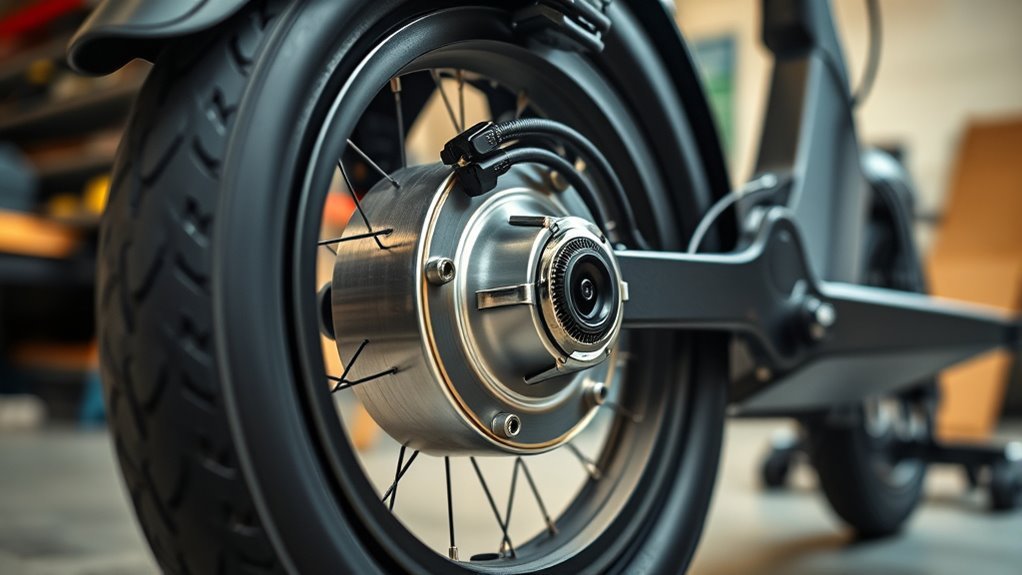
The vast majority of modern electric scooters use permanent magnet brushless DC (BLDC) motors housed directly within the wheel rim, commonly known as hub motors. This integrated configuration routes power straight from the motor stator to the tire without intermediary chains, belts, or drive shafts, minimizing drivetrain friction losses to negligible levels.
An electric scooter’s motor forms a closed-loop powertrain system with the battery pack and the electronic speed controller (ESC). The battery supplies direct current (DC), the controller rapidly switches that current into multi-phase alternating pulses, and the motor transforms that electrical energy into mechanical torque. Depending on whether you prioritize portability, range, or steep incline climbing, motors range from compact 250-watt front-hub units to massive dual-drive configurations exceeding 3,000 watts of continuous output.
Brushless DC (BLDC) Motors in Electric Scooters
Brushless DC motors have largely replaced older electromagnetic motor variants across the micro-mobility sector. Unlike traditional motors, BLDC motors do not use physical carbon brushes or a mechanical commutator ring to alternate current direction. Instead, they rely on external electronic commutation managed by the scooter’s speed controller.
Inside a BLDC hub motor, an array of copper wire coils (the stationary stator) is fixed to the central axle, while high-grade neodymium permanent magnets (the rotor) are attached to the outer rotating hub casing. When the motor controller energizes the coils in a precise sequential pattern, it generates a rotating electromagnetic field that pulls the permanent magnets along with it, spinning the wheel.
- High Energy Efficiency: Operating at 85% to over 90% efficiency, BLDC motors convert significantly more battery energy into motion rather than waste heat.
- Extended Lifespan & Reliability: With no physical brushes rubbing against a commutator, mechanical wear is limited almost entirely to the sealed wheel bearings.
- Regenerative Braking Support: BLDC motors can instantly reverse their role to act as generators during braking, feeding electrical current back into the battery while providing smooth electronic deceleration (often called KERS or electronic braking).
- Quiet, Low-Vibration Ride: Electronic phase switching produces minimal acoustic noise compared to mechanical friction motors.
Pro Tip: Look for scooters equipped with Sine-Wave (FOC) motor controllers rather than basic Square-Wave controllers. Field-Oriented Control (FOC) delivers smoother low-speed throttle modulation, virtually silent motor operation, and up to 10% greater electrical efficiency.
Brushed DC Motors in Electric Scooters
Brushed DC motors represent an older, legacy electric drive architecture. In a brushed configuration, physical carbon brushes press directly against a spinning mechanical commutator to reverse the electrical polarity of the internal rotor windings. While functionally straightforward, this mechanical contact generates inherent friction, electrical arcing, and significant thermal waste.
Brushed Motor Operation
Brushed motors operate without complex multi-phase electronic controllers; applying simple DC voltage directly spins the motor shaft. This design keeps manufacturing costs minimal, which is why brushed motors were historically favored in entry-level children’s scooters and early generation adult models.
- Mechanical Commutation: Carbon brushes physically glide over copper commutator segments to reverse polarity automatically.
- Direct Voltage Control: Speed is adjusted simply by raising or lowering applied voltage, requiring cheaper control electronics.
- High Initial Starting Torque: Full torque is available immediately at stall, though efficiency drops rapidly as RPM rises.
Brushed Motor Drawbacks
The mechanical friction inherent in brushed systems introduces severe operational handicaps for daily commuter use:
- Rapid Component Wear: Carbon brushes degrade continuously during operation, requiring periodic replacement every few hundred riding hours to prevent total motor failure.
- Lower Operating Efficiency: Efficiency typically maxes out between 70% and 75%, generating excessive heat and substantially reducing real-world riding range per battery charge.
- Acoustic Noise & Heat Build-Up: Commutator friction produces a distinctive whining noise and requires open ventilation ports, which exposes internal components to road moisture and dust contamination.
Hub Motors vs. Chain & Belt Drive Systems
The mechanical mounting location of the motor dictates a scooter’s durability, weatherproofing, and service demands. Modern electric scooters utilize either direct-drive hub motors or chassis-mounted motors connected by chains or toothed belts.
| Drive System | Efficiency & Maintenance | Best Use Case | Key Drawback |
|---|---|---|---|
| Direct-Drive Hub Motor | High efficiency (~90%); sealed unit requires zero belt or chain maintenance. | Daily urban commuting, wet weather riding, and low-maintenance travel. | Increases unsprung wheel weight; tire changes require disconnecting motor wiring. |
| Belt-Drive Motor | Moderate efficiency (~82–86%); quiet operation, smooth torque transmission. | Custom performance builds and lightweight electric skateboards/scooters. | Belts can snap under sudden shock loads or slip when exposed to mud and grit. |
| Chain-Drive Motor | Lower efficiency (~78–82%); high mechanical durability under heavy torque. | Heavy-duty off-road utility scooters and extreme high-torque applications. | Loud operation; requires continuous lubrication, tensioning, and sprocket alignment. |
Geared Hub Motors vs. Gearless (Direct-Drive) Hub Motors
Within the hub motor category, designs diverge into geared and gearless (direct-drive) architectures, representing a deliberate engineering trade-off between low-end mechanical leverage and long-term durability.
Geared Hub Motors house an internal planetary gear reduction set (often nylon or composite gears) inside the hub casing. The internal electric motor spins at 3 to 5 times the speed of the outer wheel, multiplying low-end torque output. This design makes geared hub motors exceptionally compact and lightweight for their hill-climbing prowess. Furthermore, geared hubs contain an internal freewheel clutch, meaning the scooter rolls freely without magnetic resistance when coasting. However, the mechanical gears introduce wear points and eliminate the possibility of regenerative braking.
Gearless Direct-Drive Hub Motors connect the motor’s rotor directly to the wheel rim in a 1:1 drive ratio. Because there are no internal gears or touching parts besides the axle bearings, direct-drive motors are virtually indestructible, run almost silently, and support powerful regenerative braking. They are physically larger and heavier than geared hubs to produce comparable low-speed torque, but their simplicity makes them the standard choice for modern commercial and consumer commuter scooters.
Nominal (Continuous) vs. Peak Motor Power Explained
Motor power is rated in Watts ($W$), representing the rate at which electrical energy is transformed into mechanical work ($P = \text{Current } [A] \times \text{Voltage } [V]$). When comparing electric scooters, understanding the distinction between continuous and peak ratings prevents performance disappointment.
Always verify nominal (continuous) wattage over peak wattage: nominal power indicates what the motor can safely sustain without overheating, while peak power reflects brief bursts during hard acceleration.
- Nominal (Continuous) Power: The maximum electrical power a motor can consume indefinitely while remaining within safe thermal limits. A true 350W nominal motor can run continuously at that level without melting phase wires or demagnetizing magnets.
- Peak Power: The absolute maximum wattage the motor controller delivers for short intervals (typically 5 to 30 seconds) during hill climbing or initial launch. A 500W nominal motor often has a peak output between 750W and 900W.
- Voltage Platform Synergy: Higher voltage electrical systems (48V, 52V, or 60V vs. 36V) pull fewer Amperes to produce identical wattage, running substantially cooler under heavy hill-climbing loads.
Warning: Beware of misleading marketing that highlights only peak wattage. A scooter marketed as “800W Peak” may feature a modest 350W continuous motor paired with an aggressive controller, which can quickly trigger thermal throttling on long inclines.
How Scooter Torque Affects Acceleration and Incline Capability
While wattage sets the ceiling for sustained high-speed output, torque—measured in Newton-meters (Nm)—dictates the rotational twisting force delivered at the pavement. Torque directly determines initial acceleration from a complete stop and the scooter’s ability to maintain speed up steep grades with adult payload capacities.
| Torque Range (Nm) | Typical Motor Class | Max Incline Capability | Rider Weight & Real-World Performance |
|---|---|---|---|
| 12 – 18 Nm | 250W – 350W Single Motor | 8% – 12% grade (4.5° – 7°) | Best for riders under 170 lbs (77 kg) on flat urban tarmac; slows noticeably on mild overpasses. |
| 20 – 30 Nm | 500W – 750W Single Motor | 15% – 20% grade (8.5° – 11.5°) | Supports riders up to 220 lbs (100 kg); brisk city acceleration and stable climbing up moderate hills. |
| 35 – 55 Nm | 1,000W – 1,600W (Single/Dual) | 22% – 30% grade (12.5° – 17°) | Accommodates riders up to 265 lbs (120 kg); rapid 0–15 mph launches and effortless hill climbing. |
| 60+ Nm | 2,000W+ Dual Motors | 35%+ grade (20°+) | Extreme off-road and hyper-scooter tier; handles heavy payloads up mountain gradients without speed loss. |
Single vs. Dual Motor Configurations
The layout and quantity of motors dictate traction control, power distribution, and overall chassis stability:
- Single Front-Wheel Drive (FWD): Common on ultra-portable, compact commuter scooters. While lightweight and simple to wire, front hub motors can suffer from wheel spin on wet pavement or loose gravel during uphill launches due to rearward weight transfer.
- Single Rear-Wheel Drive (RWD): The optimal choice for single-motor commuting. Weight shifts toward the rear tire during acceleration, increasing mechanical grip and eliminating front-wheel torque steer.
- Dual-Motor All-Wheel Drive (AWD): Uses independent hub motors in both the front and rear wheels. Dual-motor setups split the electrical workload across two stators, significantly reducing thermal strain while doubling contact patch traction on steep climbs and off-road terrain. Most dual-motor models allow riders to toggle between single-motor mode (for battery conservation) and dual-motor mode (for maximum power).
Note: A dual 500W motor setup (1,000W combined) will almost always climb hills more efficiently than a single 1,000W motor because two tires distribute traction across two separate contact patches, reducing wheel slippage and stator heat build-up.
How to Choose the Right Scooter Motor for Your Riding Needs
Selecting the ideal electric scooter motor requires aligning motor wattage, torque capabilities, and drive layouts with your physical weight, local topography, and commuting patterns:
- Flat City Commuting (Riders under 180 lbs / 80 kg): A single 250W to 350W BLDC rear hub motor provides adequate cruising speeds (15–18 mph / 24–29 km/h) while keeping the scooter portable (under 30 lbs).
- Mixed Terrain & Moderate Hills (Riders 180–220 lbs / 80–100 kg): Opt for a single 500W to 800W nominal motor on a 48V electrical architecture. This setup delivers roughly 20–25 Nm of torque, sustaining 20–25 mph top speeds without bogging down on moderate bridge inclines.
- Steep Grades, Heavy Payloads, or High Performance (Riders 220+ lbs / 100+ kg): Target a dual-motor system with at least 1,000W to 2,000W combined nominal output (producing 40+ Nm of torque). This configuration ensures steady hill ascents, instant throttle response, and robust all-weather traction.
- Water & Dust Ingress Protection: Verify that the hub motor assembly features an IP54 or IPX5 rating minimum, ensuring that moisture and road grit cannot penetrate the axle seals and corrode internal copper windings or magnets.
Frequently Asked Questions
What motor type is most common in electric scooters?
Brushless DC (BLDC) hub motors are the most common type used in modern electric scooters. They mount directly inside the wheel hub, operating at 85% to 92% electrical efficiency with zero brush wear, minimal noise, and sealed, maintenance-free reliability.
How fast will a 500W electric scooter go?
A scooter with a true 500W nominal motor typically reaches a top speed of 20 to 25 mph (32 to 40 km/h) on flat terrain. Actual top speed depends on rider weight, tire pressure, state of battery charge, and system voltage (a 48V 500W motor runs faster than a 36V 500W motor).
How long do brushless scooter hub motors typically last?
Because BLDC hub motors have no physical contact brushes, they frequently last beyond 5,000 to 10,000 riding miles (or 5 to 10+ years). The only wear components are the sealed internal bearings, which can be replaced independently if they experience water ingress or mechanical wear.
Why are dual motors better than single motors for climbing hills?
Dual motors distribute power across both wheels, providing all-wheel traction that prevents wheel slippage on steep gradients. Spreading the load across two separate motor stators also cuts current demand per motor in half, keeping temperatures lower and preventing thermal throttling.
Can electric scooter motors overheat?
Yes. Under prolonged heavy loads—such as climbing steep inclines with maximum payload weight—excessive current generates heat within the stator copper windings. Quality scooters feature thermal sensors that throttle motor current or temporarily shut down the system to prevent permanent magnet demagnetization.
Conclusion
The motor is the core mechanical driver of an electric scooter’s overall performance, shaping acceleration dynamics, hill-climbing authority, and long-term reliability. For modern urban commuting, a brushless DC (BLDC) direct-drive hub motor delivers the optimal balance of high energy efficiency, silent operation, and zero maintenance. While flat city routes are well-served by a single 250W to 500W rear-drive hub, challenging routes and heavier payloads benefit significantly from dual-motor setups delivering higher torque and all-wheel traction. Matching motor wattage, torque output, and voltage to your real-world riding conditions ensures responsive, dependable performance for thousands of miles.
Sources
- IEEE Xplore — Design and efficiency analysis of permanent magnet brushless DC hub motors in light electric vehicles.
- SAE International — Standards and mechanical classifications for light electric mobility powertrain systems.
- UL Solutions — UL 2272 electrical and motor drive safety standards for personal e-mobility devices.
- U.S. Consumer Product Safety Commission (CPSC) — Micromobility safety, engineering, and operating guidelines.
