
Last Updated on August 25, 2026 by Caleb Warren
Choosing the right electric scooter helmet is the single most critical safety decision you will make as a rider. While electric scooters provide efficient, agile transportation, their small wheels, steep steering angles, and rapid acceleration leave riders uniquely vulnerable to falls and collisions. Matching your helmet to your scooter’s maximum speed, riding environment, and terrain ensures you stay protected without sacrificing comfort or visibility.
Quick Answer
For speeds under 20 mph (32 km/h), a certified standard bicycle helmet (CPSC 16 CFR Part 1203) provides adequate lightweight protection and ventilation. For speeds between 20–28 mph (32–45 km/h), upgrade to an NTA-8776 certified e-bike helmet or an ASTM F1952 downhill mountain bike helmet. For performance scooters exceeding 28 mph, you must wear a certified full-face motorcycle helmet (DOT FMVSS 218 or ECE 22.06) to ensure critical chin, jaw, and high-energy impact protection.
Key Takeaways
- Match Speed to Shell: Bicycle helmets are engineered solely for low-speed impacts (<20 mph); higher speeds require thicker EPS liners and extended temporal/occipital coverage.
- Prioritize Full-Face at Higher Speeds: Over 30% of serious e-scooter trauma involves facial and jaw impacts where open-face helmets offer zero defense.
- Look for Rotational Impact Tech: Systems like MIPS reduce rotational brain strain during oblique, angled road impacts.
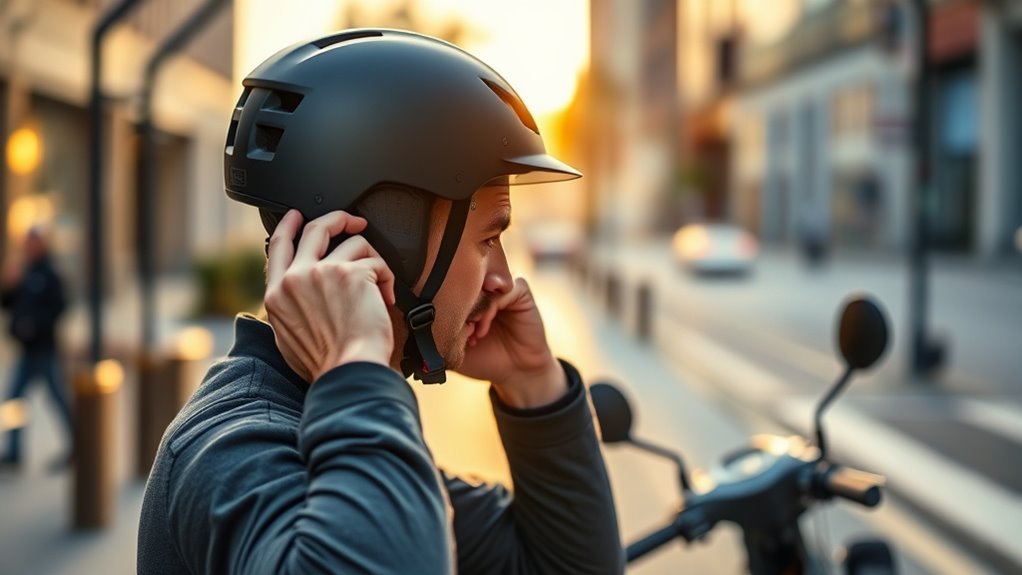
- Master the 2-V-1 Fit: Position the rim 2 fingers above the eyebrows, form a clean ‘V’ under the earlobes, and allow no more than 1 finger under the chinstrap.
- Replace After Any Crash: Expanded Polystyrene (EPS) foam is single-use; replace helmets immediately following an impact or every 3–5 years due to environmental degradation.
Disclosure: As an Amazon Associate I earn from qualifying purchases. Some links on this page are affiliate links, at no extra cost to you.
Which Helmet Type Is Best for E-Scooters?
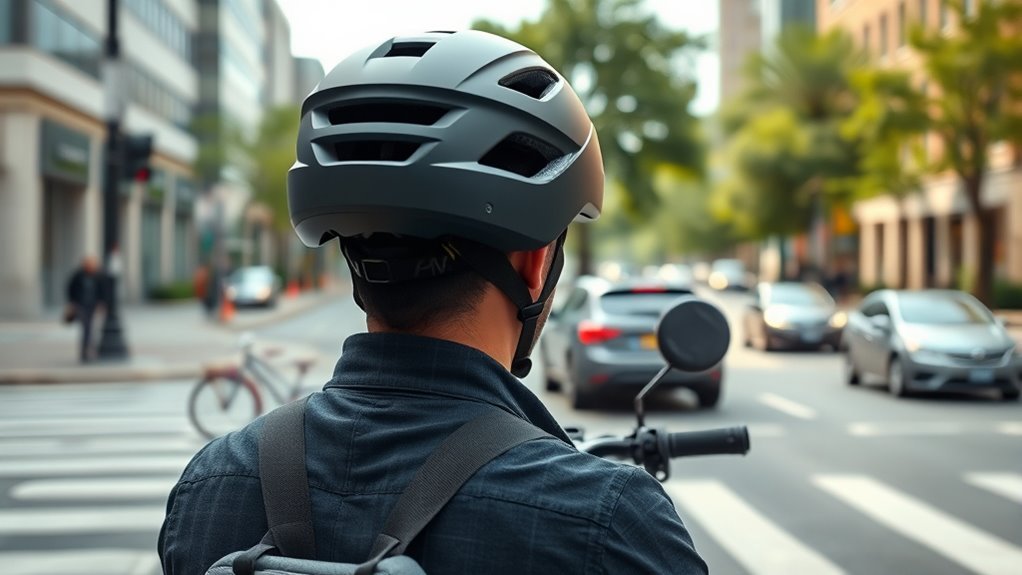
The best helmet for your electric scooter depends primarily on your maximum traveling speed, traffic exposure, and riding surface. Because scooter geometry places the rider upright over small 8-to-11-inch wheels, sudden braking or road hazards frequently cause over-the-handlebar ejections. Selecting a helmet engineered to manage the kinetic energy generated at your specific cruising speed is essential.
Helmets are categorized across four distinct protection profiles:
- Standard Bicycle Helmets (Under 20 mph / 32 km/h): Lightweight, open-face construction with maximum airflow; designed for casual commuting on smooth bike lanes.
- BMX & Skate-Style Helmets (Up to 20 mph / 32 km/h): Thicker hard-shell ABS construction providing better resistance to multiple minor scrapes, but with reduced ventilation.
- Downhill MTB & E-Bike Helmets (20–28 mph / 32–45 km/h): Certified to standards such as NTA-8776 or ASTM F1952, offering extended rear-head coverage and reinforced chin bars without excessive weight.
- Full-Face Motorcycle Helmets (28+ mph / 45+ km/h): Multi-density liners, heavy-duty composite shells, and shatterproof visors built to withstand high-velocity motor vehicle collisions.
| Helmet Class | Speed Rating | Key Safety Standards | Primary Benefit | Best Use Case |
|---|---|---|---|---|
| Standard Bicycle | < 20 mph | CPSC 16 CFR 1203, EN 1078 | High airflow, minimal weight | Low-speed bike lane commuting |
| BMX / Skate Hardshell | < 20 mph | ASTM F1492, CPSC 1203 | Tough ABS outer shell | Urban riding, stunt parks |
| E-Bike / Speed Pedelec | 20–28 mph | Dutch NTA-8776 | 40% higher impact attenuation | Fast urban commuters |
| Downhill MTB (Full-Face) | 20–30 mph | ASTM F1952 | Chin protection with good ventilation | Mixed off-road and fast roads |
| Full-Face Motorcycle | 28+ mph | DOT FMVSS 218, ECE 22.06 | Maximum high-velocity defense | Performance/hyperscooters |
Why Bicycle Helmets Work for Slow Rides
For low-speed electric scooter riding under 20 mph (such as shared rental scooters or entry-level commuter models), a certified bicycle helmet provides practical, proven protection. Bicycle helmets are constructed using in-mold Expanded Polystyrene (EPS) foam bonded to a thin polycarbonate outer shell. This structure is engineered to crush progressively upon impact, decelerating the head smoothly to prevent fatal skull fractures.
Peer-reviewed clinical studies indexed by the National Institutes of Health (NIH) show that wearing a certified helmet reduces the risk of serious head trauma by more than 50% and severe brain injury by up to 88%. For urban riders navigating stop-and-go traffic, the generous ventilation channels prevent overheating, while the ultra-low weight (typically 250–350 grams) eliminates neck strain.
“The most protective helmet is the one you consistently wear on every ride. For casual, low-speed commuting, the lightweight comfort and airflow of a CPSC-certified bike helmet ensure compliance without compromising baseline cranial safety.”
Pro Tip: When buying a commuter bicycle helmet for e-scooters, choose a model featuring an integrated, USB-rechargeable rear LED light. Because electric scooters sit low to the ground, a head-height rear flashing light dramatically improves your visibility to trailing motor vehicles at night.
When to Choose BMX or Downhill Helmets
Riders often confuse BMX/skate-style helmets and downhill mountain bike helmets. While both offer sturdier shells than standard road bike helmets, they serve distinctly different performance needs:
- BMX & Skate Helmets: Feature a thick outer ABS plastic shell designed to resist frequent abrasive knocks, drop damage, and everyday urban wear. However, standard skate helmets lack large airflow channels, making them warmer during summer commutes. Ensure any skate-style helmet carries the CPSC 16 CFR Part 1203 or ASTM F1492 certification badge; non-certified novelty skate lids do not absorb severe crash impacts.
- Downhill Mountain Bike (ASTM F1952) Helmets: Incorporate a rigid, non-removable chin bar and undergo far more rigorous anvil drop tests and chin-deflection testing than traditional road helmets. Downhill helmets offer an exceptional middle ground for riders traveling between 20 and 30 mph who require facial protection and high airflow without the 1,500-gram bulk of a motorcycle helmet.
Why Full-Face Helmets Help at Higher Speeds
When scooter speeds exceed 20 mph, kinetic energy increases exponentially with the square of velocity ($E_k = \frac{1}{2}mv^2$). A crash at 25 mph generates nearly double the destructive energy of a fall at 18 mph. At these speeds, open-face helmets leave riders exposed to severe trauma.
Impact Protection Coverage
Standard open-face helmets protect the top, front, and sides of the cranial vault but leave the temporal base, occipital lobe, face, and jaw completely exposed. Full-face helmets enclose the entire head in a rigid structural shell lined with multi-density EPS foam. This structure dissipates high-energy impact forces across a wide surface area before they reach the skull.
Chin And Jaw Safety
Emergency room trauma reports indicate that facial fractures, broken mandibles, and dental destruction account for roughly one-third of all severe micro-mobility injuries. When an electric scooter wheel hits a pothole or curb, the rider is pitched forward along a downward trajectory. An open-face helmet allows the pavement to strike the chin and mouth directly.
| Full-Face Feature | Direct Mechanism | Specific Risk Reduced |
|---|---|---|
| Reinforced Chin Bar | Deflects direct head-on pavement strikes | Mandibular fractures & lost teeth |
| Polycarbonate Face Shield | Blocks flying gravel, insects, and road grit | Corneal abrasions & soft-tissue lacerations |
| Extended Cheek Pads | Stabilizes the helmet against rotational twisting | Rotational shear trauma & jaw dislocation |
Warning: Never ride a high-performance e-scooter capable of 30+ mph with a standard bicycle helmet. At 30 mph, a crash matches the impact energy of falling from a third-story window; bicycle-grade EPS foam will crush completely, transmitting the remaining lethal force directly to your skull.
Better High-Speed Stability and Eye Protection
At speeds above 20 mph, wind blast causes natural tearing and involuntary blinking, impairing your hazard perception. A full-face helmet with an integrated visor shields your eyes from drying wind, dust, insects, and road spray. Furthermore, the aerodynamic profile reduces buffeting and helmet lift, preventing neck fatigue on long rides.
Advanced Safety: MIPS and Rotational Impact Protection
Traditional helmet testing historically focused on direct, linear impacts (dropping a helmet straight down onto an anvil). In real-world e-scooter crashes, however, riders almost always hit the asphalt at an angle while moving forward, generating severe rotational acceleration.
Rotational forces twist the brain inside the cerebrospinal fluid, shearing delicate axonal nerve fibers and causing concussions or permanent traumatic brain injury (TBI). Modern high-grade helmets incorporate rotational mitigation systems such as:
- MIPS (Multi-Directional Impact Protection System): A low-friction internal layer that allows 10–15 mm of omni-directional sliding during the critical first 5–10 milliseconds of an impact, redirecting dangerous rotational forces into harmless lateral movement.
- WaveCel: A collapsible cellular structure that flexes, crumples, and glides to absorb both linear and rotational energy.
- SPIN / Fluid Pods: Silicone-injected internal padding that shears locally to reduce rotational force transmission.
Note: While rotational management systems like MIPS add $20–$40 to a helmet’s retail cost, safety testing by independent labs (such as the Virginia Tech Helmet Lab) confirms they significantly lower concussion risk across angled road impacts.
Which Helmet Standards Matter?
A safety certification sticker on the inside or rear of a helmet proves it has passed standardized destructive laboratory testing. Look for the following certifications depending on your scooter’s capabilities:
- CPSC 16 CFR Part 1203: The mandatory legal standard for all bicycle helmets sold in the United States since 1999. Tested for moderate-velocity drops and strap retention. Ideal for rides under 20 mph.
- NTA-8776: The Dutch speed-pedelec standard. Specifically engineered for electric bikes and micro-mobility up to 28 mph (45 km/h). Helmets certified to NTA-8776 provide 40% more impact attenuation at the rear and temples than standard bike helmets.
- ASTM F1952: The premier standard for downhill mountain biking. Requires rigid chin bar testing, higher impact velocity drops, and broader coverage. The gold standard for fast, off-road, or aggressive scooter riding (20–30 mph).
- Snell B-95: An elite bicycle standard with stricter impact drop criteria and penetration resistance than standard CPSC.
- DOT FMVSS 218 / ECE 22.06: Legal motorcycle standards. ECE 22.06 is the updated European standard featuring advanced multi-angle, rotational, and modular visor testing. Mandatory for hyperscooters traveling 30 to 60+ mph.
How to Measure Your Head for a Helmet
A poorly fitted, loose helmet will rotate off your forehead during a crash, leaving you unprotected. Sizing requires finding both your exact head circumference and matching your anatomical head shape.
At a Glance
| Time Required | 3–5 Minutes |
| Difficulty | Easy / Beginner |
| Tools Needed | Flexible tailor’s measuring tape (or piece of string + ruler) |
| Cost | $0 (Free self-measurement) |
Measure Circumference Correctly
To record an accurate baseline measurement:
- Take a flexible measuring tape and position it across the middle of your forehead, approximately 1 inch (2.5 cm) or two finger-widths above your eyebrows.
- Wrap the tape horizontally around the widest circumference of your head, passing just above your ears and over the prominent occipital bone at the back of your skull.
- Ensure the tape is level and snug against your skin, but not pulled tight.
- Record the number in centimeters (cm), as almost all manufacturer sizing charts use metric measurements. Repeat twice to confirm consistency.
Match Size To Shape
Head circumference alone does not guarantee a proper fit; cranial shape is equally critical. Helmets are molded around three primary internal profiles:
- Intermediate Oval (Most Common): Slightly longer front-to-back than side-to-side.
- Round Oval: Roughly equal width and length. Placing a round head in an intermediate oval helmet causes painful pressure hotspots on the forehead.
- Long Oval: Noticeably longer from forehead to occiput.
The 2-V-1 Fit Test Method
Once your helmet arrives, adjust the straps and retention dial, then perform the standard 2-V-1 test:
- “2” Fingers on the Forehead: The front rim of the helmet must sit level, exactly two finger-widths above your eyebrows. If tilted back, your forehead is exposed; if tilted forward, your vision is blocked.
- “V” Straps Around the Ears: The side straps should form a clean “V” shape meeting directly beneath your earlobes without twisting.
- “1” Finger Under the Chinstrap: Fasten the buckle. You should be able to slide only one finger comfortably between the strap and your chin. When you open your mouth wide, you should feel the helmet pull down firmly on top of your head.
- The Shake Test: Shake your head vigorously side-to-side and nod up-and-down with the chinstrap unbuckled. The helmet should stay in place without shifting or sliding into your eyes.
When to Replace an E-Scooter Helmet
Helmets do not last forever. Follow these two mandatory replacement rules:
- After Any Crash or Hard Drop: Bicycle, skate, and downhill helmets use Expanded Polystyrene (EPS) foam. When subjected to impact, the micro-beads in the EPS liner crush to absorb energy. This compression is permanent. Even if the outer plastic shell looks completely undamaged, the crushed internal foam cannot protect you in a second crash. Discard and replace it immediately.
- Every 3 to 5 Years: Over time, exposure to ultraviolet (UV) sunlight, body sweat, hair oils, temperature swings, and cosmetic solvents degrades the EPS foam and adhesive resins. The Snell Memorial Foundation recommends replacing any active helmet every five years, or every three years under heavy daily commuting use.
How to Choose the Right E-Scooter Helmet
Use this simple checklist to choose the right helmet before ordering:
- Determine Top Speed: Match your scooter’s maximum capable speed (not just your average speed) to CPSC (<20 mph), NTA-8776 (20–28 mph), or DOT/ECE (>28 mph) standards.
- Evaluate Climate & Commute: Hot, sunny climates require deep channel venting; cold or rainy areas benefit from modular visors and removable ear pads.
- Check for Safety Tech: Look for MIPS or WaveCel rotational liners.
- Verify Retention System: Choose helmets with micro-adjust rear dials (e.g., Boa dials) and magnetic pinch-free buckles (such as Fidlock) for quick one-handed operation.
Frequently Asked Questions
What helmet should I wear on an electric scooter?
If your electric scooter tops out under 20 mph (32 km/h), a CPSC-certified bicycle or skate-style helmet is sufficient. If your scooter travels between 20 and 28 mph (32–45 km/h), choose an NTA-8776 certified e-bike helmet or an ASTM F1952 downhill full-face helmet. For hyperscooters capable of speeds exceeding 28–30 mph, wear a certified DOT FMVSS 218 or ECE 22.06 full-face motorcycle helmet.
What is the most common injury on an electric scooter?
Head, facial, and upper-extremity fractures are the most frequent severe injuries sustained in electric scooter crashes. Clinical trauma data reveals that facial lacerations, broken jaws, concussions, and traumatic brain injuries account for over 50% of hospital admissions among non-helmeted riders.
Are you legally required to wear a helmet with an electric scooter?
Helmet laws for electric scooters vary significantly by jurisdiction. In many US states and European municipalities, riders under 18 years of age are legally mandated to wear a helmet. Furthermore, local regulations frequently require all riders to wear helmets on scooters capable of exceeding 15–20 mph. Regardless of local legal requirements, wearing a certified helmet is strongly recommended for all riders.
Can I reuse a helmet after an electric scooter crash?
No. Certified bicycle, skate, and downhill helmets rely on Expanded Polystyrene (EPS) foam, which permanently crushes upon impact to absorb crash energy. Even if the outer shell appears pristine, the compressed internal liner cannot provide adequate shock absorption in a subsequent collision. Replace any helmet immediately after an accident.
Conclusion
Wearing a properly fitted, certified helmet is the most effective safety measure you can take when riding an electric scooter. By aligning your helmet type with your riding speed—choosing standard bicycle helmets for casual cruising under 20 mph, NTA-8776 or downhill helmets for moderate speeds up to 28 mph, and full-face motorcycle helmets for higher speeds—you protect yourself against life-altering cranial and facial injuries. Measure your head carefully, look for rotational safety systems like MIPS, confirm a snug 2-V-1 fit, and replace your helmet promptly after any crash or after five years of active use.
Sources
- U.S. Consumer Product Safety Commission (CPSC) — Mandatory Bicycle Helmet Standard (16 CFR Part 1203).
- NEN Dutch Standards Institute — NTA-8776 Standard for High-Speed E-Bikes and Micro-Mobility.
- ASTM International — Standard Specification for Helmets Used for Downhill Mountain Bicycle Racing (F1952).
- National Library of Medicine (PubMed / Cochrane Review) — Systematic review of bicycle helmet efficacy in reducing head and facial injuries.
- Snell Memorial Foundation — Helmet safety certification standards and replacement guidelines.
- Virginia Tech Helmet Lab — Independent bicycle and multi-sport impact testing and STAR ratings.
