
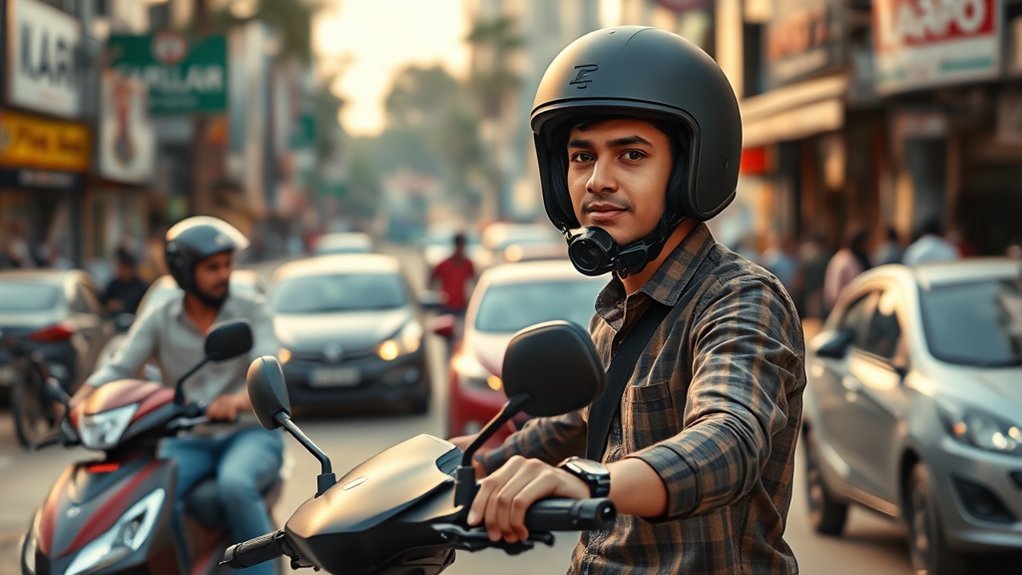
Last Updated on September 10, 2026 by Daniel Globe
Whether you need a helmet on an electric scooter in India depends first on whether the scooter is legally treated as a motor vehicle. A genuinely exempt low-speed pure electric two-wheeler can fall outside the normal Motor Vehicles Act helmet requirement, but speed and wattage alone do not decide the exemption. Regulated electric two-wheelers are subject to the normal motorcycle rules for helmets, licensing, registration and insurance.
Quick Answer
If your electric scooter is legally a motor vehicle, the rider and pillion passenger generally must wear compliant helmets in public places. A two-wheeled pure EV can be exempt only when it satisfies the complete CMVR exemption, including motor power below 0.25 kW, maximum speed below 25 km/h and several additional conditions.
Key Takeaways
- The commonly quoted 250W/25 km/h rule is incomplete: the exemption requires additional construction, weight and testing-agency conditions.
- For a regulated electric motorcycle, Section 129 requires protective headgear for people above four years riding or being carried on it in a public place, subject to the statutory Sikh-turban exception.
- The central helmet offence under Section 194D carries a ₹1,000 fine and three-month licence disqualification; a state may apply a valid notified penalty multiplier.
- Use a genuine BIS-certified helmet conforming to the applicable Indian standard rather than relying on DOT or ECE certification alone.
- Regulated electric scooters also require the applicable driving licence, registration and third-party insurance.
Disclosure: As an Amazon Associate I earn from qualifying purchases. Some links on this page are affiliate links, at no extra cost to you.
Are Helmets Required on Electric Scooters in India?
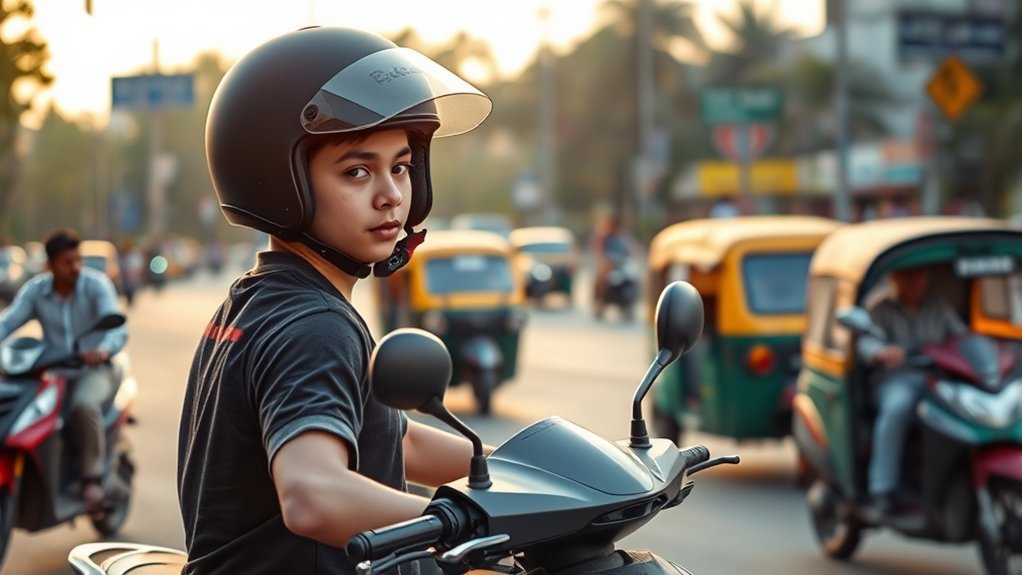
Yes, if the electric scooter is legally treated as a motorcycle or other motor vehicle to which the helmet provisions apply. Section 129 of the Motor Vehicles Act, 1988 requires every person above four years of age who is driving, riding or being carried on a motorcycle in a public place to wear prescribed protective headgear. That includes a pillion passenger.
The important exception for many low-speed electric scooters comes from the Central Motor Vehicles Rules. A qualifying two-wheeled pure electric vehicle is not deemed a motor vehicle when it meets every condition of the exemption. If that exemption applies, the normal Motor Vehicles Act motorcycle helmet mandate does not apply in the same way.
Warning: Do not assume that a scooter is legally exempt simply because a seller calls it “low-speed,” “no-licence,” or “25 km/h.” Check the manufacturer’s official classification or type-approval documentation. The statutory exemption contains more conditions than speed and wattage alone.
How India Classifies Electric Scooters
For this question, the most important distinction is whether the electric two-wheeler qualifies for the special CMVR exemption or remains a motor vehicle under the Motor Vehicles Act. The current formulation appears in the Central Motor Vehicles Rules as amended by G.S.R. 823(E), dated November 6, 2023.
Low-Speed Vs High-Speed
“Low-speed” and “high-speed” are useful everyday descriptions, but they can oversimplify the legal test. A two-wheeled pure electric vehicle is not deemed a motor vehicle only when all applicable exemption conditions have been verified and authorised by a testing agency specified under Rule 126.
- Exempt pure electric two-wheeler: satisfies every statutory exemption condition.
- Regulated electric two-wheeler: does not qualify for that exemption and therefore falls within the normal motor-vehicle framework.
- Practical check: confirm the vehicle’s certified classification rather than relying only on the dashboard speed or advertised motor rating.
250W And 25km/h Limits
The frequently quoted “250W and 25 km/h” rule needs precision. Under the current CMVR wording, an exempt two-wheeled pure electric vehicle must satisfy all of the following conditions:
| Thirty-minute motor power | Less than 0.25 kW |
| Maximum speed | Less than 25 km/h |
| Brakes and reflectors | Suitable brakes and the required retro-reflective devices |
| Unladen weight | Not more than 60 kg, excluding battery weight |
| Verification | Conditions verified and authorised by a Rule 126 testing agency |
For a pedal-assisted vehicle, additional motor cut-off requirements also apply. Notice that the power and speed wording is “less than”, not “less than or equal to.” You therefore should not treat exactly 0.25 kW or exactly 25 km/h as satisfying those particular exemption conditions.
Pro Tip: Before buying a scooter advertised as licence-free, ask the manufacturer or authorised dealer for documentation showing that the model is certified within the applicable CMVR exemption. A marketing claim is not a substitute for legal classification.
RTO, Licence, And Helmet Rules
If the electric scooter is a motor vehicle, normal statutory requirements become relevant. The rider needs an effective driving licence authorising the applicable vehicle class, the vehicle must be registered and display its registration mark, and the required insurance must be in force.
| Requirement | Verified exempt two-wheeler | Regulated motor-vehicle e-scooter |
| Motor-vehicle registration | Generally not required under the exemption | Required |
| Driving licence | Motor Vehicles Act licensing requirement does not apply in the normal way | Required |
| Motorcycle helmet mandate | Not triggered on the same basis, but helmet use remains strongly recommended | Required where Section 129 applies |
Helmet Rules for Low-Speed E-Scooters
If a two-wheeled pure electric vehicle genuinely satisfies the complete CMVR exemption and is therefore not deemed a motor vehicle, the ordinary motorcycle helmet mandate under Section 129 does not apply to it in the same manner.
That does not make riding without a helmet a good safety choice. Low speed does not eliminate falls, potholes, side impacts, turning vehicles or collisions with pedestrians and bicycles. A properly fitted helmet remains sensible protective equipment even when the motor-vehicle helmet provision does not compel it.
Also check the manufacturer’s instructions before carrying a passenger. Some small low-speed scooters are designed for one occupant only. A legal helmet exemption does not create permission to exceed the scooter’s seating or load design.
Helmet Rules for High-Speed E-Scooters
If your electric scooter does not qualify for the special pure-EV exemption and is legally a motorcycle, the normal helmet rule applies in a public place. Under Section 129, people above four years who drive, ride or are carried on a motorcycle must wear prescribed protective headgear, subject to the statutory exception for a Sikh who is wearing a turban.
High-Speed Helmet Mandate
For legal compliance in India, choose a genuine BIS-certified two-wheeler helmet conforming to the applicable Indian standard. The Helmet for Riders of Two Wheeler Motor Vehicles (Quality Control) Order, 2020 specifies IS 4151 for covered two-wheeler helmets and requires the BIS Standard Mark.
- Look for a genuine BIS/ISI Standard Mark and certification details.
- Choose the correct helmet size so it does not rotate or lift excessively on your head.
- Fasten the retention strap every time you ride.
- Do not assume DOT or ECE certification alone replaces Indian BIS requirements; those certifications can be additional.
Rider And Pillion Safety
The helmet obligation is not limited to the driver. A pillion passenger above four years on a regulated motorcycle is also covered by Section 129. The passenger should have a separate correctly sized helmet and should sit only on a proper passenger seat where the vehicle is designed to carry a pillion.
Section 128 also addresses motorcycle passenger safety and limits a two-wheeled motorcycle to one person in addition to the driver. Carrying extra passengers or using a scooter in a manner contrary to its approved seating arrangement creates additional risk and may violate other provisions.
Penalties For Non-Compliance
Section 194D of the Motor Vehicles Act establishes the central penalty for violating the protective-headgear requirement: a ₹1,000 fine and disqualification for holding a driving licence for three months.
The central statutory helmet penalty is ₹1,000 plus three months’ driving-licence disqualification under Section 194D.
Section 210A also allows a State Government, subject to the statutory conditions, to notify a multiplier for fines. For that reason, the amount actually processed through a state traffic-challan system should be checked against the current notification in that state rather than guessed from an older article or social-media post.
License and Registration Rules for Riders
Once an electric scooter is legally a motor vehicle, helmet compliance is only one part of the rider’s obligations. Section 3 of the Motor Vehicles Act requires an effective driving licence authorising the relevant vehicle, while Section 39 prohibits use of an unregistered motor vehicle except where a lawful exception applies.
| Issue | Central Act consequence |
| No required driving licence | Section 181: fine of ₹5,000, imprisonment up to three months, or both |
| Using an unregistered motor vehicle | Section 192: first-offence fine generally ₹2,000–₹5,000; higher consequences can apply to subsequent offences |
| No required third-party insurance | Section 196 provides separate penalties for driving an uninsured motor vehicle |
| No helmet where Section 129 applies | Section 194D: ₹1,000 plus three-month licence disqualification |
A regulated motor vehicle also needs third-party insurance under Section 146 when used in a public place. The government’s Parivahan registration guidance explains the normal registration process and documents.
Note: The exact driving-licence class or endorsement appropriate to a particular scooter should be confirmed through the licensing authority or Parivahan rather than inferred solely from motor wattage.
Helmet Rules for Pillion Riders
If the electric scooter is legally a motorcycle subject to Section 129, a pillion passenger above four years must also wear the required protective headgear. The driver should not treat the rear passenger’s helmet as optional merely because the trip is short.
- Provide the pillion with a correctly sized BIS-compliant helmet.
- Fasten the chin strap securely.
- Carry only one pillion and only if the scooter provides an appropriate passenger seat and is designed for that use.
- Do not exceed the manufacturer’s load limit.
On a genuinely exempt pure electric two-wheeler, the Motor Vehicles Act helmet rule does not apply on the same basis, but both rider and passenger are still safer with suitable head protection.
Special Rules for Young Child Passengers
Children below four years are covered by separate safety measures. Under G.S.R. 126(E), dated February 15, 2022, Rule 138(7) specifies measures for a child between nine months and four years being carried as a motorcycle pillion.
- A prescribed safety harness is to be used to attach the child securely to the driver.
- The driver must ensure that the child wears the required fitting crash helmet or qualifying bicycle helmet described in the rule.
- The motorcycle’s speed while carrying a child up to four years under this provision must not exceed 40 km/h.
Warning: Do not improvise a child restraint with ordinary bags, scarves or loose straps. Use equipment that satisfies the applicable rule and fits the child correctly.
State and City Helmet Rules
The basic Section 129 helmet obligation is national law; it is not simply optional from one city to another. What can differ is enforcement practice, the state’s notified fine multiplier or compounding amount, and the way challans are processed.
State Helmet Laws
Section 210A allows State Governments, subject to conditions specified by the Central Government, to notify a multiplier of between one and ten for fines under the Act. That is why a rider should distinguish between the central statutory offence and the amount or procedure currently applied by the relevant state.
- Start with the Motor Vehicles Act and CMVR for the national rule.
- Check the current State Transport Department or traffic-police notification for local fine implementation.
- Do not rely on an old screenshot or an unofficial penalty chart.
City Traffic Enforcement
City police may conduct helmet checks more frequently in some areas than others, but uneven enforcement does not remove the underlying legal obligation. If you ride a regulated electric motorcycle, carry the required documents and wear a compliant helmet every trip rather than relying on whether a particular road normally has checkpoints.
| Situation | Practical rule |
| Regulated e-scooter rider | Wear compliant protective headgear |
| Pillion above four years | Wear compliant protective headgear |
| Verified exempt pure EV | Motorcycle mandate does not apply on the same basis; helmet still strongly recommended |
Helmet Fines for E-Scooter Riders
If Section 129 applies to your scooter, Section 194D sets the central helmet offence at ₹1,000 together with three months’ disqualification for holding a driving licence. State-specific implementation can differ where a valid multiplier or compounding notification applies, so check the current official state traffic schedule for the actual challan amount in your location.
Do not confuse a helmet offence with other violations. Riding a regulated scooter without the required licence, registration or insurance can generate separate offences and penalties. Those separate violations are one reason a traffic stop can become substantially more expensive than the helmet offence by itself.
How to Ride Legally on an E-Scooter
Use this sequence before riding an electric scooter on public roads:
- Confirm its legal classification. Check the manufacturer’s certified specification or type-approval information.
- Do not rely solely on “250W/25 km/h.” A legally exempt two-wheeler must satisfy every applicable CMVR condition.
- If it is a motor vehicle, keep the registration valid. Make sure the registration mark is displayed as required.
- Hold the required driving licence. It must authorise the relevant vehicle class.
- Maintain required third-party insurance.
- Wear a BIS-compliant helmet when Section 129 applies. Provide one for the pillion too.
- Follow child-passenger rules. The special harness, helmet and speed requirements apply where Rule 138(7) is triggered.
- Follow traffic signals, lane rules and speed restrictions.
If you are unsure about a particular model, confirmation from the manufacturer, authorised dealer, testing/type-approval documentation or the relevant transport authority is more reliable than guessing from advertised top speed.
Safety Tips Beyond the Helmet Rule
Legal compliance is only the minimum. Electric scooters can accelerate quickly and are relatively small in traffic, so visibility, braking distance and road-surface awareness matter even at modest speeds.
- Inspect the scooter: check tyres, brakes, lights and reflectors before riding.
- Wear the helmet correctly: keep the retention strap fastened and replace a helmet after a significant impact in accordance with manufacturer guidance.
- Improve visibility: use working lights and reflective equipment, particularly at night.
- Leave braking space: wet surfaces, sand and potholes can increase stopping risk.
- Avoid overloading: follow the scooter’s rated passenger and weight limits.
- Do not modify speed limiters or power systems: modifications can alter safety and may also affect the vehicle’s approved legal classification.
Legal note: This article provides general information about Indian motor-vehicle rules and is not legal advice. Laws, state penalty notifications and enforcement procedures can change. For a disputed challan or model-specific legal question, consult the relevant State Transport Department, traffic police or a qualified legal professional.
Sources
- Ministry of Road Transport and Highways — G.S.R. 823(E), November 6, 2023 — current pure-electric-vehicle classification and low-speed exemption conditions.
- India Code — Motor Vehicles Act, 1988 — Sections covering licensing, registration, helmets, insurance and penalties.
- Bureau of Indian Standards — Helmet for Riders of Two Wheeler Motor Vehicles (Quality Control) Order, 2020 — BIS certification and IS 4151 helmet standard.
- Ministry of Road Transport and Highways — G.S.R. 126(E), February 15, 2022 — child pillion safety harness, helmet and speed rules.
- Parivahan Sewa — Permanent Registration — official vehicle-registration guidance.
Frequently Asked Questions
Does an EV scooter need a helmet in India?
Yes, if the electric scooter is legally a motorcycle or other motor vehicle covered by Section 129. A qualifying pure electric two-wheeler that satisfies the complete CMVR exemption is not deemed a motor vehicle, so the motorcycle helmet requirement does not apply on the same basis. Wearing a helmet is still strongly recommended.
What happens if I get caught on my electric scooter without the required documents?
The consequence depends on the violation. No-licence, no-registration, no-insurance and no-helmet offences have separate provisions. Section 207 also permits authorised officers to detain a motor vehicle in specified licence, registration and permit situations. A helmet violation alone should not be described as automatically causing scooter seizure.
How much is the fine for not wearing a helmet on an e-scooter?
Where Section 129 applies, Section 194D sets the central penalty at ₹1,000 plus three months’ disqualification for holding a driving licence. A State Government can apply a properly notified multiplier under Section 210A, so check the current official state challan schedule.
Can I ride an electric scooter without a helmet?
Only when the motorcycle helmet requirement does not legally apply, such as where a two-wheeled pure EV genuinely satisfies the complete exemption from being deemed a motor vehicle. Do not decide this from speed alone. Even on an exempt scooter, wearing a helmet provides valuable protection.
Is a 250W, 25 km/h electric scooter automatically licence-free?
No. The current CMVR test is stricter than that shorthand. The thirty-minute motor power must be less than 0.25 kW, maximum speed must be less than 25 km/h, and the vehicle must also meet requirements for brakes, reflectors, weight and testing-agency verification.
Does a pillion passenger need a helmet on an electric scooter?
Yes when the scooter is a regulated motorcycle and Section 129 applies. A pillion above four years must wear compliant protective headgear. The scooter must also be designed to carry a passenger, and the rider should stay within its seating and load limits.
What helmet should I use on an electric scooter in India?
For a regulated two-wheeler, use a genuine BIS-certified helmet bearing the applicable Standard Mark and conforming to the Indian two-wheeler helmet standard. DOT or ECE certification can be additional, but should not be treated as a substitute for the Indian requirement.
What are the helmet rules for a child under four?
Rule 138(7) contains special measures for a child between nine months and four years carried as a motorcycle pillion. These include a safety harness, appropriate head protection and a maximum motorcycle speed of 40 km/h while carrying the child under the rule.
Conclusion
Before riding an electric scooter in India, confirm whether the model genuinely qualifies for the CMVR pure-electric-vehicle exemption. The legal test involves more than a 250W or 25 km/h marketing claim. If the scooter is a regulated motor vehicle, comply with the applicable helmet, driving-licence, registration and insurance requirements, and provide proper protection for any pillion passenger. For the safest approach on any scooter, wear a correctly fitted BIS-certified helmet, follow the manufacturer’s passenger limits, and check current official state enforcement information before you ride.
