
Last Updated on August 26, 2026 by Caleb Warren
Electric scooter gradeability tells you how steep a slope a scooter is designed or claimed to climb. It is usually shown as a percentage, such as 15% or 20%. Motor output matters, but so do the controller, battery, rider and cargo weight, tires, traction, hill length, temperature, and whether you start the climb with momentum. That is why the slope rating and its test conditions are more useful than motor wattage alone.
Quick Answer
Electric scooter gradeability is the steepest slope a scooter is claimed or tested to climb under stated conditions. It is usually shown as percent grade, not as motor wattage alone. Compare the slope rating, test rider weight, battery state, surface, tire condition, and whether the hill is short or sustained before buying.
Key Takeaways
- Percent grade is rise divided by horizontal run, multiplied by 100. A 20% grade is about 11.3°, not 20°.
- Wattage alone does not tell you hill performance. Two scooters with similar motor ratings can have different maximum-slope claims.
- Manufacturer test conditions matter. Rider load, battery state, surface, speed, temperature, and hill length can change the result.
- Use watt-hours, not amp-hours alone, to compare stored battery energy across packs with different voltages.
- A maximum climbing rating is not a downhill safety rating. Braking, traction, local laws, and rider skill still matter.
Disclosure: As an Amazon Associate I earn from qualifying purchases. Some links on this page are affiliate links, at no extra cost to you.
What Is Electric Scooter Gradeability?
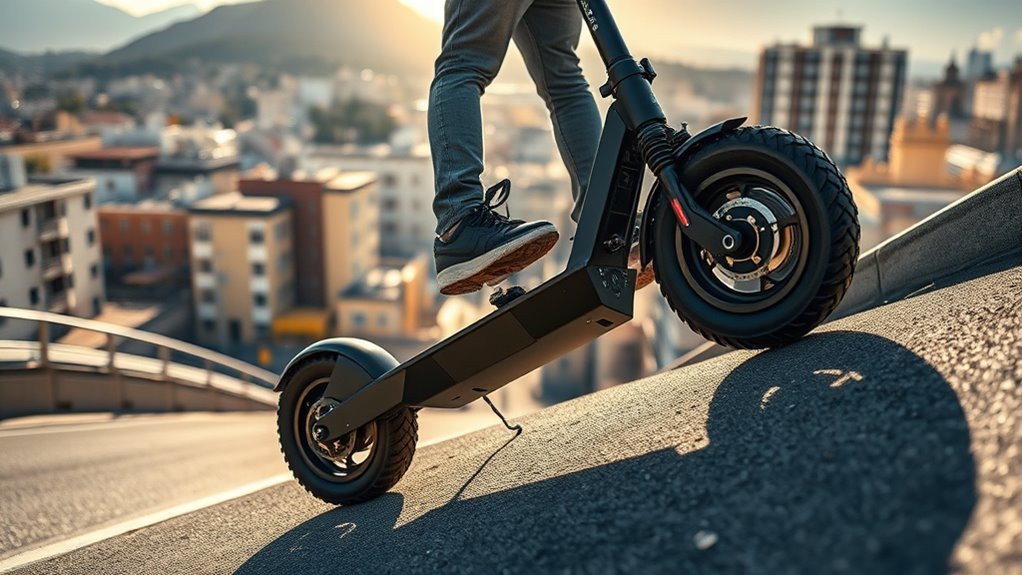
Electric scooter gradeability describes the steepness of a slope a scooter can climb under a particular set of conditions. Manufacturers may call it maximum slope, maximum climbing slope, hill grade, or climbing capability.
Percent grade is based on vertical rise compared with horizontal run. According to the USDA Forest Service’s grade-measurement guidance, the formula is:
Grade (%) = vertical rise ÷ horizontal run × 100
A road that rises 10 feet over 100 horizontal feet is therefore a 10% grade. Percent grade and degrees are not the same measurement.
| Percent Grade | Approx. Angle | What It Means |
|---|---|---|
| 5% | 2.9° | 5 units of rise per 100 horizontal units |
| 10% | 5.7° | 10 units of rise per 100 horizontal units |
| 15% | 8.5° | 15 units of rise per 100 horizontal units |
| 20% | 11.3° | 20 units of rise per 100 horizontal units |
| 25% | 14.0° | 25 units of rise per 100 horizontal units |
| 30% | 16.7° | 30 units of rise per 100 horizontal units |
Note: A manufacturer’s “maximum slope” is not automatically comparable with another brand’s rating. Check the stated rider load and any published test conditions before treating two percentages as equivalent.
How Is Electric Scooter Gradeability Measured?
There is no single consumer-facing hill test that every electric scooter manufacturer reports in exactly the same way. A manufacturer may test whether a scooter can climb a certain slope with a specified rider mass, battery state, surface, temperature, or riding mode. Some specifications provide only the maximum slope and rider weight, while others disclose more detail.
That means a 20% rating should be read as a model-specific performance claim under the maker’s conditions, not as a promise that every rider will climb every 20% hill at a particular speed.
Measurement Methods
For the hill itself, grade can be measured from elevation change and horizontal distance or with an inclinometer or clinometer. A 15% grade means 15 units of vertical rise for every 100 horizontal units of run. That is about 8.5°. A 30% grade is about 16.7°.
If a map or surveying tool gives you the rise and horizontal run, divide the rise by the run and multiply by 100. Measure the steepest meaningful segment rather than averaging a long route that includes flatter sections.
Gradeability Test Conditions
Always look for the conditions behind a maximum-slope claim. For example, Segway currently lists the F3’s maximum climbing slope at approximately 20% with a 75 kg rider. Other specifications may publish a slope figure without describing the same variables, so cross-brand comparison requires caution.
Real-world climbing can change with:
- Total rider and cargo weight.
- Battery state of charge and temperature.
- Whether the hill is short or sustained.
- Whether you enter with momentum or start from rest.
- Pavement condition, gravel, water, leaves, or loose debris.
- Tire type, tread, pressure, and condition.
- Motor and controller temperature.
- Drive layout and available traction.
Why Gradeability Ratings Are Not Always Directly Comparable
Maximum-slope numbers can look simple, but manufacturers may use different test methods. One scooter may be rated with a 75 kg rider on dry pavement and a fresh battery, while another brand may not publish its exact hill-test load or duration.
For a useful comparison, check the slope rating together with nominal and maximum motor power, test load, maximum payload, battery specification, tire setup, drive wheel, and any test notes supplied by the manufacturer.
How to Measure the Steepest Hill on Your Route
You do not need to guess whether your commute contains a 10%, 15%, or 20% hill. If you know the elevation gain and horizontal distance for the steepest section, use the grade formula:
Grade (%) = rise ÷ horizontal run × 100
- Identify the steepest continuous part of the hill rather than the entire street.
- Find the elevation difference between the bottom and top of that segment.
- Measure the horizontal distance between those points.
- Divide the elevation gain by horizontal distance.
- Multiply by 100 to get percent grade.
A phone inclinometer can provide a rough check, but mounting angle and sensor calibration can affect the reading. For an important buying decision, compare more than one measurement method when practical.
Pro Tip: Measure the steepest sustained section and note whether you must stop at a traffic light or intersection before it. Starting from rest on a steep grade can be more demanding than entering the same hill with safe momentum.
Which Gradeability Rating Fits Your Route?
Choose a scooter whose published maximum climbing slope is comfortably above the steepest grade you expect to ride, especially if you are heavier than the manufacturer’s test rider, carry cargo, encounter long climbs, or ride in less-than-ideal conditions. There is no universal rule that guarantees a specific number of extra percentage points will provide enough margin.
Instead of relying on a fixed “safety buffer,” compare your route and load with the manufacturer’s published conditions. If your hill is already close to the scooter’s claimed maximum, expect less speed and less reserve for heat, low battery, rough pavement, or a standing start.
Matching Hills To Motors
Motor wattage helps describe a drivetrain, but it does not translate directly into a particular hill grade. Current manufacturer specifications illustrate the difference:
- The NIU KQi2 Pro is listed with 250 W rated power, 500 W maximum power, and a 15% uphill-climb specification.
- Segway lists the G30LP at 350 W nominal, 700 W maximum, and an approximately 20% maximum climbing slope.
- On the same Segway comparison, the G3 is listed at 850 W nominal, 2,000 W maximum, and an approximately 30% maximum climbing slope.
These examples show why a claim such as “500 W equals an 18% hill” is too simple. Controller current, motor design, wheel diameter, thermal limits, traction, software tuning, and riding speed all affect usable climbing performance.
Choosing A Safety Buffer
Build margin by choosing a scooter whose published hill rating exceeds the steepest part of your route under conditions similar to yours. Give yourself more margin when you:
- Weigh substantially more than the stated hill-test rider.
- Carry a backpack, groceries, or other cargo.
- Have long rather than short climbs.
- Need to start on an incline.
- Ride in hot or cold conditions.
- Use rough, wet, loose, or damaged pavement.
If the manufacturer does not explain its slope-test conditions, treat the maximum rating as a best-case specification rather than a guaranteed everyday result.
Why Motor Power Affects Hill Climbing
Motor power matters because climbing requires the scooter to do work against gravity while also overcoming rolling resistance and drivetrain losses. However, the watt figure printed on a specification sheet is only part of the system.
- Nominal or rated power describes the motor’s normal operating rating.
- Maximum or peak power describes a higher short-duration output under certain conditions.
- Controller current limits influence how much electrical power and low-speed torque the system can deliver.
- Wheel size and motor design affect how motor torque becomes force at the tire.
- Thermal protection may reduce output when the motor, controller, or battery becomes too hot.
A 500 W label therefore does not correspond to a fixed torque value such as 40 or 50 Nm. Torque depends on motor speed and drivetrain design, so two scooters with the same nominal wattage may climb very differently.
How Battery Voltage and Capacity Affect Climbing
The battery has to supply the electrical energy and current demanded by the motor and controller. Voltage is important, but higher voltage by itself does not guarantee a better hill climber.
At a given electrical power, a higher-voltage system can deliver that power at lower current because electrical power is approximately voltage multiplied by current. But actual hill performance also depends on battery internal resistance, controller limits, motor design, state of charge, temperature, and software.
Capacity also needs careful comparison. Amp-hours (Ah) alone do not tell you total battery energy when voltages differ. A better comparison is watt-hours:
Battery energy (Wh) ≈ nominal voltage × amp-hours
For example, a 48 V 10 Ah pack is roughly 480 Wh, while a 36 V 10 Ah pack is roughly 360 Wh. Higher Wh generally means more stored energy, although it still does not tell you how much power the pack can safely deliver at once.
Climbing normally consumes more energy than flat riding because the scooter must raise the combined scooter-and-rider mass against gravity. The extra consumption is not a fixed 40%; it varies with slope, speed, total mass, efficiency, wind, temperature, and hill length.
Note: ANSI/CAN/UL 2272:2026 covers electrical-system safety for personal e-mobility devices, including the battery and charger combination. It does not certify hill-climbing performance or overall vehicle reliability.
Why Rider Weight, Tires, and Traction Matter
Your scooter must move the combined mass of the scooter, rider, and cargo uphill. More mass requires more force and energy for the same slope and speed, but there is no universal rule saying each additional 20 or 25 pounds removes a fixed number of grade percentage points.
Instead, compare your total load with both the scooter’s maximum payload and the load used for any published hill test. A model tested at 75 kg may not deliver the same maximum-slope performance near its full payload limit.
- Heavier loads increase the force and energy needed to climb.
- Drive-wheel traction determines how much motor force can reach the pavement without slipping.
- Tire condition and tread affect grip, especially on loose or wet surfaces.
- Tire pressure should stay within the manufacturer’s recommended range; excessive pressure can reduce grip, while insufficient pressure increases rolling resistance and can damage the tire.
Rear-wheel drive can provide useful climbing traction on some designs, but it is not automatically superior in every situation. Overall geometry, rider position, tire grip, and electronic traction control also matter.
How to Improve Electric Scooter Gradeability
You cannot safely turn a scooter into a much steeper hill climber simply by changing one setting, but you can help it perform closer to its intended capability.
- Keep pneumatic tires at the pressure recommended by the manufacturer.
- Remove unnecessary cargo before a difficult climb.
- Start with enough battery charge for the route.
- Approach the hill with safe momentum when traffic and conditions allow.
- Use smooth throttle instead of repeated abrupt acceleration.
- Keep brakes adjusted so they do not drag.
- Inspect tires, bearings, drivetrain components, and wheels for damage or excessive resistance.
- Allow an overheated scooter to cool if its manual or display indicates thermal protection.
Do not bypass controller limits, install an unapproved battery, or modify electrical protection systems just to gain hill performance. The U.S. Consumer Product Safety Commission recommends using only manufacturer-approved batteries and chargers and following the manufacturer’s operating and charging instructions.
How to Ride Uphill Safely
Approach a hill at a controlled speed and maintain a stable stance. A modest forward body position may help counter the uphill angle, but avoid shifting so far forward that you reduce traction on the driven wheel. Keep both hands on the handlebars and make smooth steering and throttle inputs.
Before riding, CPSC recommends checking the scooter’s handlebars, brakes, throttle, lights, tires, cables, and frame and wearing a properly fitted bicycle helmet.
- Inspect tire condition and pressure.
- Test the brakes before reaching the hill.
- Look for loose gravel, water, potholes, leaves, and other traction hazards.
- Accelerate smoothly rather than snapping the throttle open.
- Leave room to stop or turn around safely if speed drops sharply.
- Dismount and walk if the scooter cannot maintain safe, controlled progress.
Warning: A scooter’s maximum climbing rating is not a downhill braking rating. A steep descent can increase speed and braking demand. If you are unsure whether the scooter can control a hill safely in both directions, walk it and follow the manufacturer’s limits.
Short Hills vs. Sustained Climbs
A scooter may crest a short steep ramp but struggle on a longer hill with the same percentage grade. Longer climbs keep the motor, controller, and battery under high load for more time, which can increase heat and energy consumption.
Starting from rest can also be harder than entering a hill already moving. If your route has a stop sign or traffic light at the bottom of a steep climb, that detail may matter more than the street’s average grade.
When comparing scooters for a hilly commute, look beyond the maximum grade number and ask whether independent testing or the manufacturer describes sustained climbs, start-from-rest behavior, thermal limits, and rider load.
Frequently Asked Questions
What Does 30% Gradeability Mean?
A 30% grade rises 30 units for every 100 horizontal units of run. It is approximately a 16.7° slope. It does not mean a 30° hill. A scooter rated for 30% should still be judged according to the manufacturer’s test load and conditions.
Are Scooters Good for Autistic Kids?
There is no one-size-fits-all answer. Suitability depends on the child’s age, balance, coordination, judgment, sensory comfort, and the scooter itself. Electric scooters may be designed for teens or adults and can reach speeds that are inappropriate for younger children. Follow the manufacturer’s age and weight limits, use a helmet and close supervision, and consider advice from a pediatrician or occupational therapist when motor or sensory needs affect safe riding.
Can a 500W Scooter Go Uphill?
Yes, many scooters with around 500 W of maximum or nominal motor power can climb hills, but there is no universal grade for a 500 W scooter. For example, NIU lists the KQi2 Pro at 250 W rated and 500 W maximum with a 15% uphill specification. Always use the specific model’s slope rating and test conditions rather than wattage alone.
Is 30 Mph Fast for an E-Scooter?
Yes. A 30 mph electric scooter is fast enough that braking distance, protective equipment, visibility, road conditions, and rider skill become especially important. Wear a properly fitted helmet, follow local speed and roadway rules, and use only a scooter designed and maintained for that speed.
Is a 20% Grade Steep for an Electric Scooter?
A 20% grade is about 11.3°. That is a meaningful climb for a small electric scooter, particularly if the hill is long, the rider is heavy, the surface is poor, or the scooter must start from rest.
Does a Low Battery Reduce Hill-Climbing Performance?
It can. Some scooter systems reduce available power as battery voltage falls or when battery, motor, or controller protection limits are reached. The effect varies by model, battery condition, temperature, and controller design.
How Do I Measure the Grade of a Hill?
Measure the vertical elevation change and horizontal distance over the section you want to evaluate. Divide the rise by the horizontal run and multiply by 100. For example, a 15-foot rise over 100 horizontal feet is a 15% grade.
Can I Trust a Manufacturer’s Maximum Slope Rating?
Use it as a useful comparison point, not an unconditional guarantee. Check whether the manufacturer states the rider load or other test conditions, and leave extra performance margin for heavier loads, long hills, rough surfaces, low battery, temperature, and standing starts.
Conclusion
Electric scooter gradeability is useful when you understand what the number does and does not tell you. Measure the steepest part of your route, convert the slope correctly, and compare it with the manufacturer’s maximum-slope rating and published test conditions.
Do not choose a hill scooter from wattage or voltage alone. Motor and controller design, total load, battery condition, traction, temperature, and hill length all affect real-world climbing. Choose enough performance margin for your route, keep the scooter properly maintained, and walk hills that exceed what you or the scooter can safely control.
Sources
- USDA Forest Service — Measuring Trail Grade — percent-grade formula and slope measurement.
- Segway — G30LP, Max G2 and Max G3 specifications — motor, voltage, payload, and maximum climbing-slope examples.
- Segway — F3 specifications — maximum climbing slope, stated test load, power, voltage, and payload.
- NIU — KQi2 Pro specifications — rated/maximum motor power and 15% uphill-climb specification.
- U.S. Consumer Product Safety Commission — Micromobility Information Center — helmet, inspection, riding, charging, age, and weight-limit guidance.
- UL Standards & Engagement — UL 2272 — current electrical-system safety standard and scope for personal e-mobility devices.
