
Last Updated on September 11, 2026 by Daniel Globe
Using the London Underground is straightforward once you understand the map, fare zones, payment readers, and train directions. The Tube has 11 lines and serves most major central London sights, while connecting with the DLR, Elizabeth line, London Overground, buses, and National Rail. This guide explains how to choose a payment method, find the right platform, avoid maximum fares, travel at night, and reach London’s airports.
Quick Answer
To use the London Underground, plan your route in TfL Go, tap in with an Oyster card or the same contactless card or device you will use to tap out, follow signs for the correct line and direction, let passengers leave first, and tap out at your destination. Most visitors travel mainly in Zones 1–2.
Key Takeaways
- Contactless and Oyster use pay-as-you-go fares and daily capping. Use one card or device per traveller.
- Always tap in and out on the Tube, DLR, Elizabeth line, and London Overground. On buses and trams, tap in only.
- Follow the line name, direction, and destination shown on the platform display rather than relying only on north, south, east, or west.
- Night Tube service runs on five lines on Friday and Saturday nights, but exact first and last trains vary by station.
- Check TfL’s step-free route information if you use a wheelchair, have limited mobility, or are carrying heavy luggage.
At a Glance
| Time Required | About 2–5 minutes to plan a typical journey, plus travel time |
| Difficulty | Easy after you understand line directions and payment readers |
| Tools Needed | Contactless card or device, Oyster card, and TfL Go or a Tube map |
| Cost | Common Zone 1-inclusive PAYG singles range from £3.00 to £5.90 as of July 24, 2026 |
Disclosure: As an Amazon Associate I earn from qualifying purchases. Some links on this page are affiliate links, at no extra cost to you.
What Is the London Underground?
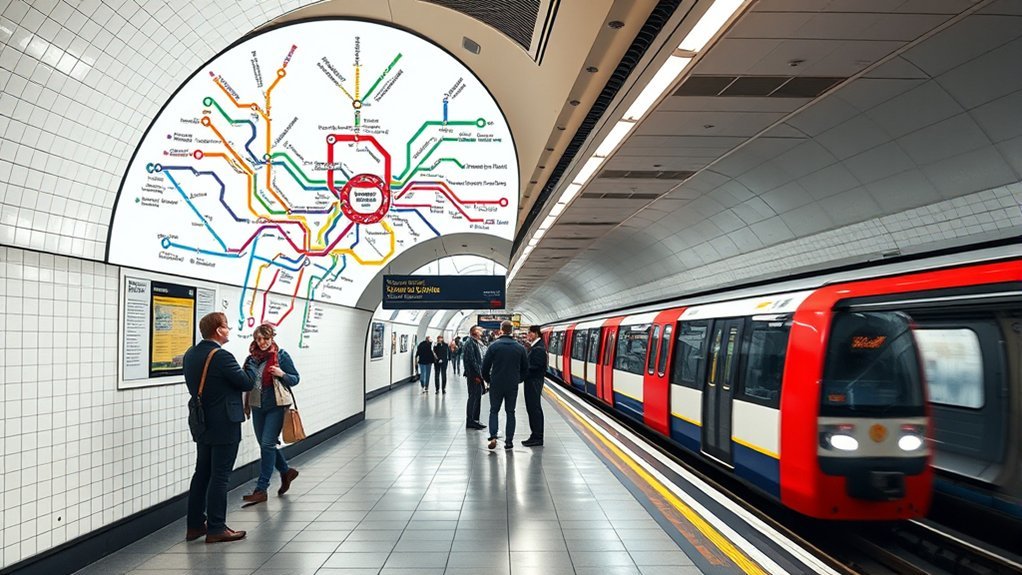
The London Underground, commonly called the Tube, is London’s rapid-transit railway. Passenger service began in 1863 between Paddington and Farringdon, making it the world’s first underground railway.
Today, the network has 11 lines covering about 402 kilometres and serving 272 stations, according to Transport for London. TfL operates the Tube and also manages or coordinates buses, the DLR, London Overground, the Elizabeth line, trams, and several other transport services.
The Underground carries passengers across 11 lines and 272 stations, but the Tube map also shows several connected services that are not Underground lines.
The Elizabeth line, DLR, London Overground, and National Rail are separate from the Underground, even though they appear on many TfL maps and accept Oyster or contactless payment on eligible routes. Pay attention to the service name when planning because operating hours, fares, platforms, and airport routes can differ.
How London Underground Zones and Lines Work
London’s public transport fare area is divided into nine concentric zones. Zone 1 covers central London, and the zone numbers increase as you travel farther from the centre. Most major visitor attractions are in Zones 1–2, while Heathrow Airport is in Zone 6 and London City Airport is in Zone 3.
- Zone 1: Westminster, Soho, Covent Garden, the City of London, and many central attractions
- Zone 2: areas around central London, including parts of Camden, Islington, Hammersmith, Greenwich, and Battersea
- Zones 3–6: outer London neighbourhoods and destinations such as Wembley, Wimbledon, and Heathrow
- Zones 7–9: selected stations on outer sections of the Metropolitan line and some rail services
Some stations appear in two zones, such as Zone 1/2 or Zone 2/3. This means the station sits on a fare-zone boundary and can generally count as either zone when the system calculates the relevant journey.
How to Read Tube Lines and Directions
Each Underground line has a name and colour. At a station, first find the signs for your line, then check the direction and destination shown on the platform display.
Directions may be described as northbound, southbound, eastbound, or westbound, but those labels are not always enough. The most reliable method is to check the final destination displayed on the train and confirm that your station appears on that branch.
Pro Tip: Branching lines such as the Northern, District, Metropolitan, and Piccadilly lines can send trains to different destinations from the same platform. Read the front of the train and the platform display before boarding.
Best London Underground Payment Options
Most adults should use contactless payment or an Oyster card. Both support pay-as-you-go fares and daily capping. The right choice depends on your bank card, age, discounts, and length of stay.
| Payment method | Best for | Important limitation |
| Contactless card or device | Most adults who have an accepted bank card | Overseas transaction fees may apply, and each traveller needs a separate card or device |
| Standard Oyster card | Visitors without a suitable contactless card and travellers eligible for certain discounts | Requires prepaid credit and may include a card fee |
| Visitor Oyster card | Visitors who want a card delivered before travelling or cannot rely on an overseas bank card | Must normally be ordered before arrival and does not automatically cost less than contactless |
| Travelcard | Regular travellers, groups using eligible products, or people who specifically need unlimited travel in selected zones | A Day Travelcard may cost more than reaching a PAYG daily cap |
Current Tube Fares and Daily Caps
The following adult prices apply as of July 24, 2026. Single fares can vary by route and direction, so use TfL’s Single Fare Finder for an exact journey.
| Journey or limit | Peak | Off-peak or fixed price |
| Zone 1 only PAYG single | £3.10 | £3.00 |
| Zones 1–2 PAYG single | £3.60 | £3.10 |
| Zones 1–6 PAYG single | £5.90 | £4.00 |
| Zones 1–2 daily cap | £8.90 | |
| Zones 1–5 daily cap | £15.30 | |
| Zones 1–6 daily cap | £16.30 | |
| Zones 1–6 seven-day Travelcard | £81.60 | |
Peak PAYG fares generally apply when you touch in from 06:30 to 09:30 and 16:00 to 19:00, Monday to Friday. Weekends and public holidays are off-peak. Directional and route-specific exceptions exist, so check the fare finder when price matters.
Note: Tube and rail PAYG single fares increased on March 1, 2026, but Travelcard prices and multimodal daily caps were frozen. Current and planned fare changes are published in the March 2026 fare decision.
Bus and Tram Fares
London buses and trams use a flat fare rather than Tube zones. As of July 24, 2026, an adult PAYG journey costs £1.75. The Hopper fare allows additional bus or tram journeys within one hour of the first touch using the same card or device.
The £1.75 fare is scheduled to remain in place through October 31, 2026. It is scheduled to rise to £1.85 on November 1, 2026, according to the July 2026 mayoral fare decision.
Children and Family Payment Rules
- Children under 11 can travel free on the Tube, DLR, London Overground, Elizabeth line, and eligible National Rail services when accompanied by a fare-paying adult.
- One adult can generally accompany up to four children under 11 on TfL rail services.
- Children aged 11–15 normally need an 11–15 Zip Oyster photocard or another eligible child ticket or discount.
- Visitors with children aged 11–15 can ask station staff whether a Young Visitor discount can be added to an Oyster card.
- Two adults cannot share one contactless card or one Oyster card for the same journey. Each paying passenger needs a separate payment method.
How to Use the London Underground Step by Step
1. Plan Your Route
Use the official TfL Go app or TfL Journey Planner. Enter your starting point and destination, then review:
- The line or lines you need
- The direction or train destination
- Any station changes
- Live delays or closures
- Walking time inside large interchange stations
- Step-free options and lift closures
Citymapper can also compare Tube, bus, rail, walking, and cycling routes, but TfL remains the official source for service status and station information.
2. Tap In at the Station
Hold your Oyster card, contactless card, phone, or watch flat against the yellow reader. Wait for the green light and gate to open. If the station has no closed gates, find a freestanding yellow reader and tap before entering the platform area.
3. Find the Correct Platform
Follow signs showing the line name and colour. At the platform entrance, check the list of stations to confirm that your destination is in that direction. Then read the electronic display to check the train’s final destination.
At a large interchange, changing lines may involve stairs, escalators, lifts, corridors, or a walk between platforms. Follow the coloured line signs rather than following the crowd.
4. Board and Change Trains
Stand behind the yellow line while waiting. Allow passengers to leave before boarding, then move farther inside the carriage so the doorway remains clear.
If you change trains within a station, you normally do not tap out and back in. Follow the signs for the connecting line. At certain interchanges, you may pass through ticket gates or complete an out-of-station interchange. Keep using the same payment method.
5. Tap Out at Your Destination
Use the same card or device that you used to tap in. A bank card and a phone linked to that card are treated as different payment methods. Tapping in with one and out with the other can create two incomplete journeys and two maximum fares.
Warning: Do not tap in with a physical bank card and tap out with a phone or watch, even when they use the same bank account. Keep other contactless cards away from the reader to prevent card clash.
Common Tube Payment Mistakes
Forgetting to Tap In or Out
An incomplete journey can result in a maximum fare and may not count correctly toward your daily cap. Tap out even when station gates are open.
If a reader was unavailable or you were charged unexpectedly, review your journey history and refund options through TfL’s refunds and replacements service.
Ignoring a Pink Reader
Pink readers appear at selected interchange stations. They tell the fare system that you took a route avoiding Zone 1. If your journey has an eligible cheaper route, touch the pink reader while changing trains, but do not exit the station.
Use TfL’s Single Fare Finder to check whether a pink-reader route applies to your journey.
Card Clash
Card clash occurs when the reader detects more than one Oyster or contactless card. Remove the card you want to use from your wallet and touch only that card.
Using a Phone With a Low Battery
If you tap in with a phone or smartwatch, make sure it will remain powered until you tap out. A dead device can prevent you from completing the journey or showing the payment method during an inspection.
Tapping Out on a Bus
On London buses and trams, you generally touch in only. Do not touch a bus reader again when leaving. Tube, DLR, London Overground, Elizabeth line, and most eligible rail journeys require both a touch in and a touch out.
Tube Tips, Etiquette, and Safety
- Escalators: Stand on the right and walk on the left where signs permit.
- Boarding: Let passengers leave before you enter.
- Doorways: Move down the carriage and keep doors clear.
- Priority seats: Offer them to passengers who are elderly, pregnant, disabled, unwell, or less able to stand.
- Platforms: Stay behind the yellow line and avoid running for closing doors.
- Bags: Keep luggage beside you and remove backpacks in crowded carriages.
- Belongings: Keep phones, wallets, passports, and bags secure, especially at busy central stations.
- Emergency help: Speak to station staff or use a passenger help point if you feel unsafe or need assistance.
Large stations such as King’s Cross St Pancras, Bank, Waterloo, and Green Park can involve long walks between lines. A route with one extra train stop but an easier interchange may be better when travelling with children, luggage, or limited mobility.
Tube Hours, Night Tube, and Accessibility
First and Last Tube Trains
Most Underground lines operate from early morning until around midnight, but there is no single opening or closing time for the whole network. First and last trains vary by:
- Station
- Direction
- Line and branch
- Day of the week
- Engineering work or temporary closures
Check the station page, TfL Go, or Journey Planner before an early flight, late event, or Sunday journey. Do not assume that arriving at a station before midnight guarantees a train to the end of the line.
Night Tube Lines
The Night Tube runs on Friday and Saturday nights on selected sections of these lines:
- Central line
- Jubilee line
- Northern line
- Piccadilly line
- Victoria line
Night Tube fares are charged at off-peak rates. Other lines may be served by night buses or alternative rail services, but planned closures can affect both day and night travel.
Step-Free Access
More than a third of Tube stations provide some form of step-free access, while all DLR stations and all Elizabeth line stations have step-free routes. However, step-free to the platform does not always mean level access between the platform and train.
TfL’s accessible journey planner can identify:
- Step-free routes from street to platform
- Routes with level access from street to train
- Stations where a boarding ramp may be needed
- Lift closures and alternative stations
- Routes with fewer stairs, escalators, changes, or walking
Note: Ask station staff for assistance when needed. TfL staff can help with routes, boarding ramps, lifts, and alternative step-free connections.
Tube and Rail Routes to London Airports
Heathrow Airport
The Piccadilly line provides a direct Underground connection between central London and Heathrow. The journey usually takes about 50–60 minutes, depending on your central London station and the terminal.
Heathrow has three Underground stations:
- Heathrow Terminals 2 & 3
- Heathrow Terminal 4
- Heathrow Terminal 5
Check the train destination because not every westbound Piccadilly line train goes to Heathrow, and Heathrow trains may serve different terminal branches.
The Elizabeth line also serves Heathrow and is often faster for Paddington, Bond Street, Tottenham Court Road, Farringdon, Liverpool Street, and Canary Wharf. It appears on TfL maps but is not an Underground line.
London City Airport
London City Airport is served by the Docklands Light Railway in Zone 3. The airport station is step-free, and DLR services provide connections toward Bank, Stratford, Canning Town, Tower Gateway, Woolwich Arsenal, and other east London destinations.
DLR branches vary, so check the destination displayed on the train. You may need to change at Canning Town, Poplar, or another interchange for your final destination.
Gatwick, Stansted, and Luton Airports
Gatwick, Stansted, and Luton airports do not have London Underground stations. Use the appropriate National Rail or airport coach service:
- Gatwick: Thameslink, Southern, or Gatwick Express
- Stansted: Stansted Express or coach
- Luton: Thameslink or East Midlands Railway to Luton Airport Parkway, followed by the airport connection
Oyster availability and contactless fares differ outside London’s normal fare zones. Check the relevant train operator before travelling.
Frequently Asked Questions
What areas are in Zones 1 and 2 in London?
Zone 1 covers most of central London, including Westminster, Soho, Covent Garden, South Bank, and the City of London. Zone 2 surrounds it and includes areas such as Camden Town, parts of Islington, Hammersmith, Greenwich, and Battersea. Always check the current TfL map because some stations sit on zone boundaries.
How much is a Zones 1–6 Travelcard?
As of July 24, 2026, a seven-day adult Zones 1–6 Travelcard costs £81.60. An Anytime Day Travelcard for Zones 1–6 costs £23.60, while an Off-Peak Day Travelcard for Zones 1–6 costs £16.60. Check TfL before travelling because fares can change.
Is Zone 1 always the most expensive?
Not always, but journeys that include Zone 1 often cost more than comparable journeys made entirely in outer zones. The exact fare depends on the stations, route, direction, and touch-in time. Use TfL’s Single Fare Finder for the correct price.
What does Zone 1/2 mean on a Tube map?
Zone 1/2 means the station sits on the boundary between the two zones. It can generally be treated as being in either zone when the fare system calculates a journey, which may reduce the number of zones charged.
Can two people use the same contactless card?
No. Each paying passenger must use a separate contactless card, device, Oyster card, or valid ticket. One card cannot open the gates for two adults on the same journey.
Do you tap out on London buses?
No. Touch your Oyster card or contactless payment method once when boarding a London bus. Do not tap again when leaving. Tube, DLR, London Overground, Elizabeth line, and eligible rail journeys require both a touch in and a touch out.
Which Underground lines run all night?
Night Tube service normally runs on Friday and Saturday nights on selected parts of the Central, Jubilee, Northern, Piccadilly, and Victoria lines. Check TfL before travelling because engineering work can close sections of a line.
Sources
- Transport for London: What We Do — Underground line, station, and network-length figures
- London City Hall: March 2026 TfL Fare Changes — PAYG fares, caps, and Travelcard prices
- London City Hall: July 2026 Fare Changes — current and scheduled bus and tram fares
- Transport for London: How to Pay the Right Fare — touching rules, card clash, pink readers, and maximum fares
- Transport for London: Night Tube — overnight lines, days, fares, and accessibility
- Transport for London: Plan an Accessible Journey — step-free routes, lifts, ramps, and accessibility tools
Conclusion
The London Underground becomes much easier once you know three rules: plan the route before entering, follow the line destination as well as the direction, and use the same Oyster card or contactless device when tapping in and out. Check current fares and service updates in TfL Go, leave extra time for large interchanges, and review step-free information when accessibility or luggage is a concern. With those habits, you can travel across London quickly without paying avoidable maximum fares or boarding the wrong branch.
