
Last Updated on September 11, 2026 by Daniel Globe
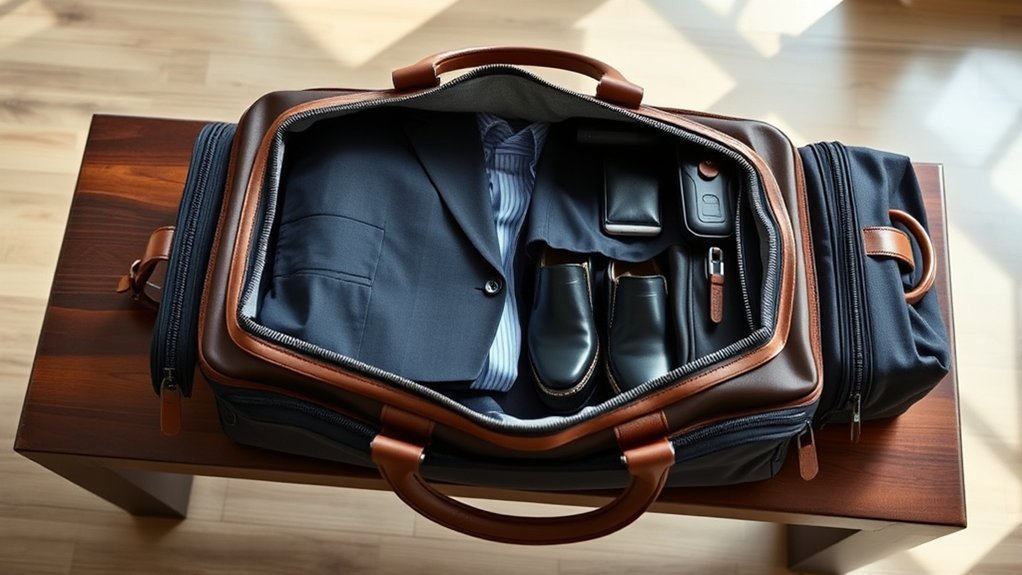
A convertible garment duffle bag combines a lay-flat garment section with the storage space of a weekender bag. It can be useful for business trips, weddings, cruises, and short breaks when you need to carry a suit, dress, shoes, and everyday clothing in one bag. However, capacity, weight, materials, and airline compatibility vary by model, so you should compare the packed dimensions instead of relying only on a “carry-on friendly” label.
Quick Answer
A convertible garment duffle opens flat so you can secure a suit, dress, or shirts inside, then zips into a duffle for shoes and folded clothing. It can reduce hard creases, but it cannot guarantee wrinkle-free clothes. Check the bag’s packed dimensions against your airline’s current carry-on rules before flying.
Key Takeaways
- A garment duffle combines hanging-garment storage with a regular duffle compartment.
- Many models hold enough for a short trip, but bulky shoes and jackets reduce usable space.
- The bag helps limit sharp folds, but fabric, packing pressure, and travel time still affect wrinkles.
- Weight, capacity, materials, and maximum suit size are model-specific.
- Airlines, not TSA, set carry-on dimensions and baggage allowances.
Disclosure: As an Amazon Associate I earn from qualifying purchases. Some links on this page are affiliate links, at no extra cost to you.
What Is a Convertible Garment Duffle?
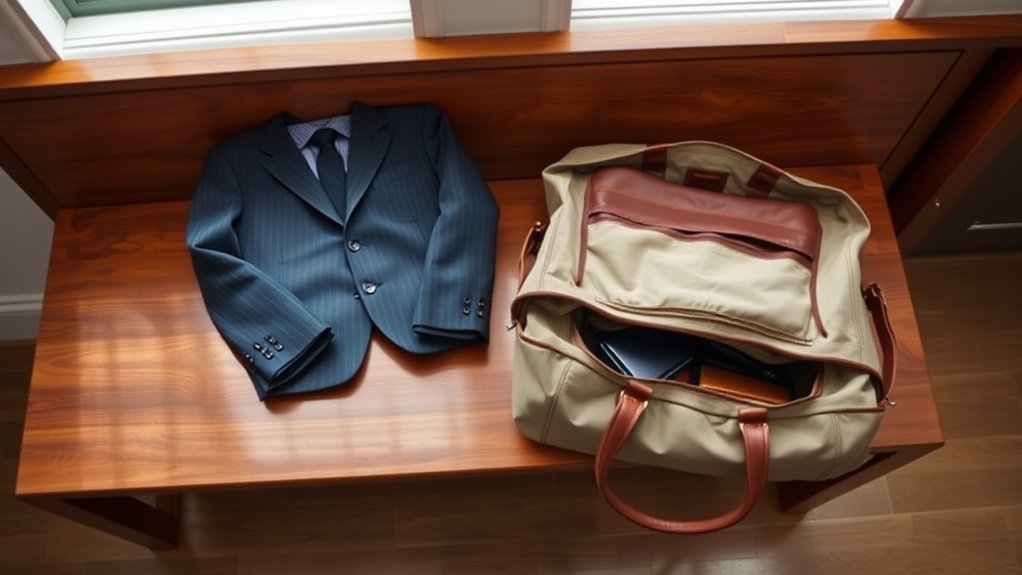
A convertible garment duffle is a two-in-one travel bag. When opened, the outer section lies flat and holds hanging clothing. After you secure the garments, the sides zip together to form a duffle-shaped main compartment.
The garment section can help you avoid the tight folds created by a standard suitcase. The central space can then hold folded clothes, toiletries, accessories, and sometimes shoes. Many models also include a removable shoulder strap, carry handles, small organizer pockets, and a trolley sleeve that fits over a rolling suitcase handle.
Specifications vary. For example, the Halfday Garment Duffel 45L is listed at 45 liters, 2.3 pounds empty, and 22 by 12 by 12 inches. It is also advertised to hold garments up to a size 50R. Those figures describe that product, not every convertible garment duffle.
Note: “Wrinkle resistant,” “water resistant,” and “carry-on friendly” are not guarantees. Read the manufacturer’s exact specifications and compare them with your clothing, trip, and airline.
Why a Convertible Garment Duffle Is Easier to Travel With
A convertible garment duffle can replace a separate weekender and garment carrier on a short trip. Its main advantage is convenience: your formal clothing, shoes, toiletries, and casual items remain in one piece of luggage.
Easy Airport Handling
Soft-sided garment duffles are usually easier to lift than hard-shell luggage, although the final weight depends on the bag and what you pack. Shoulder straps can help during short walks, while grab handles are often more comfortable when lifting the bag into a car or overhead bin.
A heavily packed duffle can become uncomfortable because most of its weight hangs from one shoulder. Check whether the shoulder pad is wide, whether the strap attaches with metal or strong reinforced hardware, and whether the handles wrap around the base of the bag.
Trolley Sleeve Convenience
A built-in trolley sleeve slides over the telescoping handle of a rolling suitcase. This can reduce shoulder strain while you move through a terminal or hotel.
The sleeve should fit closely enough to limit side-to-side movement. An overfilled duffle may lean or twist even when it is attached to a suitcase, so place heavier items near the sleeve and do not treat it as a locking system.
Packs Flat for Storage
Many soft convertible garment duffles fold or lie relatively flat when empty. This makes them easier to store under a bed, on a closet shelf, or inside larger luggage.
Not every model collapses equally well. Thick padding, reinforced bases, laptop sleeves, wheels, and structured shoe compartments can make a bag bulkier in storage.
Advantages and Disadvantages
| Advantages | Limitations |
|---|---|
| Combines garment and duffle storage | Does not eliminate every wrinkle |
| Useful for short formal trips | Can become uncomfortable when heavy |
| Often includes separate shoe storage | Shoe pockets reduce space for clothing |
| Soft construction may compress slightly | Overpacking can make it exceed airline limits |
| Many models store relatively flat | Provides less impact protection than a hard case |
How Much Can a Garment Duffle Hold?
Many full-size convertible garment duffles offer roughly 40 to 50 liters of stated capacity. That may be enough for a two- to five-day trip, but the result depends on the season, clothing size, number of shoes, and whether you need a laptop or toiletry kit.
Capacity measurements also do not tell the full story. Two bags with the same stated volume may pack differently because of curved sides, thick lining, divided shoe pockets, internal padding, or a narrow opening.
Capacity by Trip Length
| Trip length | Realistic light-packing example |
|---|---|
| 1–2 days | One suit or dress, one spare shirt, underwear, toiletries, and one pair of shoes |
| 3 days | One formal outfit, two casual outfits, toiletries, and compact accessories |
| 4 days | Three or four mix-and-match outfits, light sleepwear, toiletries, and one pair of shoes |
| 5 days | Possible for a light packer using thin layers, compact shoes, and a small toiletry kit |
| Cold-weather trip | Usually fewer days because sweaters, coats, and boots use more space |
Packing Layout and Limits
A typical layout may include:
- A lay-flat garment panel for a jacket, dress, shirt, or trousers
- Fastening straps or hanger loops
- A central compartment for folded or rolled clothing
- One or two shoe pockets
- Small zippered pockets for underwear, ties, belts, or accessories
- An exterior pocket for travel documents or small electronics
Check the garment panel’s actual length before buying. A claim that a bag holds a suit does not guarantee that it will fit a long dress, broad jacket, or large hanger without additional folding.
Shoe storage is also a tradeoff. Separate compartments help keep dirt away from clean clothes, but large shoes push into the main compartment and reduce usable clothing space.
How a Convertible Garment Duffle Packs
The exact method varies by design, but most convertible garment duffles follow the same basic process.
- Open the bag fully. Lay the garment section on a clean, flat surface with the lining facing up.
- Prepare the clothing. Empty pockets, fasten buttons, close zippers, and smooth the collar, sleeves, and lapels.
- Place the longest garment first. Lay the jacket, dress, or trousers flat and align it with the bag’s hanger loop or top section.
- Secure the garment. Use the supplied straps, loops, or clips without pulling them so tightly that they create pressure lines.
- Fold only where the bag requires it. Use wide, gentle folds instead of sharp creases.
- Zip the garment panel into a duffle. Check that no fabric is caught in the zipper.
- Add shoes and folded items. Put shoes in their compartment and place heavier items near the bottom or trolley-sleeve side.
- Fill gaps lightly. Use underwear, socks, or soft accessories to stop items from shifting, but do not force the sides outward.
- Measure the packed bag. Include bulging sides, handles, wheels, and any exterior pockets when comparing it with airline limits.
Pro Tip: Pack the suit before filling the central compartment. It is much harder to smooth and secure formal clothing after the bag has become round and tightly packed.
Garment Duffle vs. Garment Bag vs. Rolling Carry-On
| Bag type | Best for | Main drawback |
|---|---|---|
| Convertible garment duffle | Short trips with one or two formal outfits | Shoulder carry becomes tiring when heavily packed |
| Traditional garment bag | Several suits, dresses, or longer garments | Less space for shoes and casual clothing |
| Rolling carry-on with suiter | Heavier loads and long airport walks | Heavier empty weight and less flexible storage |
| Regular duffle | Casual clothing and flexible packing | No dedicated flat garment section |
Will a Garment Duffle Keep Clothes Wrinkle-Free?
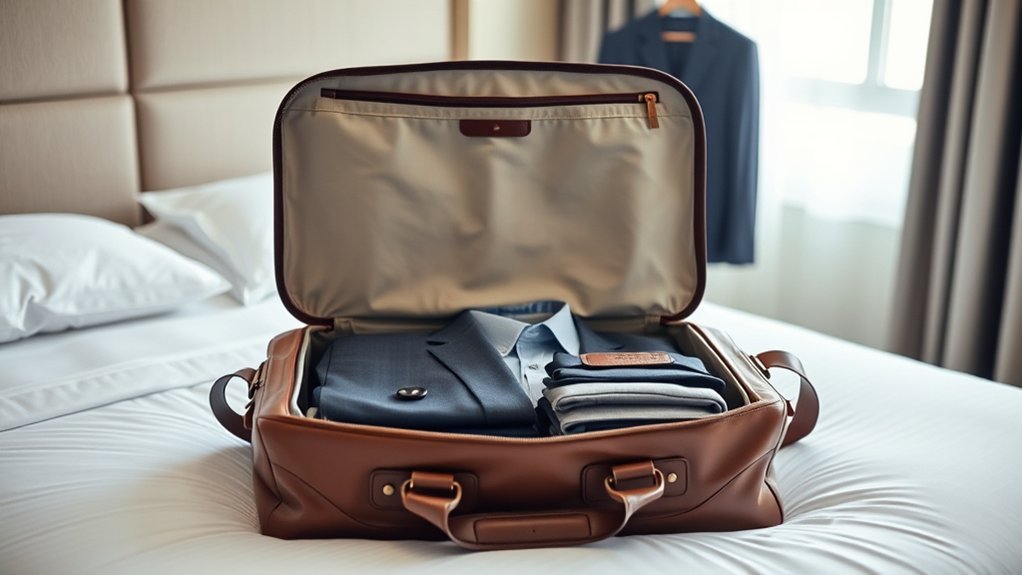
A garment duffle can reduce wrinkles, but no soft travel bag can promise that every garment will arrive perfectly smooth. Wrinkles develop when fabric is tightly folded, compressed, twisted, or left packed for a long period.
Fabric matters. Linen and untreated cotton tend to show creases easily. Wool often recovers better because its fibers have natural elasticity. Woolmark describes Merino wool as naturally crease resistant, although any suit can still wrinkle under enough pressure. You can read more in Woolmark’s travel-clothing guidance.
- Use wide, gentle folds instead of narrow folds.
- Keep shoes and toiletry bottles away from the garment panel.
- Do not pull compression straps excessively tight.
- Avoid packing the bag until its sides bulge.
- Unpack and hang formal clothing as soon as you arrive.
- Follow the garment’s care label before steaming or ironing it.
A garment compartment reduces harsh folding, but fabric choice and packing pressure usually matter more than the word “wrinkle-free” on a product page.
Can You Pack a Suit in a Garment Duffle?
Yes, most convertible garment duffles are designed to carry at least one suit, jacket, or dress. The fit still depends on the garment panel’s length and width.
Some specific models advertise a maximum jacket size. Halfday, for example, states that its 45L Garment Duffel can hold a jacket or suit up to size 50R. Do not assume that another bag with a similar exterior size offers the same garment space.
| Packing choice | Likely effect |
|---|---|
| Secure the jacket at the shoulders | Helps the jacket stay aligned |
| Place trousers flat beneath or beside it | Limits unnecessary folds |
| Keep shoes in a separate compartment | Reduces dirt transfer and pressure points |
| Overfill the central compartment | Increases compression and wrinkles |
| Pack wrinkle-prone linen tightly | Makes visible creases more likely |
What to Look for Before You Buy
Start with the features that affect fit, comfort, and durability rather than choosing only by appearance or stated capacity.
Packed Dimensions
Measure length, width, and depth when the bag is filled. Soft sides can bulge several inches beyond the listed empty dimensions. Include handles, wheels, exterior pockets, and any rigid base.
Warning: A “carry-on friendly” label does not guarantee that an airline will accept the bag. The FAA advises travelers to check their airline’s baggage rules. Delta and American Airlines, for example, publish a standard carry-on limit of 22 by 14 by 9 inches, although policies and aircraft restrictions can vary.
Garment Panel Size
Compare the opened length with your longest jacket or dress. Look for reinforced hanger loops, straps that hold the shoulders in place, and zipper placement that will not catch loose fabric.
Materials and Weather Protection
High-denier polyester and ballistic nylon are common because they balance weight and abrasion resistance. Leather can look more formal but is usually heavier and requires different care. PU or “vegan leather” varies widely in thickness and long-term durability.
Water-resistant fabric can handle light rain or splashes. It does not necessarily make the seams, zippers, lining, or shoe compartment waterproof.
Zippers, Seams, and Hardware
- Open and close every long zipper several times.
- Check whether the garment zipper moves smoothly around corners.
- Look for reinforced stitching at handles and strap attachment points.
- Check whether zipper sliders can separate under outward pressure.
- Prefer replaceable or removable shoulder straps.
- Inspect the hanger loop and garment fasteners for weak stitching.
Organization and Comfort
Useful features may include a trolley sleeve, padded shoulder strap, separate shoe storage, wet-item pocket, laptop sleeve, and quick-access document pocket. More compartments are not always better because thick dividers add weight and reduce usable volume.
Cleaning Instructions
Check the care label before buying. Some polyester bags can be spot-cleaned with mild soap and water, while leather and PU materials may require a damp cloth or product-specific cleaner. Avoid soaking a structured bag unless the manufacturer specifically permits washing.
Garment Duffle Bags Worth Checking Out
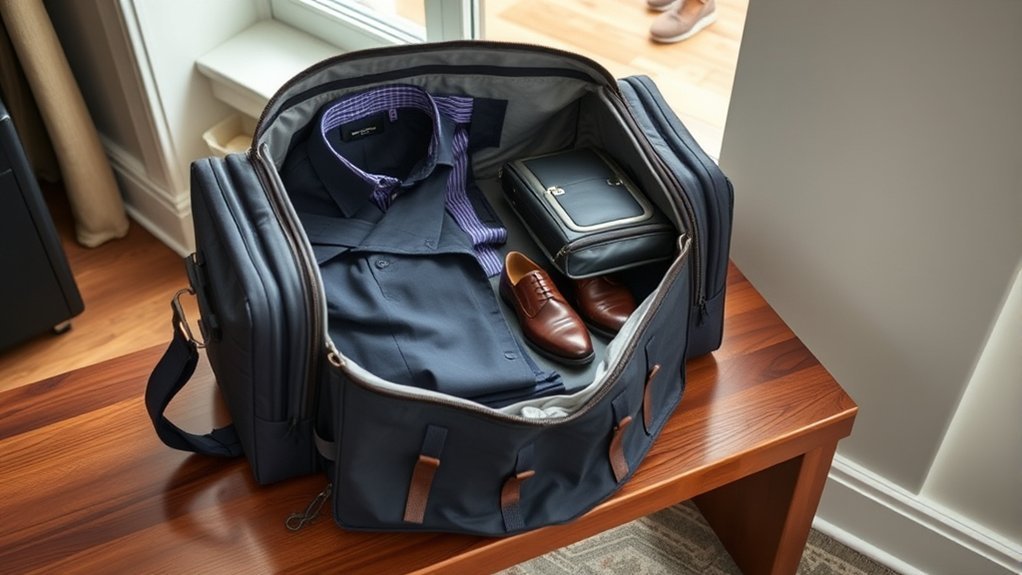
The following models illustrate the range of available designs. Prices, colors, dimensions, and availability can change, so confirm the current listing before buying.
| Model | Why consider it | What to verify |
|---|---|---|
| Halfday Garment Duffel 45L | Published 45L capacity, 2.3-pound empty weight, trolley sleeve, shoe pockets, and garment space up to 50R | Its 22-by-12-by-12-inch shape may need to compress for airlines with a 9-inch depth limit |
| Modoker Convertible Garment Bag | Two-in-one design with a hanging section, central duffle space, and shoe storage | Current dimensions, materials, zipper construction, and seller-specific version |
| Seyfocnia Convertible Travel Garment Bag | Common marketplace option with a PU-style exterior, garment layout, and separate shoe storage | Exact seller, packed size, warranty, material description, and return policy |
| Ytonet PU Leather Carry-On Garment Bag | Style-focused two-in-one design with a separate shoe pouch and external storage | PU care requirements, actual weight, airline fit, and current product version |
| Tommy Bahama Siena Tan 2-in-1 Garment Duffel | A more polished design for travelers who prioritize appearance | Current availability, dimensions, material, and zipper performance |
Note: Compare the exact model number, not only the brand name. Marketplace brands often sell several similar bags with different measurements, materials, and pockets.
Who a Convertible Garment Duffle Is Best For
A convertible garment duffle is a strong choice for:
- Business travelers carrying one suit or jacket
- Wedding guests who need formal clothes and shoes
- Travelers taking two- to four-day trips
- People who want one soft bag instead of a garment carrier and weekender
- Drivers and train passengers who are less restricted by airline dimensions
- Travelers who can pack lightly and unpack soon after arrival
It may not be the best choice for:
- Long trips with several suits or dresses
- Travelers who need wheels for long airport walks
- People carrying heavy electronics or camera equipment
- Trips that require bulky winter clothing or large boots
- Anyone who needs rigid impact protection
- Travelers whose airline has strict carry-on depth or weight limits
Frequently Asked Questions
Are convertible garment duffle bags carry-on approved?
No bag is universally carry-on approved. Airlines set their own size, weight, and item-count rules. Measure the fully packed bag, including bulges, handles, wheels, and exterior pockets. The FAA recommends checking directly with your airline before packing.
How do you clean a convertible garment duffle bag?
Follow the manufacturer’s care label. For many polyester bags, you can remove loose dirt and spot-clean the exterior with a damp cloth and mild soap. Do not soak leather, PU, padded, or structured bags unless the manufacturer specifically allows it. Air-dry the bag completely before storage.
Can it fit shoes separately from clothing?
Many models include interior shoe sleeves, a side compartment, or a removable shoe pouch. Check the stated shoe-size limit. Remember that shoes still use internal volume and may press against clothing when the bag is full.
What materials are most durable for garment duffle bags?
Ballistic nylon and high-denier polyester can provide good abrasion resistance without excessive weight. Durability also depends on zipper quality, seam reinforcement, lining, coatings, handles, and strap hardware. Leather can last well with proper care but is usually heavier.
Do convertible garment duffle bags have TSA-friendly features?
Quick-access pockets and organized compartments may make it easier to remove liquids or electronics during screening, but “TSA-friendly” is not a general approval for the bag. TSA controls security screening and prohibited items. Your airline controls baggage size and allowance.
Will a garment duffle completely prevent wrinkles?
No. It can reduce sharp folds by keeping garments flatter, but compression, fabric type, humidity, and travel time still affect creasing. Pack loosely and hang formal clothing soon after arrival.
Can you pack toiletries in the bag?
Yes, but use a leak-resistant toiletry pouch and keep it away from formal clothing. For flights departing from the United States, liquids, aerosols, gels, creams, and pastes in a carry-on generally need to follow TSA’s 3-1-1 rule unless an exemption applies.
Conclusion
A convertible garment duffle bag can be a practical choice when you need formal clothing and everyday travel gear in one soft bag. Its garment panel helps reduce harsh folds, while the central compartment provides room for shoes, toiletries, and short-trip essentials.
The best model is not simply the one with the largest capacity or the strongest wrinkle-free claim. Check the opened garment length, packed exterior dimensions, empty weight, zipper quality, shoulder comfort, shoe-pocket design, and care instructions. Most importantly, compare the fully packed bag with your airline’s current limits before leaving for the airport.
Sources
- Federal Aviation Administration: Carry-On Baggage Tips — carry-on sizing and airline-policy guidance
- Transportation Security Administration: Travel Tips — security screening and the 3-1-1 liquids rule
- Delta Air Lines: Carry-On Baggage — example airline dimensions and baggage restrictions
- American Airlines: Carry-On Bags — standard carry-on and soft-sided garment-bag guidance
- Halfday: Garment Duffel 45L Specifications — model-specific dimensions, capacity, weight, material, and garment size
- The Woolmark Company: Travel Clothing — wool elasticity and crease-resistance guidance

