Last Updated on July 30, 2026 by Caleb Warren
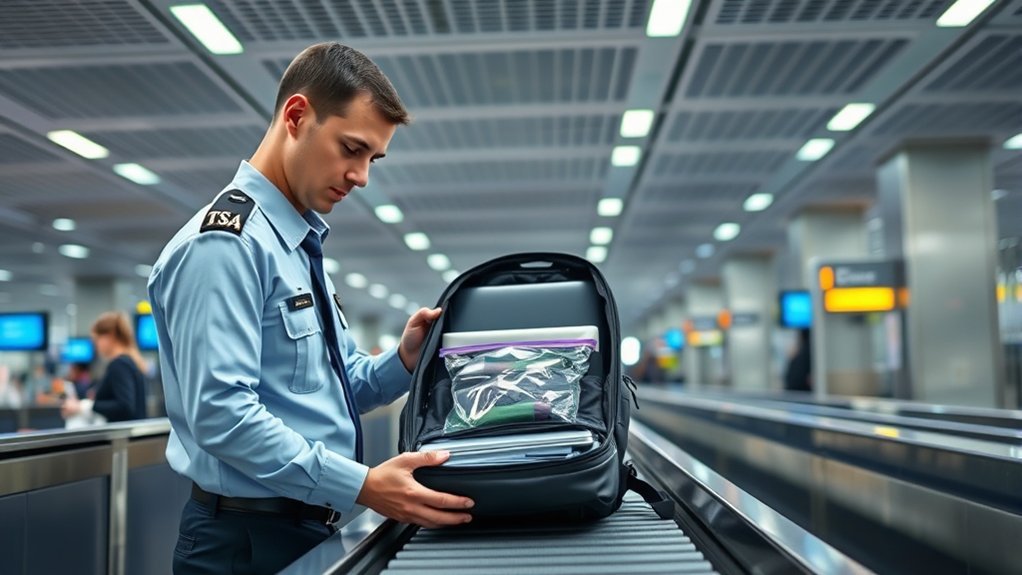
A backpack can work well as either a carry-on bag or a personal item, but passing airport security and getting it onto the plane involve different rules. TSA controls what may pass through U.S. security checkpoints, while your airline decides the backpack’s size, weight, baggage allowance, and where it must be stored.
Quick Answer
A backpack can go through TSA screening as a carry-on or personal item if its contents are allowed, but TSA does not set the bag’s size. Your airline does. Follow the 3-1-1 liquids rule, keep power banks and spare lithium batteries in the cabin, and obey the officer’s screening instructions.
Key Takeaways
- TSA controls checkpoint screening and prohibited items; your airline controls backpack dimensions and baggage allowances.
- A common carry-on limit is 22 × 14 × 9 inches, but it is not universal and must include exterior pockets, handles, wheels, and attachments.
- Most carry-on liquids must be in containers no larger than 3.4 ounces or 100 milliliters and fit in one quart-sized bag.
- Power banks and spare lithium batteries must stay in carry-on baggage and must be removed if the backpack is checked at the gate.
- Place identification, medication, travel documents, electronics, and valuables where you can reach them quickly.
At a Glance
| Time Required | 10–20 minutes to measure and organize the backpack |
| Difficulty | Easy |
| Tools Needed | Tape measure, quart-sized liquids bag, small organizers or packing cubes, and your airline’s current baggage policy |
| Cost | $0 with supplies on hand; about $5–$15 if you need travel bottles or a clear liquids bag |
Disclosure: As an Amazon Associate I earn from qualifying purchases. Some links on this page are affiliate links, at no extra cost to you.
Understanding TSA Rules for Backpacks
Three separate sets of rules may affect your backpack:
- TSA rules determine which items can pass through a U.S. security checkpoint and whether an item needs extra screening.
- FAA and federal hazardous-material rules control items such as lithium batteries, power banks, aerosols, and other potentially dangerous goods.
- Airline policies determine the number, size, and sometimes weight of bags you may take into the cabin.
This means TSA does not impose one universal backpack size. The agency advises passengers to check with their airline because cabin-baggage dimensions vary by carrier. A backpack may count as your larger carry-on when placed in the overhead bin or as your personal item when it fits completely beneath the seat in front of you.
Note: Airline approval and TSA screening are separate. A bag can contain only TSA-permitted items and still be rejected at the gate because it is too large, too heavy, or not included with the fare.
Liquids, Gels, Aerosols, Creams, and Pastes
For ordinary carry-on liquids, follow the TSA 3-1-1 liquids rule:
- Each container must hold no more than 3.4 ounces or 100 milliliters.
- The containers must fit inside one clear, quart-sized, resealable bag.
- Each passenger may bring one liquids bag through the checkpoint.
- The limit is based on the container’s capacity, not the amount remaining inside it. A half-full 6-ounce bottle is still too large for the standard liquids bag.
Toothpaste, lotion, shampoo, sunscreen, gel deodorant, spreads, sauces, yogurt, jam, and similar products normally count as liquids, gels, creams, or pastes.
Medication and Other Liquid Exceptions
Medically necessary liquids, medications, gels, and aerosols may exceed 3.4 ounces when carried in reasonable quantities for the trip. Tell the TSA officer about these items before screening and keep them separate and easy to reach.
Formula, breast milk, toddler drinks, and baby or toddler food also receive special screening treatment and do not have to fit within the normal quart-sized liquids bag. Ice packs used to keep exempt medical or infant items cold may require additional screening.
Food in a Carry-On Backpack
Most solid foods, including sandwiches, baked goods, fruit, and snack bars, may travel in a carry-on backpack. Liquid or gel foods are subject to the liquids rule unless an exemption applies. TSA officers may ask you to separate food from the bag when clutter blocks the X-ray image.
Electronics During Security Screening
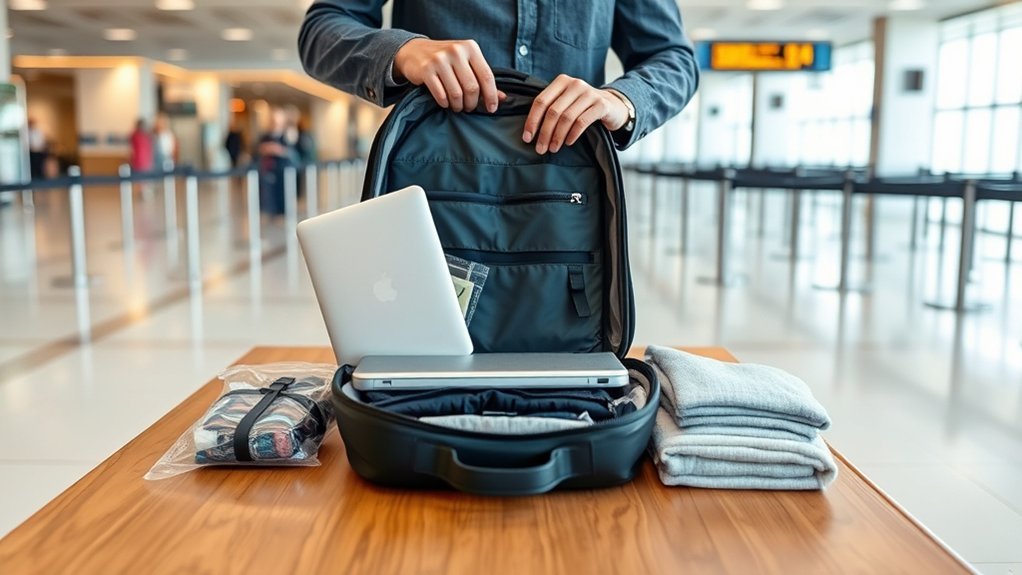
In many standard screening lanes, personal electronics larger than a cell phone—such as laptops, tablets, and handheld game systems—must be removed and placed in a bin without items above or below them. However, procedures vary.
At checkpoints using computed-tomography scanners, travelers may be told to leave electronics and travel-size liquids inside the backpack. TSA PreCheck passengers also generally follow different unpacking procedures. Always listen to the officer and follow the instructions posted at your specific lane.
Pro Tip: Pack your laptop or tablet in a separate padded sleeve near the backpack’s opening. You can remove it quickly when required without disturbing clothing or loose accessories.
Power Banks and Spare Lithium Batteries
Power banks, portable chargers, charging cases, and spare lithium batteries must be carried in the passenger cabin. They are not permitted in checked baggage. Protect exposed battery terminals from short circuits by using the original packaging, a protective case, terminal covers, or individual plastic bags.
- Lithium-ion batteries rated at 100 watt-hours or less are normally permitted for personal use.
- Spare batteries rated from 101 to 160 watt-hours require airline approval and are generally limited to two per passenger.
- Spare batteries above 160 watt-hours are normally prohibited in passenger baggage unless a specific mobility-device exception applies.
- Damaged, swollen, overheating, or recalled batteries should not be packed for air travel unless the manufacturer or airline confirms that they have been made safe.
Review the FAA passenger battery chart and your airline’s policy before traveling with large camera batteries, professional equipment, drones, or multiple power banks.
Warning: If your backpack is checked at the gate, remove every power bank, portable charger, spare lithium battery, electronic cigarette, and other carry-on-only battery item before handing over the bag.
Sharp Objects, Weapons, and Other Prohibited Items
Do not rely on broad categories such as “all sharp objects.” TSA rules are item-specific. Some small scissors are permitted, while knives, multi-tools with blades, box cutters, and many other sharp items are prohibited in carry-on baggage. Search the official TSA What Can I Bring database for the exact item.
Firearms, firearm parts, and ammunition are not permitted in a carry-on backpack. Firearms transported in checked baggage must be unloaded, secured in a locked hard-sided container, and declared to the airline during check-in. Additional airline and local laws may apply.
Warning: Finding a firearm or other weapon in a carry-on bag can result in law-enforcement involvement, loss of TSA PreCheck eligibility, and civil penalties. Empty every compartment before packing, especially when using a backpack previously taken hunting, shooting, camping, or to a work site.
Identification and Travel Documents
Travelers age 18 and older should bring an acceptable form of identification to a U.S. checkpoint. For domestic flights, a state driver’s license or identification card must be REAL ID compliant unless the traveler uses another accepted document, such as a passport.
Keep your identification, boarding pass, passport when needed, medication information, and itinerary in an accessible but secure pocket. Do not place your only identification or essential medication in a section that might be gate-checked.
Packing Essentials for Air Travel
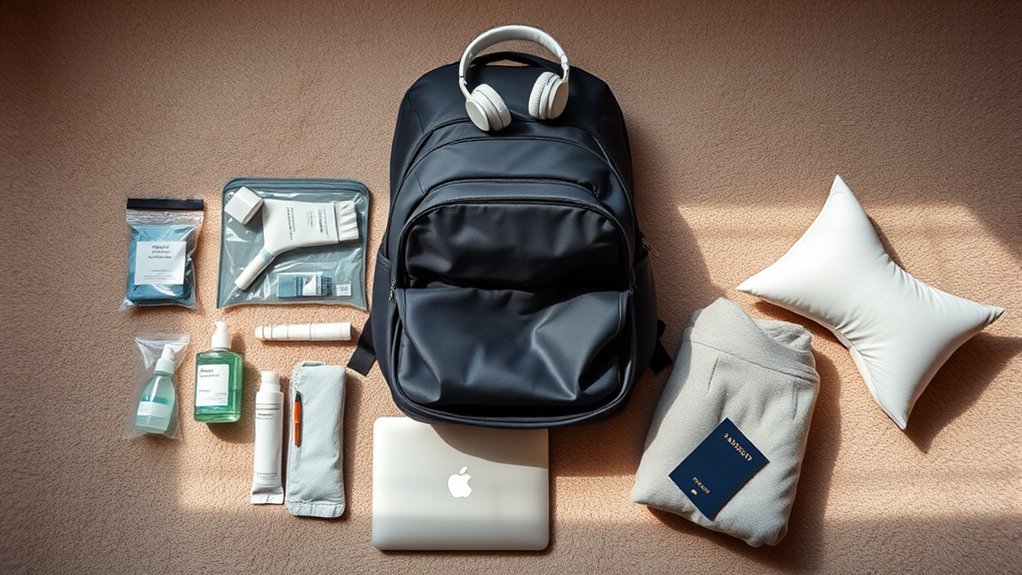
Pack in layers based on what you may need at the checkpoint, at the gate, and during the flight. The following process keeps essential items accessible while reducing the chance that your backpack needs to be unpacked completely.
- Empty every pocket first. Check small organizer pockets, hydration sleeves, key clips, and hidden compartments for forgotten tools, blades, liquids, or ammunition.
- Measure the packed backpack. Include filled exterior pockets, compression straps, handles, wheels, and anything attached to the outside.
- Pack clothing in the main compartment. Use packing cubes or rolled clothing to control loose fabric and leave a clear path to electronics.
- Place dense items close to your back. Keep shoes, toiletry kits, and other heavier objects near the back panel around the middle of the pack instead of letting them pull from the outer edge.
- Place the liquids bag near the top. It should be easy to remove without opening packing cubes.
- Keep electronics accessible. Use a padded sleeve and avoid burying charging cables or batteries beneath clothing.
- Separate batteries and power banks. Protect their terminals and keep them in a cabin-accessible pocket.
- Secure documents and valuables. Use an inside zippered pocket rather than an exposed front pocket.
- Test the fit. Close every zipper, tighten loose straps, and confirm the bag still fits the airline’s published measurements.
Airline Carry-On Policies for Backpacks
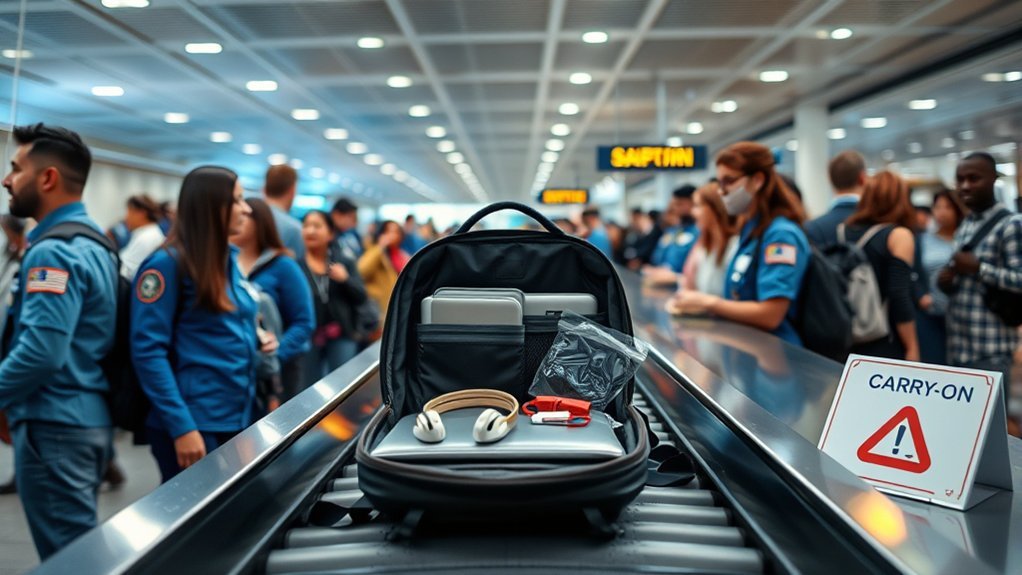
A common U.S. carry-on measurement is 22 × 14 × 9 inches, or about 56 × 36 × 23 centimeters, but it is not a universal rule. The packed bag must also fit in the airline’s sizer and the assigned storage space.
| Airline | Published Carry-On Maximum | Personal-Item Rule |
|---|---|---|
| American Airlines | 22 × 14 × 9 inches, including handles and wheels | Up to 18 × 14 × 8 inches and must fit under the seat |
| Delta Air Lines | 22 × 14 × 9 inches, including handles and wheels | One smaller item that fits beneath the seat |
| Southwest Airlines | 24 × 16 × 10 inches, including wheels, handles, and attachments | Must fit under the seat; no single universal dimension is published on the policy page |
These examples were current when this guide was reviewed, but baggage policies, fare inclusions, and aircraft restrictions can change. Check the operating airline’s page before each trip, especially when flying on a regional aircraft, basic fare, partner airline, or international itinerary.
A soft backpack may compress into a sizer, but do not depend on forcefully squeezing an overpacked bag. Gate agents can require it to be checked when it does not fit, creates a safety issue, or overhead space is unavailable.
How to Measure a Backpack
- Pack the backpack with everything you plan to carry.
- Set it upright on a flat surface without pressing it down.
- Measure the tallest point, the widest point, and the deepest point.
- Include handles, wheels, full exterior pockets, frames, rigid hip belts, and attachments.
- Compare the measurements with the operating airline’s current limit.
Tips for Choosing the Right Backpack
Choose a travel backpack by its packed dimensions first and its liter rating second. Capacity labels are useful for comparing bags, but two 40-liter backpacks can have very different shapes.
- Match the intended allowance: Decide whether the backpack must qualify as a personal item or an overhead carry-on. Personal-item limits are normally much smaller.
- Check exterior dimensions: Compare the manufacturer’s measurements with your airline’s policy and allow room for bulging pockets.
- Use capacity as a guide: Many 30- to 40-liter travel backpacks can work as overhead carry-ons, but dimensions determine acceptance. Some 45-liter hiking packs are too tall.
- Choose useful access: A clamshell opening, padded electronics sleeve, and separate small-item pockets make checkpoint screening easier.
- Look for compression: Side straps can control soft contents, but they cannot make a rigid frame shorter.
- Prioritize comfort: Padded shoulder straps, an adjustable sternum strap, and a properly positioned hip belt can reduce strain on longer walks.
- Control loose straps: Stowable shoulder straps and tuck-away hip belts reduce snagging if the bag must go through a conveyor or be gate-checked.
- Consider weather protection: Water-resistant fabric or a pack cover can protect documents and electronics, but wet items and gel packs still remain subject to screening rules.
What to Do if Your Backpack Is Gate-Checked
Even a compliant backpack may be checked at the gate when overhead bins are full or the aircraft has small storage compartments. Before surrendering it:
- Remove all power banks, spare lithium batteries, charging cases, and electronic cigarettes.
- Remove medication, identification, passports, money, keys, jewelry, and fragile electronics.
- Make sure bottles are closed and any leak-prone toiletries are sealed in plastic bags.
- Tuck in shoulder straps and secure loose compression straps.
- Label the bag with your name and contact information.
- Confirm whether the bag will be returned on the jet bridge or sent to baggage claim.
International Flights and Connecting Airports
TSA rules apply at checkpoints under TSA control in the United States. A foreign country’s security authority may use different liquid, food, medication, electronics, and prohibited-item rules.
On international itineraries, check:
- The rules for every departure and connecting airport.
- The operating airline’s carry-on and personal-item limits for each flight segment.
- Customs and agriculture restrictions on food, plants, meat, and animal products.
- Whether your medication requires original packaging, a prescription copy, or destination-specific documentation.
- Whether a partner airline applies a smaller or lighter baggage allowance.
Pack dense items close to your back panel rather than simply putting everything heavy at the bottom. Keep your passport, medication, electronics, and one change of clothing accessible in case a larger bag is unexpectedly checked.
Pros and Cons of Using a Backpack as a Carry-On
A backpack provides hands-free mobility and can be easier to move through stairs, trains, and crowded airports than a rolling suitcase. The tradeoff is that an overloaded or poorly fitted backpack can strain your shoulders and may bulge beyond the airline’s limit.
| Pros | Cons |
|---|---|
| Hands-free mobility | Can cause shoulder, neck, or back strain when overloaded |
| Flexible shape and packing options | Soft sides can bulge beyond the size limit |
| Useful for walking, public transit, and outdoor activities | May be harder to organize without cubes or compartments |
| Often lighter than a wheeled suitcase | Loose straps can snag during handling |
For the most comfortable carry, tighten the hip belt around the top of your hip bones, adjust the shoulder straps so the pack sits close to your back, and avoid filling every pocket merely because space remains.
Frequently Asked Questions
Can I bring food in my backpack through TSA security?
Yes. Most solid foods can travel in carry-on or checked baggage. Foods that are liquids, gels, creams, or pastes—such as yogurt, jam, sauce, and peanut butter—must follow the 3-1-1 rule unless a medical or infant-related exception applies. A TSA officer may ask you to separate food for clearer screening.
Do I have to remove electronics from my backpack?
In many standard lanes, electronics larger than a cell phone must be removed and placed in a bin. CT-equipped lanes and TSA PreCheck lanes may use different procedures. Keep laptops and tablets accessible and follow the officer’s instructions at the checkpoint.
How should I pack my backpack for an international flight?
Check the security and customs rules for every departure and connection, plus each operating airline’s baggage limits. Place dense items near your back, keep documents and medication accessible, separate liquids, and keep power banks and spare lithium batteries in the cabin.
What happens if TSA finds a prohibited item in my backpack?
The bag will be stopped for inspection. Depending on the item, airport, and available time, you may be able to place it in checked baggage, return it to a vehicle, give it to a non-traveling companion, or voluntarily abandon it. Weapons and hazardous items can lead to law-enforcement action and civil penalties.
Can I lock my backpack when traveling by air?
Yes, but you must be able to open a carry-on backpack if a TSA officer requests an inspection. For checked baggage, a TSA-recognized lock may let officers open and relock the bag with accepted tools, but it does not guarantee that the lock will never be cut or damaged.
Can I put a power bank in my backpack?
Yes, provided it meets the applicable battery limit, but it must remain in carry-on baggage. Protect its terminals from short circuits. If the backpack is checked at the gate, remove the power bank and keep it with you in the cabin.
Can my backpack count as a personal item?
Yes, when the airline allows a personal item and the packed backpack fits completely beneath the seat in front of you. A backpack that is too large for the personal-item allowance may count as your overhead carry-on or may need to be checked.
Conclusion
Using a backpack for air travel is straightforward once you separate TSA screening requirements from airline baggage policies. Check the operating airline’s dimensions, measure the bag after packing, follow the 3-1-1 liquids rule, and keep identification, medication, electronics, valuables, power banks, and spare batteries accessible.
Before leaving for the airport, empty every pocket and search TSA’s official item database for anything uncertain. That final check can prevent a delayed screening, an abandoned item, an unexpected bag fee, or the need to repack at the gate.
Sources
- Transportation Security Administration: Liquids, Aerosols, and Gels Rule — carry-on container and quart-sized bag requirements.
- Transportation Security Administration: What Can I Bring? — item-specific carry-on and checked-baggage restrictions.
- Transportation Security Administration: Acceptable Identification — current identification requirements at U.S. checkpoints.
- Federal Aviation Administration: Airline Passengers and Batteries — power-bank and lithium-battery packing rules.
- American Airlines Carry-On Baggage Policy — airline-specific carry-on and personal-item dimensions.
- Southwest Airlines Carry-On and Personal-Item Policy — an example of a different airline carry-on size limit.