
Last Updated on September 11, 2026 by Daniel Globe
South Asia’s rainy season is shaped by the monsoon, a seasonal change in winds that carries moist ocean air over the subcontinent. The best-known phase is the southwest summer monsoon, but its start, strength, and rainfall vary widely by country and landscape. Mountains, ocean temperatures, tropical weather patterns, and climate change all affect where and when the rain falls.
Quick Answer
The South Asian monsoon is a seasonal reversal of winds that brings moist air and heavy rain to much of the region. India’s main southwest monsoon is officially measured from June through September, while the northeast monsoon brings important October-to-December rain to southeastern peninsular India.
Key Takeaways
- A monsoon is a seasonal wind system, not one storm or a nonstop wall of rain.
- The southwest monsoon is the main rainy season across much of South Asia, but timing differs by location.
- The Arabian Sea, Bay of Bengal, mountains, and active-and-break cycles create large regional differences.
- Climate change is increasing the risk of heavier downpours even where average seasonal rainfall has fallen.
- Monsoon rainfall supports crops, reservoirs, hydropower, ecosystems, and daily water supplies, but it also brings floods and landslides.
What Is the South Asian Monsoon?
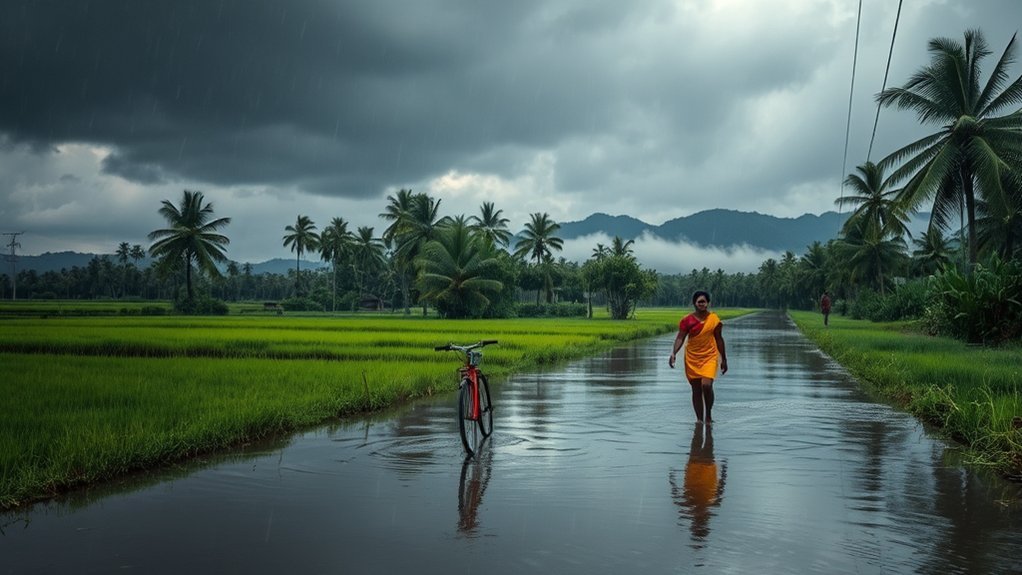
The word monsoon comes from the Arabic mawsim, meaning “season.” In weather and climate science, it describes a seasonal shift in prevailing winds that produces a major change between wetter and drier conditions. NOAA explains that the strongest rainy monsoons develop near the Indian Ocean, where moist air moves inland and rises to form clouds and rain.
The South Asian system includes two broad seasonal phases:
- Southwest monsoon: Moist winds blow from the Indian Ocean toward the subcontinent during the Northern Hemisphere summer. This is the main rainy season for most of India and much of neighboring South Asia.
- Northeast monsoon: Winds reverse during the cooler part of the year. Much of the interior becomes drier, but winds crossing the Bay of Bengal bring important rain to southeastern peninsular India and nearby areas.
Note: “Monsoon” does not mean a single thunderstorm. It refers to the wider seasonal circulation. Rain can arrive in intense bursts separated by hours or days of lighter rain or dry weather.
When Is Monsoon Season in South Asia?
There is no single start date for all of South Asia. The season advances across the region in stages and later retreats in stages.
- India’s southwest monsoon season: June through September is the standard four-month rainfall season used for national monitoring. The India Meteorological Department says the monsoon normally reaches Kerala around June 1 and usually covers India by about July 15.
- Early and late arrivals: Parts of Sri Lanka, the Maldives, northeastern India, and the Bay of Bengal region may receive monsoon rain before or after those broad dates.
- Northeast monsoon: The India Meteorological Department defines October through December as the northeast monsoon season. It is especially important to Tamil Nadu and other parts of southeastern peninsular India.
- Withdrawal: Rain does not stop everywhere at once. The southwest monsoon begins retreating from northwestern India and withdraws gradually toward the south.
Local timing also changes from year to year. A “late monsoon” may describe delayed onset in one area even while other areas have already received rain.
How Does the South Asian Monsoon Work?
The monsoon is driven by a connected land-ocean-atmosphere system. Land warms faster than the ocean in spring and early summer. Rising air and lower pressure over the heated continent help draw moist air inland. At the same time, the tropical rain belt, often called the Intertropical Convergence Zone or ITCZ, shifts north.
- Summer heating builds: The Indian subcontinent and surrounding high terrain warm strongly.
- Moist air moves inland: Cross-equatorial winds turn southwesterly and carry moisture from the Arabian Sea and Bay of Bengal.
- Air rises and cools: Convergence, storms, and mountain slopes lift the moist air, causing condensation and rain.
- Rainfall pulses north and west: The monsoon advances in surges rather than as a smooth line.
- The circulation reverses: As the continent cools later in the year, pressure patterns change and the southwest monsoon retreats.
Arabian Sea and Bay of Bengal Branches
The traditional two-branch description is useful, though the real circulation is more complex.
- The Arabian Sea branch supplies moisture to India’s west coast and interior. The Western Ghats force air upward, producing very heavy rain on windward slopes.
- The Bay of Bengal branch carries moisture toward northeastern India, Bangladesh, the Himalayan foothills, and the Indo-Gangetic Plain before curving westward.
Mountains, Uplift, and Rain Shadows
Topography is one reason rainfall can change sharply over short distances. The Western Ghats and Himalayan foothills lift moist air and increase rainfall on exposed slopes. Areas behind mountain barriers receive less moisture and can form rain shadows. This is why a single national rainfall total cannot describe conditions in every district.
Active and Break Spells
Monsoon rain is not steady. During an active spell, the rain belt and weather systems favor widespread or intense rainfall. During a break spell, rain weakens over much of central India and may shift toward the Himalayan foothills or other areas. These swings can affect crop planting, reservoir inflow, and flood risk even when the full-season total appears close to average.
What Is Monsoon Season Like in South Asia?
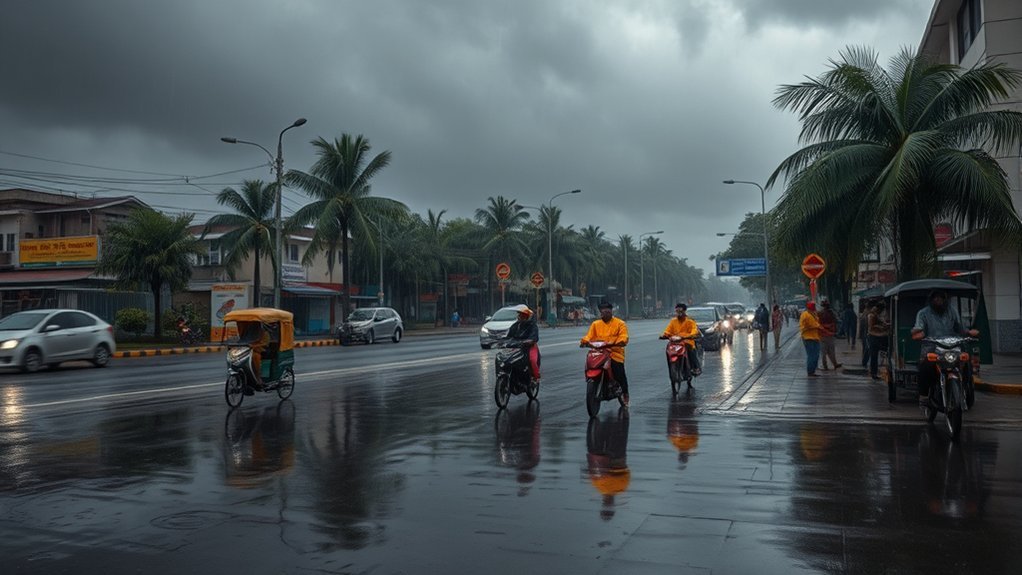
Monsoon season usually brings high humidity, frequent cloud cover, warm nights, and sudden heavy downpours. Some days have short, intense showers followed by clearer weather. Active periods can bring repeated rain for several days, while break periods can produce hot, drier conditions.
Conditions vary greatly:
- Windward mountain slopes and coastal belts can receive very heavy rain.
- Interior and rain-shadow regions may receive much less.
- Urban areas can flood quickly when drainage cannot handle short, intense bursts.
- Steep terrain faces a higher risk of landslides after prolonged or extreme rain.
- Rivers may remain high even after local rain has stopped because runoff arrives from upstream.
Warning: Monsoon flooding can become life-threatening with little notice. Follow local weather and disaster-management alerts, avoid flooded roads and low-water crossings, and never assume moving water is shallow or safe.
What Controls Monsoon Strength and Timing?
Land-sea heating and the seasonal movement of the tropical rain belt provide the basic framework, but several large-scale patterns change the monsoon from year to year:
- El Niño and La Niña: Changes in tropical Pacific Ocean temperatures can alter atmospheric circulation. El Niño often raises the chance of weaker Indian summer rainfall, but the relationship is not automatic.
- Indian Ocean Dipole: East-west temperature differences across the Indian Ocean can strengthen or weaken moisture transport and sometimes offset other influences.
- Madden-Julian Oscillation: A moving pulse of tropical clouds and rainfall can help trigger active or break periods over several weeks.
- Bay of Bengal depressions and cyclones: These systems can carry large amounts of moisture inland and produce concentrated rainfall.
- Snow, soil moisture, and local land conditions: These affect heating and moisture exchange, but they are only part of a much larger coupled system.
Because these influences interact, seasonal forecasts describe probabilities rather than guaranteeing rainfall for a specific farm, city, or travel date.
How Is Climate Change Affecting Monsoon Rains?
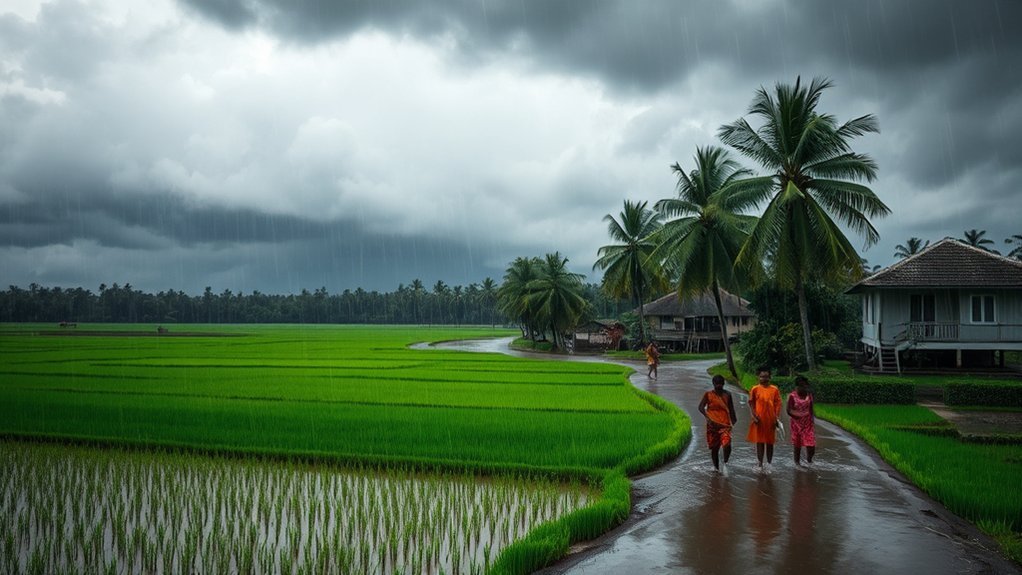
Climate change is not making every part of South Asia uniformly wetter or drier. Observed trends differ by place and time period, and average rainfall can move in a different direction from extreme rainfall.
A 2017 Nature Communications study found that central India’s average summer monsoon rainfall declined by about 10% during 1950–2015. Over the same period, widespread extreme-rain events over central India increased threefold. Those findings apply to the study’s defined central Indian region and should not be presented as a uniform trend for all of South Asia.
The Intergovernmental Panel on Climate Change reports high confidence that heavy precipitation has increased recently in South Asia. It also projects that heavy and intense precipitation will become more frequent and stronger across South, Southeast, and East Asia as warming continues. At the same time, future changes in local seasonal totals remain uncertain and uneven.
The clearest climate signal is not “less monsoon” or “more monsoon” everywhere. It is a greater risk of intense rain, flooding, and uneven rainfall alongside regional changes in seasonal totals.
For farmers, water managers, and cities, this means planning for both extremes: longer dry gaps and heavier bursts. Better drainage, floodplain management, reservoir coordination, crop diversification, and local forecasting can reduce risk.
Why Does the South Asian Monsoon Matter?
The monsoon is one of South Asia’s most important climate systems because it affects:
- Agriculture: Rainfall timing helps determine when farmers sow crops, whether seedlings survive, and how much irrigation is needed.
- Water supply: Monsoon runoff refills reservoirs, rivers, wetlands, and some groundwater systems.
- Energy: Reservoir levels influence hydropower production, while storms can also damage power and transport networks.
- Food prices and rural income: Poorly timed rain, drought, or flooding can reduce harvests and raise costs.
- Ecosystems: Seasonal floods and freshwater flows support forests, wetlands, fisheries, and river habitats.
- Public safety: Extreme rain can cause flash floods, river floods, landslides, water contamination, and disease outbreaks.
A season can be “normal” in its total rainfall yet still cause serious harm if the rain falls in the wrong places, arrives too late for planting, or is concentrated into a few extreme events.
Are South Asian and Southeast Asian Monsoons the Same?
No. The two regions are connected to the wider Asian monsoon system, but they do not share one uniform rainy season. South Asia includes countries such as India, Pakistan, Bangladesh, Nepal, Bhutan, Sri Lanka, and the Maldives. Southeast Asia includes countries farther east and south, such as Thailand, Vietnam, Malaysia, Indonesia, and the Philippines.
The ASEAN Specialised Meteorological Centre describes a northeast monsoon from roughly December to March and a southwest monsoon from roughly June to September across Southeast Asia. The northern and southern parts of the region can have opposite wet-and-dry patterns during the same monsoon. That is why there is no single “best month” for every Southeast Asian destination.
Frequently Asked Questions
What is the season when it rains a lot in Southern Asia?
It is generally called the monsoon season. Across much of India and neighboring South Asia, the main southwest monsoon occurs from June through September, although rain can begin earlier or end later in some locations.
Why does it rain so much in South Asia?
Seasonal pressure and wind changes pull moist air from the Indian Ocean toward the heated continent. The air rises through convergence, storms, and mountain uplift, then cools and condenses into rain.
Does Southeast Asia get a lot of rain?
Yes. Much of Southeast Asia has a tropical monsoon climate, but the wet season varies by country, island, coast, and elevation. Northern and southern areas can experience different rainfall patterns at the same time.
What is the best month to go to Southeast Asia?
There is no universal best month. November through February is often drier in much of mainland Southeast Asia, but parts of southern Thailand, Malaysia, Indonesia, and nearby islands can be wetter during the northeast monsoon. Check the specific country and coast before booking.
Does monsoon season mean it rains all day?
Not always. Many places get short, heavy downpours with clearer periods between them. Active spells can bring several wet days, while break spells may be much drier.
Is the northeast monsoon the same as the northeast of India?
No. “Northeast monsoon” describes the seasonal wind direction. It is especially important for rainfall in southeastern peninsular India, including Tamil Nadu, rather than meaning the northeastern states of India.
Conclusion
The South Asian monsoon is more than a rainy season. It is a changing wind and rainfall system that connects the Indian Ocean, the continent, mountains, farms, rivers, cities, and ecosystems. Its broad cycle is seasonal, but its local behavior is highly variable. Understanding onset, active and break spells, regional differences, and climate-driven extremes helps communities prepare for both water shortages and dangerous floods.
Sources
- NOAA NESDIS: What Is a Monsoon? — definition, wind reversal, moisture, and rainfall formation.
- India Meteorological Department: Onset and Advance of Monsoon — normal Kerala onset and advance across India.
- India Meteorological Department: Northeast Monsoon of South Asia — October-to-December season and regional rainfall.
- IPCC AR6 Working Group II, Chapter 10: Asia — observed and projected heavy precipitation changes.
- Nature Communications: A Threefold Rise in Widespread Extreme Rain Events Over Central India — 1950–2015 rainfall and extreme-event trends.
- ASEAN Specialised Meteorological Centre: Regional Climate FAQ — Southeast Asian monsoon timing and north-south differences.

