

Last Updated on September 10, 2026 by Daniel Globe
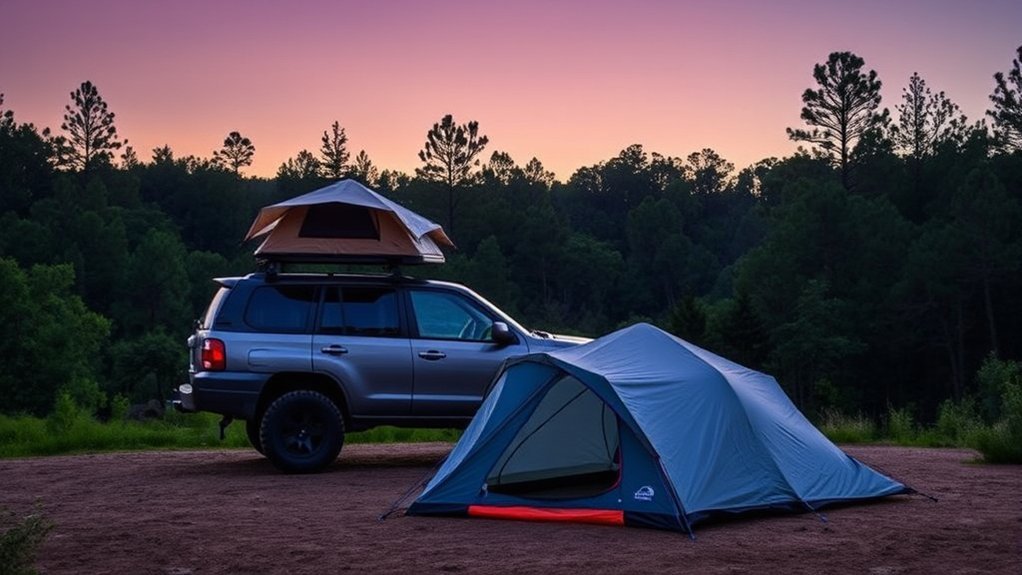
Choosing between a rooftop tent and a ground tent changes more than where you sleep. It affects your setup routine, vehicle handling, campsite options, storage, comfort, and budget. Rooftop tents are especially convenient for road trips and overlanding, while ground tents remain lighter, roomier, less expensive, and far more flexible when you want to camp away from your vehicle.
Quick Answer
A rooftop tent is usually best for road-based campers who value fast setup, a built-in mattress, and an elevated sleeping platform. A ground tent is usually better for families, budget campers, backpackers, and anyone who wants more space or the freedom to leave camp set up while driving away.
Key Takeaways
- Many rooftop tents deploy within a few minutes, with some hard-shell designs opening in under a minute, but setup time varies by model.
- Rooftop tents cost substantially more and add significant weight and aerodynamic drag to the top of your vehicle.
- Vehicle and rack compatibility is essential: driving loads and parked sleeping loads are rated differently.
- A rooftop tent keeps your sleeping platform above wet or uneven ground, but it is not flood-proof or wildlife-proof.
- Ground tents offer more choices in size, price, weight, accessibility, and campsites that cannot be reached by a vehicle.
- For families or campers who make day trips from one base camp, a ground tent is often the more practical choice.
Disclosure: As an Amazon Associate I earn from qualifying purchases. Some links on this page are affiliate links, at no extra cost to you.
Rooftop Tent vs Ground Tent: Side-by-Side Comparison
| Factor | Rooftop Tent | Ground Tent |
|---|---|---|
| Setup | Often a few minutes; some hard shells open in under a minute | Varies from quick instant designs to longer pole-and-stake setups |
| Purchase cost | Usually much higher, plus a compatible rack may be required | Much wider price range, including inexpensive entry-level tents |
| Weight | Commonly well over 100 lb | From ultralight backpacking tents to 20+ lb family tents |
| Sleeping surface | Elevated platform, usually with an integrated mattress | Ground-level floor; sleeping pad or mattress added separately |
| Interior space | Usually designed for about 2-4 sleepers | Available from solo shelters to large standing-height family tents |
| Camp mobility | Normally must be packed before driving away | Can remain pitched while you use the vehicle |
| Site access | Requires a legal, suitable place to park the vehicle | Works at drive-in, walk-in, and many backcountry campsites |
| Accessibility | Requires climbing a ladder | Ground-level entry is generally easier |
Setup And Pack-Away Speed
Setup speed is one of the strongest arguments for a rooftop tent, especially if you change campsites every night. Hard-shell designs can be extremely quick. For example, the Thule Basin is advertised to go from closed to ready for use in less than a minute. Soft-shell designs can also be fast: the Thule Approach M is designed to be ready in under three minutes.
That does not mean every rooftop tent opens in 30 seconds or every ground tent takes 30 minutes. Ground-tent setup varies widely. Instant tents, simple dome tents, and practiced two-person teams can pitch quickly, while larger shelters with rainflies, guylines, and many stakes take longer.
A rooftop tent can also simplify early departures because many models let you leave at least some bedding inside when closed. Check the manufacturer’s packing instructions, though, because thick pillows, blankets, or extra gear may prevent a tent from closing correctly.
If you’re eager to hit the trails each morning and move to a new campsite each evening, this repeated time saving can be valuable.
Durability And Weather Resistance
Rooftop tents are commonly built for repeated vehicle-based travel, and many use heavy fabric, reinforced floors, aluminum framing, or rigid outer shells. That can make them feel more substantial than lightweight backpacking tents. It does not mean every rooftop tent is stronger than every ground tent, however.
Weather performance depends on the specific tent’s fabric, seams, waterproof coatings, rainfly, pole or frame design, ventilation, staking, and wind limits. A quality four-season ground tent may outperform a recreational rooftop tent in demanding weather, while a rugged rooftop model may be better suited to repeated overland travel than an inexpensive family tent.
Useful life is also impossible to reduce to a reliable “5 years versus 10 years” rule. Sun exposure, mold, damp storage, abrasive dirt, zipper damage, fabric coatings, installation stress, and how often the tent is used all affect longevity.
Pro Tip: Whatever style you buy, let it dry fully before long-term storage. Regularly inspect seams, zippers, mounting hardware, poles, rainflies, and waterproof coatings instead of relying on a predicted lifespan.
Flooding And Safe Campsite Selection

A rooftop tent keeps its sleeping floor above puddles, mud, shallow runoff, rocks, and wet ground. That is a genuine comfort advantage in ordinary rain. It does not make the tent, vehicle, or campsite flood-proof.
What Elevation Actually Helps With
When the vehicle is parked in a safe campsite, an elevated platform can keep bedding away from saturated soil and water flowing across the immediate ground surface. You also avoid having to find a perfectly smooth patch of dirt for your tent floor, although the vehicle itself still needs to be reasonably level for comfortable sleeping.
Ground-tent campers can reduce rain problems by avoiding depressions, choosing well-drained higher ground, using the tent’s footprint correctly, and keeping the rainfly properly tensioned.
Flash-Flood Safety
Flash flooding is different from ordinary campsite puddling. The National Park Service warns that rapidly rising water can move vehicles. A rooftop tent therefore offers no reliable protection when the vehicle itself is in a wash, ravine, creek bed, canyon bottom, or other flood zone.
Warning: Never treat a rooftop tent as a substitute for safe campsite selection. Do not camp or park in washes, low areas, ravines, or stream channels when flooding is possible. If a flash flood develops, leave belongings and move to higher ground immediately when it is safe to do so.
| Feature | Rooftop Tent | Ground Tent |
|---|---|---|
| Sleeping-floor elevation | Elevated | Ground level |
| Protection from puddles and muddy ground | Very good when safely parked | Depends heavily on site selection and drainage |
| Flash-flood protection | No — vehicle can still be endangered | No |
| Need to avoid low areas | Yes | Yes |
| Action during dangerous flooding | Seek safe higher ground | Seek safe higher ground |
Vehicle Compatibility And Roof-Load Limits
This is the most important technical check before buying a rooftop tent. A tent that physically fits on top of a vehicle is not automatically safe to install there.
According to the Thule Rooftop Tent Guidelines, you need to consider both the vehicle and the complete rack system. The lowest-rated component limits the system.
- Dynamic capacity applies while driving. The rack, rooftop tent, mounting hardware, and any other roof cargo must remain within the applicable vehicle and rack limits.
- Static capacity applies when parked. This is when the tent is supporting sleepers and their gear.
- Roof design matters. Panoramic or glass roofs, unsupported rails, clamp-style systems, and factory crossbars may have restrictions depending on the vehicle and tent manufacturer.
- Crossbar spacing matters. A tent’s mounting system normally specifies minimum and maximum bar spacing and compatible bar dimensions.
Never assume that a universal “165 lb roof limit” applies to your vehicle. Check the vehicle owner’s manual, rack instructions, and rooftop-tent manual together. Contact the vehicle or rack manufacturer when any rating or compatibility information is unclear.
Cost And Weight
Ground tents have a major advantage in both categories. Prices vary enormously, but current manufacturer examples show the difference clearly. Thule’s rooftop tents are commonly priced in the thousands of dollars: the Approach M is listed at $2,699.95 and the Basin at $2,999.95 at the time of this update. A compatible rack or platform can add further cost.
Ground tents span a much wider range. Even large name-brand family tents can cost far less than a rooftop system. For example, The North Face Wawona 6 is a six-person ground tent with a listed weight of 19 lb 7 oz and a current manufacturer price of $585.
Rooftop tents are much heavier. The Thule Approach M weighs 128 lb, while the hard-shell Basin weighs 176 lb. Ground tents range from ultralight backpacking shelters weighing only a few pounds to large car-camping tents weighing 20 lb or more.
Putting a large mass high on a vehicle can also change handling and increases aerodynamic drag. Expect some effect on fuel economy or electric-driving range, especially at highway speeds, although the amount varies with the vehicle, tent shape, speed, wind, and installation.
Warning: Check the vehicle, roof rack, mounting hardware, and tent instructions before installation. While driving, stay within the lowest applicable dynamic load limit. When parked, confirm that the complete system is rated for the tent, occupants, and in-tent gear as a static load.
Vehicle Storage Space
A rooftop tent can free up some cabin or cargo-room space because the shelter itself rides on the roof. Some models can also close with limited bedding inside, reducing what you need to pack into the vehicle each morning.
There are important exceptions. Bedding-storage capacity varies by tent, and many rooftop tents occupy most of the available roof-rack space that might otherwise carry a cargo box, kayak, bicycle, or other equipment. Ground tents take up space in the trunk, but compact models can pack surprisingly small and leave the roof available for other gear.
So the storage winner depends on what else you carry. A rooftop tent is useful when the roof would otherwise be empty; a ground tent may be better when roof space is already needed for bug-season travel gear, boats, bikes, skis, or cargo.
Daily Driving And Base-Camp Mobility
This is one of the most overlooked differences. Once a rooftop tent is deployed, the vehicle effectively becomes part of the shelter. Before driving to a trailhead, restaurant, store, or sightseeing stop, you normally have to remove loose items, retract the ladder, close the tent, and secure it for travel.
A ground tent can stay pitched while you use the vehicle for the day. That makes it especially convenient for families and campers who spend several nights at one campground but drive somewhere different each morning.
Rooftop tents are at their best when the vehicle moves with the camp. Ground tents are at their best when the campsite stays put while the vehicle goes somewhere else.
Better Views
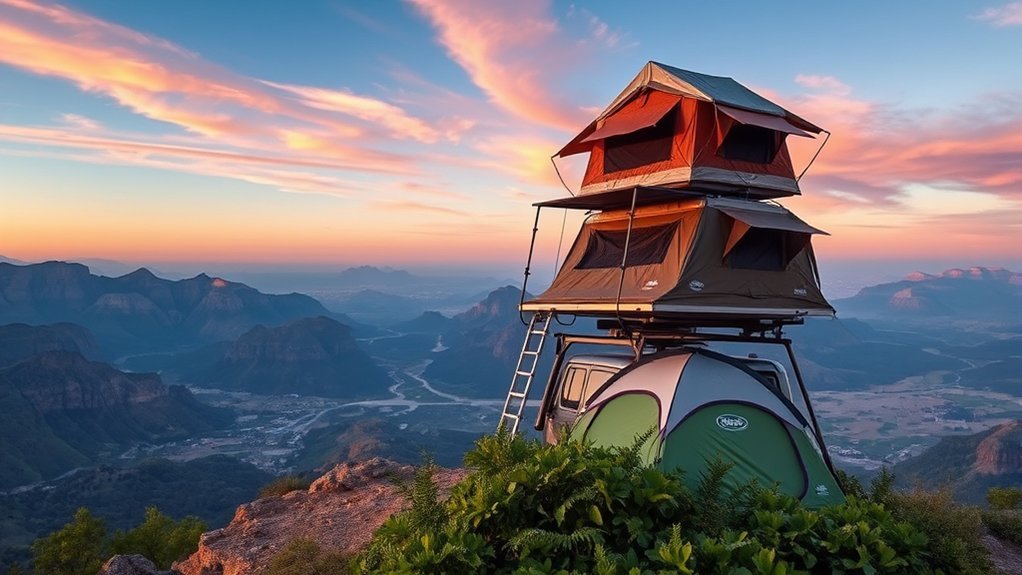
Sleeping several feet above the ground can improve your sightline at an open campsite. Whether the difference is dramatic depends on nearby vegetation, the vehicle’s height, the tent’s window layout, and where you are allowed to park.
Elevated Perspective Benefits
A rooftop tent can provide several enjoyable view-related advantages:
- Higher sightlines: Short bushes and grass are less likely to block the immediate view.
- Stargazing: Models with roof panels, skylights, or large screened windows can provide excellent sky views.
- Sunrise and sunset views: An elevated position can improve the view at open campsites.
- Less contact with crawling insects: The sleeping floor is separated from the ground, although doors and screens still need to remain properly closed.
Scenic Surroundings Advantage
Do not assume every rooftop tent provides a 360-degree panorama. Some have large windows on several sides; others have limited openings. The biggest scenic advantage is simply the extra height.
Ground tents can still win visually when you are allowed to pitch them closer to a lake, viewpoint, forest clearing, or walk-in campsite that vehicles cannot reach.
Ground Tents Offer More Campsite Flexibility
Ground tents have the clear edge when vehicle access is limited. They can be carried to places where a rooftop tent cannot go, including:
- Walk-in campsites and many backcountry sites
- Secluded campsites reached on foot
- Locations where vehicles must remain in a separate parking area
- Sites where the available parking space is too sloped for comfortable rooftop sleeping
A rooftop tent does have one terrain advantage: the ground immediately beneath the vehicle does not have to be smooth enough to sleep on. Rocks, roots, or damp soil beneath the car do not touch your sleeping platform. The trade-off is that the vehicle must be positioned safely and reasonably level.
Note: “Dispersed camping” does not mean you can park anywhere. Stay on routes and campsites where vehicle travel and overnight camping are legally permitted, and follow local land-management rules.
Warmth Depends On The Complete Sleep System
A rooftop tent is not automatically warmer than a ground tent. Many rooftop models include a thick foam mattress and a substantial floor, which can provide good insulation. Their heavier fabrics can also reduce drafts.
Ground campers lose heat toward a cold surface when their sleeping pad is poorly insulated, but a suitable insulated pad can dramatically reduce that heat loss. Rooftop campers also need adequate floor and mattress insulation because cold air can circulate beneath the elevated platform.
For either tent, nighttime warmth depends on the sleeping bag, mattress or pad insulation, clothing, wind, humidity, ventilation, shelter design, and outside temperature. Choose your sleep system for the conditions rather than assuming elevation alone makes one shelter warmer.
Condensation And Ventilation
Both tent styles can collect condensation. Warm, humid air from breathing can meet a cold fabric or shell surface and form moisture inside the shelter.
Keep roof vents, windows, or mesh panels partly open when conditions allow, even on cool nights. Avoid pressing sleeping bags against wet tent walls, and dry damp bedding before packing it away for long periods.
Rooftop tents deserve extra attention because mattresses may remain inside a closed shell between camps. An anti-condensation mat, breathable mattress layer, or periodically lifting the mattress to dry the underside can help when moisture collects beneath it.
Bugs And Wildlife: Elevation Helps, But It Is Not Animal-Proof
Elevation can reduce contact with crawling insects, mud, and some small ground-level pests. Good mesh screens also help keep mosquitoes and flies outside.
That does not make a rooftop tent wildlife-proof. Bears and other animals are attracted by food and odors, not simply by whether your bed is three or six feet above the ground.
The National Park Service camping-safety guidance advises campers not to take food inside a tent. Follow the food-storage regulations for the place you are camping, which may require a locked vehicle, food-storage locker, or approved bear-resistant container.
- Keep food, trash, and scented items out of sleeping tents when local guidance requires it.
- Keep a clean campsite and dispose of scraps properly.
- Use screens and close tent doors to reduce insect entry.
- Never rely on elevation as protection from bears or other wildlife.
Space, Families, Pets, And Accessibility
Ground tents offer far more choices in floor area and standing height. Large family tents can sleep six or more people and provide room for chairs, bags, pets, and changing clothes during bad weather. Rooftop tents are more commonly designed for couples or small families, although larger models exist.
The ladder is another practical difference. Every nighttime bathroom trip involves climbing down and back up. That may be inconvenient for young children, older campers, people with limited mobility, or anyone uncomfortable using a ladder in rain or darkness.
Dogs can also complicate rooftop camping. Small pets may need to be carried, and large dogs may be difficult or unsafe to lift onto a high platform. A ground tent’s level entrance is usually simpler.
Installation, Storage, And Maintenance
A ground tent requires almost no vehicle preparation: put it in the trunk and take it out at camp. A rooftop tent requires more planning.
Before the first trip, you may need to install a compatible rack or platform, lift a tent weighing well over 100 lb onto the roof, position mounting hardware correctly, and torque fasteners according to the manufacturer’s instructions. Large rooftop tents commonly require at least two people or a garage hoist for safe installation and removal.
You also need somewhere to keep the tent if you remove it between trips. Leaving it on the vehicle year-round saves lifting work but exposes it to more UV, weather, road dirt, and daily aerodynamic drag.
Whichever type you own, clean off mud and debris, repair damage promptly, dry fabric before storage, and inspect hardware before the next trip.
Which One Should You Choose?
Choose a rooftop tent if most of your trips are vehicle-based, you move camp frequently, your vehicle and rack are fully compatible, you do not mind the ladder, and quick nightly setup is worth the added cost and roof weight.
Choose a ground tent if you camp on a tighter budget, need more room, travel with children or pets, want easy ground-level access, visit walk-in or backcountry sites, or prefer leaving camp set up while driving elsewhere during the day.
For occasional campers, a good ground tent is usually the simpler purchase. Rooftop tents make the strongest case for frequent road trippers and overlanders who repeatedly benefit from their integrated mattress, elevated platform, and fast deployment.
Frequently Asked Questions
Which tent is better for family camping trips?
Ground tents are usually more practical for larger families because they come in much bigger sizes and provide ground-level entry. A rooftop tent can work well for a couple or small family, but check the manufacturer’s actual sleeping capacity and static load rating.
How much do rooftop tents typically weigh compared to ground tents?
Many rooftop tents weigh well over 100 lb. Current examples include the 128 lb Thule Approach M and 176 lb Thule Basin. Ground tents vary from ultralight backpacking shelters weighing only a few pounds to large family tents weighing 20 lb or more.
Can you use a rooftop tent on any vehicle?
No. The vehicle roof, rack system, crossbars, mounting system, and tent all need to be compatible. Check the vehicle’s dynamic roof limit, rack instructions, tent requirements, crossbar spacing, and any restrictions involving panoramic roofs, unsupported rails, factory bars, or clamp-style racks.
What’s the average lifespan of a rooftop tent?
There is no reliable universal lifespan. A well-maintained rooftop or ground tent can provide years of service, but useful life depends on fabric quality, UV exposure, moisture, storage, zipper and seam care, frequency of use, and accidental damage. Manufacturer warranties should not be treated as expected lifespan estimates.
Are rooftop tents more expensive than ground tents?
Usually, yes. Mainstream rooftop tents commonly cost thousands of dollars, and you may also need a compatible rack or platform. Ground tents cover a much wider price range and normally provide more sleeping space for the money.
Are rooftop tents flood-proof?
No. The elevated floor can keep bedding above puddles and ordinary surface runoff, but the vehicle can still be endangered or swept away in serious flooding. Never camp or park in washes, ravines, stream channels, or other flood-prone low areas when dangerous weather is possible.
Do rooftop tents keep bears and other wildlife away?
No. Elevation can reduce encounters with crawling insects and small ground-level pests, but a rooftop tent is not bear-proof or wildlife-proof. Never use the tent itself as food storage; follow the campground or land manager’s rules for food, trash, toiletries, and other scented items.
Conclusion
The better choice between a rooftop tent and a ground tent depends on how you actually camp. Rooftop tents shine on vehicle-based trips where you change campsites frequently and value fast deployment, an integrated mattress, and an elevated sleeping platform. Their disadvantages are the higher purchase price, substantial roof weight, rack requirements, ladder access, aerodynamic drag, and the need to pack the tent whenever you want to drive away.
Ground tents remain the more versatile option for most campers. They cost less, offer far more choices in size and weight, work away from the vehicle, provide easier access for families and pets, and can stay pitched while you use your vehicle elsewhere. Neither shelter is automatically safer in severe weather, warmer in every condition, or protected from wildlife, so choose based on your travel pattern rather than marketing claims.
Sources
- Thule Rooftop Tent Guidelines — dynamic versus static loads, roof-rack compatibility, rail types, and crossbar requirements
- Thule Approach M — current weight, static capacity, dimensions, price, and under-three-minute setup specification
- Thule Basin — hard-shell weight, static capacity, weather construction, price, and sub-one-minute deployment specification
- National Park Service: Finding and Setting Up a Campsite — safe site selection, avoiding flood-prone low ground, and wildlife-aware campsite layout
- National Park Service: Zion Flash Flood Safety — flash-flood danger, vehicle risk, and moving immediately to higher ground
- National Park Service: Camping Safely During Your Stay — wildlife precautions and safe food-storage guidance
