

Last Updated on September 11, 2026 by Daniel Globe
A hotel-room label such as “4 max / 2 adults / 2 children” sets limits on both the total number of guests and the types of guests allowed. It does not automatically mean that any combination of four people will fit. Before booking, check the children’s age definition, approved beds, infant policy, and the exact rules for your selected room.
Quick Answer
“4 max / 2 adults / 2 children” normally means the room allows no more than four registered guests: up to two adults and up to two guests whom the property classifies as children. Children usually count toward the four-person total. Infant, cot, extra-bed, and child-age rules must be confirmed with the property.
Key Takeaways
- The room permits no more than four guests in total and normally caps the party at two adults and two children.
- Do not assume that an infant can be added as a fifth guest or that a sofa bed increases the occupancy limit.
- “Kids stay free” describes pricing. It does not override the room’s maximum occupancy.
- Enter every guest and the correct ages when booking, then get written confirmation if any rule is unclear.
Disclosure: As an Amazon Associate I earn from qualifying purchases. Some links on this page are affiliate links, at no extra cost to you.
What Does 4 Max / 2 Adults / 2 Children Mean?
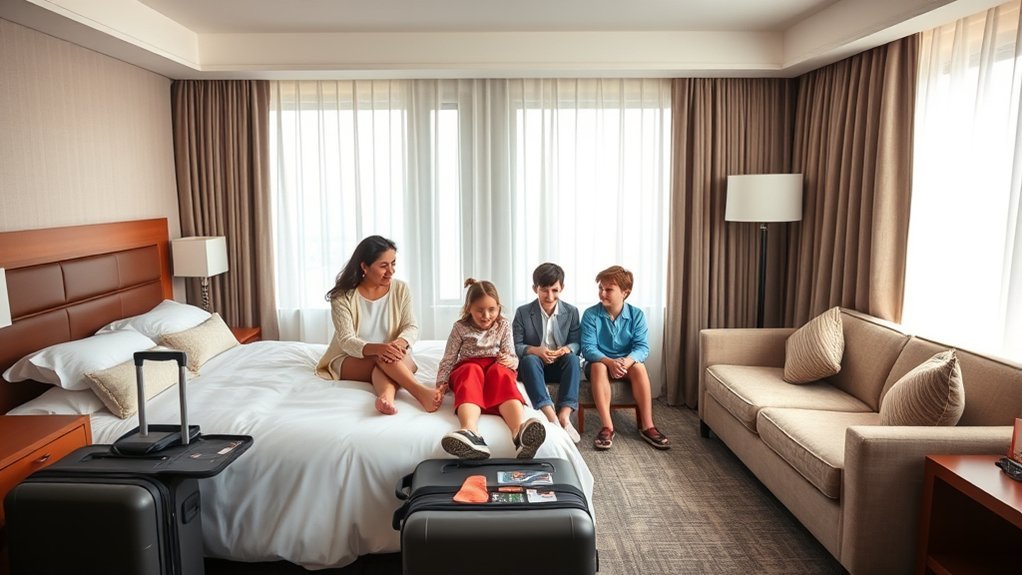
“4 max” means the room has a maximum of four registered occupants. “2 adults / 2 children” normally divides those four places into no more than two adults and no more than two children.
The label should not be read as permission for any group of four. For example, four adults would exceed the adult limit even though the total is four. One adult and three children may also fall outside the stated child limit. The hotel’s booking system or written terms will decide whether a different combination is permitted.
Official hotel policies show why the exact wording matters. Premier Inn’s booking terms, for example, state that its family rooms can accommodate two adults and two children under 16 and that guests must not exceed the allocated room’s maximum occupancy. Other brands and properties use different age definitions and room combinations.
| Proposed Party | Does It Fit the Label? | Why |
|---|---|---|
| 2 adults and 2 children | Normally yes | The party matches both the four-person total and the stated adult-child split. |
| 2 adults and 1 child | Normally yes | The party stays below all stated limits. |
| 3 adults and 1 child | Normally no | The party exceeds the two-adult cap. |
| 1 adult and 3 children | Confirm first | The total is four, but the party may exceed the two-child category shown. |
| 2 adults, 2 children, and 1 infant | Do not assume | The infant may be treated as a fifth occupant unless the property confirms an exception. |
| 4 adults | No | The group exceeds the two-adult limit. |
A room can have enough places to sleep while still being restricted to fewer registered occupants. Beds do not automatically determine the approved guest limit.
Do Children Count Toward the Room Limit?
Yes. In this specific label, the two children are part of the four-person maximum. A party of two adults and two children has already reached the stated limit.
What varies is the hotel’s definition of a child. One property may classify a 15-year-old as a child, while another may price or count that guest as an adult. For example, Premier Inn defines children as under 16 for its family-room occupancy policy, while other hotels use different thresholds. Always enter each child’s correct age instead of choosing a lower age to make the room appear available.
The treatment of babies also varies. Travelodge’s published booking terms expressly include babies and children in its listed room combinations. That example shows why you should not assume that a baby in a cot is automatically excluded from the limit.
Note: A child may stay without an additional room charge and still count toward maximum occupancy. Price and occupancy are separate parts of the booking policy.
Maximum Occupancy vs. Bedding Capacity
Maximum occupancy tells you how many registered guests the property permits in the room. Bedding capacity tells you where those approved guests can sleep. The two numbers may be different.
For example, a room might permit four people but have only one double bed and one sofa bed. Another room might have two large beds but still carry a lower occupancy limit. A cot, rollaway, or sofa bed can provide an approved sleeping surface, but it does not automatically add another guest place.
Before booking, confirm all of the following:
- The maximum number of registered occupants
- The maximum number of adults and children
- The hotel’s child-age definition
- The number and size of fixed beds
- Whether the sofa converts into a bed
- Whether a cot or rollaway is available for the selected room
- Whether extra bedding carries a nightly charge
- Whether adding bedding changes the room layout or available floor space
IHG’s Kids Stay and Eat Free terms illustrate the distinction: a cot may be complimentary and a rollaway may be chargeable, but maximum-room-occupancy restrictions still take priority.
Can a Studio Room Fit Your Family?
A studio room can fit two adults and two children only when the individual listing approves that party and provides suitable sleeping arrangements. The word “studio” describes an open-plan room layout; it does not guarantee a four-person occupancy limit, a sofa bed, or space for a rollaway.
Check the room description rather than relying on the room name. A studio may contain one queen or king bed, two beds, a sofa bed, a kitchenette, or another arrangement. Some properties permit cots only in certain room categories, and an extra bed may not fit safely after the existing furniture is considered.
Think about comfort as well as permission. For a family of four, confirm:
- Each person has an approved place to sleep.
- The children can use the stated bed type safely and comfortably.
- There is enough space to reach the door and bathroom when a sofa bed or cot is open.
- The room provides enough storage for luggage and family equipment.
- The bathroom and open-plan layout provide an acceptable level of privacy.
Pro Tip: Ask the property to confirm the exact bed arrangement in writing. “Sleeps four” may mean two people share the main bed and two share a sofa bed, which may not suit older children.
Do Babies or Infants Count as Guests?
Do not assume that an infant can be added beyond the four-person maximum. Some properties count every person, including a baby, while others publish a specific cot-age exception for selected room types.
Enter the baby as a guest when searching and provide the correct age. If the booking system will not accept the party, do not book the room for fewer guests and plan to explain the baby at check-in. Contact the property and ask:
- Does the infant count toward this room’s maximum occupancy?
- Can this exact room accept a cot?
- Is the cot guaranteed or only available on request?
- Does the cot carry a fee?
- Will the reservation confirmation show the infant?
A request for a cot is not the same as approval for an additional occupant. Keep the hotel’s response with your reservation documents.
Does “Kids Stay Free” Change the Room Limit?
No. “Kids stay free” is normally a pricing benefit for eligible children who share a room with adults. It does not mean that extra children can be added beyond the approved occupancy.
For example, Hilton Garden Inn Mobile Downtown states that two children under 18 may stay free when sharing their parents’ room, but the benefit remains subject to maximum room occupancy. IHG similarly states that maximum-occupancy rules supersede its child-stay offer.
Also check whether “free” applies only to the room rate. Breakfast, rollaway beds, resort fees, local taxes, and other charges may follow separate rules.
Will the Hotel Turn You Away At Check-In?

Yes, a hotel may refuse to accommodate an undeclared guest when your arriving party exceeds the reserved room’s limits. The exact response depends on the property’s terms, available rooms, and the type of mismatch.
The property may:
- Ask you to reserve a second room
- Move you to a larger room and charge the difference
- Add an approved extra-person or extra-bed fee
- Refuse the extra guest
- Decline accommodation when no compliant arrangement is available
Do not rely on the front desk making an exception. Premier Inn’s current terms, for example, state that guests must not exceed the maximum occupancy of the allocated room and that the company may check compliance.
Warning: Booking for fewer people than will actually stay can leave your family without a valid room at check-in. Register every overnight guest before arrival.
How To Book Without Exceeding Occupancy Limits
Follow these steps before paying for the room:
- Enter the full party. Include every adult, child, and infant and provide the correct ages.
- Open the exact room details. Do not rely only on the hotel’s general family policy because room types can have different limits.
- Read both occupancy and bedding information. Confirm the guest limit, fixed beds, sofa beds, cots, and rollaways separately.
- Review child-pricing rules. Check the age at which a child is charged as an adult and whether meals or extra beds cost more.
- Contact the property when anything is unclear. Use the contact details in the booking platform or reservation confirmation.
- Request written confirmation. Keep the email or message showing the approved guest count and bed arrangement.
- Check the final confirmation. Make sure it lists the correct number of adults and children before your cancellation deadline passes.
- Check the room details on your phone or computer and save a copy of the stated occupancy policy.
- Confirm that both children have approved sleeping places rather than assuming that a sofa can be used as a bed.
- Ask the front desk or reservations team to record any approved cot, rollaway, or guest-count change on the booking.
If one room does not fit your party, compare a larger family room, a suite with a confirmed occupancy of four or more, connecting rooms, or two separate rooms. Requesting connecting rooms does not guarantee them unless the property expressly confirms the arrangement.
What If Your Party Changes After Booking?
Update the reservation as soon as the number of guests or a child’s age category changes. Do not wait until check-in.
Contact the hotel or the booking service used for the reservation and ask it to:
- Add or remove the affected guest
- Recheck the room’s occupancy limit
- Recalculate the rate, taxes, meals, and extra-bed charges
- Confirm whether a different room is required
- Send an updated confirmation showing the complete party
A visitor who does not stay overnight may be covered by a separate visitor policy. Ask the hotel before inviting anyone to the room, especially when the visitor would remain late, use hotel facilities, or stay overnight.
Frequently Asked Questions
Does Max Occupancy Include Children?
Usually, yes. When a listing says “4 max / 2 adults / 2 children,” the children are included in the four-person total. A property may publish a specific infant exception, but you should not assume one.
Can an Infant Be a Fifth Guest in a Four-Person Room?
Only when the property confirms that the selected room allows the infant in addition to four other occupants. Enter the infant during booking and obtain written approval before assuming a cot-age exception.
Does a Sofa Bed Increase Maximum Occupancy?
No. A sofa bed provides another sleeping surface only when the room policy already permits the additional guest. It does not independently change the approved occupancy.
Does “Kids Stay Free” Mean Extra Children Are Allowed?
No. The offer normally removes or reduces the room charge for eligible children who already fit the approved occupancy. It does not override the room limit.
Can a Hotel Refuse Check-In for Too Many Guests?
Yes. The hotel may require another room, move the party to a larger available room for an added charge, refuse the extra guest, or decline accommodation when the reservation does not meet its terms.
Are People Happier With 3 or 4 Kids?
Family happiness is personal and does not determine hotel occupancy. For booking purposes, enter the actual number and ages of your children and choose a room that officially permits the whole party.
What Is the Maximum Number of Children a Person Can Have?
That question is separate from hotel-room capacity. A hotel limits the number of guests allowed in a specific room, so a larger family may need a suite, connecting rooms, or more than one room.
How Much Space Do You Need With Two Kids?
There is no single room-size rule that suits every family. Check the approved occupancy, bed sizes, open floor space, bathroom setup, luggage storage, and whether the room remains usable when a cot or sofa bed is open.
Sources
- Premier Inn Booking Terms and Conditions — supports its maximum-occupancy rules and definition of children for family rooms.
- Travelodge Booking Terms and Conditions — shows that babies and children can be included in published room-occupancy combinations.
- IHG Kids Stay and Eat Free Terms — confirms that maximum occupancy overrides the promotion and that cot or rollaway terms can differ.
- Hilton Garden Inn Mobile Downtown Hotel Policies — provides an example of children staying free only where maximum room occupancy permits.
Conclusion
When you see “4 max / 2 adults / 2 children,” read it as a maximum of four registered guests with no more than two adults and two children, unless the property clearly approves another arrangement. Children normally count toward the total, and an infant, cot, rollaway, sofa bed, or free-child promotion does not automatically create an extra guest place.
Enter every traveler and the correct ages, check the approved bed setup, and get written confirmation when anything is unclear. If the room cannot officially hold your party, choose a larger room, connecting rooms, or a second room before arrival.
