

Last Updated on September 10, 2026 by Daniel Globe
In Virginia, you do not need to register an electric scooter with the Department of Motor Vehicles (DMV), nor do you need a vehicle title, license plate, mandatory insurance, or a driver’s license—provided your scooter meets state classification limits. Under Virginia law, privately owned electric scooters designed to travel at 20 mph or less and weighing under 100 pounds are treated similarly to bicycles, giving riders convenient access to public roadways, bike lanes, and shared paths without administrative red tape.
Quick Answer
No, you do not need to register an electric scooter in Virginia. Under Virginia Code § 46.2-100, an electric scooter weighing under 100 pounds with a top speed of 20 mph is classified as a motorized skateboard or scooter. It requires no DMV registration, title, license, or insurance, but riders must be at least 14 years old to operate one unsupervised.
Key Takeaways
- No DMV Registration: E-scooters meeting state criteria are completely exempt from DMV titling, registration, and inspection.
- Age Threshold: You must be at least 14 years old to ride independently; children under 14 require supervision by an adult aged 18 or older.
- Where to Ride: Legal on public streets with posted speed limits of 25 mph or lower, designated bike lanes, and shared-use paths.
- Night Riding Equipment: Requires a front white headlight visible from at least 500 feet and a rear red reflector or taillight visible from 600 feet.
- Local Rules Override State Baselines: Virginia cities (such as Richmond, Alexandria, and Virginia Beach) enforce distinct local sidewalk and parking restrictions.
Disclosure: As an Amazon Associate I earn from qualifying purchases. Some links on this page are affiliate links, at no extra cost to you.
Virginia Electric Scooter Registration Rules
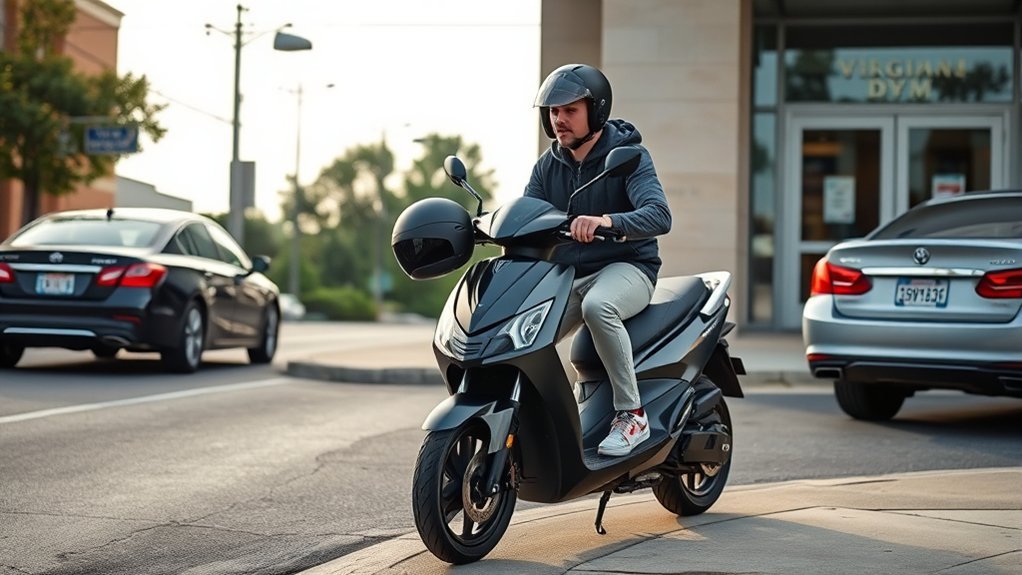
The Commonwealth of Virginia exempts low-speed electric scooters from the traditional motor vehicle registry. Because standard stand-up electric scooters operate at lower speeds and pose lower kinetic risks than automobiles or motorcycles, the state classifies them under personal micro-mobility statutes rather than motor vehicle codes.
This exemption means you will not receive a vehicle identification number (VIN) inspection, nor will you pay annual personal property taxes or registration fees to the Virginia Department of Motor Vehicles. However, this administrative exemption remains valid only as long as your scooter strictly complies with state statutory performance definitions.
At a Glance: Virginia E-Scooter Requirements
| DMV Registration & Title | Not required (Exempt under state law) |
| Driver’s License Requirement | None required (No standard, commercial, or motorcycle license needed) |
| Mandatory Insurance | None required by state law |
| Minimum Age | 14 years old for solo operation; under 14 requires adult supervision |
Virginia Electric Scooter Legal Definition
To qualify for exemption from motor vehicle registration, your scooter must meet the explicit legal criteria outlined in Virginia Code § 46.2-100. If a device exceeds these parameters, it shifts into a different legal class (such as a moped or motorcycle), triggering mandatory licensing and registration mandates.
Electric Scooter Classification
Under Virginia statutes, an electric scooter falls under the umbrella classification of a motorized skateboard or scooter. The law defines this as every device with handlebars, designed to be stood or sat upon by the operator, powered by an electric motor or human propulsion, and capable of a maximum speed of no more than 20 mph on level ground.
| Legal Criterion | Virginia Statutory Requirement |
|---|---|
| Maximum Weight | Must weigh less than 100 pounds (unladen) |
| Maximum Speed | Cannot exceed 20 mph on level ground |
| Propulsion | Electric motor or hybrid human-electric drive |
| Physical Build | Must feature handlebars and floorboard/deck; up to three wheels |
Speed and Design Limits
If you modify your electric scooter by swapping controllers, flashing firmware, or adding high-voltage battery packs that allow it to exceed 20 mph, you forfeit its legal status as a motorized scooter under state law. Operating an unclassified, modified vehicle on public streets can lead to equipment violations and citations for operating an unregistered motor vehicle.
Warning: High-performance electric scooters capable of speeds exceeding 20 mph (e.g., dual-motor models reaching 30–50 mph) cannot legally be operated as standard e-scooters on Virginia public roads, sidewalks, or multi-use paths. They must conform to moped or motorcycle equipment and registration standards.
Where You Can Ride Electric Scooters in Virginia
Virginia state law establishes baseline operational zones for micro-mobility devices under Virginia Code § 46.2-908.1. However, municipal jurisdictions have the explicit statutory authority to add restrictions or expand access.
Roadways and Permitted Speed Limits
You may ride an electric scooter on public highways and roadways that have a posted speed limit of 25 mph or less. In certain localities, ordinances permit operation on roads with speed limits up to 35 mph if a designated bicycle lane or wide paved shoulder is present. When riding on roadways, you must:
- Ride as close as practicable to the right-hand curb or edge of the roadway.
- Obey all standard vehicular traffic signals, stop signs, and lane-direction markings.
- Never carry additional passengers unless the scooter is factory-designed for tandem use.
- Yield to pedestrians crossing at intersections and marked crosswalks.
Bike Lanes and Shared-Use Paths
Designated bike lanes and paved multi-use paths represent the safest corridors for e-scooter travel. Virginia treats motorized scooter operators in bike lanes identically to traditional cyclists. When passing pedestrians or slower cyclists on shared pathways, give an audible warning (bell or voice callout) and reduce your speed to pedestrian pace.
Sidewalks and Local Municipal Restrictions
Under Virginia Code § 46.2-904, riding an e-scooter on sidewalks is permitted by default across the Commonwealth unless the specific city, town, or county has enacted an ordinance prohibiting it. Where sidewalk riding is lawful, operators must yield right-of-way to all pedestrians and maintain a cautious speed.
Pro Tip: Major Virginia urban centers restrict sidewalk riding in congested pedestrian corridors. Always yield right-of-way to foot traffic and dismount in heavily crowded zones.
| Jurisdiction | Sidewalk Riding Policy | Key Local Distinction |
|---|---|---|
| Richmond | Prohibited in commercial business districts | Must utilize dedicated bike lanes or low-speed roads. |
| Alexandria | Prohibited on narrow sidewalks in Old Town | Shared fleet rentals are software-geofenced to 15 mph. |
| Arlington County | Allowed on most sidewalks yielding to pedestrians | Speed capped at 15 mph in shared commercial zones. |
| Virginia Beach | Strictly prohibited on Oceanfront boardwalk | Restricted to marked bike paths and residential roadways. |
Age, License, and Helmet Rules
Virginia law balances open personal transportation access with public safety by imposing age tiers rather than traditional driver licensing exams:
- Age Limits: You must be at least 14 years old to operate a motorized scooter unsupervised on public roadways or paths. Children under 14 may ride only under the direct supervision of an adult who is at least 18 years of age.
- Driver’s License: No driver’s license, learner’s permit, or special endorsement is required by the state.
- Helmet Requirements: State statute does not mandate helmets for riders aged 14 and older. However, commercial dockless rental companies (such as Lime and Bird) often require riders to be 18+ per user agreements, and medical professionals universally recommend certified CPSC bicycle helmets.
Virginia Scooter Speed and Equipment Rules
If you plan to ride your electric scooter after dark or during conditions of reduced visibility, your device must comply with mandatory lighting regulations outlined in Virginia Code § 46.2-1015:
- Front Headlight: A white light on the front of the scooter visible from a distance of at least 500 feet during nighttime operation.
- Rear Reflector / Taillight: A red reflector mounted on the rear visible from at least 600 feet when directly in front of vehicle high beams, or an illuminated red taillight visible from at least 500 feet.
- Braking System: Functional brakes that enable the rider to come to a controlled stop on dry, level pavement.
- Audible Bell: While not mandated by state statute, many local municipalities require a bell or horn to signal passes around pedestrians.
How Local Rules Change Scooter Use
Virginia is a “Dillon Rule” state, but the General Assembly explicitly granted local city councils and county boards the power to regulate commercial shared micro-mobility operations and designate no-ride zones. Local authorities maintain the power to:
- Enforce designated parking corrals to prevent blocked pedestrian curb ramps and building exits.
- Impose curfew hours for commercial rental fleets (often shutting off rentals between 11:00 PM and 5:00 AM).
- Designate pedestrian malls, university campuses, and historic districts as mandatory dismount zones.
Note: College campuses across Virginia (such as UVA, Virginia Tech, and VCU) have independent internal traffic and sidewalk regulations that may restrict where e-scooters can be ridden or stored inside dormitories.
Virginia Electric Scooter Penalties
Failing to abide by state and municipal traffic laws while operating an electric scooter carries real legal consequences. Law enforcement officers can issue moving citations that result in civil fines and court costs:
- Traffic Signal Violations: Running red lights or failing to yield carries fines equivalent to standard bicycle moving violations ($25 to $100 depending on jurisdiction).
- Impaired Riding (DUI / DWI): Under Virginia Code § 18.2-266, operating a motorized scooter on public highways while impaired by alcohol or drugs is unlawful and can lead to Class 1 misdemeanor DUI charges.
- Improper Parking & Abandonment: Impound fees and administrative penalties ranging from $25 to $75 for blocking ADA access paths.
- Underage Operation: Fines assessed against parents or supervising adults for allowing unsupervised operation by minors under age 14.
Electric Scooters vs. Mopeds in Virginia
Many riders confuse electric scooters with mopeds or electric sit-down mopeds. Under Virginia law, these are distinct vehicle classes with vastly different legal obligations.
| Feature / Requirement | Electric Scooter | Moped | Motorcycle |
|---|---|---|---|
| Top Speed | ≤ 20 mph | 21 to 35 mph | Over 35 mph |
| DMV Registration & Title | None (Exempt) | Mandatory with Virginia DMV | Mandatory with Virginia DMV |
| Driver’s License | None required | Government Photo ID (Age 16+) | Driver’s License + Class M Endorsement |
| Helmet Mandate | Optional for riders 14+ | Mandatory (DOT-approved) | Mandatory (DOT-approved) |
| Permitted Riding Areas | ≤25 mph roads, bike lanes, paths | Public roadways (No interstates) | All public roadways & interstates |
Virginia Electric Scooter Safety Basics
While registration is not required, practicing smart riding fundamentals keeps you safe and protects other road users:
- Perform a Pre-Ride Inspection: Check tire pressure, verify that folding latches are securely locked, and test both electronic and mechanical brakes.
- Maintain Visibility: Wear bright or retro-reflective clothing, especially during dawn, dusk, and evening commutes.
- Ride Defensively: Avoid motor vehicle blind spots, watch for opening car doors (the “door zone”) alongside parallel parking lanes, and keep both hands on the handlebars.
- Respect Pedestrian Right-of-Way: Slow down and give audible notice before passing anyone on shared sidewalks or multi-use greenways.
Frequently Asked Questions
Do I need a driver’s license to ride an electric scooter in Virginia?
No, Virginia does not require an operator’s license, learner’s permit, or motorcycle endorsement to ride a standard electric scooter that travels at 20 mph or less. However, solo riders must be at least 14 years old.
Can I ride an electric scooter on the sidewalk in Virginia?
Under state law (Va. Code § 46.2-904), sidewalk riding is permitted unless prohibited by a local town or city ordinance. Cities like Richmond and Alexandria restrict or ban sidewalk riding in busy commercial corridors, requiring riders to use bike lanes or roadways.
Are helmets mandatory for electric scooter riders in Virginia?
Virginia state law does not mandate helmets for electric scooter riders aged 14 and older. However, wearing a certified bicycle or skate helmet is strongly advised to prevent head injuries in collisions or falls.
How do I transfer ownership when selling a private electric scooter?
Because electric scooters do not possess DMV vehicle titles, you transfer ownership simply with a written bill of sale. Provide the buyer with a document listing the date, sale amount, scooter make/model, and serial number for their personal records.
Conclusion
Operating an electric scooter in Virginia offers an efficient, environmentally friendly commuting option free from DMV registration lines, title fees, and compulsory vehicle insurance. By keeping your scooter within the 20 mph statutory threshold, respecting age limits, equipping proper lighting, and abiding by local city ordinances, you can travel legally and safely throughout the Commonwealth.
Sources
- Virginia Code § 46.2-100 — Statutory definitions of motorized skateboards, scooters, and motor vehicles.
- Virginia Code § 46.2-908.1 — Operational requirements, roadway speed limits, and age restrictions for motorized scooters.
- Virginia Code § 46.2-904 — Sidewalk riding statutes and municipal regulatory powers.
- Virginia Code § 46.2-1015 — Mandatory headlight, reflector, and night lighting safety equipment.
- Virginia DMV: Mopeds and Low-Speed Vehicles — Official titling, registration, and driver licensing classifications.
