

Last Updated on August 26, 2026 by Caleb Warren
You may find an electric scooter fuse near the battery, controller, charging circuit, or under the deck—but not every scooter has a user-serviceable fuse at all. Many newer models rely on a resettable circuit breaker or electronic protection inside the battery management system (BMS) and controller. Before removing panels, identify your exact model and check its owner’s or service manual.
Quick Answer
If your electric scooter has a replaceable fuse, it is commonly placed in an accessible electrical compartment near the battery, controller, or charging wiring. However, many scooters use a circuit breaker or electronic BMS/controller protection instead. Check the exact model manual before opening the scooter, and never open a sealed lithium-ion battery pack just to look for a fuse.
Key Takeaways
- Not every electric scooter has a conventional, replaceable fuse.
- Check the exact model manual before opening the deck, stem, controller compartment, or battery area.
- A reset button may indicate a circuit breaker rather than a fuse.
- Test a removable fuse with the scooter powered off and the circuit isolated.
- Replace a fuse only with the manufacturer-specified type and rating; do not install a higher-amperage fuse.
- Do not open, modify, or solder inside a sealed lithium-ion battery pack unless the manufacturer provides a qualified service procedure.
At a Glance
| Time Required | About 10–30 minutes for an accessible, user-serviceable fuse; internal battery faults require professional service. |
| Difficulty | Easy to moderate for an external fuse; advanced and potentially hazardous for sealed battery or BMS work. |
| Tools Needed | Owner’s manual, appropriate screwdriver or hex tool, and a multimeter if the fuse is removable and safe to test. |
| Cost | A user-replaceable fuse is normally a low-cost part; professional battery, BMS, controller, or wiring repair varies by model and fault. |
Warning: Do not open, puncture, modify, bypass, or solder inside a sealed lithium-ion battery pack merely to search for a fuse. High-current battery packs can create severe short-circuit, burn, and fire hazards. The U.S. Consumer Product Safety Commission also recommends using only manufacturer-approved batteries and chargers and avoiding battery packs modified by unqualified personnel.
Disclosure: As an Amazon Associate I earn from qualifying purchases. Some links on this page are affiliate links, at no extra cost to you.
What Does an Electric Scooter Fuse Do?
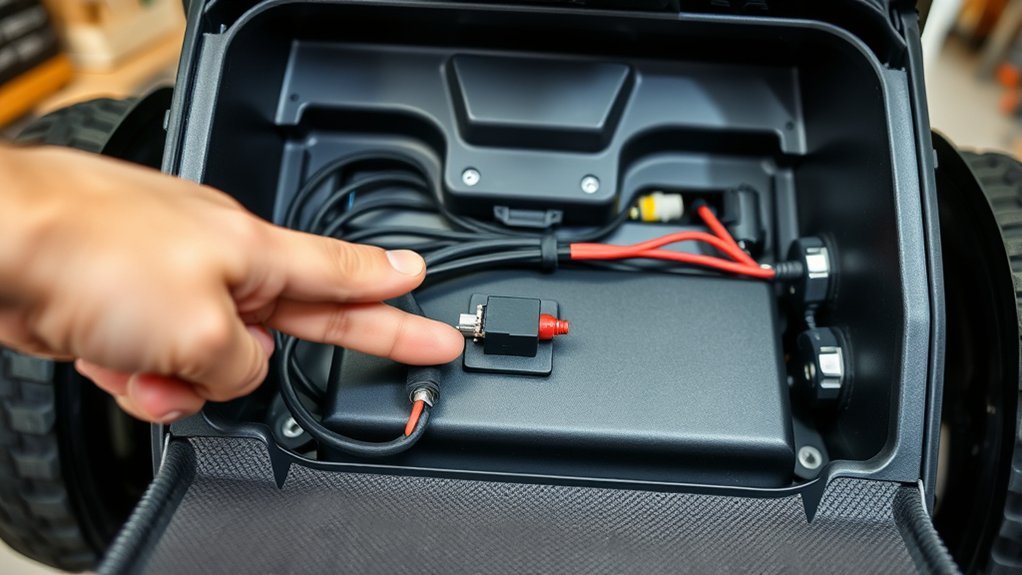
An electric scooter fuse is an overcurrent-protection device. When excessive current flows through a properly selected fuse, its internal element opens the circuit before the protected wiring or components are exposed to damaging current for too long. Fuse makers such as Littelfuse describe a fuse as a deliberately weak link designed to protect wiring and equipment from overcurrent.
However, a modern electric scooter may use several layers of protection. The battery management system can monitor battery current, temperature, voltage, and cell conditions, while the motor controller may provide current limiting or electronic shutdown. A conventional replaceable fuse may therefore be only one part of the system—or may not be provided as a user-serviceable component at all.
If a fuse does blow, treat it as a symptom. Do not simply install a larger fuse. Find out why the circuit exceeded its safe limit before riding again.
Where to Find the Fuse on Your Scooter
If your scooter has a conventional serviceable fuse, likely areas include an accessible battery compartment, controller compartment, wiring harness, or charging circuit. The exact position depends on the model. Some scooters instead use a resettable circuit breaker, while others rely mainly on electronic BMS or controller protection.
Your first step should therefore be to locate the model number—usually on a label under the deck, on the frame, or in the app—and check the manufacturer’s owner’s manual, parts diagram, or service documentation.
Common Fuse Locations
Possible locations on scooters that actually use a replaceable fuse include:
- Battery or electrical compartment: An inline or blade-type fuse may be placed in the main power wiring on some designs.
- Controller area: Some designs place overcurrent protection close to the motor controller.
- Charging circuit: A separate protective device may be fitted to the charge path on certain models.
- Near a reset button: What looks like a “fuse problem” may instead be a tripped circuit breaker.
Do not assume that a component hidden inside a sealed battery pack is intended to be serviced by the rider. If the manual does not identify a user-serviceable fuse, stop disassembly and use the manufacturer’s troubleshooting or repair process.
Brand-Specific Fuse Spots
Brand names alone are not enough to identify a fuse location because one manufacturer may sell scooters with very different electrical systems. Use the exact model and revision whenever possible.
- Xiaomi: Official support material for current and earlier Xiaomi scooters discusses BMS, controller, battery, charging, and error-code faults, but the official documents reviewed do not establish a universal user-serviceable fuse location or a single fuse amperage for Xiaomi scooters.
- GOTRAX: GOTRAX publishes individual manuals for models such as the GXL V2, Apex, G4, G5, G6, GMAX and GX series. Use the correct manual instead of assuming every GOTRAX scooter has the same fuse arrangement.
- Segway-Ninebot: Electrical architecture varies by model. Some Segway documentation explicitly warns that battery assemblies contain no user-serviceable parts.
- Razor: Certain Razor E-series scooters use a reset button/circuit breaker. Razor’s E200/E200S documentation, for example, identifies a reset button in the electrical assembly.
Accessing The Fuse
Only access a fuse if the manufacturer identifies it as a serviceable component. Turn the scooter off, unplug the charger, and follow the manual’s power-isolation procedure. If the design allows the main battery connector to be safely disconnected, do that before touching the fuse holder.
Remove only the panel specified by the manufacturer. Photograph the wiring before disturbing connectors, then locate the labeled fuse or holder. Never probe exposed battery terminals with loose metal tools.
Pro Tip: If you cannot identify an obvious removable fuse holder after opening the manufacturer-approved service panel, stop. Do not keep dismantling the scooter in search of one; your model may use electronic protection or an internal non-user-serviceable device.
Fuse Locations by Scooter Brand
The safest brand-specific answer is based on the exact model documentation rather than a generic amperage chart.
| Brand | What Official Support Confirms | Best Next Step |
|---|---|---|
| Xiaomi | Uses battery-management and controller protection; official documentation reviewed does not provide a universal rider-replaceable fuse specification. | Use the exact Xiaomi model FAQ/manual or after-sales service. |
| GOTRAX | GOTRAX provides model-specific manuals and troubleshooting information rather than one universal fuse layout. | Identify the model and use the matching manual. |
| Segway-Ninebot | Protection and serviceability vary by model; some battery assemblies are explicitly non-user-serviceable. | Follow the exact manual or authorized repair guidance. |
| Razor | Some E-series models use a reset button/circuit breaker rather than a replaceable fuse as the first overload-reset device. | Check the model parts diagram and reset procedure. |
| Apollo and other brands | Electrical layouts differ by generation and model. | Use the manufacturer’s current service documentation before removing panels. |
How to Tell If the Fuse Is Blown?
A removable fuse may show a broken element, scorching, melted plastic, or discoloration, but appearance alone is not always reliable. The more dependable method is a continuity or resistance test with a multimeter after the circuit has been powered down and the fuse has been safely isolated.
Visual Fuse Check
If the fuse has a transparent body, inspect its element for a visible break or heavy discoloration. Also examine the holder and nearby wiring for melted insulation, corrosion, loose terminals, or heat damage.
A damaged holder can interrupt power even if the fuse itself is intact. If you find severe melting, burnt wiring, swelling, or signs of battery damage, do not reinstall a fuse and test-ride the scooter. Arrange professional inspection.
Continuity Test Method
To test a removable fuse, switch the scooter off, disconnect the charger, isolate the battery as directed by the manufacturer, and remove the fuse from its holder when practical. Set the multimeter to continuity mode and touch one probe to each fuse terminal.
A functioning fuse normally produces a continuity tone and very low resistance. An open fuse normally produces no continuity tone and may display OL or an open-circuit indication. Fluke’s continuity-testing guidance uses the same basic principle for identifying an open fuse.
Note: The exact resistance reading that triggers a continuity beep varies by meter. Do not rely on a specific resistance number unless your multimeter manual provides one.
Replace The Fuse
If testing confirms that a removable fuse is open, replace it only with the specification required by the scooter manufacturer. Do not choose a replacement based on amperage alone. The correct part must have the required current rating, voltage rating, fuse characteristic/type, and physical form factor for that circuit.
Never install a higher-amperage fuse to stop repeated failures. Doing so can allow wiring or components to carry more current than the original protection scheme permits.
If the new fuse fails again, stop replacing fuses and diagnose the underlying short circuit, damaged wiring, failed controller, motor fault, moisture damage, or other electrical problem.
How to Replace an Electric Scooter Fuse
Use this procedure only when your scooter manual identifies an accessible, rider-serviceable fuse.
- Turn the scooter off. Remove the charger and wait for the scooter to shut down completely.
- Follow the manufacturer’s isolation procedure. Disconnect the removable battery or approved battery connector if the manual instructs you to do so.
- Open the correct service panel. Use the specified tool and avoid touching exposed terminals with metal objects.
- Identify the fuse specification. Read the markings on the original part and confirm them against the manual or manufacturer parts information.
- Test the fuse. If necessary, use a multimeter to confirm that it is open.
- Inspect the circuit. Look for loose connectors, chafed insulation, melted holders, corrosion, or obvious short-circuit damage.
- Install the exact approved replacement. Do not up-rate the fuse.
- Reassemble the scooter. Refit covers, seals, screws, and connectors exactly as specified.
- Power on and test carefully. If the fuse blows again or the scooter shows another electrical fault, stop using it and arrange diagnosis.
Where Xiaomi Scooter Fuses Are Located
Xiaomi scooters use battery-management and controller protection, but you should not assume that every Xiaomi scooter contains an externally replaceable fuse or that different Xiaomi models share the same fuse rating. The official Xiaomi support documents reviewed for this article do not establish a universal M365, Pro, Pro 2, 1S, or current-model user-serviceable fuse location.
Xiaomi’s troubleshooting material instead discusses battery faults, controller protection, communication errors, overcurrent protection, charging problems, and professional battery/BMS replacement where necessary. If your Xiaomi will not power on, use the exact model’s official troubleshooting information before dismantling the battery.
Xiaomi Battery Pack Fuse
Do not treat a component inside the Xiaomi battery-management assembly as a normal quick-swap fuse. The battery pack contains high-current lithium-ion cells and control electronics. Xiaomi’s own safety guidance discourages unqualified modification and directs users toward professional repair when necessary.
| Model | Official User-Serviceable Fuse Rating Confirmed? | Recommended Action |
|---|---|---|
| Mi M365 | No universal rider-replaceable rating confirmed in the official sources reviewed | Use the exact manual/service information |
| Mi Electric Scooter Pro / Pro-series | No universal rider-replaceable rating confirmed in the official sources reviewed | Use Xiaomi troubleshooting or after-sales service |
This corrects a common online problem: fuse ratings circulated for one board revision or third-party repair may not apply to another battery, BMS revision, or scooter model.
BMS Board Fuse Access
The BMS board is inside the battery system and manages critical battery functions. It is not equivalent to an external automotive-style fuse holder. If the suspected protection device is on or inside the BMS assembly, do not open the sealed battery pack unless you are following manufacturer-authorized service documentation and are qualified to work on lithium-ion packs.
For Xiaomi scooters, start with the official support path. Xiaomi documents battery communication faults, overcurrent protections, temperature faults, cell imbalance, and BMS/battery replacement on newer models, showing why a dead scooter should not automatically be diagnosed as “a blown fuse.”
Checking Fuse Continuity
Use a continuity test only if you have reached a removable fuse through a manufacturer-approved service procedure. Do not puncture insulation, bridge terminals, or probe an exposed lithium-ion battery assembly simply to obtain a continuity reading.
If the protection component is integrated into the BMS or battery electronics, professional diagnosis is the safer route.
Where GOTRAX Scooter Fuses Are Located
GOTRAX sells many electric scooter designs, so there is no single fuse location or amperage that should be applied to every model. The company maintains official GOTRAX manuals for models including the G2, GXL V2, Apex, G3, G4, G5, G6, G7, Eclipse, GMAX and GX series.
If your GOTRAX will not turn on, identify the exact model and use its manual and GOTRAX troubleshooting resources. If the documentation shows an accessible fuse, use that location and specification. If it does not, do not assume a 20A, 25A, or 30A blade fuse belongs in the scooter.
Is It a Fuse or a Circuit Breaker?
A fuse is a one-time overcurrent-protection device: after it opens, it must be replaced. A circuit breaker is designed to trip and can usually be reset after the cause of the overload has been addressed. Electronic BMS or controller protection may shut the scooter down without either device being visible.
- Check the manual or parts diagram for the words fuse, reset button, circuit breaker, overcurrent protection, or BMS.
- Look for an externally accessible reset button only if the manual shows one.
- Do not repeatedly reset a breaker that trips again immediately.
- Do not replace a fuse until you know the correct specification and have checked for an obvious electrical fault.
Razor provides a useful example: the company’s E-series support material includes reset-button replacement and circuit-breaker troubleshooting, and the E200/E200S parts documentation identifies a reset button in the scooter’s electrical assembly.
Why Scooter Fuses Keep Blowing
A fuse that repeatedly opens is usually responding to a fault rather than wearing out randomly. Common causes can include:
- Chafed or pinched wiring that intermittently shorts to another conductor or the frame.
- Loose or overheated connectors that show melting, carbonization, or damaged terminals.
- Water or corrosion inside electrical compartments.
- A failed controller, motor, or other electrical component drawing abnormal current.
- An incorrect replacement fuse with the wrong specification or characteristic.
- Mechanical overload or a stalled motor contributing to high current on a system that is not limiting it normally.
A charger problem should also be taken seriously, especially if the fault appears during charging. The U.S. Consumer Product Safety Commission warns against unapproved “universal” micromobility chargers because a connector that physically fits can still be electrically incompatible.
If a correctly specified fuse fails twice, stop treating the fuse as the problem. The circuit needs diagnosis.
How to Prevent Fuse Problems
Good electrical maintenance reduces the chance of shorts, overheating, and recurring protection faults.
- Inspect accessible wiring and connectors for abrasion, corrosion, looseness, or heat damage.
- Follow the scooter’s stated rider/load limits and operating conditions.
- Keep electrical compartments and charging connectors dry.
- Use only the charger supplied by the manufacturer or a replacement the manufacturer has approved for your exact model.
- Do not modify the battery pack, BMS, controller, or protective devices to obtain more power.
- Replace damaged battery packs only with manufacturer-approved compatible packs.
- Stop using the scooter if the battery is swollen, leaking, unusually hot, physically damaged, or giving off an unusual odor.
A blown fuse is not a reason to install a bigger fuse—it is evidence that the electrical system needs attention.
Frequently Asked Questions
Do Electric Scooters Have a Reset Button?
Some do, but it depends on the model. Certain Razor E-series scooters, for example, use a reset button associated with circuit-breaker protection. Many other scooters use electronic controller or BMS protection instead. Check the exact model manual rather than searching for a universal reset-button location.
How Do I Fix My Electric Scooter That Won’t Turn On?
Start with the simple checks: confirm the power button works normally, check battery charge status, inspect the charger and charge connection, review app or display error codes, and look for loose external connectors. Then check the manual for a resettable breaker or serviceable fuse. If the problem points to the sealed battery, BMS, or controller, arrange professional diagnosis.
How to Tell if a Scooter Fuse Is Blown?
A transparent fuse may show a broken element or heat damage, but a continuity test is more reliable. With the circuit safely powered down and the removable fuse isolated, test across its terminals. A good fuse normally shows continuity and very low resistance; an open fuse normally shows no continuity or an OL/open indication.
How Do You Know if Your Battery Fuse Is Blown?
Only test a battery-related fuse if the manufacturer identifies it as a user-serviceable removable component. Do not open a sealed lithium-ion battery pack solely to test an internal BMS device. A scooter that will not power on can also have a discharged battery, BMS shutdown, damaged wiring, controller fault, communication error, or other problem.
Does Every Electric Scooter Have a Replaceable Fuse?
No. Some scooters use conventional fuses, some use resettable circuit breakers, and many use electronic protection in the controller or BMS. The owner’s manual or service documentation for the exact model is the most reliable way to identify its protection system.
Can I Open the Battery Pack to Replace an Internal Fuse?
Not as a routine DIY repair. A sealed lithium-ion battery pack contains high-current cells and electronics that can create a serious short-circuit or fire hazard if damaged or bridged accidentally. Use manufacturer-authorized service information and qualified repair for internal battery or BMS faults.
Conclusion
Your electric scooter may have a replaceable fuse near an accessible battery, controller, or charging circuit, but you should never assume that every scooter uses the same layout. Some models use resettable circuit breakers, while others depend on electronic BMS and controller protection.
Identify the exact model first, follow its manufacturer documentation, and test only a safely accessible fuse. If a replacement is required, use the exact manufacturer-specified type and rating. Never install a larger fuse or open a sealed lithium-ion battery pack simply to search for one. If a fuse or breaker fails repeatedly, diagnose the underlying electrical fault before riding again.
Sources
- U.S. Consumer Product Safety Commission — Micromobility Safety Center — battery, charging, replacement-pack, and fire-safety guidance.
- U.S. CPSC — Universal Charger Warning — compatibility and charging-fire guidance.
- Xiaomi — Mi M365 Electric Scooter Safety Notice — official maintenance, battery/charger, and repair precautions.
- GOTRAX — Official Scooter Manuals — model-specific owner documentation.
- Razor — E-Series Support — manuals, reset-button replacement, and circuit-breaker troubleshooting.
- Littelfuse — Fuseology — fundamentals of fuse and overcurrent protection.
