
Last Updated on August 26, 2026 by Caleb Warren
Electric scooter width depends on what you measure. On a stand-up electric kick scooter, the widest fixed part is often the handlebars, while the deck and tires are much narrower. Many adult commuter scooters fall roughly in the 16-to-23-inch range at their widest point, but there is no universal standard. Always compare the manufacturer’s overall, handlebar, deck, and folded dimensions before buying.
Quick Answer
Most adult electric kick scooters are roughly 16 to 23 inches wide at the handlebars, although compact and performance models can fall outside that range. Decks are much narrower, often around 6 to 9 inches. For storage, use the scooter’s actual folded dimensions rather than assuming folding makes it narrower.
Key Takeaways
- There is no single standard electric scooter width; manufacturers measure handlebars, decks, tires, and folded dimensions separately.
- The handlebars are usually the widest fixed part of a stand-up electric kick scooter.
- A wider handlebar can provide more steering leverage, while a wider deck mainly gives your feet more room.
- Folding the stem does not always reduce scooter width because many handlebars do not fold inward.
- Mobility scooters are a different category and should not be directly compared with stand-up kick scooters.
Disclosure: As an Amazon Associate I earn from qualifying purchases. Some links on this page are affiliate links, at no extra cost to you.
How Wide Is an Electric Scooter?
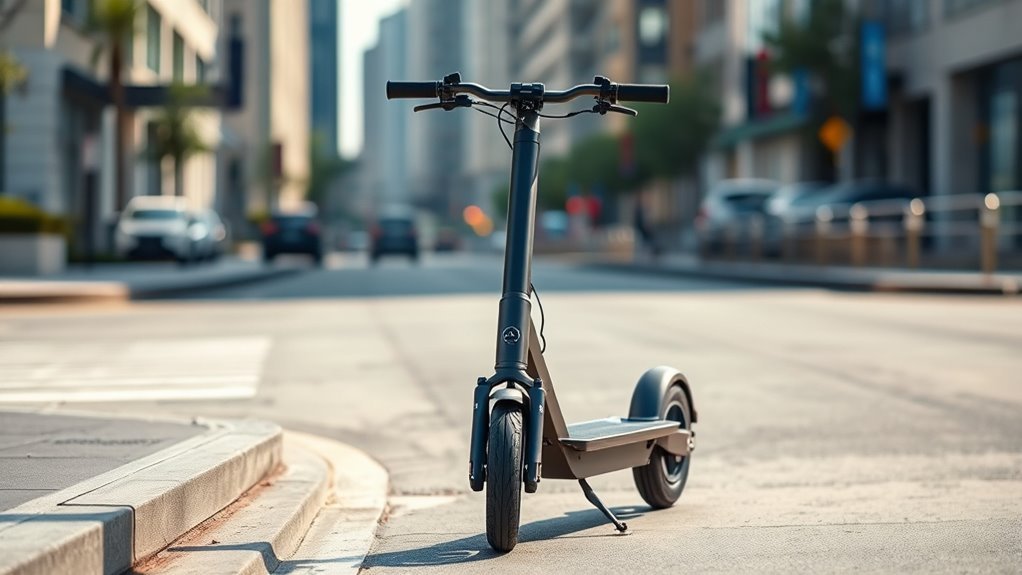
For an adult stand-up electric kick scooter, a practical ballpark is roughly 16 to 23 inches wide at the widest fixed point, which is commonly the handlebar. That is a guide rather than an industry standard. Some compact scooters are narrower, while larger performance scooters may use wider handlebars.
Current manufacturer specifications show how much dimensions can vary. The Segway MAX G2 is about 22.4 inches (570 mm) wide. The NIU KQi3 Max has a 21.3-inch handlebar but only a 6.7-inch deck. Those numbers describe different parts of the scooter, so they should not be used interchangeably.
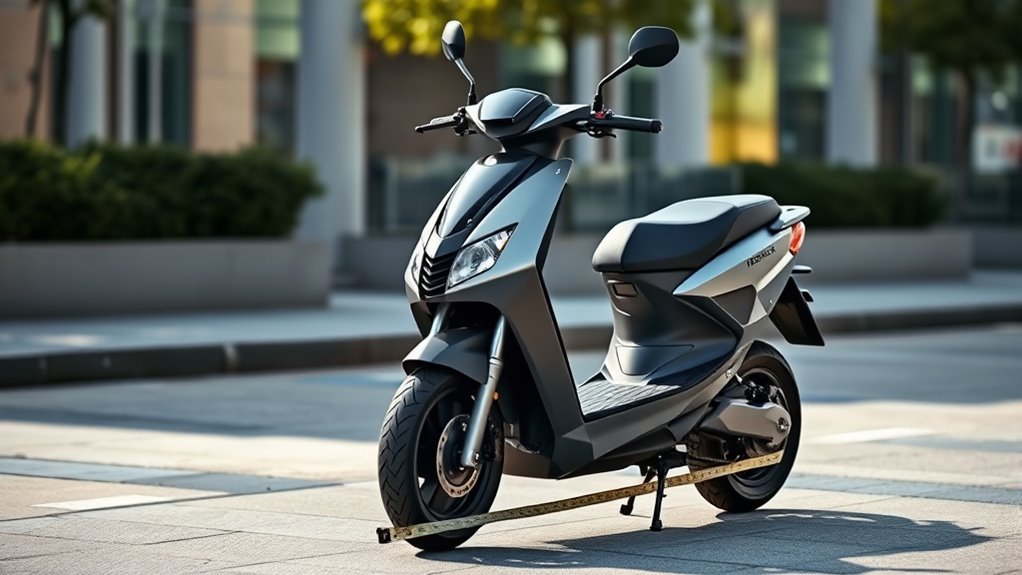
Note: A seated mobility scooter is a different vehicle category. For example, Pride Mobility lists the Victory 10 at 22.25 inches overall width. That figure describes the body of a medical mobility scooter, not the handlebar width of a two-wheel commuter e-scooter.
Electric Scooter Width by Type
The most useful way to compare electric scooter width is by the specific measurement rather than by a broad scooter category.
| Measurement | What It Means | Why It Matters |
|---|---|---|
| Overall width | The widest point of the complete scooter in riding position | Doorways, storage, transport, and maneuvering |
| Handlebar width | Distance from one handlebar end to the other | Steering leverage, rider ergonomics, and clearance |
| Deck width | Usable width of the standing platform | Foot placement and comfort |
| Tire width | Width of an individual tire | Grip, steering feel, rolling resistance, and surface behavior |
| Folded width | Width after using the scooter’s folding mechanism | Closets, trunks, stairs, and public transport |
Compact commuter models generally prioritize manageable weight and dimensions. Larger performance scooters may have wider handlebars and decks. Fat-tire models use broader tires, while seated mobility scooters have a body and wheel track that make overall width a different measurement altogether.
What Scooter Width Means for Stability
Width can affect how a scooter feels, but it is inaccurate to say that a wider two-wheel scooter automatically has a wider base that prevents tipping. The front and rear wheels of an electric kick scooter remain roughly in one line, unlike the wheels of a three- or four-wheel mobility scooter.
Handlebar width mainly changes steering leverage. A somewhat wider bar can give the rider more leverage for small steering corrections, while an excessively narrow or wide bar may feel awkward depending on body size and riding position.
Deck width changes how much room you have to position your feet. More deck space can make it easier to adopt a comfortable staggered stance, but deck width alone does not guarantee greater dynamic stability.
Tire width, wheel diameter, wheelbase, steering geometry, suspension, speed, road surface, tire condition, and rider technique can all affect how planted a scooter feels. For this reason, arbitrary rules such as “23–24 inches is the most stable” or “20 inches is ideal for cities” should not be used.
A scooter’s width is only one part of its handling. Handlebar leverage, foot position, tires, geometry, speed, and road conditions all matter.
Handlebar Width vs Deck Width
Handlebar width and deck width affect different parts of your ride. The handlebars determine your hand position and steering leverage, while the deck determines how much space your feet have.
- Wider handlebars: can provide more steering leverage but also need more clearance through doors, corridors, and storage spaces.
- Narrower handlebars: reduce the scooter’s side-to-side footprint but may feel cramped for some riders.
- Wider decks: give you more options for staggered foot placement.
- Narrower decks: reduce bulk but provide less room to reposition your feet.
- Rider fit: should consider natural hand position and foot stance separately rather than matching shoulder width to deck width.
The NIU KQi3 Max illustrates the difference clearly: NIU lists a 21.3-inch handlebar and a 6.7-inch deck. The scooter can therefore be more than three times wider at the handlebars than at the standing platform.
How Electric Scooter Width Affects Foldability
Folding does not automatically make an electric scooter narrower. Most folding systems lower the stem toward the deck, which greatly reduces height. If the handlebar itself does not fold inward, however, the scooter may remain almost exactly as wide as it was while standing.
| Design | Effect on Width |
|---|---|
| Stem folds only | Usually reduces height but may leave width unchanged |
| Folding handlebars | Can substantially reduce folded width |
| Fixed handlebars | Handlebar width remains the main storage constraint |
The Segway MAX G2 is a useful example. Segway lists its dimensions at about 47.6 × 22.4 × 49.8 inches when unfolded and 47.6 × 22.4 × 23.8 inches when folded. The height drops considerably, but its 22.4-inch width remains the same.
Unagi publishes a folded footprint of approximately 37.8 × 16.5 × 15 inches for the Model One Voyager. That is considerably different from describing the scooter as only 7.5 inches wide when folded.
Width of Popular Scooter Models
Real manufacturer measurements give a better picture than a single generic range.
| Model | Verified Width Information | What It Shows |
|---|---|---|
| Segway MAX G2 | 22.4 in overall width | A full-size commuter scooter can remain the same width when folded. |
| NIU KQi3 Max | 21.3 in handlebar; 6.7 in deck | Handlebar width and deck width are very different measurements. |
| Unagi Model One Voyager | Published folded dimensions about 37.8 × 16.5 × 15 in | Compact folding should be evaluated from the complete folded footprint. |
| Pride Victory 10 | 22.25 in overall width | This is a seated mobility scooter, so its width cannot be compared directly with a two-wheel kick scooter. |
The Mercane WideWheel family is another reminder to check what a measurement describes. Its “WideWheel” name refers largely to unusually broad tires. A tire, folded package, deck, and complete riding scooter can all have very different widths, so a single 10-inch figure should not be presented as the scooter’s overall riding width without a model-specific specification.
How Scooter Width Affects Storage Space
A few inches can matter when you need to put a scooter in a closet, hallway, elevator, car trunk, or beside a desk. The key measurement is the scooter’s widest point in the exact configuration in which you plan to store it.
Do not assume that a scooter advertised as “foldable” becomes narrow. Check all three folded dimensions—length, width, and height—and also check the scooter’s weight if you need to lift it onto stairs, into a trunk, or onto public transport.
Storage Clearance Needs
Measure the actual opening rather than relying on a nominal doorway or closet size. Door handles, trim, shelving, parked objects, and the door itself can reduce usable clearance.
- Measure the narrowest clear opening.
- Measure the scooter at its widest fixed point.
- Include brake levers, mirrors, phone mounts, bags, and other accessories if they extend farther outward.
- Leave extra clearance so you do not have to scrape grips or controls against the opening.
- For vertical storage, confirm both width and the amount of floor or wall clearance required by the manufacturer’s approved storage position.
Pro Tip: Make a cardboard strip the same width as the scooter’s widest point and test it through a tight storage opening before buying. It is an easy way to catch clearance problems that are hard to judge from product photos.
Folded Width Benefits
A genuinely narrow folded scooter can be easier to fit beside furniture, into a vehicle, or through a crowded storage area. The biggest benefit comes from models with handlebars that fold inward as well as a stem that folds down.
For scooters with fixed handlebars, folding mainly reduces height. In that case, the handlebar may still determine how much horizontal clearance you need. Weight and folded length can also matter just as much as width when carrying the scooter up stairs or loading it into a vehicle.
How to Choose the Right Scooter Width
Choose width by considering your riding position, storage limits, transportation needs, and the manufacturer’s rider-weight rating. Do not use a single width threshold as a substitute for checking the complete scooter specification.
Rider Size Fit
For handlebar fit, think about whether your hands can rest in a natural position without forcing your shoulders excessively inward or outward. Handlebar shape, grip angle, stem height, and reach also affect comfort.
For deck fit, focus on your feet rather than your shoulder width. The deck should give you enough usable space for the stance recommended by the manufacturer and allow you to reposition your feet without standing on controls or unsupported edges.
- Check handlebar width and height.
- Check usable deck length and width.
- Confirm the manufacturer’s maximum rider weight.
- Consider your preferred staggered foot position.
- If possible, stand on or test-ride the scooter before buying.
Storage And Maneuverability
A narrower scooter is usually easier to move through restricted storage spaces, but riding maneuverability cannot be predicted from overall width alone. Wheelbase, steering angle, handlebar leverage, speed, and rider technique all influence how a scooter turns.
Before buying, compare the scooter’s riding dimensions and folded dimensions with the spaces you use most often. Measure your closet, car trunk, elevator, office storage area, and any narrow passage you regularly need to cross.
Wide Tires and Fat Tire Scooters
Tire width is another separate measurement. There is no universal 3-to-5-inch standard for electric scooter tires. For example, NIU specifies 9.5 × 2.5-inch tires on the KQi3 series, while purpose-built wide-tire designs can use substantially broader tires.
Broader tires can change steering feel, traction, cushioning, and rolling resistance, but width alone does not determine performance. Tire construction, pressure, compound, tread, wheel diameter, suspension, speed, and surface conditions also matter.
- Wider tires can provide a larger contact area depending on tire pressure and construction.
- Pneumatic tires can absorb small surface irregularities better than hard solid tires of similar dimensions.
- Wide tires may add weight and rolling resistance.
- Loose sand, gravel, wet pavement, and broken surfaces still require reduced speed and careful riding.
- A “fat tire” does not necessarily mean the complete scooter is unusually wide.
Warning: Do not choose a scooter based on width alone and assume it will be safe on rough ground. The U.S. Consumer Product Safety Commission warns that small e-scooter tires can be stopped suddenly by obstacles and uneven surfaces. Check the scooter, brakes, tires, handlebars, lights, and controls before riding and slow down for bumps and poor pavement.
How to Measure Scooter Width
You can measure electric scooter width with a tape measure in a few minutes. Measure the scooter on a flat surface and record riding width and folded width separately.
| Step | What to Do | Why It Matters |
|---|---|---|
| 1 | Place the scooter upright on a flat surface. | Keeps the measurement level and repeatable. |
| 2 | Find the widest fixed point, usually the outside edges of the grips or controls. | Gives the practical riding width. |
| 3 | Measure straight across from one outer edge to the other. | Avoids an exaggerated diagonal measurement. |
| 4 | Include permanent accessories that extend beyond the original width. | Shows how much clearance the scooter actually needs. |
| 5 | Fold the scooter exactly as the manufacturer instructs and measure again. | Gives the true storage width rather than assuming folding makes it narrower. |
If you are checking whether the scooter will fit through an opening, measure the narrowest usable clearance of that opening as well. Compare width, length, height, and weight when planning car or closet storage.
Frequently Asked Questions
What are the negatives of e-scooters?
Electric scooters have small wheels, limited weather protection, battery and charging requirements, and less physical protection than an enclosed vehicle. Rough pavement and obstacles can cause sudden loss of control. The CPSC recommends wearing a helmet, inspecting the scooter before riding, testing the brakes, watching for road hazards, and following manufacturer charging instructions.
Can an electric scooter fit in a car?
Many foldable electric scooters fit in car trunks or cargo areas, but there is no universal fit. Compare the manufacturer’s folded length, width, and height with the narrowest trunk opening and available cargo space. Also check scooter weight if you need to lift it regularly.
What is the standard width of a scooter wheel?
There is no single standard electric scooter tire width. Tire dimensions vary by model and intended use. The NIU KQi3 series, for example, uses 2.5-inch-wide tires, while scooters designed specifically around wide or fat tires can use broader ones.
What size is an adult electric scooter?
Adult electric scooters do not have one standard size. As examples, the Segway MAX G2 is about 47.6 inches long and 22.4 inches wide, while the NIU KQi3 Max has a 21.3-inch handlebar and 6.7-inch deck. Check width together with height, length, deck size, scooter weight, and rider capacity.
Does folding an electric scooter make it narrower?
Not always. Folding the stem usually lowers the scooter’s height, but fixed handlebars can leave the width unchanged. The Segway MAX G2, for example, is listed at 22.4 inches wide both folded and unfolded. Scooters with folding handlebars can become substantially narrower.
How much clearance should I leave around a scooter for storage?
Leave enough clearance to move the scooter without hitting grips, brake levers, walls, doors, or furniture. There is no universal minimum. Measure the scooter’s widest point, measure the narrowest opening, and leave additional space for comfortable handling.
Conclusion
Electric scooter width is most useful when you know exactly what is being measured. For a stand-up e-scooter, the handlebar is often the widest point, while the deck and tires are much narrower. A commuter scooter may be roughly 16 to 23 inches wide, but there is no universal standard.
Compare riding width, folded dimensions, deck space, rider capacity, and storage clearance rather than choosing by one number. Wider handlebars can change steering leverage, a wider deck can improve foot-placement options, and folding may or may not reduce the scooter’s width. Manufacturer specifications are the best source for deciding whether a particular scooter fits your body, storage space, vehicle, and route.
Sources
- Segway MAX G2 Specifications — overall and folded dimensions.
- NIU KQi3 Max Specifications — handlebar, deck, tire, and body dimensions.
- Unagi Lightweight Electric Scooter Guide — Model One Voyager folded dimensions.
- Pride Mobility Victory 10 Specifications — mobility-scooter overall width and dimensions.
- U.S. Consumer Product Safety Commission Micromobility Information Center — e-scooter riding, inspection, obstacle, and charging safety guidance.
