
Last Updated on September 27, 2026 by Caleb Warren
Knowing how to transport an electric scooter safely can prevent damaged parts, lifting injuries, and problems during travel. The right method depends on your scooter’s weight, folded dimensions, battery, and destination. Whether you’re using a car, train, or storage space, prepare the scooter before moving it and secure it against shifting.
Quick Answer
To transport an electric scooter, switch it off, fold and lock it if possible, and use appropriate lifting points. For car travel, place it in the cargo area and secure it with suitable straps. Check transit restrictions before boarding. For heavy scooters, use a rated ramp or lift. Air travel requires separate battery checks.
At a Glance
| Difficulty | Depends on scooter weight, available space, and loading height. |
| Tools Needed | Suitable tie-down straps, protective padding, and a ramp or lift for heavier models. |
Disclosure: As an Amazon Associate I earn from qualifying purchases. Some links on this page are affiliate links, at no extra cost to you.
How to Transport an Electric Scooter: Choose the Right Method
Start by checking your scooter’s weight, folded dimensions, and battery specifications. These details determine whether it fits in your vehicle, can be carried comfortably, or meets the rules of your transport provider.
Measure the scooter after folding it, including any parts that extend beyond the frame. Compare those measurements with your trunk opening, cargo floor, or available storage space.
Choose your transport method based on the following practical differences:
- Car or SUV: Suitable for most portable scooters when they fit securely inside the cargo area.
- Public transit: Convenient for compact models, provided the operator permits your scooter.
- Carry strap or bag: Useful for manageable scooters that you regularly carry through stations or up stairs.
- Ramp or lift: Appropriate when the scooter is too heavy or awkward to lift safely.
- Air travel: Requires advance approval and close attention to battery capacity.
For longer journeys, some travel models can be separated into lighter components. Only disassemble parts that the manufacturer specifically allows users to remove.
Inspect the frame, folding mechanism, and battery before packing. A scooter with visible damage needs attention before you move it.
Fold Your E-Scooter the Right Way
Turn your scooter off before folding it. Follow the manufacturer’s instructions for its specific latch or lever, because folding systems differ between models.
Keep your fingers clear of the hinge and move the stem slowly. Once folded, confirm that the carrying lock has engaged.
| Step | Action |
|---|---|
| 1 | Power off completely and disconnect the charger. |
| 2 | Locate the folding latch or release mechanism. |
| 3 | Release the mechanism gently. |
| 4 | Fold the stem and engage the carrying lock. |
| 5 | Add a suitable securing strap if needed. |
Before lifting, gently check that the folded stem cannot swing open. A strap can provide additional restraint, but it should not replace a damaged or faulty folding lock.
Inspect the hinge, latch, and stem regularly for looseness, cracks, or unusual movement.
If the mechanism sticks, do not force it. Check the manual and have damaged parts repaired before transporting or riding the scooter.
How to Lift and Carry an E-Scooter Safely?
Lift your electric scooter using the carrying point specified in its manual. Keep the load close to your body, avoid twisting, and ask for help when the weight is difficult to control.
Some manufacturers designate the folded stem as the carrying point. Others may provide a handle or require a different grip. Never assume the handlebars, brake cables, or folding latch can support the scooter’s full weight.
- Switch off the scooter and confirm the folding lock is secure.
- Clear your route of obstacles before lifting.
- Stand close to the scooter with your feet apart for balance.
- Bend at your hips and knees while keeping your back in a neutral position.
- Grip the approved carrying point securely.
- Lift smoothly using your legs and keep the scooter close to your torso.
- Turn by moving your feet rather than twisting your back.
These techniques follow the basic principles in OSHA’s safe lifting guidance.
If you cannot maintain control throughout the lift, put the scooter down and use another method.
For long distances, a suitable carrying bag, trolley, or wheeled transport aid may be easier than holding the scooter continuously.
Pack an E-Scooter for Car Travel
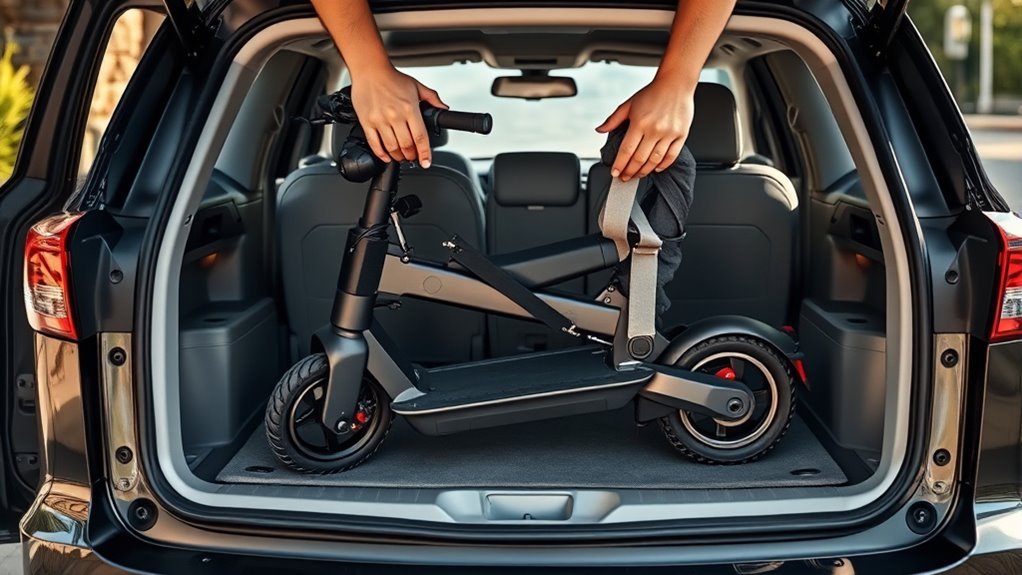
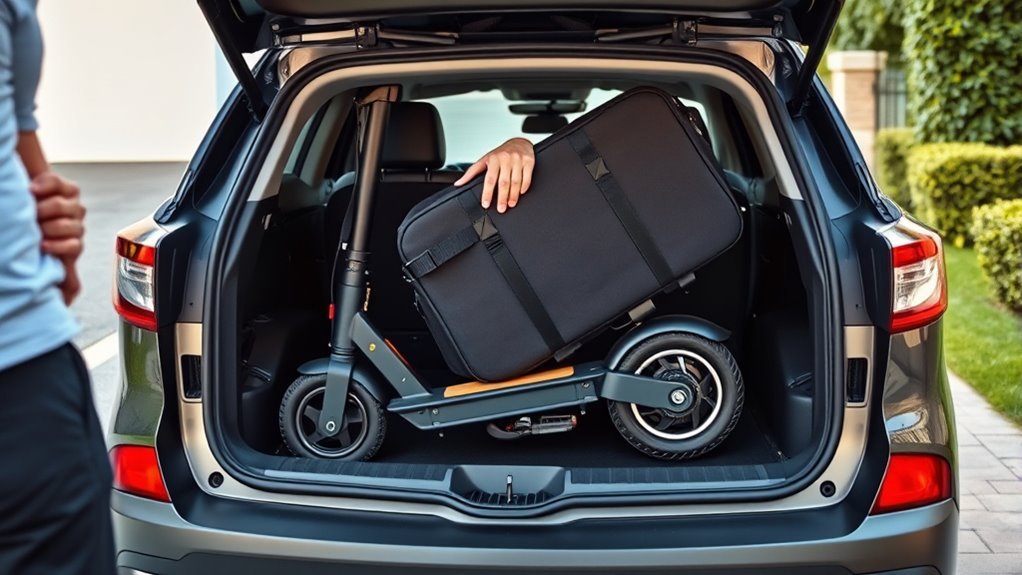
The safest practical approach is to place your scooter in a suitable cargo area and restrain it against movement. Fold it when possible, protect vulnerable parts, and keep it separate from passengers.
Measure the trunk opening as well as the available floor space. A scooter may fit inside the vehicle but still be too large to pass through the opening comfortably.
Fold and Secure
Switch the scooter off, fold it completely, and engage its lock. Use a protective case, foam, or padding around exposed controls and surfaces.
| Step | Action | Result |
|---|---|---|
| 1 | Fold the scooter | Smaller footprint |
| 2 | Lock the stem | Prevents unexpected unfolding |
| 3 | Use suitable straps | Limits movement during travel |
Attach cargo straps to appropriate vehicle anchor points. Avoid tightening them against delicate wiring, brake components, or displays.
A protective bag can prevent scratches, but padding alone will not stop the scooter from moving during sudden braking.
The National Highway Traffic Safety Administration’s cargo-safety guidance recommends securing large objects and checking that loads cannot shift during travel.
Position in Vehicle
Place the folded scooter flat in the trunk or cargo area whenever possible. Keep it low, stable, and clear of the rear window and other visibility areas.
Prevent the wheels from rolling and make sure the scooter cannot slide forward during an emergency stop.
If your vehicle has no separate cargo compartment, use an appropriate restraint system rather than relying on the scooter’s weight to hold it in place.
A rear seat or footwell may be an alternative only when the scooter fits safely and can be secured without putting passengers at risk. Do not block seat belts, airbags, pedals, or access to vehicle controls.
If you transport the scooter upright in an unoccupied seating area, restrain it against tipping and movement in every direction.
Also check the vehicle’s payload capacity, particularly when carrying passengers and other heavy luggage.
Warning: Never leave an unsecured scooter on a seat or cargo floor. During hard braking or a collision, it can move into the passenger compartment and cause injury.
Secure an E-Scooter on Public Transit
Electric scooters are permitted on some trains and buses but prohibited on others. Folding the scooter does not automatically make it acceptable for every service.
For example, Caltrain’s scooter rules allow folding scooters and electric non-folding scooters under specified loading and storage conditions. Folding models must remain under their owner’s control and cannot block aisles or stairs.
In contrast, Transport for London prohibits e-scooters on its services, including folded scooters. Medical mobility aids are treated separately.
These differences show why you should confirm your operator’s policy before beginning your journey.
| Action | Why it matters |
|---|---|
| Fold before boarding when required | Reduces the space needed |
| Use the designated storage area | Keeps aisles and exits clear |
| Keep the scooter restrained | Prevents rolling or shifting |
Switch the scooter off and carry or roll it only as the operator permits. Do not ride it inside stations or vehicles where riding is prohibited.
Keep the scooter close to you without blocking wheelchair spaces, doors, or emergency equipment.
During crowded journeys, avoid placing sharp or protruding components where they could strike other passengers.
Be prepared to use another service if staff determine that your scooter cannot be carried safely.
Use an E-Scooter Carry Strap or Bag
A suitable carry strap or scooter bag can make short-distance transport more manageable. It can also help protect the frame, controls, and surrounding surfaces from scratches.
Choose a strap rated for your scooter’s weight and compatible with its approved attachment points.
Look for these practical features:
- Secure attachment: The strap should not slip along the stem or interfere with the folding lock.
- Comfortable support: A padded strap can reduce pressure on your shoulder.
- Proper fit: The bag should match the scooter’s folded dimensions.
- Protective construction: Padding can help protect exposed components during normal handling.
- Accessory storage: Separate compartments can hold the charger, tools, and small items.
Keep heavy accessories from pressing against the display or control cables.
A shoulder strap does not make an excessively heavy scooter safe to carry. If the weight causes you to lean or lose balance, use a wheeled transport aid or ask for help.
Store Your E-Scooter at Home or Work
Store your scooter in a cool, dry location away from direct sunlight and moisture. Indoor storage can reduce exposure to temperature extremes, corrosion, and accidental damage.
The original suggested indoor range of 50°F to 86°F (10°C to 30°C) is a useful storage target, but your manufacturer’s specified temperature limits take priority.
Follow these storage practices:
- Use a suitable stand or manufacturer-approved wall mount where appropriate.
- Fold the scooter if you need to place it under a desk or inside a suitable closet.
- Keep it away from heaters, direct sunlight, and damp areas.
- Check the battery charge periodically during extended storage.
- Inspect the tires, hinges, wiring, and other exposed parts before returning it to service.
For long-term storage, follow the battery charge level and maintenance interval in your scooter’s manual. Avoid leaving the battery fully discharged for an extended period.
Do not charge the scooter while it is covered or enclosed in a storage bag.
Government e-scooter battery-safety guidance also recommends avoiding escape routes, combustible materials, and extreme temperatures during storage and charging.
Warning: Do not charge or transport a scooter with a battery that is swollen, leaking, unusually hot, smoking, or making hissing sounds. If it starts smoking or catches fire, move away, alert others, and call emergency services. Do not attempt to carry a burning battery outside.
Pack an E-Scooter for Air Travel
Most standard recreational electric scooters are difficult to take on passenger aircraft because their batteries exceed airline limits. Always obtain airline approval before packing or arriving at the airport.
Under the FAA rules for lithium-powered recreational vehicles, battery capacity determines whether a scooter can qualify for carriage.
| Battery Capacity | US Passenger-Aircraft Rules |
|---|---|
| Up to 100 Wh | May qualify, subject to airline acceptance and other requirements. |
| Over 100 Wh to 160 Wh | Requires airline approval. |
| Over 160 Wh | Prohibited as recreational-vehicle battery baggage. |
An airline may refuse a recreational scooter even when its battery meets the applicable capacity limit.
To calculate battery capacity, multiply voltage by amp-hours:
Watt-hours (Wh) = Volts (V) × Amp-hours (Ah).
For example, a 36 V battery rated at 10 Ah has a capacity of 360 Wh. That exceeds the recreational-device limit for passenger baggage.
If your scooter’s label provides milliamp-hours, divide that number by 1,000 before calculating watt-hours.
Removing an oversized battery does not make the battery acceptable for passenger baggage. The airline must also agree to carry the remaining scooter frame.
For an eligible scooter, prepare it as follows:
| Step | Action |
|---|---|
| 1 | Confirm the battery capacity and obtain airline acceptance. |
| 2 | Remove detachable parts only as instructed by the manufacturer. |
| 3 | Protect the scooter and approved battery according to airline requirements. |
Use suitable foam or protective packaging to prevent scratches and movement. Protect exposed battery terminals against short circuits.
Spare lithium-ion batteries must travel in carry-on baggage, not checked baggage, and remain subject to capacity restrictions.
A travel bag or rigid case does not override airline battery rules. Likewise, placing the charger in your carry-on does not guarantee that the scooter will be accepted.
What if Your Scooter Is a Medical Mobility Aid?
A medically necessary mobility scooter falls under a different set of aviation rules than a recreational stand-up scooter.
The FAA’s mobility-device battery guidance explains when lithium batteries may remain installed and when they must be removed and carried separately.
Relevant conditions include battery protection, capacity, short-circuit prevention, and airline handling requirements. Advance arrangements may be necessary.
Do not apply medical mobility-device allowances to an ordinary commuter scooter simply because both are called scooters.
Transport Large Scooters With Ramps or Lifts
Use a properly rated ramp or lift when your scooter is too heavy or awkward to load manually. Some large models weigh over 140 pounds, making their weight and balance especially important during loading.
Check the scooter’s actual weight, including any installed accessories, and select equipment with sufficient load capacity.
Before loading:
- Inspect the ramp or lift for cracks, bends, loose hardware, and worn surfaces.
- Position it according to the equipment manufacturer’s instructions.
- Check that it is stable and properly connected to the vehicle.
- Use a gentle loading angle that provides adequate ground clearance.
- Move the scooter slowly while maintaining control.
- Secure the scooter with approved restraints once loaded.
Never exceed the equipment’s rated capacity. Also check the vehicle’s permitted load and any rack or carrier limits.
Do not stand directly below a raised scooter or place yourself where it could roll into you.
If the manufacturer permits powered loading, follow its exact procedure. Otherwise, keep the scooter powered off and use the recommended manual-loading method.
After loading, check the restraints and verify that the scooter cannot roll, tip, or slide.
Common E-Scooter Transport Mistakes to Avoid
Most transport problems come from poor preparation, unsecured cargo, or using equipment that does not match the scooter. A short inspection before departure can prevent avoidable damage.
Watch for these mistakes:
- Leaving the scooter switched on: Accidental throttle activation can create an unexpected movement hazard.
- Skipping the folding lock: The stem may open while you carry or load the scooter.
- Using unsuitable lifting points: Pulling on controls or cables may damage components.
- Relying on padding alone: A protective bag does not prevent heavy cargo from shifting.
- Ignoring weight limits: Overloaded racks, ramps, or carriers can fail.
- Forcing removable components: Incorrect disassembly may damage connectors, wiring, or joints.
- Assuming all transit providers have the same policy: Permission can differ between cities and individual operators.
- Ignoring battery condition: A damaged battery can create a serious fire hazard during transport or storage.
For car travel, also inspect any externally mounted rack or carrier after the initial loading. Make sure the scooter is clear of the road, vehicle lights, and license plate.
Before your next trip, confirm that the folding mechanism, straps, battery, and transport equipment are all suitable for the journey.
Key Takeaways
- Measure the folded scooter and your vehicle’s loading opening, not just the available cargo floor.
- Use only manufacturer-approved carrying points and removable components.
- Caltrain permits scooters under specific conditions, while Transport for London prohibits e-scooters on its services.
- Recreational scooter batteries exceeding 160 Wh cannot travel as passenger baggage under FAA rules.
- Keep battery-powered scooters away from escape routes and follow the manufacturer’s long-term storage instructions.
Frequently Asked Questions
What Is the Best Way to Transport an Electric Scooter?
The best method is to fold and secure a portable scooter inside your vehicle’s cargo area. Use appropriate restraints and protect delicate parts. For heavier scooters, a rated ramp or lift reduces the need for manual lifting. Public transit and air travel require additional operator approval.
Are Scooters Good for Autistic Kids?
Some autistic children enjoy non-motorized scooters for movement, balance practice, and recreation. Suitability depends on the child’s abilities, comfort, and supervision needs. An occupational therapist can help identify appropriate activities. The American Academy of Pediatrics advises that children under 16 should not ride motorized or electric scooters.
What Happens if an Electric Scooter Is Not Used for a Long Time?
The battery can gradually discharge, tires may lose pressure, and exposed parts can develop corrosion. Store the scooter in a cool, dry location and maintain the battery according to its manual. Some models require periodic charging during storage. Inspect the scooter thoroughly before riding again.
Can You Take a Scooter Through a Drive-Through?
It depends on the restaurant’s policy and local safety requirements. Some drive-throughs do not permit scooters because they share lanes with motor vehicles. Contact the location before entering. If scooter access is prohibited, use the indoor counter or another available ordering option.
Should You Remove the Battery Before Transporting an Electric Scooter?
You do not normally need to remove the battery for ordinary car transport unless the manufacturer instructs you to do so. Remove it only when the scooter is designed for user removal. For flights, battery capacity and airline rules determine whether the scooter and battery can travel.
Conclusion
Transporting your electric scooter safely starts with understanding its weight, dimensions, and battery requirements. Fold it correctly, use approved carrying points, and secure it against movement.
For public transit or air travel, confirm the applicable restrictions before departure. A few careful checks can help prevent damage, reduce injury risks, and make your next trip easier.
Sources
- National Highway Traffic Safety Administration: Vehicle cargo security and load restraint.
- Occupational Safety and Health Administration: Safe lifting techniques and mechanical assistance.
- Caltrain: Scooter carriage, folding requirements, and onboard storage.
- Transport for London: Restrictions on electric scooters and mobility-device distinctions.
- Federal Aviation Administration: Recreational Vehicles: Airline approval, watt-hour limits, and battery protection.
- Federal Aviation Administration: Mobility Devices: Separate battery requirements for medical mobility equipment.
- UK Department for Transport: Electric scooter battery charging, storage, and fire safety.
- American Academy of Pediatrics: Children and electric scooter safety.
