
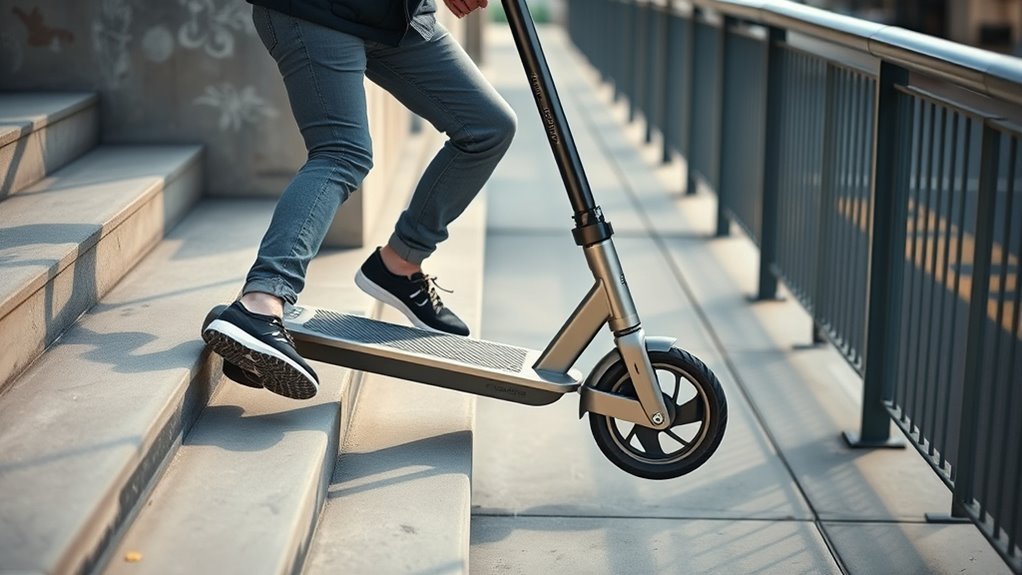
Last Updated on July 23, 2026 by Caleb Warren
Carrying an electric scooter is safest when you prepare it first, use the lift point named in the owner’s manual, and keep the folded scooter close to your body. Turn it off, disconnect the charger, secure the folding latch, remove loose items, and check the route before lifting. Use two hands, an elevator, a cart, or another person whenever the scooter feels awkward or too heavy to control.
Quick Answer
To carry an electric scooter safely, turn it off, fold and lock it according to the manual, and lift from the approved stem, frame, or carry handle. Keep the scooter close, bend at your hips and knees, avoid twisting, and use two hands or get help when you cannot maintain full control.
Key Takeaways
- Check your owner’s manual because the correct folding steps and lifting point vary by scooter.
- Turn the scooter off, unplug it, secure the latch, and remove loose accessories before lifting.
- Keep the load close to your torso, move your feet instead of twisting, and lower it with control.
- There is no universal safe weight or stair-count rule. Use two hands, a cart, an elevator, or another person when needed.
- Check current transit rules before every trip, and secure the scooter against movement when transporting it in a car.
At a Glance
| Time Required | About 30 to 60 seconds to prepare and fold, plus carrying time |
| Difficulty | Easy to moderate, depending on scooter weight, shape, distance, and stairs |
| Tools Needed | None; optional model-compatible strap, bag, cart, or cargo tie-downs |
| Cost | No cost for normal carrying; optional accessories vary by model |
Disclosure: As an Amazon Associate I earn from qualifying purchases. Some links on this page are affiliate links, at no extra cost to you.
Carry an Electric Scooter Safely
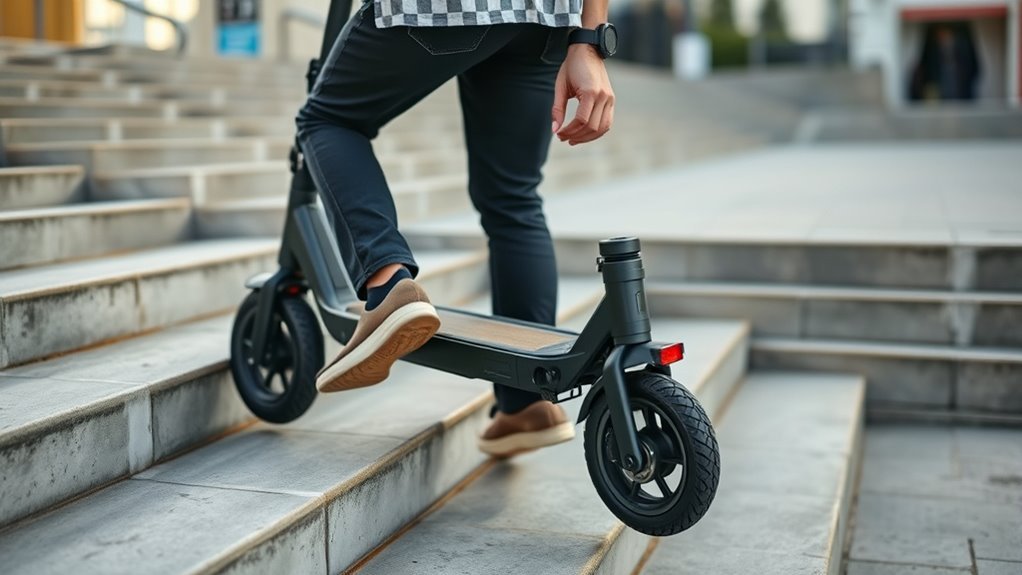
Start with the instructions for your exact model. Folding systems and safe lift points are not identical. For example, Xiaomi tells Mi Electric Scooter 3 users to turn the scooter off before folding and to carry the folded standpipe with one or both hands. A Segway ZT3 Pro manual directs users to lift that model by the stem. Follow your own manual rather than assuming every scooter should be held the same way.
- Power down: Turn off the scooter and disconnect the charger. Do not fold or carry it while charging.
- Remove loose items: Take bags, locks, bottles, phones, and other accessories off the handlebars or deck.
- Fold and secure: Complete every folding step and confirm that the latch or hook is fully engaged.
- Plan the route: Look for wet floors, narrow doors, stairs, crowds, and places where you can rest safely.
- Test the balance: Lift the scooter only a few centimeters first. If it tilts, opens, or feels hard to control, set it down and change your grip.
- Carry close: Keep the scooter near your torso, take short steps, and keep your view of the floor clear.
- Lower with control: Bend at your hips and knees, place the wheels or deck gently on level ground, and keep fingers away from pinch points.
Warning: Do not lift or ride a scooter with a folding latch that will not lock, a cracked stem or frame, loose controls, an exposed wire, or a battery that is swollen, leaking, unusually hot, smoking, or giving off an unusual odor.
Check Your Scooter Before Lifting
A quick inspection helps prevent the scooter from opening, snagging, or shifting while it is off the ground. The U.S. Consumer Product Safety Commission advises checking micromobility products for damage and following the manufacturer’s instructions.
| Check | What to Look For | Why It Matters |
|---|---|---|
| Power and charger | Scooter off and charging cable removed | Prevents accidental operation and cable damage |
| Folding mechanism | Latch, hook, or safety lock fully engaged | Reduces the chance of unexpected opening |
| Stem, frame, and handle | No cracks, looseness, sharp edges, or damaged grips | Protects the main load-bearing parts and your hands |
| Tires and wheels | No major damage, loose wheel, or debris that can fall or snag | Keeps the folded scooter cleaner and easier to control |
| Battery area | No swelling, impact damage, liquid, heat, smoke, or unusual smell | Damaged lithium-ion batteries can create fire and burn hazards |
| Accessories and cargo | Nothing loose on the bars, deck, or frame | Prevents shifting, snagging, and dropped items |
Also check the scooter’s listed weight in the manual or product specifications. Weight alone does not decide whether a lift is safe. Shape, grip quality, stairs, distance, fatigue, footwear, and your own strength and mobility all matter. If you cannot lift the scooter without leaning, twisting, blocking your view, or losing balance, do not carry it alone.
Fold Your Electric Scooter the Right Way
Fold the scooter only as the manufacturer describes. Some models use a lever and safety latch, while others also hook the stem to the rear fender or deck. Do not force a stiff mechanism, and do not assume a click always means the lock is secure. Check it by sight and touch.
Check Folding Lock
Turn the scooter off, hold the stem so it cannot fall, release the folding mechanism, and lower the stem in a controlled motion. Engage every secondary latch, hook, or buckle. Then gently try to move the folded stem without placing your fingers near the hinge. If the mechanism has play, does not reach its locked position, or releases under light pressure, stop and arrange a repair.
Pro Tip: Practice folding and unfolding the scooter on level ground at home. A familiar routine helps you avoid rushed mistakes at stairs, stations, or crowded entrances.
Reduce Carry Bulk
Fold adjustable handlebars only when the manual says they are designed to fold. Remove detachable accessories and secure any loose strap ends. Keep brake cables, the display, lights, and controls away from hard edges. Folding time varies by model and experience, so focus on a complete lock rather than trying to meet a universal three- or five-second target.
Use the Carry Handle or Frame Grip
Use only a carry handle, stem, or frame section approved for your model. Do not lift by the throttle, brake lever, cable, fender, wheel, kickstand, folding lever, or a decorative part. Those parts may bend, release, or damage the scooter.
Handle Grip Basics
Stand close to the scooter with your feet about shoulder-width apart. Place your hands at the approved lift points and keep your wrists as straight as possible. Tighten your core, bend at your hips and knees, and stand smoothly. Guidance from the Occupational Safety and Health Administration supports keeping a load close to the body, maintaining a neutral spine, and avoiding twisting while lifting.
A padded grip may improve comfort, but padding does not make a weak or unapproved part safe. Inspect straps, handles, hooks, and stitching before every use.
Frame Carry Tips
Use one hand only when the owner’s manual permits the chosen lift point and you can keep the scooter stable, close, and clear of the floor. Use two hands when the scooter is long, top-heavy, slippery, or difficult to balance. Move your feet to change direction instead of twisting your torso.
Pause before entering a doorway or turning a corner. The front or rear wheel can swing farther than expected. Keep people, glass, walls, and railings clear of both ends of the scooter.
Lift and Lower an Electric Scooter Step by Step
- Stand beside the scooter, not at the far end of it.
- Make sure the folded package is stable and the route is clear.
- Place one or both hands on the manual-approved lift point.
- Bring the scooter close before taking its full weight.
- Bend at your hips and knees while keeping a neutral spine.
- Stand smoothly without jerking or twisting.
- Walk with short steps and stop if your grip changes or your view becomes blocked.
- To set it down, reverse the movement and keep control until the scooter is fully supported.
Do not try to catch a falling scooter with an outstretched arm or foot. Step clear when possible and inspect the scooter before using it again.
Carry an Electric Scooter Up Stairs
Stairs increase the risk because you must control the scooter while watching each step. There is no reliable rule that makes one-hand carrying safe below a certain number of steps or requires two hands above it. Choose the method that lets you keep your balance, see the stairs, and control the scooter from start to finish.
| Situation | Safer Choice |
|---|---|
| Scooter feels light and stable | Use the approved handle or stem only if you can keep full control |
| Scooter is long, heavy, or unbalanced | Use two hands, a second person, or an elevator |
| Stairs are narrow, wet, crowded, or poorly lit | Wait, use another route, or ask for help |
| You need the handrail for balance | Do not carry alone unless one hand still controls the scooter safely |
| Long climb or repeated flights | Use an elevator, compatible cart, or another person when available |
Keep the scooter on the side away from the handrail when that gives other people more room, but adjust for the stair layout. Do not let the wheels strike steps, and do not rest the scooter where it can slide or block an exit.
Warning: Avoid carrying a scooter on escalators. A wheel, strap, or folding part can become trapped, and you may not be able to control the scooter if you lose balance.
Take an Electric Scooter on Transit
Transit rules can differ by operator, vehicle type, battery policy, time of day, and local fire-safety requirements. Check the operator’s official website on the day you travel. Do not assume a folded scooter is automatically allowed.
Transit Policy Check
Look for rules covering electric scooters, lithium-ion batteries, folded dimensions, weight, peak hours, stations, buses, trains, and replacement transport during disruptions. Policies can be strict. For example, Transport for London states that electric scooters are not allowed on any TfL service, whether folded or not. Other systems may allow them under specific conditions.
| Check Item | What to Confirm |
|---|---|
| Permission | Whether personal electric scooters are allowed at all |
| Folding requirement | When and where the scooter must be folded |
| Size and weight | Any maximum dimensions or lifting requirements |
| Battery condition | Whether damaged, modified, or recalled batteries are prohibited |
| Time and route | Peak-hour, station, vehicle, or route restrictions |
Folding and Boarding
Power off and fold the scooter before you reach the boarding area when the operator requires it. Keep control of the scooter while boarding, and wait for a less crowded vehicle if you cannot board without striking people or blocking the door. Use elevators where available instead of carrying a heavy scooter on station stairs.
On board, place the scooter only where the operator allows. Keep it flat or firmly supported so it cannot roll, fall, or open. Never block an aisle, emergency exit, wheelchair area, door, or driver’s view.
Courtesy in Crowds
- Wipe dirt or water from the wheels before entering.
- Keep sharp edges, handlebars, and wheels away from other riders.
- Remove shoulder straps that may trail or catch.
- Do not place the scooter on a seat unless the operator clearly permits it.
- Wait for more space instead of forcing the scooter into a crowded doorway.
Choose Scooter Carrying Accessories
A carrying accessory should match the scooter’s weight, dimensions, approved lift points, and folding design. A generic strap can press the throttle, damage cables, release the folding lever, or slip toward a wheel. Use a manufacturer-approved accessory or one that clearly lists your model as compatible.
| Accessory | Best Use | What to Check |
|---|---|---|
| Padded carry strap | Short, level carries | Rated capacity, secure attachment, stitching, and buckle position |
| Carry bag | Clean storage and permitted transit | Ventilation, strong handles, wheel clearance, and exact folded size |
| Backpack-style carrier | Only models designed for that carrier | Manufacturer compatibility, secure retention, and no pressure on controls or battery |
| Foldable cart | Long indoor routes or heavy scooters | Stable base, wheel locks, strap points, and total load rating |
| Cargo tie-downs | Transport inside a car | Sound webbing, working buckles, and secure vehicle anchor points |
Do not use a strap around the neck, and do not attach a strap where it can pull on wiring, the display, a brake line, or the folding release.
Protect Your Back While Carrying
Good technique lowers risk, but it does not make every scooter safe for every person to lift. Use a cart, elevator, ramp, or another person whenever the scooter is too heavy, bulky, or awkward for you to hold close and control.
The safest carry is the one that lets you keep the scooter close, your path visible, and your balance steady from lift to set-down.
- Warm up your grip and test the balance before taking a full lift.
- Wear closed, slip-resistant shoes.
- Keep your spine neutral and avoid twisting.
- Take rest breaks during longer carries.
- Do not carry while tired, dizzy, injured, or in pain.
- Ask for help before you lose control, not after.
If you have a back, shoulder, hand, balance, or joint condition, use an alternative transport method or seek personal advice from a qualified clinician before lifting a heavy scooter.
Secure Your Scooter in a Car
Turn the scooter off, unplug it, fold it, and place it in the trunk or cargo area when possible. Protect the display, brake levers, cables, folding mechanism, and battery deck from hard contact. Position the scooter so it cannot become a projectile or damage occupants during sudden braking.
Use the vehicle’s cargo anchor points and strong straps when available. The National Highway Traffic Safety Administration recommends tying down cargo and double-checking that it cannot shift. Do not rely on the scooter’s kickstand, a loose blanket, or friction alone.
- Choose a flat position that does not press on controls, wiring, or the folding latch.
- Use padding to prevent scratches without covering a hot or damaged battery.
- Attach straps to strong frame areas approved by the manufacturer, not to cables or moving parts.
- Tighten the straps enough to stop movement without crushing components.
- Push and pull the scooter in several directions to test the setup.
- Recheck the load after the first part of a long trip.
A wheel stand may help only when it fits the scooter and is secured to the vehicle. It is not a universal requirement, and a bicycle stand may not support an electric scooter correctly.
Warning: Do not transport a battery that is swollen, leaking, smoking, unusually hot, recalled, or damaged by a crash, water, or modification without expert guidance. PHMSA explains that damaged lithium batteries have a greater risk of short circuit, heat release, and fire.
Note: Follow the storage-temperature limits in your manual. A parked vehicle can become very hot, so do not leave the scooter in a car when the temperature may exceed the manufacturer’s allowed range.
When Not to Carry an Electric Scooter
Stop and choose another method when any of these conditions apply:
- The folding latch will not lock or the stem moves unexpectedly.
- The frame, stem, handle, wheel, or approved lift point is cracked or loose.
- The battery is damaged, swollen, leaking, smoking, unusually hot, or smells unusual.
- You cannot see the floor or stairs while holding the scooter.
- The route is wet, icy, crowded, poorly lit, or blocked.
- You need both hands for balance or a handrail.
- You feel pain, weakness, dizziness, numbness, or loss of grip.
- The transit operator prohibits the scooter.
Wheel the scooter when it is safe and permitted, use an elevator or ramp, use a compatible cart, or ask another person to help.
Avoid Common Carrying Mistakes
- Lifting before the latch is secure: The stem can open and shift the load suddenly.
- Carrying by a weak part: Fenders, brake levers, cables, and folding releases are not general-purpose handles.
- Using an invented weight or stair rule: Safe handling depends on the model, person, grip, route, and conditions.
- Leaving accessories attached: Bags, locks, and bottles can swing, snag, or change the balance.
- Twisting while holding the scooter: Turn with your feet and keep the load close.
- Blocking your view: Reposition the scooter or use help before entering stairs or crowds.
- Ignoring transit policy: A folded scooter can still be prohibited.
- Leaving it loose in a car: Secure the scooter against forward, rearward, and side-to-side movement.
- Transporting a damaged battery: Isolate the area, keep people away, and contact the manufacturer or local emergency authority as appropriate.
Frequently Asked Questions
How do I carry a scooter through tight doorways?
Fold it fully, remove loose accessories, and pause before the doorway. Keep the scooter close, turn your whole body with your feet, and move one end through at a time. Do not twist your back or let a wheel swing into the frame, glass, or another person.
Can I carry an electric scooter one-handed?
Only when the manual permits the lift point and you can keep the folded scooter stable, close, and clear of the floor. Switch to two hands, a cart, an elevator, or another person when the scooter tilts, blocks your view, or strains your grip.
What should I do if the folding latch is broken?
Turn the scooter off and do not ride it. Do not use the broken latch as a handle or depend on a temporary tie as a structural repair. Follow the manufacturer’s service instructions or contact an authorized repair provider. Move it only with a safe, manual-approved grip and help when necessary.
How do I carry a scooter across a wet floor?
Avoid the route when possible. Dry your shoe soles, use two hands if that improves control, take short steps, and keep the scooter close without blocking your view. Do not rush, and set it down only on a level, dry surface where it cannot slide.
What is the safest way to set down a scooter?
Stop on level ground, bend at your hips and knees, and lower the scooter smoothly while keeping it close. Maintain your grip until the wheels or deck are fully supported. Keep fingers away from the folding hinge, then use the kickstand only after the scooter is stable.
How heavy is too heavy to carry?
There is no single safe limit for every person or scooter. It is too heavy or awkward when you cannot lift it smoothly, hold it close, see your path, keep your balance, or lower it under control. Use assistance before attempting stairs or a long carry.
Can I use a shoulder strap or backpack carrier?
Use one only when it is rated for the scooter and compatible with your exact model. Check attachment points, stitching, buckles, and clearance around controls, cables, the folding lever, and battery. Stop if the scooter swings or the strap changes the latch position.
Can I take an electric scooter on a plane?
Airline and hazardous-material rules depend on the battery, device, country, and purpose of travel. Many consumer electric scooters have batteries that exceed normal passenger baggage limits. Check the airline and aviation authority before travel, and never arrive expecting the scooter to be accepted without written confirmation.
Conclusion
To carry an electric scooter safely, prepare it before lifting and follow the instructions for your exact model. Turn it off, secure the folding mechanism, use the approved lift point, keep the scooter close, and move without twisting. When stairs, crowds, weight, damage, or battery condition make control uncertain, use another route, a cart, an elevator, or another person. A careful carry protects you, the scooter, and everyone around you.
Sources
- Xiaomi: How to Fold and Carry Mi Electric Scooter 3 — supports powering off before folding and using the folded standpipe as the model-specific carry point.
- Segway ZT3 Pro User Manual — supports following the model’s folding-latch and stem-carry instructions.
- OSHA Ergonomic Solutions for Back Safety — supports keeping loads close, maintaining a neutral spine, and avoiding twisting.
- U.S. Consumer Product Safety Commission Micromobility Information Center — supports damage checks and lithium-ion battery safety precautions.
- Transport for London: Cycles on Public Transport — demonstrates that transit operators may prohibit electric scooters even when folded.
- NHTSA: How to Secure Your Load — supports tying down cargo and checking that it cannot shift in a vehicle.
