
Last Updated on September 10, 2026 by Daniel Globe
You can tell your electric scooter battery is bad if your real-world riding range drops by more than 40%, acceleration feels weak, the scooter abruptly shuts off under load, charging finishes abnormally fast or stalls, or the battery pack exhibits physical swelling, leaks, or extreme heat above 140°F (60°C). Diagnosing the issue involves checking nominal pack voltage, observing under-load voltage sag with a digital multimeter, and assessing cell balance.
Quick Answer
An electric scooter battery is bad if it loses significant range, experiences heavy voltage sag (dropping 5V–10V+ when accelerating) causing sudden shutoffs, fails to charge to its maximum rated voltage (e.g., 42V on a 36V system, 54.6V on a 48V system), or shows physical swelling. If measuring resting voltage shows readings below the pack’s low-voltage cutoff, the battery has deteriorated and requires replacement.
Key Takeaways
- Significant Range Drop: A 40% to 50% loss in mileage indicates irreversible cell wear and capacity degradation.
- Severe Voltage Sag: Sudden cutouts on hills or during throttle punches point to high internal resistance ($R_i$) tripping the Battery Management System (BMS).
- Voltage Diagnostic Benchmarks: A fully charged healthy pack must read close to its peak voltage (42.0V for 36V packs; 54.6V for 48V packs).
- Physical Hazards: Swelling, hissing, chemical odors, or temperatures exceeding 140°F (60°C) represent immediate fire hazards requiring disconnection.
At a Glance
| Time Required | 15–30 minutes for inspection and voltage testing |
| Difficulty | Intermediate (requires basic multimeter handling) |
| Tools Needed | Digital Multimeter (DC Voltage mode), Hex/Torx screwdrivers, Insulated safety gloves |
| Cost | $0 (Self-test) to $120–$450 (Replacement battery pack depending on voltage/capacity) |
Disclosure: As an Amazon Associate I earn from qualifying purchases. Some links on this page are affiliate links, at no extra cost to you.
Electric Scooter Battery Bad Signs
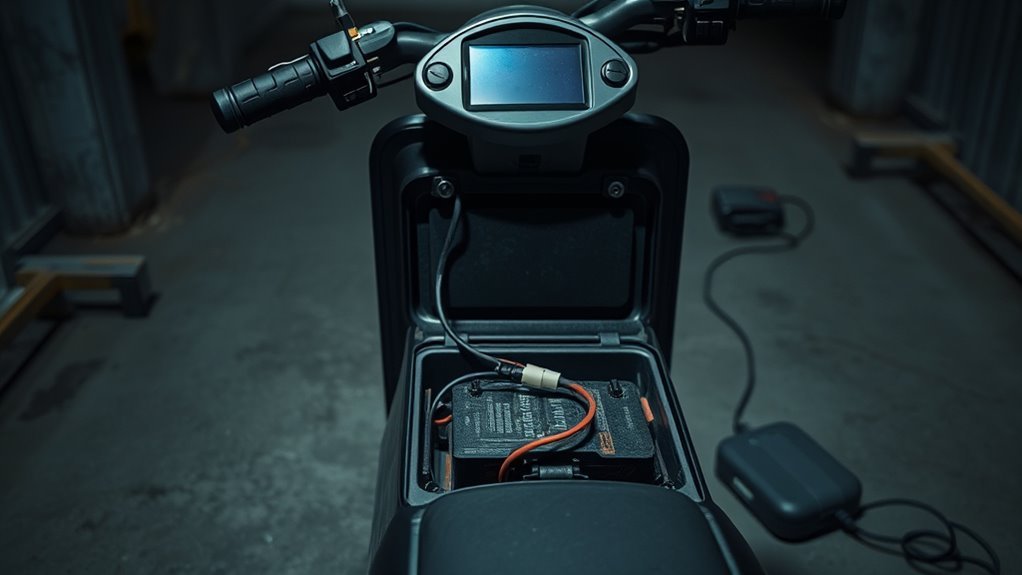
Lithium-ion battery packs in electric scooters degrade gradually through charge cycles, thermal stress, and internal chemical changes. Recognizing early warning signs prevents you from getting stranded or risking dangerous battery failures.
- Premature Capacity Exhaustion: The scooter achieves only a fraction of its factory-rated mileage under identical payload, tire pressure, and terrain conditions.
- Severe Voltage Sag Under Load: Pressing the throttle causes the battery indicator bar to plummet immediately from full to near-empty, recovering only when you release the throttle.
- Sudden Power Cutouts: The scooter powers off completely during acceleration or hill climbs even when the display indicates 30% to 50% remaining charge.
- Abnormal Charge Times: The battery either takes twice as long to charge due to high internal resistance or finishes in under an hour without storing actual usable energy (false peak charging).
- Physical Deformation: Pouch or cylindrical cell expansion causes bulging of the outer heat-shrink or casing, signaling electrolyte decomposition and gas production.
Reduced Range and Performance
Usable battery capacity is measured in Watt-hours (Wh) or Amp-hours (Ah). As lithium-ion cells age, their active material degrades and loss of lithium inventory occurs, as documented by Battery University research on lithium degradation.
Reduced Range
If a scooter that previously achieved 20 miles per charge now struggles to reach 8 to 10 miles under the same ambient temperatures and riding conditions, capacity has dropped past the standard 70% end-of-life threshold. This irreversible capacity loss happens naturally after 300 to 500 complete charge cycles, but it can accelerate if the battery has been stored at 100% state-of-charge in hot environments or repeatedly drained down to 0%.
Sluggish Performance and Voltage Sag
A failing battery exhibits elevated internal resistance ($R_i$). When the motor controller demands high current ($I$) to climb an incline or accelerate, the voltage drop across internal resistance ($\Delta V = I \times R_i$) pulls the battery output voltage below the controller’s Low Voltage Cutoff (LVC) threshold. This results in sluggish top speeds, delayed throttle response, and unexpected power shutdowns.
Pro Tip: Cold weather temporarily increases internal resistance. Always test battery performance and range at room temperature (65°F–75°F / 18°C–24°C) before concluding the pack is permanently damaged.
Abnormal Charging Times and Charger Behavior
Charging irregularities are a primary indicator of degraded cell health or battery management system (BMS) failure:
- Excessively Long Charge Cycles: If a standard 2A charger that normally charges your pack in 4 hours now takes 8 to 10 hours, the BMS is struggling to balance drifting cell groups, or high internal resistance is turning charging energy into waste heat.
- Premature Green Light (False Charging): The charger LED turns green within 30 to 60 minutes, but the scooter dies within a few minutes of riding. This occurs when high internal resistance causes surface charge voltage to spike instantly to the charger cutoff threshold (42V/54.6V) without storing actual charge in the cells.
- Charger Stays Red Indefinitely: If the charger never turns green, one or more parallel cell groups may be dead, self-discharging rapidly, or failing to reach the balance cutoff voltage.
How to Test Scooter Battery Voltage with a Multimeter
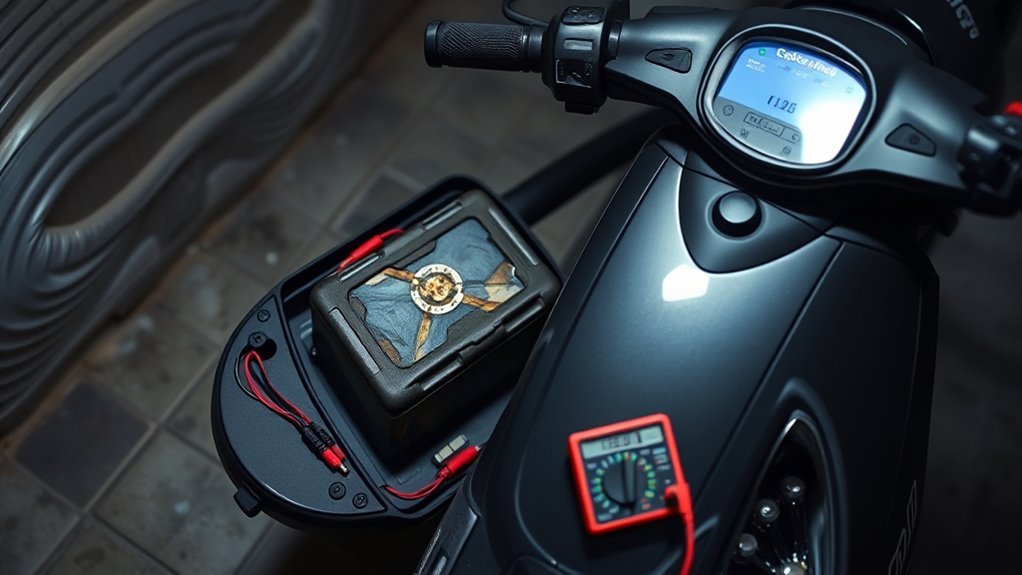
Testing your scooter battery with a digital multimeter provides definitive numerical proof of its health. You can measure voltage at the charge port (if not diode-protected) or directly at the main discharge connector (such as an XT60 or Deans plug) under the deck.
Note: Standard electric scooter lithium-ion batteries are wired in series configurations (10S for 36V, 13S for 48V, 14S for 52V, 16S for 60V). Each healthy cell charges to a maximum of 4.2V and discharges down to 3.0V.
| Nominal System Voltage | Cell Configuration | 100% Full Charge (Resting) | 50% Nominal Voltage | Cutoff / Empty Threshold |
|---|---|---|---|---|
| 36V | 10S | 42.0V (±0.2V) | 36.0V–37.0V | 30.0V–31.0V |
| 48V | 13S | 54.6V (±0.3V) | 48.0V–48.5V | 39.0V–40.0V |
| 52V | 14S | 58.8V (±0.3V) | 51.8V–52.5V | 42.0V–43.0V |
| 60V | 16S | 67.2V (±0.4V) | 59.2V–60.0V | 48.0V–49.0V |
- Charge your scooter until the charger LED turns solid green, then disconnect the charger and let the pack rest for 30 minutes.
- Turn your digital multimeter dial to DC Voltage (V DC or $\overline{\text{V}}$) and select the 200V range.
- Connect the red probe to the positive terminal and the black probe to the negative terminal of the main discharge port.
- Read the displayed value. If a fully charged 48V pack measures only 49.0V instead of 54.6V, one or more internal cell groups have severely drifted or died.
- Perform a load test: Prop the drive wheel off the ground securely, apply full throttle for 10 seconds, and observe the multimeter reading. A voltage sag greater than 3.0V–4.0V during an unloaded free-spin test indicates high cell resistance and battery failure.
Random Power Cutouts and Weak Acceleration
When an e-scooter cuts power mid-ride and refuses to turn back on until connected to a wall charger, the BMS has triggered an undervoltage fault latch. In an aging pack, cell groups become unbalanced. While group A might sit at 3.7V, a degraded group B may drop to 2.8V under load. The BMS immediately cuts power to prevent the weak group from suffering irreversible polarity reversal or thermal runaway.
“A single failing cell group in a series pack limits the total capacity and current output of the entire battery, regardless of how healthy the remaining cells are.”
Swelling or Physical Damage
Physical inspection is the most crucial safety check for any personal electric vehicle (PEV) battery.
Visible Bulging and Swelling
Cell swelling is caused by gas generation inside the cell casing, typically resulting from overcharging, deep over-discharging below 2.5V/cell, or severe thermal breakdown. Swelling compromises the separator between anode and cathode, substantially increasing the risk of an internal short circuit.
Warning: A swollen, punctured, or dented lithium battery must never be charged or stored indoors. Stop using the scooter immediately, disconnect the pack, and place it in a fireproof container away from combustible materials.
Case Cracks, Moisture Ingress, and Leaks
Inspect the heat-shrink wrap and aluminum casing for fractures, white powdery residue, or moisture accumulation. Water ingress through cracked deck gaskets corrodes nickel strip welds and shorts the BMS circuit board. Organic electrolyte leakage produces a distinct sweet, chemical solvent smell resembling acetone.
Immediate Safety Replacement Protocol
- Power down the scooter and open the deck compartment carefully.
- Unplug the main power discharge connector first (XT60/XT90), followed by the charging port connector.
- Inspect for pinched wires, burned insulation, or melting plastic around pins.
- Do not dispose of lithium-ion batteries in household trash. Take the pack to a certified recycling facility via EPA-compliant battery drop-off programs.
Overheating During Use or Charging
Lithium-ion batteries operate safely between 32°F and 113°F (0°C to 45°C) during charging, and up to 131°F (55°C) during discharge. According to micromobility safety alerts from the Consumer Product Safety Commission (CPSC), excessive surface temperatures indicate impending thermal runaway.
- During Charging: The pack should feel barely warm to the touch (90°F–105°F / 32°C–40°C). If the pack is too hot to hold comfortably, unplug the charger immediately.
- During Riding: If the deck feels hot after moderate riding on flat ground, degraded cells are dissipating excessive energy as heat due to high internal impedance.
Why Scooter Battery Health Drops Over Time
Battery wear is driven by four primary degradation mechanisms:
- Cycle Count and Solid Electrolyte Interphase (SEI) Growth: Each charge-discharge cycle thickens the SEI layer on the anode, trapping lithium ions and permanently raising electrical resistance.
- Thermal Degradation: Operating or charging at temperatures above 115°F (46°C) accelerates electrolyte breakdown and cell imbalance.
- Deep Discharge Stress: Repeatedly draining the pack until the scooter shuts off strains the anode structure and leads to copper dissolution.
- High C-Rate Demands: Sustained high-amp riding on under-specced packs stresses small cell configurations (e.g., 2P or 3P packs), causing accelerated cell divergence.
Simple Battery Checks You Can Do at Home
- The Range Audit: Record your start-to-finish GPS mileage on a full charge over a standard route. Compare this to your baseline.
- The Multimeter Voltage Verification: Check resting voltage after a complete charge. Compare your numbers to the voltage reference table above.
- The Charger Touch Test: Check that the charger brick warms up during the constant-current phase and cools down as it approaches full charge.
- Visual & Smell Inspection: Open the deck lid to inspect for swelling, burnt trace smells, or corroded nickel strips.
When to Replace Your Scooter Battery
Knowing when to repair or replace your battery depends on whether the defect is physical, electrical, or related to overall capacity.
Warning Signs Requiring Assessment
Plan for a battery replacement if you observe:
- Real-world range has dropped by more than 35%–40% of its original mileage.
- The battery has accumulated over 500 charge cycles or is more than 3 to 4 years old.
- The pack fails to charge past 90% of its rated maximum voltage after balancing.
Conditions Requiring Immediate Replacement
Stop riding and replace the pack immediately without attempting repair if:
- The battery pack or individual cells exhibit visible swelling, bulging, or case rupture.
- The scooter shuts off abruptly during moderate acceleration despite showing ample battery percentage.
- The battery pack emits smoke, hissing sounds, electrolyte odor, or exceeds 140°F (60°C).
- The battery has been submerged in water or sustained severe impact damage.
Note: When purchasing a replacement battery, look for packs certified to UL 2271 or UL 2272 electrical safety standards to ensure quality cells and robust BMS protection.
Frequently Asked Questions
How do I test my electric scooter battery with a multimeter?
Set a digital multimeter to DC voltage (200V setting). Charge the scooter fully and let it rest for 30 minutes. Insert the probes into the main discharge port (red to positive, black to negative). Compare the reading to your pack’s full voltage spec: 42.0V for a 36V pack, 54.6V for a 48V pack, or 58.8V for a 52V pack. A reading significantly lower than these thresholds indicates degraded or unbalanced cell groups.
How do I reset an electric scooter battery BMS?
To reset a tripped Battery Management System (BMS), power off the scooter, open the deck, and disconnect the main battery plug and charger harness for 15 to 20 minutes. If the BMS circuit board features a dedicated reset button (common on Smart BMS units), press and hold it for 5 seconds before reconnecting. Plug in the official charger to wake the BMS from sleep mode.
What is the average life of an e-scooter battery?
An electric scooter lithium-ion battery typically lasts 2 to 4 years or between 300 and 500 complete charge cycles before usable capacity drops below 70%. You can extend lifespan by avoiding deep discharges below 20%, charging between 32°F and 113°F (0°C–45°C), and storing the battery at roughly 50% charge (around 3.8V per cell) when not riding for extended periods.
Can a dead scooter battery be recharged or revived?
If the battery is merely in BMS low-voltage sleep, plugging in the factory charger can often wake it safely. However, if individual lithium cells have dropped below 2.0V for an extended duration, copper shunts form inside the cells, creating permanent internal short circuits. Attempting to force-charge deeply discharged, swollen, or physically damaged cells poses a severe fire risk and should never be attempted.
Conclusion
A failing electric scooter battery displays distinct operational and electrical symptoms: premature mileage loss, heavy voltage sag under throttle demand, erratic charging behavior, and lower resting voltage readings on a digital multimeter. When voltage measurements sit well below standard thresholds (such as under 40V on a fully charged 48V pack) or physical swelling and overheating occur, internal chemical breakdown is irreversible. Promptly retiring and replacing a compromised lithium pack restores your scooter’s original performance while protecting you from hazardous thermal failures.
Sources
- Battery University (BU-808) — Lithium-based battery capacity loss mechanisms, cycle life, and degradation factors.
- U.S. Consumer Product Safety Commission (CPSC) — Micromobility device safety guidance and fire risk prevention.
- UL Solutions (UL 2271 / UL 2272) — Standard for electrical systems and batteries in personal e-mobility devices.
- U.S. Environmental Protection Agency (EPA) — Safe handling, recycling, and disposal standards for lithium-ion power packs.
