
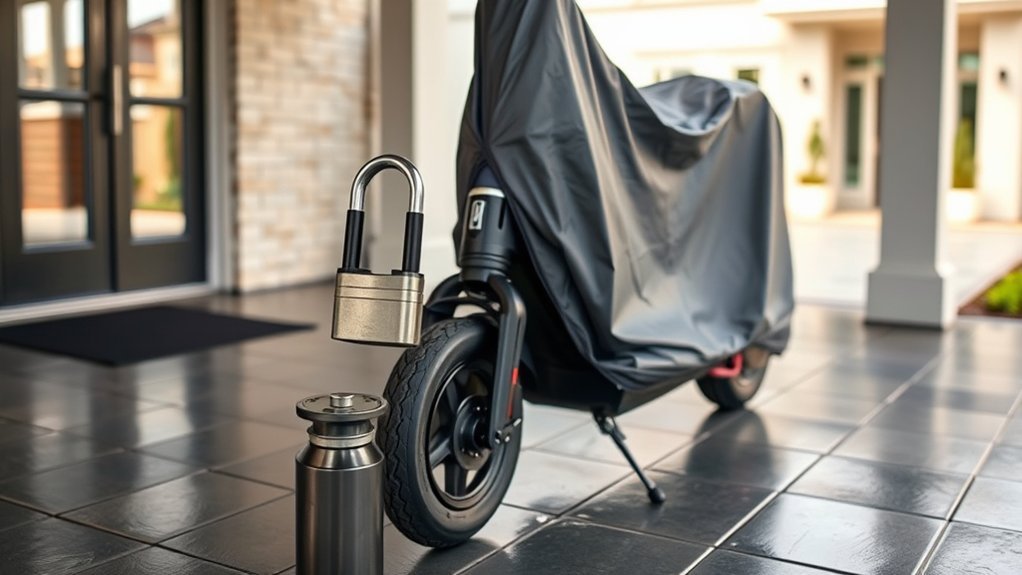
Last Updated on July 23, 2026 by Caleb Warren
You can store an electric scooter outside for a short period when indoor storage is impossible, but it should be a last resort. Outdoor moisture, direct sun, temperature swings, dirt, and theft can damage the scooter or shorten battery life. The safest setup combines a sheltered location, a breathable cover, careful battery handling, a secure lock, and regular inspections.
Quick Answer
Store an electric scooter indoors whenever possible. If it must stay outside, switch it off, clean and dry it, follow the manufacturer’s battery-storage instructions, place it on a raised surface under solid shelter, use a breathable waterproof cover, and lock the frame to a fixed anchor. Never charge it outdoors or while any charging part is wet.
Key Takeaways
- Indoor storage is safer; use outdoor storage only when you cannot provide a dry indoor space.
- Your scooter manual controls the correct storage charge, temperature range, and battery-check schedule.
- A cover should block rain and UV exposure while allowing condensation to escape.
- Never charge outdoors, under a cover, or when the charge port, charger, outlet, or scooter is wet.
- Inspect the battery, tires, brakes, wiring, folding mechanism, and lock before riding again.
At a Glance
| Time Required | About 20–30 minutes for the first setup, plus brief checks during storage |
| Difficulty | Easy, provided the scooter and battery are undamaged |
| Tools Needed | Soft cloth, mild soap, tire gauge, raised stand or platform, breathable cover, secure lock, and original charger |
| Cost | Varies according to the cover, lock, anchor, and shelter you already have |
Disclosure: As an Amazon Associate I earn from qualifying purchases. Some links on this page are affiliate links, at no extra cost to you.
Why Storing an Electric Scooter Outside Is Risky
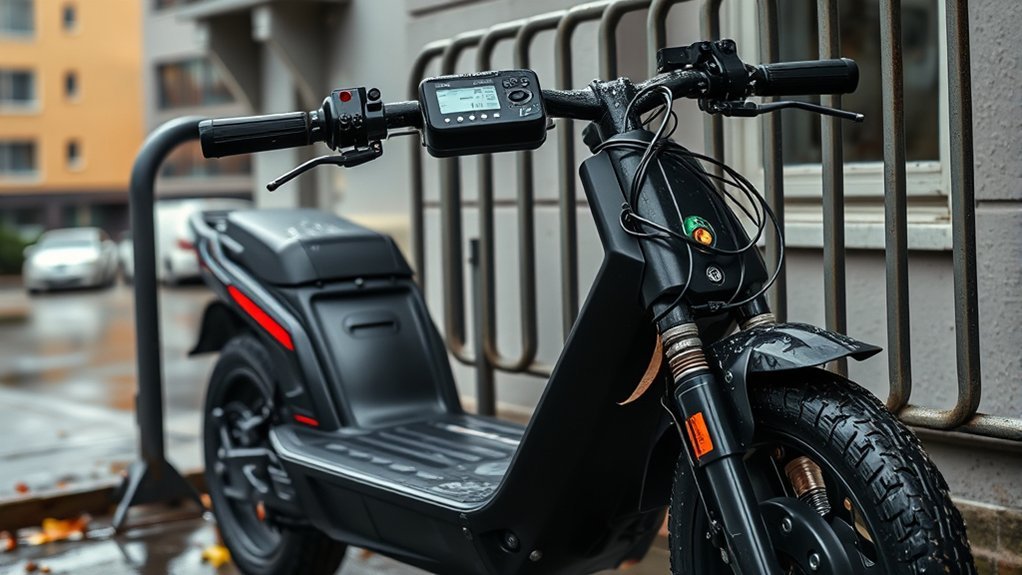
Storing an electric scooter outside exposes it to rain, condensation, snow, direct sunlight, dirt, road salt, temperature changes, and theft. Moisture can reach fasteners, bearings, wiring, the display, charging connections, or the battery compartment. Sunlight can fade surfaces and age plastic or rubber parts, while freezing or very hot conditions can reduce battery performance and speed up wear.
A water-resistance rating does not mean you can leave the scooter exposed to weather indefinitely. Requirements differ by model, and some manufacturers specifically instruct owners to store their scooters indoors rather than outside for long periods. Review the storage, charging, cleaning, and temperature sections of your manual before choosing an outdoor location.
Warning: Stop using or charging the scooter if the battery is swollen, leaking, unusually hot, discolored, wet, hissing, giving off an unusual odor, or making unfamiliar noises. Move away from it, keep people clear, and contact the manufacturer, an authorized service center, or local emergency services when there is an immediate fire risk. Do not open, puncture, modify, or attempt to repair the battery yourself.
Check the Manual Before Using Outdoor Storage
The owner’s manual should decide whether your scooter can tolerate the planned storage conditions. Check these points before leaving it outside:
- Storage temperature: Confirm that expected daytime and nighttime temperatures remain within the stated range.
- Charging temperature: Do not charge a battery that is colder or hotter than the manufacturer permits.
- Water-resistance limits: Check the exact rating and all related warnings instead of assuming the scooter is waterproof.
- Battery design: Determine whether the battery is user-removable or sealed inside the deck.
- Long-storage charge: Use the percentage and recharging interval given for your model.
- Warranty conditions: Confirm whether extended outdoor exposure or water damage is excluded.
For example, the Segway Ninebot KickScooter product manual cited in this guide tells owners to store that model indoors, avoid extended outdoor storage, and never charge outdoors. Other scooters may have different limits, so do not copy one model’s numbers to another.
Choose a Sheltered Storage Spot
Choose a sheltered spot under a solid roof, awning, enclosed porch, ventilated bike shed, or similar structure. The location should block direct rain, snow, sun, and strong wind while still allowing air to move around the scooter.
Keep the scooter elevated off the ground on a stable platform or stand. Do not place it where standing water, runoff, roof drainage, sprinklers, or flooding can reach the deck or wheels. Avoid bare soil, wet grass, and locations where road salt or coastal spray can collect on metal parts.
The surface should be level and firm enough to prevent the scooter from tipping. Keep it away from vehicle traffic, falling objects, heaters, grills, combustible waste, and places where it blocks a doorway or escape route.
Note: A cover is a second layer of protection, not a replacement for a roof. If rain can strike the scooter directly or water regularly pools beneath it, choose another location.
Clean and Inspect Your Scooter Before Storage
Switch off the scooter and unplug the charger before cleaning it. Wipe the frame, deck, stem, wheels, and controls with a soft damp cloth and mild soap where the manual permits it. Avoid pressure washers, strong hose streams, harsh solvents, and water around the charge port. Dry the scooter completely before covering it.
| Check | What You Are Looking For |
|---|---|
| Tires | Correct pressure for the model, plus cuts, bulges, punctures, flat spots, or severe wear |
| Brakes | Firm lever response, adequate pad material, straight cables, and no fraying or contamination |
| Wiring and charge port | Cracks, loose connections, abrasion, corrosion, moisture, or a damaged port cover |
| Moving parts | Stiffness, play, unusual noise, or damage; lubricate only manual-approved points with an approved product |
| Frame and folding mechanism | Rust, dents, cracks, loose hardware, incomplete locking, or impact damage |
| Battery area | Swelling, excess heat, odor, leaking, discoloration, water marks, or unusual sounds |
Repair safety-related faults before storage rather than leaving them to worsen. Keep oil and silicone products away from brake rotors, brake pads, drums, tires, the charge port, wiring, and electrical connectors.
Pro Tip: Take dated photos of the scooter, battery condition, serial number, storage location, and lock setup. The photos make it easier to notice later corrosion or damage and may help with a theft or insurance report.
Charge the Battery to Storage Level
Set the battery to the long-term storage level specified in your owner’s manual. There is no single correct percentage for every electric scooter. Some manufacturers recommend about half charge, while others specify a higher range. Current examples include 50% or above for a Segway model family, about 60–70% in Apollo’s general guidance, and about 80% for certain Xiaomi models.
Whatever target your manufacturer gives, do not leave the battery deeply discharged for weeks or months. Powered-off scooters can still draw a small amount of energy, so check the level at the interval listed in the manual.
Set Battery Storage Level
- Let the scooter and battery reach an approved charging temperature.
- Confirm that the scooter, charge port, cable, charger, and outlet are completely dry.
- Use only the charger supplied or approved by the scooter manufacturer.
- Charge in a dry, ventilated area while you are awake and present.
- Stop at the storage level specified for your model.
- Unplug the charger when charging is complete.
- Record the date and schedule the next battery check according to the manual.
The U.S. Consumer Product Safety Commission’s micromobility guidance advises owners to follow manufacturer charging instructions, remain present while charging, avoid charging while sleeping or away, and use only an approved charger and battery.
Avoid Full Or Empty
Do not assume that either 100% or one fixed lower percentage is the ideal long-storage level for every model. Follow the manual’s stated target and recharge interval. The main goals are to prevent deep discharge, avoid leaving the battery outside its approved temperature range, and prevent unnecessary charging while the scooter is wet or unattended.
If the battery is designed to be removed by the user, you may store it separately in the dry, temperature-controlled location specified by the manufacturer. If the battery is sealed inside the deck, do not open the deck, disconnect wiring, or dismantle the battery merely for storage.
Warning: Never charge the scooter outdoors, beneath its storage cover, in rain, beside pooled water, or while the charge port, charger, cable, outlet, or battery is wet. Do not charge a battery that is damaged, swollen, leaking, unusually hot, or outside the charging temperature stated in the manual.
Use a Waterproof Cover Correctly
Use a breathable waterproof cover that fits the scooter without leaving large areas exposed. The cover should reduce contact with rain, snow, dust, and sunlight while allowing condensation to escape.
Never cover a wet scooter. Trapped moisture can remain around fasteners, the deck, wiring, and controls. Let the scooter dry fully before fitting the cover, and uncover it periodically to check for condensation.
Choose A Breathable Cover
Look for a cover with:
- A size matched to the scooter in its stored position
- Water-resistant or waterproof fabric and protected seams
- Ventilation or breathable material
- UV-resistant fabric for sunny locations
- A soft inner surface that will not scratch the display or paint
- Straps or an elastic hem that can resist wind
Avoid loose plastic tarps that trap moisture, flap against the scooter, or collect water in deep pockets. Replace a cover when the fabric thins, seams split, straps fail, or the waterproof coating peels.
Secure Cover Against Wind
Pull the cover over the dry scooter and fasten its straps beneath the deck or around the wheels as the cover manufacturer directs. The material should cover the controls, stem, deck, and battery area without dragging in standing water.
Do not tighten cords where they can press the brake lever, throttle, cables, wiring, or display. After strong wind or a storm, inspect the cover for tears, loose straps, abrasion, pooled water, and newly exposed parts.
Lock Your Scooter to Prevent Theft
Use a hardened U-lock, a heavy-duty chain, or both. Pass the lock through a solid part of the frame and around a fixed anchor that cannot be lifted, cut easily, or unbolted. Locking only a wheel is less secure because a wheel may be removed or the scooter carried away.
- Choose a lock that leaves little open space for leverage tools.
- Use a well-lit location that is visible from your home or a security camera.
- Keep the scooter’s serial number and purchase records in a separate place.
- Add a motion alarm or compatible tracker as a second layer of protection.
- Remove detachable accessories and a user-removable battery when the manufacturer permits it.
- Inspect the lock and anchor for cuts, scratches, loosened bolts, or other tampering.
No lock guarantees that a scooter will not be stolen. Outdoor storage for several nights or longer carries a greater theft risk than keeping it inside a secured building.
Check Tires and Damage Regularly
Inspect the scooter regularly during storage rather than waiting until the next ride. A practical schedule is after severe weather and at each battery-check interval stated in the manual.
Check tire pressure with an accurate gauge when the tires are cold. Look for cracks, bulges, punctures, flat spots, and uneven wear. Underinflated pneumatic tires can affect handling and make punctures more likely. Solid tires should still be checked for cuts, separation, or damage.
Do not rotate the front and rear tires unless the manufacturer specifically allows it. Many scooters use different front and rear wheel assemblies, brakes, motors, or tires.
Also check the folding latch, handlebars, fasteners, brake cables, brake surfaces, lights, display, wiring, charge-port cover, and underside of the deck. Stop and arrange service if you find corrosion near electrical parts, damaged wires, a loose steering assembly, or a battery warning sign.
What Not to Do When Storing a Scooter Outside
- Do not leave the scooter in direct rain, snow, strong sunlight, or standing water.
- Do not charge it outdoors or beneath the cover.
- Do not cover the scooter while it is wet.
- Do not use an airtight plastic sheet that traps condensation.
- Do not pressure-wash the scooter or direct a strong hose stream at it.
- Do not spray lubricant near brakes, tires, wiring, the battery, or the charge port.
- Do not open a sealed deck or battery casing.
- Do not use a charger, replacement battery, or electrical part that the manufacturer has not approved.
- Do not ignore a battery recall, warning notice, unusual odor, heat, swelling, leaking, hissing, or discoloration.
- Do not rely on the cover as the only theft protection.
Winterize Your Scooter for Cold Weather
Cold-weather storage needs extra care because low temperatures can reduce available range and may place the battery outside its approved charging range. Whenever possible, move the scooter to a dry garage, shed, utility room, or other location that remains within the manufacturer’s storage limits.
Set the battery to the model’s specified storage level before long winter storage. Do not use “at least 80%” as a universal rule. Manufacturer guidance varies, so follow your manual and check the battery at the recommended interval.
If the scooter has a user-removable battery, store it in the dry, temperature-controlled location allowed by its instructions. Do not remove a sealed battery or dismantle the deck.
- Use a breathable waterproof cover over a completely dry scooter.
- Remove snow, salt, slush, and dirt promptly.
- Inspect for condensation after storms and temperature changes.
- Check seals, wiring, fasteners, brakes, tires, and the battery area.
- Move the scooter indoors when forecasts exceed the model’s storage limits.
- Replace a torn cover or failed strap before the next storm.
Note: When you bring a very cold scooter indoors, allow it to warm gradually and let any condensation dry before connecting the charger. Charge only after the battery is within the manufacturer’s approved charging-temperature range.
Return the Scooter to Service After Storage
Complete a full check before riding a scooter that has been stored for several weeks or months:
- Remove the cover and inspect for water, corrosion, pests, damaged wiring, or battery changes.
- Check that the frame, stem, handlebars, folding latch, and fasteners are secure.
- Set tire pressure to the value stated in the manual and inspect the tread and sidewalls.
- Test both brakes while walking beside the scooter.
- Check the throttle, display, horn or bell, lights, and turn indicators where fitted.
- Charge the battery in a dry area with the approved charger and according to the manual.
- Check the scooter app or manufacturer website for warnings, recalls, or required firmware updates.
- Take a slow test ride in a clear, dry area before returning to normal use.
Do not ride if the steering feels loose, a brake does not work correctly, the battery produces a warning sign, or the scooter displays an unresolved fault code.
Frequently Asked Questions
Can electric scooters be kept outside?
An electric scooter can sometimes be kept outside for a limited period when the manufacturer permits the conditions, but indoor storage is safer. Outdoor storage requires overhead shelter, a dry raised surface, a breathable cover, a secure lock, suitable temperatures, and frequent inspections.
Can you store an electric scooter outside in winter?
Only when temperatures remain within the model’s storage limits and the scooter stays dry and sheltered. A user-removable battery is usually better kept in the manufacturer-approved indoor conditions. Never charge a frozen or very cold battery until it reaches the permitted charging range.
What happens if an electric scooter is not used for a long time?
The battery can self-discharge, tires can lose pressure or develop flat spots, and moisture may cause corrosion. Dirt, pests, loose hardware, and damaged wiring may also go unnoticed. Set the correct storage charge, inspect the scooter periodically, and complete a full safety check before riding again.
How do you store an e-scooter outside?
Clean and dry it, set the battery to the manual’s storage level, place it under solid shelter on a raised surface, cover it with breathable waterproof material, lock the frame to a fixed anchor, and inspect it after storms and at the recommended battery-check interval.
Should you remove the battery for outdoor storage?
Remove it only when the scooter has a battery designed for routine user removal and the manual recommends separate storage. Do not open the deck, disconnect internal wiring, or dismantle a sealed battery pack.
Can you charge an electric scooter outside under a cover?
No. A cover can trap heat and moisture, and outdoor charging may expose the charger, connection, or outlet to water. Charge in a dry, ventilated location while you are awake and present, using only the charger approved for the scooter.
Conclusion
Storing an electric scooter outside can work for a limited period, but it is less protective than keeping the scooter indoors. Start with the owner’s manual, choose a dry sheltered location, elevate the scooter, use a breathable cover, and secure the frame to a fixed anchor. Follow the model’s battery-storage instructions rather than relying on one universal percentage.
Never charge outdoors or while the scooter is wet. Check it after severe weather and during long storage, and stop using it if you find battery swelling, heat, leaking, unusual odor, damaged wiring, serious corrosion, or a safety fault. A careful return-to-service inspection will help you catch problems before the next ride.
Sources
- U.S. Consumer Product Safety Commission: Micromobility Information Center — approved chargers and batteries, supervised charging, fire prevention, and disposal guidance
- Segway Ninebot KickScooter Product Manual — outdoor storage, charging, cleaning, temperature, inspection, and battery-maintenance warnings
- Xiaomi Electric Scooter 5 Pro Battery-Maintenance Guidance — model-specific storage charge, temperature, moisture, and periodic charging guidance
- Apollo Scooters General Maintenance Guide — long-storage battery level and maintenance recommendations
- UL Solutions Micromobility Safety and Product Certification — UL 2272 context, approved components, damaged-battery warnings, and charging safety
