
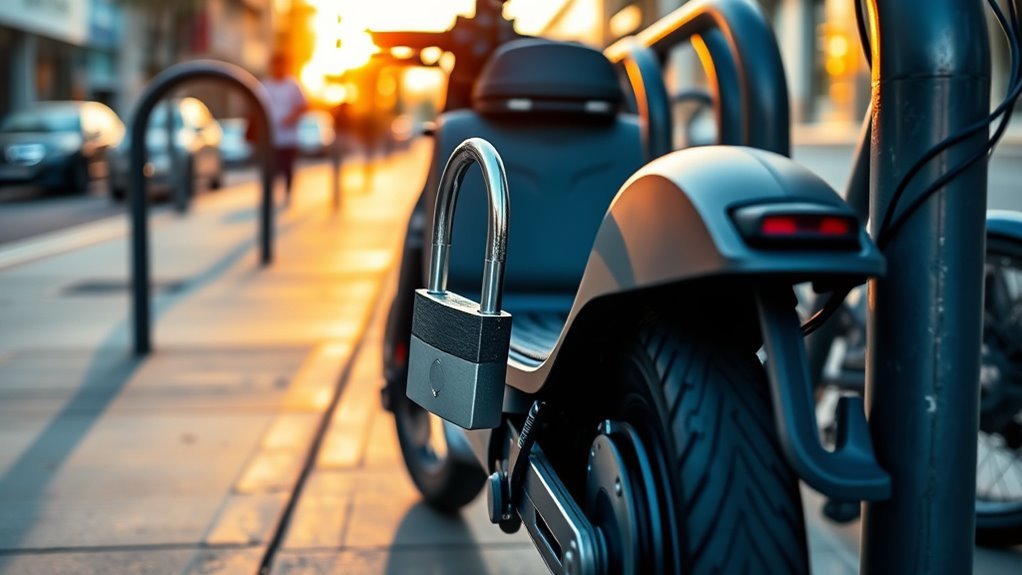
Last Updated on July 23, 2026 by Caleb Warren
A strong lock only works when you place it around the right part of your electric scooter and attach it to an anchor that cannot be cut, lifted, or removed. Scooter frames vary, so the safest locking point depends on your model. Use a quality primary lock, keep the fit tight, add a second security layer in higher-risk areas, and bring the scooter indoors whenever possible.
Quick Answer
Lock your electric scooter by passing a hardened-steel U-lock or high-security chain through a closed, non-removable part of the frame and around a fixed steel rack. Leave as little open space as possible, keep the lock off the ground, and add a second lock, alarm, or tracker when the theft risk is high.
Key Takeaways
- Use a structural frame opening or another closed part that cannot be removed with ordinary tools.
- Choose a lock that fits your scooter and has a recognized independent security rating when available.
- Attach the scooter to a solid anchor that cannot be lifted over, unbolted, or easily cut.
- Keep the primary lock tight and off the ground to reduce space for prying or striking tools.
- Treat alarms, app locks, and trackers as extra layers, not replacements for a physical lock.
At a Glance
| Time Required | About 2 to 5 minutes |
| Difficulty | Easy after you identify a safe locking point |
| Tools Needed | U-lock or high-security chain, plus an optional second lock, alarm, or tracker |
| Cost | Varies by lock size, certification, and security level |
Disclosure: As an Amazon Associate I earn from qualifying purchases. Some links on this page are affiliate links, at no extra cost to you.
Assess Scooter Locking Points
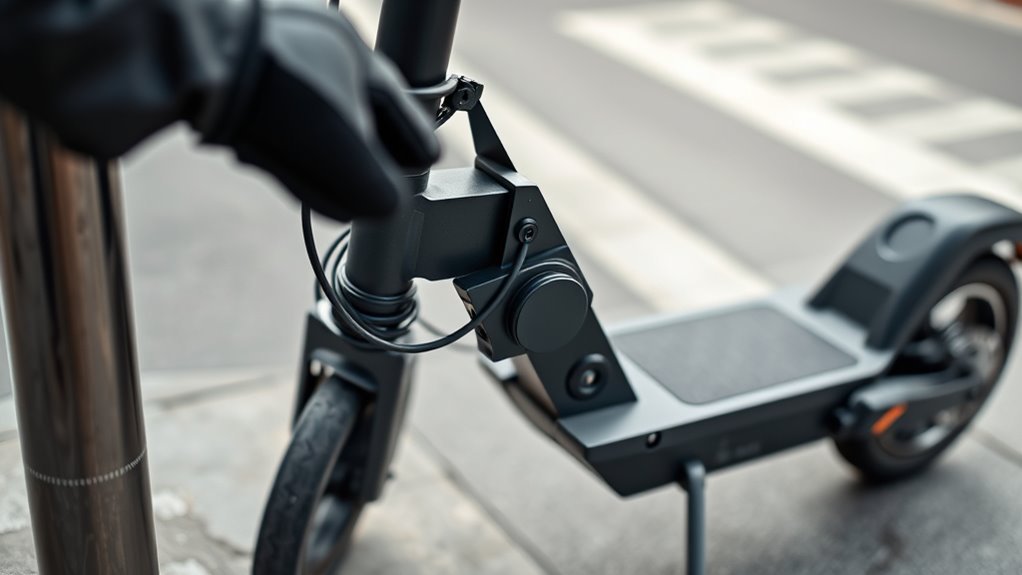
Before buying or placing a lock, inspect your scooter from the deck to the handlebars. Look for a closed frame opening, fixed carry loop, or narrow structural section that the lock cannot slide over. The point must remain attached if someone removes a wheel, handlebar, fender, light, or accessory.
Some scooters have a fixed pass-through opening between the deck and the stem. Others have no opening, so you may need a compact U-lock that fits tightly around the frame above a wheel or around the neck-and-deck area. Kryptonite’s e-scooter locking guidance recommends choosing a lock for the exact frame shape, using a solid anchor, keeping the fit tight, and avoiding parts that can be removed with standard tools.
Warning: Do not place a lock through exposed brake cables, electrical wires, the folding latch, display mount, throttle, or other working parts. Pressure from the lock can damage the scooter or stop the mechanism from operating safely.
Check the owner’s manual if your scooter has an unusual frame or a manufacturer-designated lock point. Measure the opening and the anchor you normally use before choosing a compact lock. A lock that is too large creates leverage space, while a lock that is too small may not reach a secure anchor.
Choose the Best Electric Scooter Lock
The best electric scooter lock is the strongest independently rated lock that fits both your scooter and the anchors where you park. Do not compare security numbers from different brands as though they use one shared scale. Instead, look for recognized third-party testing, suitable dimensions, hardened construction, a protected locking mechanism, and a shape that leaves little unused space.
Sold Secure tests security products and uses different rating systems for bicycles, powered cycles, motorcycles, and motor scooters. Check the exact approval category, because an accessory cable included with a rated U-lock may not share the main lock’s rating.
U-Lock Strength
A compact U-lock is often the best primary lock for a commuter scooter. Its rigid shackle can fit closely around a narrow frame section and rack, leaving less space for prying tools. Look for hardened steel, a shackle that locks on both sides, a protected cylinder, weather protection, and dimensions that match your scooter.
- Best for: Short to medium stops where a fixed rack is available.
- Main advantage: Strong, compact construction with limited leverage space.
- Main drawback: Less reach around wide posts or awkward frames.
- Buying check: Confirm the internal width, internal height, shackle thickness, weight, and independent rating.
For example, the Kryptonite New York Fahgettaboudit Mini uses an 18 mm hardened-steel shackle, a double-deadbolt design, and a compact 3.25-by-6-inch opening. Its listed weight is 4.55 pounds. Those dimensions can provide a tight fit, but they may be too small for some scooter-and-rack combinations.
Folding Lock Portability
A folding lock offers more reach and packs into a compact holder. It can be useful when a U-lock cannot fit around the scooter and anchor. Security varies widely, so check the bar thickness, rivet protection, cylinder design, and independent rating rather than assuming every folding lock is high security.
| Feature | What to Check | Why It Matters |
|---|---|---|
| Length | Enough reach without excessive slack | Helps you use more anchor types |
| Bars and joints | Hardened bars and protected rivets | The joints are common attack points |
| Certification | Approval for the correct vehicle category | Brand labels alone are not comparable |
| Holder | Secure mount that does not block steering or folding | Prevents the lock from becoming a riding hazard |
Alarm Lock Options
A motion alarm can draw attention when someone moves or strikes the scooter. Use it as a secondary layer with a physical lock. Alarm volume, sensitivity, weather resistance, battery type, and false-alarm controls differ by model, so test the device before relying on it.
A disc-brake lock only works if your scooter has a compatible brake rotor with an opening that safely accepts the locking pin. It prevents the wheel from turning, but it does not attach the scooter to a fixed object. Use a bright reminder cable or another reminder system so you do not try to ride with the disc lock installed.
Pro Tip: Use different lock types for your first and second layers. A thief may need different tools and more time to defeat a U-lock plus a chain, folding lock, or alarmed device.
Pick a Fixed Anchor Point
Choose a rack, ground anchor, or thick steel post that is firmly installed and closed at the top. Shake it before locking. Check that it is not loose, cut, unbolted, or short enough for someone to lift the scooter and lock over it.
Avoid thin fences, small trees, temporary signs, removable railings, wire mesh, wooden posts, and objects that a thief can dismantle. Do not block doors, wheelchair access, curb ramps, stairs, pedestrian paths, or emergency equipment. Follow local parking rules and property signs.
Visibility helps, but a camera or busy storefront does not make a weak lock safe. Choose an area with lighting, regular foot traffic, open sightlines, and a strong anchor. Whenever possible, park near other securely locked bikes or scooters rather than in an isolated corner.
Lock the Frame and Stem
The goal is to trap a non-removable structural part of the scooter inside the lock and connect it to an immovable anchor. On some scooters, the lock can pass through a frame opening near the stem and deck. On others, it may fit tightly around the lower stem above the wheel. Do not force the lock against wiring, brake lines, the folding latch, or moving parts.
Best Locking Point
- Inspect the scooter: Find a closed structural point that cannot slide through the lock or detach with common hand tools.
- Test the anchor: Confirm that the rack or post is solid, closed, and too tall or wide to lift the scooter over.
- Position the scooter: Place the frame close to the anchor without crushing cables or scratching vulnerable parts.
- Pass the primary lock: Enclose the frame point and the anchor in the smallest practical space.
- Reduce leverage: Keep the lock body and shackle off the ground and remove loose space where tools could fit.
- Add a second layer: Secure another part, add an alarm, or activate a tracker or model-specific app alert.
- Check your work: Pull the scooter in several directions and confirm that it cannot be lifted, rolled, or slipped free.
Stem And Frame Security
Do not assume that locking the stem alone is always safe. Some stems, handlebars, and folding assemblies can be loosened or separated. A fixed pass-through frame opening is usually better because the lock cannot slide off. If your scooter has no pass-through, use the smallest secure lock position recommended for that design and confirm that the scooter cannot be pulled through the shackle.
Place the keyway where you can use it without resting the lock on the pavement. A downward or inward position may make access harder, but the tight fit and strong anchor matter more than keyway direction alone.
Avoid Weak Attachments
- Do not use a wheel, fender, kickstand, handlebar, light bracket, or removable accessory as the primary locking point.
- Do not secure only a folding latch or clamp that can be opened, unbolted, or damaged.
- Do not let the lock press on brake hoses, electrical wires, charge ports, displays, throttles, or suspension parts.
- Do not use a thin cable as the only security for a valuable scooter.
- Do not leave enough space for the lock to be twisted, hammered against the ground, or used as a lever.
Add a Second Lock or Alarm
Layered security makes the scooter a slower and less attractive target. Your primary lock should attach the frame to the anchor. The second layer can secure another structural point, stop a wheel from turning, trigger an alarm, or help with recovery.
| Second Layer | Best Use | Limitation |
|---|---|---|
| Second U-lock or chain | Adds another physical barrier | Adds weight and may need more anchor space |
| Folding lock | Reaches a second frame point or awkward anchor | Security depends heavily on bars, joints, and rating |
| Accessory cable | Keeps a removable accessory or wheel with the scooter | Usually unsuitable as the primary lock |
| Motion alarm | Creates noise when the scooter is disturbed | Does not physically attach the scooter to anything |
| Tracker | May provide location information after theft | Coverage, battery life, subscriptions, and accuracy vary |
For long stops or high-risk areas, use two substantial locks with different mechanisms. At home, combine a high-security lock with a fixed ground or wall anchor. Secured by Design recommends layered physical security, alarms or immobilizers, tracking, property marking, and keeping locks taut and off the ground where possible.
Compare the Best U-Locks
There is no single best U-lock for every electric scooter. A compact, heavy lock can be highly resistant but useless if it will not fit your frame or normal parking rack. Compare verified specifications and the correct independent rating before buying.
| What to Compare | Better Choice | Common Mistake |
|---|---|---|
| Independent rating | A current approval in the correct vehicle category | Treating a brand’s internal score as an independent test |
| Internal dimensions | Small enough for a tight fit but large enough for your anchor | Buying by shackle thickness alone |
| Locking design | Shackle secured at both ends with a protected cylinder | Assuming all U-locks resist twisting equally |
| Weight | A lock you will carry and use every time | Leaving a heavy lock at home because it is inconvenient |
| Insurance terms | A lock and method that meet your policy conditions | Assuming any hardened lock automatically qualifies |
Use manufacturer security ratings only to compare products within that manufacturer’s system. For cross-brand comparisons, rely on independent approval and verified dimensions. Also inspect the certification date and exact model number because product names and designs can change.
Park in Safer Places
Choose a visible, well-lit place with regular foot traffic and a proper rack. Avoid isolated alleys, hidden corners, damaged racks, and places where a van can stop beside the scooter without attracting attention. If a secure indoor area is available, use it.
| Parking Spot | Relative Risk | What to Check |
|---|---|---|
| Secure indoor storage | Lowest available | Controlled access and a fixed anchor |
| Busy storefront or station rack | Lower | Strong rack, lighting, open sightlines, and legal parking |
| Quiet side street | Higher | Long unattended periods and limited witnesses |
| Loose fence or removable sign | Very high | Anchor can be cut, lifted, or dismantled |
Do not create a predictable routine if you regularly leave an expensive scooter outside for long periods. Changing the rack or arrival time can reduce repeated exposure, but it does not replace a strong lock and anchor.
Avoid Common Locking Mistakes
Most locking failures come from a weak contact point, a removable anchor, too much slack, or overreliance on a cable or electronic feature. Slow down and check the full setup before walking away.
Avoid Weak Lock Points
- Wheel only: A wheel may be removed while the rest of the scooter is taken.
- Handlebar only: Handlebars and grips can often be loosened or removed.
- Fender or kickstand: These parts are not structural security points.
- Thin fence: Cutting the anchor may be easier than attacking the lock.
- Open post: The scooter and lock may be lifted over the top.
- Folding mechanism: The latch can be damaged, opened, or separated on some designs.
Keep Lock Tight
Use the smallest practical space inside the lock. Bring the frame close to the rack and keep the shackle or chain away from the ground. Wrap excess chain around the anchor or structural point without pinching cables or damaging the finish.
After locking, pull up on the scooter, turn the handlebars, and move it side to side. Check that the lock cannot slide over the wheel, stem, handlebar, or anchor. Confirm that the rack has not been cut and loosely taped back together.
Note: No portable lock makes an electric scooter theft-proof. Your goal is to increase the time, noise, tools, and risk required while reducing the scooter’s value to a thief through registration, marking, and tracking.
Use GPS and Smart Security
A tracker can support recovery, while app alerts can tell you that the scooter has moved. Check whether the device uses true GPS with cellular service, a nearby-device network, or only short-range Bluetooth. These systems have different coverage, accuracy, battery use, and subscription requirements.
Some scooters let you lock the motor or activate an alarm in the manufacturer’s app. This may stop normal riding, but it does not stop someone from lifting the scooter into a vehicle. Use the app feature only as an extra layer and follow the manufacturer’s instructions, including any warnings about battery drain or automatic time limits.
A tracker may help locate a stolen scooter, but a physical lock is still the first line of defense.
Hide the tracker where it does not interfere with the battery, wiring, heat dissipation, steering, or folding system. Test location updates and low-battery alerts regularly. Do not publish screenshots that reveal your home or routine.
Warning: If a tracker shows a stolen scooter at a private address or moving location, give that information to police. Do not confront a suspected thief or enter private property.
Lock Your Scooter Overnight
Indoor storage is the strongest overnight option. Keep the scooter in a locked room, secure garage, or access-controlled bike store, then attach it to a fixed ground or wall anchor. A closed garage or shed is not enough by itself if the scooter is left unlocked inside.
If outdoor storage is unavoidable, use at least two strong security layers, a fixed anchor, a weather-resistant cover that does not trap moisture, and a tracker or alarm. Remove easy-to-steal accessories. Avoid charging the scooter outdoors or in a way that exposes the charger, extension cord, or battery to water and tampering.
Check your building’s fire-safety and battery-storage rules. Use the original or manufacturer-approved charger, inspect the battery and cable for damage, and never block an exit route with the scooter.
Record and Register Your Electric Scooter
Good records can help prove ownership and identify a recovered scooter. Save the model name, serial number, purchase receipt, clear photos, lock key number, tracker details, and any unique marks. Store a copy somewhere other than on the scooter.
Use a recognized property-registration or security-marking program available in your country. Cheshire Constabulary’s e-bike and e-scooter theft guidance advises owners to use suitable locks, consider tracking and security marking, report theft promptly, and provide police with the frame or serial number, registration information, photos, and other identifying details.
Review your insurance terms before relying on coverage. Policies may limit where the scooter can be stored, how long it can be left, which lock rating is required, and whether the frame must be attached to an immovable object.
What to Do If Your Scooter Is Stolen
- Confirm that the scooter was not moved by property staff, police, or a towing service.
- Report the theft promptly through the correct local police channel. Use the emergency number only when a crime is in progress or someone is in danger.
- Provide the serial number, receipt, photos, registration details, lock information, location, time window, and nearby camera details.
- Share tracker data with police and preserve screenshots, alerts, and movement history.
- Notify the registration service and insurer, following their reporting deadlines.
- Ask nearby businesses or building managers to preserve relevant camera footage before it is overwritten.
- Do not confront anyone or attempt a private recovery.
Maintain Locks and Security Gear
Inspect the lock before each use. Look for cracks, bent shackles, loose rivets, damaged coatings, corrosion, sticking cylinders, weak alarm batteries, and worn mounting brackets. Clean and lubricate the lock only with a product approved by its manufacturer. Thick oil or the wrong spray can attract dirt or damage internal parts.
Test alarms and trackers on a schedule. Replace batteries before long trips, confirm that subscriptions remain active, and verify that app permissions still allow alerts and location services. Replace a lock after a serious attack, crash, or visible deformation even if it still closes.
Frequently Asked Questions
How do you stop an electric scooter from being stolen?
Use a hardened, independently rated primary lock through a non-removable frame point and around a fixed anchor. Keep the fit tight, add a second lock or alarm in higher-risk areas, park visibly, store the scooter indoors when possible, and record its serial number.
How do you lock a scooter to prevent theft?
Find a closed structural point that cannot be removed with ordinary tools. Pass a compact U-lock or high-security chain through that point and a solid rack, remove excess space, keep the lock off the ground, and check that the scooter cannot be lifted or slipped free.
Are electric scooters easy to steal?
They can be attractive targets because many are valuable, portable, and parked with weak locks. A scooter can also be lifted even when an app locks the motor. Strong physical security and an immovable anchor are essential.
Where can you lock an electric scooter?
Use a fixed steel bike rack, approved scooter rack, ground anchor, or another legal anchor that cannot be cut, unbolted, or lifted over. Avoid trees, thin fences, temporary signs, handrails, and any location that blocks pedestrians or accessibility routes.
Can you lock an electric scooter through the wheel?
A wheel can be part of a secondary lock setup, but it should not be the only locking point. Wheels and related parts may be removable. The primary lock should secure a non-removable structural part of the scooter to a fixed anchor.
Is an app lock enough for an electric scooter?
No. An app may lock the motor, sound an alarm, or send a movement alert, but a thief can still lift or carry the scooter. Use the app feature with a strong physical lock and fixed anchor.
What should you do if a tracked scooter is stolen?
Report the theft, provide the serial number and tracker data, preserve screenshots, and follow police instructions. Do not confront a suspected thief or enter private property to recover the scooter yourself.
Conclusion
To lock an electric scooter securely, match the lock to the scooter’s actual frame design, use a fixed anchor, and leave as little space as possible for attack tools. Add a second lock, alarm, registration, or tracker when the risk is higher. Most importantly, do not rely on removable parts, thin cables, cameras, or app locks alone. A careful setup takes only a few minutes and can make your scooter a much harder target.
Sources
- Kryptonite: E-Scooter Non-Fixed Pass-Through Frame Locking Guide — frame fit, fixed anchors, tight lock placement, and removable-part warnings.
- Sold Secure: Why Security Products Are Tested — independent rating categories, lock selection, accessory-cable limits, and ground-anchor guidance.
- Secured by Design: Motorcycles, Mopeds and Scooters — layered physical security, alarms, tracking, marking, taut chains, and fixed anchors.
- Cheshire Constabulary: E-Bike and E-Scooter Theft Guidance — tracking, security marking, reporting, serial numbers, and ownership records.
- Kryptonite: New York Fahgettaboudit Mini Specifications — shackle size, locking design, dimensions, and weight.
- Xiaomi Support: Electric Scooter Motor Lock — model-specific app locking and the warning that electronic locking does not prevent theft by itself.
