Last Updated on September 27, 2026 by Caleb Warren
Electric scooter fire prevention starts with safe battery care, correct charging, and recognizing early warning signs. Lithium-ion batteries store substantial energy, and a damaged or improperly charged pack can overheat or catch fire. Following a consistent safety routine helps protect your scooter, your home, and everyone nearby.
Quick Answer
Prevent electric scooter fires by using a manufacturer-approved charger, supervising charging, keeping the battery away from heat and flammable materials, and inspecting it regularly. Never charge a damaged battery or block an exit with your scooter. If you notice swelling, unusual heat, smoke, or chemical odors, stop using the scooter and follow the appropriate emergency steps.
Disclosure: As an Amazon Associate I earn from qualifying purchases. Some links on this page are affiliate links, at no extra cost to you.
What Makes an E-Scooter Battery Catch Fire?
An electric scooter battery can catch fire when damaged cells generate more heat than the battery can release. This can trigger thermal runaway, a chain reaction in which heat spreads between cells and may produce flammable gases, smoke, or fire.
Several conditions can increase the risk:
- Incompatible chargers: Incorrect charging voltage or charging controls can damage the battery and cause overheating.
- Physical damage: Crashes, drops, crushing, or punctures can harm internal cells and create short circuits.
- Water damage and corrosion: Moisture entering the battery housing can damage electrical connections and protective components.
- Extreme temperatures: Excessive heat and charging outside the permitted temperature range can stress battery cells.
- Manufacturing defects: Poor-quality cells, inadequate wiring, or faulty battery management systems can allow dangerous failures.
- Unauthorized modifications: Rebuilt battery packs, incompatible replacement parts, and electrical modifications can interfere with built-in safety protections.
A battery management system helps monitor charging and operating conditions, but it cannot make a damaged or defective battery completely safe.
Battery damage may not be visible immediately after a crash. If the scooter has suffered a significant impact, stop using it until the battery and electrical system have been checked.
How Do You Charge an E-Scooter Safely?
The safest charging routine uses the correct charger, a suitable location, and active supervision. You should remain awake and present throughout charging and disconnect the charger when the charge cycle finishes.
The U.S. Consumer Product Safety Commission’s micromobility safety guidance recommends manufacturer-approved chargers and batteries, supervised charging, and following the device’s instructions.
- Inspect the scooter and charger. Look for damaged cables, loose connectors, swelling, leaks, or unusual odors before connecting power.
- Allow the battery to cool. After intensive riding, wait until the battery returns to its normal temperature before charging.
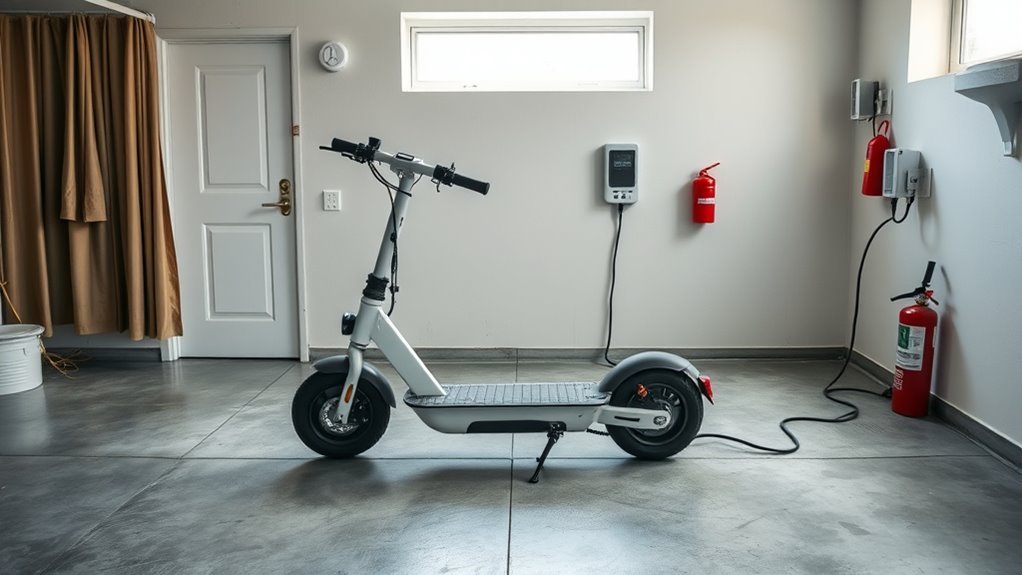
- Choose a suitable location. Place the scooter on a hard, flat, dry surface with space for heat to dissipate.
- Clear the surroundings. Keep the scooter away from curtains, paper, furniture, fuel, and other combustible materials.
- Connect the approved charger. Follow the manufacturer’s connection sequence and charging instructions.
- Stay present. Never charge while sleeping or away from home.
- Disconnect when charging finishes. Remove the charger after the normal charge cycle completes.
The London Fire Brigade’s charging guidance also recommends hard, flat charging surfaces and allowing batteries to cool after use.
Never cover the battery or charger while charging. Avoid overloaded outlets, unsuitable extension leads, and damaged charging equipment.
Warning: Never charge a scooter in a hallway, stairwell, doorway, or another location that could block your escape during a fire. Keep working smoke alarms in your home.
What E-Scooter Battery Warning Signs Should You Watch For?
The main battery warning signs are excessive heat, swelling, leaks, unusual smells, strange noises, and changes in charging behavior. Inspect your scooter before riding and charging.
Use this checklist to recognize possible battery failure:
| Warning indicator | Required action |
|---|---|
| Swelling or bulging | Stop using and charging the scooter. A warped battery housing may indicate internal cell failure. |
| Burning or chemical odor | Stop use immediately. Disconnect power only if you can do so safely. |
| Excessive heat | Stop charging or riding. Keep away from the battery and watch for signs of escalating failure. |
| Flickering or unresponsive controls | Power off the scooter if safe. Arrange an inspection of the electrical system. |
| Irregular charging | Stop charging if the battery suddenly takes much longer to charge, fails to reach full charge, or behaves abnormally. |
| Hissing, cracking, or popping sounds | Move away immediately. If accompanied by fumes, smoke, or severe heat, evacuate and call emergency services. |
| Leaks, cracks, or corrosion | Do not charge or use the scooter. Arrange professional assessment and replacement if necessary. |
The UK Department for Transport identifies heat, deformation, leaks, unusual sounds, smells, and poor charging performance as electric scooter battery fire warning signs.
A battery becoming slightly warm during normal operation is not automatically a fault. However, extreme heat, sudden temperature changes, or heat combined with another warning sign requires immediate attention.
Never open a swollen battery, puncture its casing, or attempt to repair individual lithium-ion cells yourself.
How Do You Store an E-Scooter Indoors Safely?
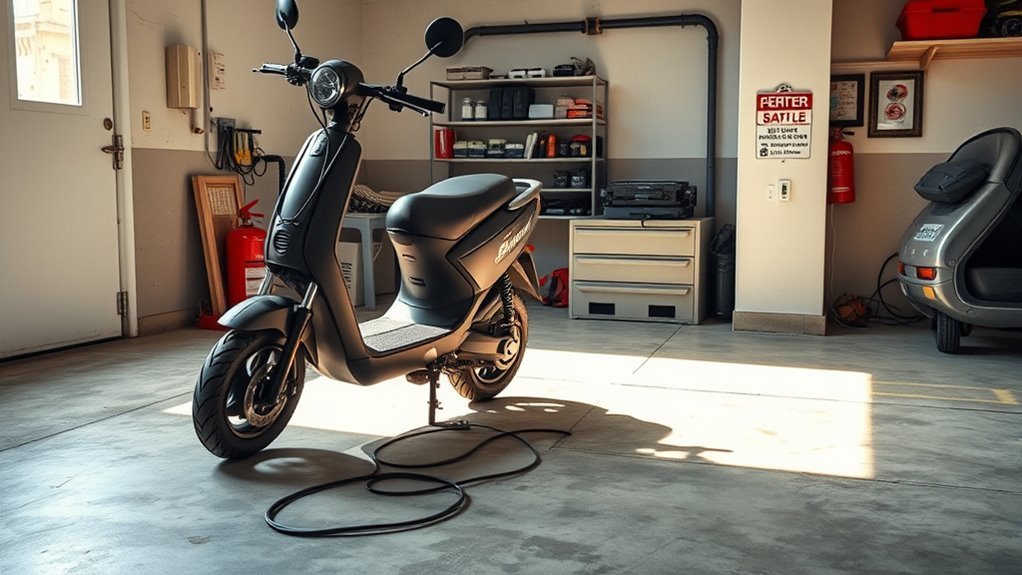
Store your scooter in a cool, dry location with adequate airflow, away from flammable materials and escape routes. A separate garage or suitable outdoor storage area can reduce the danger to living spaces when available.
Follow these indoor storage practices:
- Choose a stable location where the scooter cannot fall or become damaged.
- Keep it away from direct sunlight, heaters, radiators, and other heat sources.
- Maintain separation from paper, fabric, solvents, and combustible household items.
- Keep doors, stairs, corridors, and emergency exits clear.
- Inspect the battery housing, cables, and connectors regularly.
- Follow the manufacturer’s storage temperature and battery-charge recommendations during extended periods without use.
If you use a battery storage bag or box, follow its manufacturer’s instructions. Do not assume that a container advertised as fireproof can contain every lithium-ion battery failure.
A storage container also does not make unsafe charging acceptable. Never cover a charging battery or block the airflow required by the scooter manufacturer.
Keep the scooter dry and inspect it after exposure to rain or water. If you suspect water entered the battery housing, stop using and charging it until a qualified technician has assessed the damage.
How Do You Pick a Safe Battery and Charger?
Choose an electric scooter with independently certified electrical systems and use only batteries and chargers approved for that model. Certification helps establish that the system has been assessed against relevant safety requirements.
Look for the Correct Safety Certification
For typical standing electric scooters, UL 2272 is the relevant electrical system safety standard. UL 2271 applies to batteries used in light electric vehicles, while UL 2849 addresses electrical systems for e-bikes.
According to UL Solutions’ personal e-mobility certification information, UL 2272 evaluates the electrical drive system, battery system, and charger combination.
When shopping, look for certification of the complete scooter rather than relying only on a claim that one component is certified.
You can also check a product’s certification through UL Solutions’ certification guidance and Product iQ information.
A label stating that a product was merely tested to a standard is not the same as independent product certification.
Check Charger Compatibility
Use the charger supplied with your scooter or a replacement explicitly approved by its manufacturer. A connector that physically fits does not prove that the charger is electrically compatible.
The CPSC has issued a specific warning about universal micromobility chargers because incompatible chargers can cause battery overheating and fires.
Before using a replacement, confirm that it is approved for your exact scooter and battery model. Inspect its cable, plug, and connector for damage.
For replacement batteries, confirm the correct model and battery chemistry using the original battery label or scooter manual. Buy genuine, manufacturer-approved packs from reputable sellers.
Avoid counterfeit batteries, reused cells, unauthorized battery rebuilds, and modifications intended to increase speed or power. These changes can interfere with the protection systems designed for the original battery.
What Should You Do If an E-Scooter Battery Overheats?
If your scooter battery overheats, stop using or charging it immediately. Your response depends on whether the battery is unusually warm or is already showing signs of dangerous failure.
A smoking, hissing, rapidly heating, or leaking battery is a potential emergency. Do not risk burns or toxic fume exposure to save the scooter.
Stop Charging Immediately
If you notice abnormal heat while charging, disconnect the charger only when you can do so safely. Use the plug rather than pulling on the cable, and do not touch the battery casing.
- Stop charging or riding immediately.
- Disconnect power if the plug is safely accessible and there are no signs of active failure.
- Switch off the scooter if doing so does not bring you close to a dangerous battery.
- Keep people and pets away from the affected device.
- Contact the manufacturer or a qualified technician for further instructions.
Do not restart charging simply because the battery appears to have cooled. A damaged pack can remain unsafe even after its temperature returns to normal.
Move to a Safe Area
If the scooter is stable, not excessively hot, and showing no smoke, fumes, or other signs of active failure, move it away from combustible materials only if you can do so safely.
A suitable location should have a noncombustible surface, ventilation, and separation from people and flammable objects.
However, do not attempt to carry a dangerously hot, smoking, hissing, or leaking scooter outdoors. Moving it could expose you to burns, flames, or hazardous gases.
Warning: If the battery produces smoke, flames, or strong chemical fumes, evacuate immediately. Close doors behind you if safe, stay outside, and call 911 in the United States. Do not attempt to carry the scooter away or fight a developing lithium-ion battery fire yourself.
Watch for Warning Signs
Battery failure can develop quickly, and visible flames may not be the first warning. Unusual heat, swelling, odors, hissing, and smoke can indicate an escalating problem.
The U.S. Fire Administration’s battery fire safety guidance recommends stopping battery use when warning signs appear and evacuating if a lithium-ion battery fire occurs.
Once everyone is safe, contact the manufacturer for guidance about inspection, replacement, or disposal.
Note: Battery inspection, replacement, and electrical repairs should be handled by a qualified scooter technician or an authorized service provider. Never attempt to open, rebuild, or repair a failing lithium-ion battery pack yourself.
How Do You Recycle a Damaged E-Scooter Battery Safely?
Damaged electric scooter batteries require special handling because they can still contain enough energy to cause a fire. Never place one in household trash, curbside recycling, or an ordinary public recycling bin.
Follow these steps:
- Stop using the battery. Do not recharge, puncture, crush, or open it.
- Contact the manufacturer. Ask for handling and disposal instructions specific to the battery.
- Find an appropriate collection service. Contact your local household hazardous waste program or a specialized battery recycler.
- Disclose the damage. Tell the collection facility whether the battery is swollen, leaking, damaged, or recalled before bringing it in.
- Follow transport instructions. Use only the packaging and handling method recommended for the battery’s condition.
The U.S. Environmental Protection Agency’s lithium-ion battery recycling guidance recommends keeping batteries out of household trash and municipal recycling. It also recommends protecting exposed terminals against short circuits when appropriate.
For an intact battery that can be handled safely, nonconductive tape over exposed terminals or individual bagging can help prevent accidental contact.
However, a damaged, leaking, or recalled pack may require special handling. Do not assume a regular retail battery collection box will accept it.
Local waste management authorities and services such as Stop Waste may help identify suitable collection options. Always confirm that the selected facility accepts your particular battery condition.
If the battery is smoking, emitting fumes, or actively overheating, treat it as an emergency rather than attempting to package or transport it.
Frequently Asked Questions
How to Prevent E-Scooter Fire?
Use a manufacturer-approved charger, supervise charging, and disconnect the charger when the battery is full. Keep your scooter away from heat and flammable materials. Inspect the battery regularly, avoid unauthorized modifications, and stop using it if you notice swelling, leaks, unusual heat, or other warning signs.
What Are the Chances of an Electric Scooter Catching Fire?
There is no single reliable fire probability that applies to every electric scooter. Risk varies with battery quality, certification, damage, modifications, and charging practices. Fires are not inevitable, but lithium-ion battery failures can have serious consequences. Following manufacturer instructions and using approved components helps reduce preventable risks.
Can a Lithium Battery Catch Fire When Not Charging?
Yes. A lithium-ion battery can catch fire even when disconnected from its charger. Internal defects, physical damage, short circuits, or excessive heat can trigger thermal runaway. Store your scooter safely, inspect the battery regularly, and never continue using a pack that shows signs of failure.
Do Electric Scooters Burst if They Overheat?
Yes, a severely failing lithium-ion battery can rupture, release hot gases, or ignite. However, ordinary warmth during charging does not mean a battery will explode. Stop use if you notice excessive heat, swelling, fumes, or unusual sounds. If the battery is smoking or burning, evacuate and call emergency services.
Conclusion
Electric scooter fire prevention depends on choosing safe components, charging correctly, and responding quickly to battery warning signs. Use the approved charger, keep your charging area clear, and inspect the scooter before use.
If the battery becomes damaged or behaves abnormally, stop using it and arrange professional assessment. A damaged battery should be handled through an appropriate recycling or hazardous waste program, never ordinary household disposal.
Sources
- U.S. Consumer Product Safety Commission — Micromobility Information Center: Safe charging, approved replacement batteries, and general scooter safety.
- London Fire Brigade — How to Charge E-Bikes and E-Scooters Safely: Charging surfaces, battery cooling, and charging supervision.
- UK Department for Transport — Battery Safety for E-Scooter Users: Battery warning signs, storage, charging, and emergency precautions.
- UL Solutions — Personal E-Mobility Evaluation, Testing and Certification: UL 2272 and electrical system certification.
- UL Solutions — Is There an E-Bike in Your Future?: Certification marks and product certification verification.
- CPSC — Universal Charger Fire Hazard Warning: Risks from incompatible chargers and approved replacement guidance.
- U.S. Fire Administration — Battery Fire Safety: Battery warning signs, fire prevention, and emergency response.
- U.S. Environmental Protection Agency — Used Lithium-Ion Batteries: Safe battery handling, terminal protection, and recycling.