
Last Updated on August 26, 2026 by Mason Reed
Cold feet can ruin an otherwise comfortable night in a tent, but the solution is usually more than simply adding thicker socks. The best approach is to keep your feet dry, warm them before bed, avoid anything that restricts circulation, and make sure your entire sleep system—including your sleeping bag and sleeping pad—is suitable for the overnight conditions.
Quick Answer
To keep your feet warm while sleeping in a tent, change into dry wool or synthetic socks, warm your body with a little movement before bed, use an insulated sleeping pad and weather-appropriate sleeping bag, and add loose insulated booties if needed. A properly rated hot-water bottle can provide extra warmth when used safely.
Key Takeaways
- Change out of damp hiking socks and clothing before getting into your sleeping bag.
- Use wool or synthetic socks that fit loosely enough that they do not compress your feet.
- A warm sleeping bag cannot fully compensate for an under-insulated sleeping pad on cold ground.
- Do a small amount of movement before bed, but stop before you become sweaty.
- Insulated booties and a safe hot-water bottle are useful additions, not substitutes for an appropriate sleep system.
- Numb, pale, waxy, or unusually firm toes can indicate cold injury and should not be treated as ordinary nighttime discomfort.
At a Glance
| Time Required | About 5–10 minutes of preparation before bed |
| Difficulty | Easy |
| Tools Needed | Dry socks, appropriate sleeping bag and sleeping pad; optional insulated booties and heat-rated water bottle |
| Cost | Often no extra cost if your sleep system is already suitable; optional warming gear varies |
Disclosure: As an Amazon Associate I earn from qualifying purchases. Some links on this page are affiliate links, at no extra cost to you.
Importance of Dry Socks

Dry socks are one of the simplest ways to improve foot comfort at night. Socks worn while hiking may contain sweat even when they do not feel soaked. Moisture increases heat loss, so change into a pair reserved specifically for sleeping before you get into your sleeping bag.
Wool and synthetic materials are good choices because they manage moisture better than cotton and continue to provide useful insulation in cold conditions. The National Park Service recommends synthetic or wool socks for cold-weather backcountry travel and emphasizes keeping clothing dry.
Do not assume that thicker always means warmer. A sock that is so bulky that it makes your bootie or sleeping-bag footbox tight can reduce comfort and restrict blood flow. Your toes should still be able to move freely.
Pro Tip: Keep one pair of wool or synthetic socks sealed with your sleep clothes and use them only at night. This makes it much easier to start each night with genuinely dry feet.
Warming Feet Before Bed
A sleeping bag preserves the heat your body produces; it does not instantly warm cold feet. If you climb into your bag already chilled, your feet may take a long time to become comfortable.
Before bed, spend a minute or two generating gentle body heat. Useful options include:
- Walking around camp briefly
- Wiggling your toes and flexing your feet
- Doing slow ankle circles
- Performing a few controlled squats or other light movements
Keep the effort mild. Outdoor and wilderness-medicine guidance supports movement as a way to generate heat, but excessive exercise can make you sweat or become tired. Sweat adds moisture that can make you colder once you stop moving.
Once you feel comfortably warm—but before you begin sweating—put on your dry sleep socks and get into your sleeping bag.
Note: This advice is for an alert camper who simply feels cold. A person showing confusion, severe clumsiness, unusual drowsiness, or other signs of hypothermia needs cold-injury care rather than an exercise routine.
Use of Insulated Booties
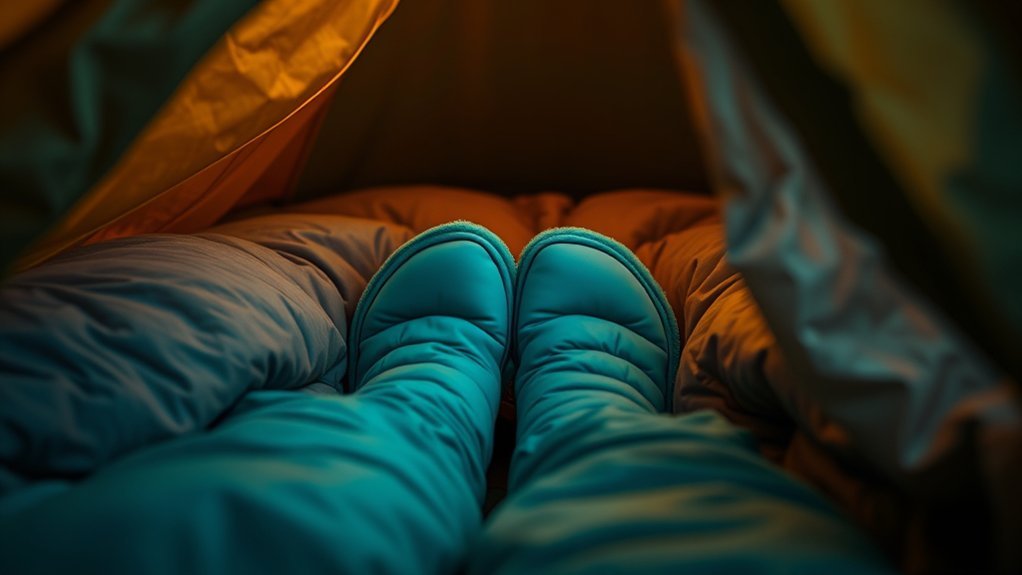
Insulated booties can add a useful layer around your feet when dry socks alone are not enough. They are especially useful for cold sleepers and for nights when you are spending a long time sitting or lying still.
Choose booties that fit comfortably rather than tightly. The goal is to trap warm air around the feet without compressing your socks or toes.
Benefits of Insulated Booties
- Extra insulation: They add warmth around an area that often feels cold first.
- Low packed weight: Many camping booties compress into a small space.
- Comfort around camp: Some models can also be used inside a tent or sheltered camp area before bed.
- Layering flexibility: You can add or remove them without changing the rest of your sleeping system.
Booties should be treated as supplemental insulation. They do not make an inadequately rated sleeping bag or sleeping pad appropriate for colder conditions.
Types of Insulation Used
| Insulation Type | Practical Characteristics |
|---|---|
| Down | High warmth-to-weight ratio and excellent compressibility; requires careful moisture management |
| Synthetic | Generally handles damp conditions better than untreated down, though it may be bulkier for a similar warmth level |
| Hybrid Fill | Combines different insulation types or zones to balance warmth, moisture management, weight, and durability |
| Best Choice | The model that provides enough warmth without compressing your feet and that suits the moisture conditions you expect |
Benefits of Hybrid-Fill Booties
Hybrid-fill booties can be useful when you want some of the compressibility of down along with synthetic insulation in areas more likely to encounter moisture. Exact construction varies by manufacturer, so check the design rather than assuming every hybrid bootie performs the same way.
The practical advantages may include:
- A good warmth-to-weight balance
- Reduced bulk compared with some all-synthetic designs
- Strategic use of moisture-tolerant insulation
- Comfort for cold feet without adding another full-body clothing layer
Regardless of fill type, keep the booties as dry as possible and make sure they do not fit tightly around your toes.
Insulate Yourself From the Ground
If your feet remain cold despite dry socks and a warm sleeping bag, check your sleeping pad. The ground can pull heat from your body through conduction, and your sleeping bag’s insulation is compressed underneath you, where it provides less loft.
A sleeping pad’s R-value describes its resistance to heat flow. In general, a higher R-value means more insulation from the ground. Current sleeping-pad guidance also uses standardized testing so R-values are more useful for comparison between models.
There is no single R-value that is perfect for everyone because comfort depends on ground temperature, air temperature, sleeping-bag performance, clothing, physiology, and whether you tend to sleep warm or cold. As conditions become colder, however, ground insulation becomes increasingly important.
If your pad is marginal for the conditions, adding a closed-cell foam pad underneath an existing pad can increase insulation. For regular winter camping, use a pad specifically intended for cold-weather conditions rather than relying on improvised fixes every night.
Warm feet depend on the whole sleep system: dry clothing, enough sleeping-bag insulation, adequate ground insulation, and a body that is warm before you settle in for the night.
Additional Tips for Warm Feet
A few additional habits can make a noticeable difference on cold nights:
- Keep your entire body warm. Wear appropriate dry base layers and a hat if needed. Reducing heat loss from your head and core helps your entire sleep system work more effectively.
- Eat before bed. A normal evening meal or light snack gives your body energy for heat production. Follow local food-storage rules and never keep food in the tent where wildlife regulations prohibit it.
- Stay hydrated. Do not intentionally dehydrate yourself to avoid getting out of the tent at night.
- Leave room around your feet. Avoid stuffing so much clothing into the footbox that insulation becomes compressed.
- Keep tomorrow’s clothes dry. Store sleep clothes, socks, and critical insulation where rain, condensation, or snow cannot soak them.
- Do not breathe deep inside your sleeping bag. Exhaled moisture can accumulate in the insulation. Keep your mouth and nose outside the bag while using the hood according to the manufacturer’s design.
Common Mistakes to Avoid
Several common habits can make cold feet worse even when you have good camping equipment:
- Sleeping in damp hiking socks: Change into a dry pair before bed.
- Adding excessively tight socks: More layers are not useful if they compress your feet or restrict circulation.
- Ignoring the sleeping pad: A warm sleeping bag alone does not stop heat loss into inadequately insulated ground.
- Getting sweaty before bed: Warm yourself gently and stop exercising before perspiration becomes noticeable.
- Using an unsuitable water bottle for heat: Follow the manufacturer’s temperature limits.
- Placing very hot objects directly against your skin: This can cause burns, particularly when you are asleep or sensation is reduced by cold.
- Assuming numb toes are normal: Persistent numbness can be a warning sign of frostbite.
- Using a sleeping bag that is inadequate for the forecast: Foot warmers and booties should supplement, not replace, suitable overnight insulation.
Utilizing Water for Warmth
A warm-water bottle inside your sleeping bag can provide additional heat for several hours. However, use only a container whose manufacturer specifically approves it for the water temperature you plan to use.
- Inspect the bottle, cap, and threads for cracks or damage.
- Fill it within the manufacturer’s permitted temperature range.
- Close the cap according to the manufacturer’s directions and confirm that it does not leak.
- Wrap the bottle in a sock, spare layer, or cloth to prevent direct skin contact.
- Place it in the sleeping bag. Keeping it near the torso or upper legs can warm a larger blood volume, while placing it near the footbox provides more direct comfort for cold feet.
Warning: Water-bottle temperature limits vary. Do not assume that every plastic or soft bottle can hold boiling water. Never use a damaged container, never heat the bottle over a flame or stove, and do not leave a very hot bottle directly against bare skin while you sleep.
What to Do if Your Feet Are Still Cold
If your feet remain cold after you get into your sleeping bag, troubleshoot the problem in this order:
- Check for moisture. Replace damp socks or base layers.
- Check for tightness. Loosen socks, booties, or anything compressing your feet.
- Warm your body. If you are otherwise well and alert, do a little gentle movement before returning to the bag.
- Check your sleeping pad. Cold coming from below can make both your feet and body feel chilled.
- Add dry insulation. Put on loose insulated booties or an additional dry layer.
- Use safe supplemental heat. Add a properly sealed, wrapped, heat-rated water bottle if available.
- Reassess conditions. If your sleep system is not adequate for the temperature, move to a safer shelter or warmer environment rather than relying on improvised warming measures all night.
When Cold Feet Become a Safety Issue
Cold toes are often only uncomfortable, but persistent numbness or abnormal skin changes can indicate frostbite. The CDC lists warning signs including white or grayish-yellow skin, unusually firm or waxy skin, and numbness.
Hypothermia is more serious because it affects the body’s core temperature. Warning signs can include persistent shivering, exhaustion, confusion, loss of coordination, slurred speech, or unusual drowsiness.
Warning: If you suspect frostbite or hypothermia, get out of the cold and seek appropriate medical care. Do not rub frostbitten tissue or expose it to uncontrolled direct heat. Significant hypothermia is a medical emergency and should not be managed simply by exercising harder or adding another pair of socks.
Packing Essential Gear
For cold-weather tent camping, pack for the full sleep system rather than focusing on one piece of gear. Useful items include:
- At least one dedicated pair of dry wool or synthetic sleep socks
- A sleeping bag appropriate for the expected nighttime temperature
- A sleeping pad with enough insulation for the ground conditions
- Dry base layers and a warm hat
- Optional insulated booties
- An optional heat-rated, leak-resistant water bottle
- Waterproof or moisture-resistant storage for sleep clothing and sleeping-bag insulation
- A sleeping-pad repair kit when using an inflatable pad
The National Park Service’s winter backpacking guidance likewise recommends a season-appropriate sleeping bag and pad, synthetic or wool clothing, warm hats, and moisture protection for essential gear.
Frequently Asked Questions
Can I use regular socks instead of moisture-wicking ones?
You can, but wool or synthetic socks are usually a better choice in cold conditions because they manage moisture better than cotton. Whatever you wear should be completely dry and loose enough that your toes can move comfortably.
How can I prevent my sleeping bag from getting cold?
Use a sleeping bag suited to the expected temperature, pair it with an adequately insulated sleeping pad, enter the bag warm and dry, and keep moisture out of the insulation. Avoid breathing deep inside the bag because exhaled moisture can accumulate.
Is it okay to sleep with my feet outside the sleeping bag?
On a warm night, exposing your feet may be comfortable. In cold or freezing conditions, however, keeping them inside the insulated footbox reduces heat loss and protects them from unnecessary cold exposure.
What materials are best for insulated booties?
Down offers excellent warmth for its weight when kept dry, while synthetic insulation generally tolerates damp conditions better. Hybrid designs combine materials in different areas. Fit and moisture protection matter as much as the fill type.
How do I choose the right sleeping pad for warmth?
Look at the pad’s R-value and intended temperature range. Higher R-values provide more resistance to heat loss into the ground. Choose enough insulation for your expected conditions, and remember that cold sleepers may prefer a warmer pad than the minimum recommendation.
Should I wear two pairs of socks to bed?
Only if both pairs remain dry and the combination does not feel tight. Two compressed pairs can be less comfortable than one dry, appropriately insulated pair because tight layers can restrict circulation and reduce insulating loft.
Can I use chemical foot warmers inside my sleeping bag?
Use them only according to the product instructions. Do not place a warmer directly against bare skin, especially while sleeping, and stop using it if it becomes painfully hot. A proper sleeping bag and pad should remain the foundation of your cold-weather sleep system.
Conclusion
Keeping your feet warm while sleeping in a tent starts with a complete sleep system. Put on dry wool or synthetic socks, warm yourself gently before bed, use a sleeping bag and insulated pad suited to the conditions, and make sure nothing around your feet is tight. Insulated booties or a safely used warm-water bottle can add comfort when needed. If your toes become persistently numb, pale, waxy, or unusually firm—or you develop signs of hypothermia—treat the situation as a cold-weather safety problem rather than ordinary cold feet.
Sources
- National Park Service — What to Bring Camping — sleeping pads, sleeping bags, dry clothing, and moisture management.
- National Park Service — Winter Backpacking Gear Checklist — cold-weather sleeping systems, wool/synthetic clothing, and moisture protection.
- CDC — Cold Weather and Travel — staying dry, hypothermia, frostbite, and cold-injury warning signs.
- Wilderness Medical Society — Frostbite Summary 2024 — peripheral warmth, avoiding constriction and moisture, exercise considerations, and frostbite prevention.
- REI Expert Advice — Sleeping Pad Buying Guide — sleeping-pad R-values and standardized insulation guidance.
- Nalgene — Hot Water in a Nalgene — current manufacturer guidance on hot-water use, bottle inspection, and skin-contact precautions.
