

Last Updated on July 29, 2026 by Mason Reed
Skunks usually visit campsites for an easy meal, not a confrontation. The safest response is to remove food and odor attractants, keep pets close, and give any skunk a clear escape route. If one approaches, stop moving toward it and back away slowly and quietly. Do not chase, corner, startle, or try to touch it.
Quick Answer
To deal with skunks at a campsite, secure food, trash, toiletries, pet food, and dirty cookware according to local campground rules. Keep pets leashed. If a skunk appears, stay calm, give it an open exit, and retreat slowly and quietly. Never chase it, make sudden noise, or approach a skunk that acts strangely.
Key Takeaways
- Food control is the most reliable prevention method. Store every scented item, not just meals.
- A skunk that stomps, hisses, raises its tail, or turns its rear toward you is warning you to back away.
- Do not rely on vinegar, ammonia, bleach, lights, or commercial sprays as a guaranteed barrier.
- Keep dogs leashed, especially from dusk through early morning.
- Treat bites and scratches as urgent rabies-exposure concerns and contact medical or veterinary professionals promptly.
At a Glance
| Time Required | 5–10 minutes to secure camp; 15–30 minutes for initial odor cleanup |
| Difficulty | Easy for prevention; moderate if a person, pet, or gear is sprayed |
| Tools Needed | Approved food storage, sealable trash bags, leash, flashlight, dish-cleaning kit, and odor-removal supplies |
| Cost | Low if you already have approved storage; higher if you must rent or buy required food-storage gear |
Disclosure: As an Amazon Associate I earn from qualifying purchases. Some links on this page are affiliate links, at no extra cost to you.
Understanding Skunk Behavior
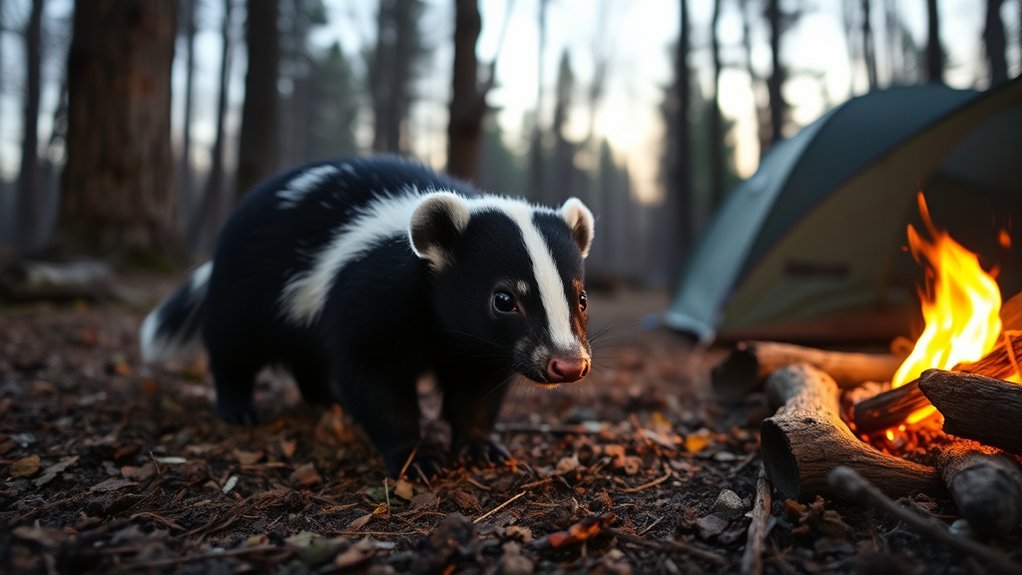
The common striped skunk (Mephitis mephitis) is an adaptable, mostly nocturnal forager. It may enter a campground when food scraps, trash, pet food, grease, or other scented items are easy to reach. Skunks are generally mild-tempered and prefer to avoid conflict, but they defend themselves when surprised, cornered, chased, or threatened. They also help the ecosystem by eating insects, grubs, rodents, and carrion, and they can be prey for great horned owls.
Watch for warning behavior. A skunk may stamp its front feet, hiss, raise or arch its tail, and turn its hindquarters toward the threat. These signals mean you are too close. Stop advancing and retreat slowly and quietly while leaving the animal a clear path away from people, tents, and vehicles.
A raised tail or rapid foot-stomping is not a challenge to scare the skunk away—it is your warning to give the animal more space.
Skunks are most active from dusk through early morning, but a daytime sighting does not automatically mean rabies. Healthy skunks may be out during the day while feeding, caring for young, or after being disturbed. Keep your distance and report a skunk that is staggering, circling, unusually aggressive, paralyzed, disoriented, or approaching people without normal caution.
Striped skunks do not truly hibernate. In cold weather they reduce activity and may enter short periods of torpor or remain in a den for extended periods. Mating activity commonly increases in late winter, which can lead to more movement and roadside or campground sightings.
Why Proper Food Storage Matters
Skunks are opportunistic feeders. A few crumbs, a greasy pan, an open cooler, pet kibble, or an overflowing trash bag can teach wildlife that campsites provide food. Once an animal is rewarded, it may return repeatedly and become bolder around people.
Use the storage method required by the land manager. In developed campgrounds, that may mean a provided food locker or a fully enclosed hard-sided vehicle. In the backcountry, an approved bear-resistant container may be required. Hang food only where the park or forest specifically allows it, and use that area’s required height and distance measurements. Rules vary, and some parks prohibit food hangs entirely.
Note: Treat toothpaste, soap, sunscreen, lip balm, deodorant, pet food, cookware, food wrappers, and trash as scented items. Do not keep them in your tent unless local rules explicitly permit it.
The National Park Service food-storage guidance recommends securing food, garbage, and scented items as soon as you reach camp, washing dishes promptly, and never storing food in a tent or unattended backpack.
Cleaning and Maintaining Your Campsite
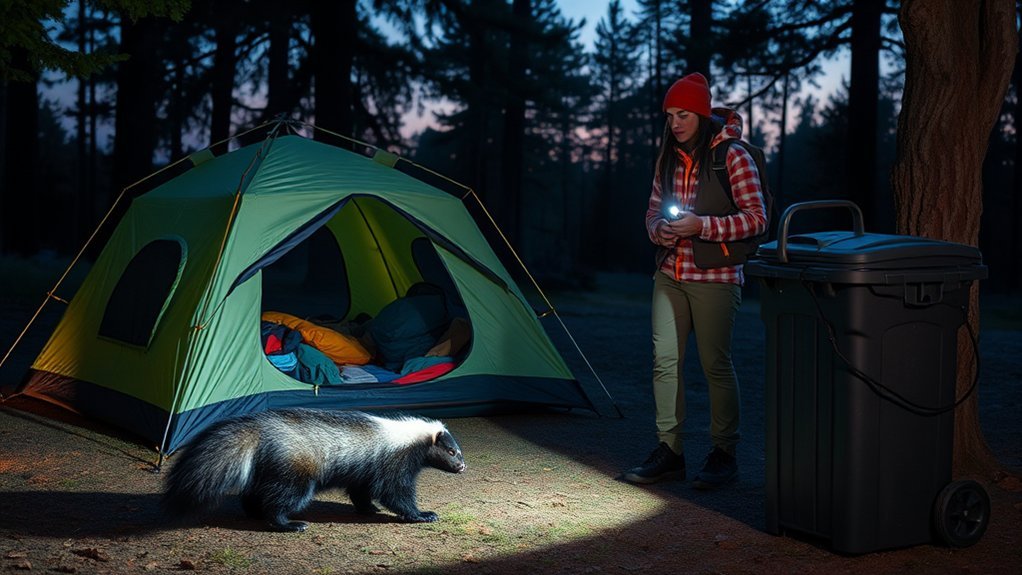
A clean camp reduces odors and removes the reward that draws skunks and other wildlife. Make cleanup part of every meal rather than waiting until bedtime.
Secure Food Storage
- Place food, drinks, pet food, trash, toiletries, and scented supplies in the campground’s approved storage location whenever they are not in active use.
- Keep bear-resistant canisters closed and locked. Do not tie ropes or bags to a canister unless the land manager’s instructions specifically require it.
- Never leave a cooler, grocery tote, backpack, or trash bag unattended outside.
- Wash pots, utensils, grills, and eating surfaces soon after cooking.
- Plan low-mess meals and repackage food to reduce wrappers, spills, and grease. Freeze-dried meals can reduce cleanup, but they still must be stored as food.
Proper Waste Disposal
Pack out all trash, leftover food, grease, and strained food particles unless the campground provides a wildlife-resistant receptacle. Do not bury food scraps, toss them into vegetation or water, or burn them in a fire ring. Partly burned food still attracts animals.
Follow Leave No Trace waste guidance: inspect the campsite for spilled food and micro-trash, pack out kitchen waste, and follow local directions for dishwater. In many backcountry settings, dishwater should be strained and dispersed well away from camp and water, with the strained solids packed out.
Maintain Campsite Cleanliness
- Do a ground-level crumb and wrapper check after every meal and again before dark.
- Wipe grease from tables, stoves, and grills.
- Keep food out of sleeping areas and change out of heavily food-scented clothing when practical in bear country.
- Store pet bowls immediately after feeding and pick up pet waste.
- Close every storage container fully; an odor-resistant bag is not wildlife-resistant by itself.
Pro Tip: Assign one person to perform a two-minute “scent check” before everyone enters the tent. Look under the table, around the fire ring, beneath chairs, and near the vehicle for dropped food, wrappers, and pet treats.
Effective Repellents for Skunks
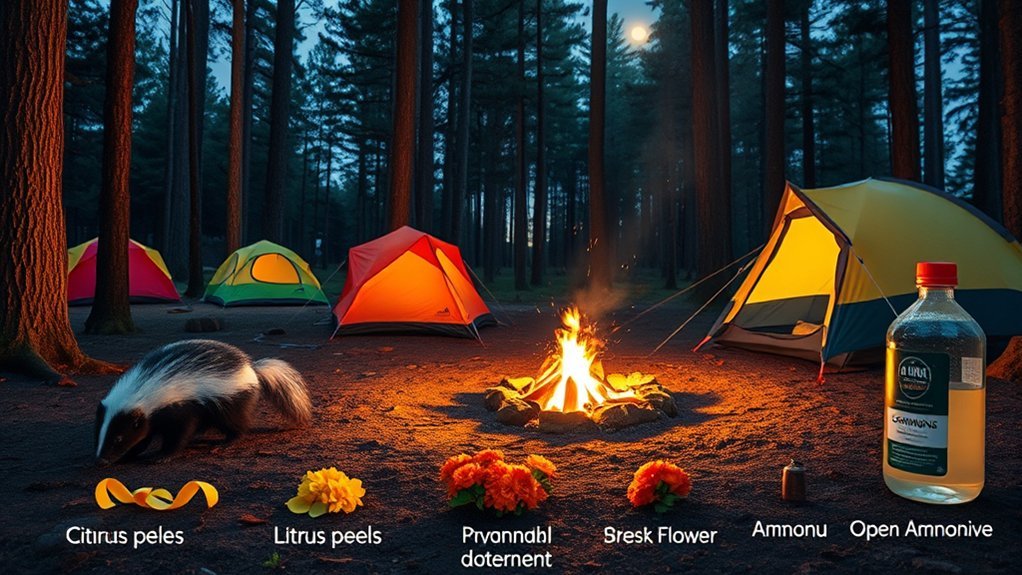
Repellents are less dependable than removing food and giving the animal no reason to stay. New Mexico State University Extension notes that repellents are temporary at best and do not provide a permanent solution for skunks. At a campsite, chemical use may also be restricted and can affect pets, plants, water, and other campers.
Natural Deterrent Options
Vinegar-soaked cloths and other strong odors are sometimes suggested as short-term deterrents, but evidence for reliable campsite protection is limited. A skunk may ignore the smell, move around it, or return after the odor fades. Do not place liquids or soaked materials where wildlife can lick them or where runoff can reach soil or water.
Lighting can help you see a skunk before stepping outside or releasing a pet, but it should not be treated as a guaranteed repellent. Keep light levels reasonable, follow quiet-hour and dark-sky rules, and avoid shining a bright beam directly into a nearby animal’s face.
Chemical Repellent Choices
Do not spread bleach, ammonia, mothballs, or other household chemicals around a campsite. These products can create inhalation, poisoning, fire, water-quality, and wildlife risks. Bleach and ammonia must never be mixed because they can release toxic gases.
If a land manager allows a commercial animal repellent, use only a product whose label lists the intended site and application. Follow the label exactly, keep it away from food and water, and understand that it may offer only temporary help. Never spray a product directly at a skunk.
Preventive Measures Overview
- Remove attractants: Secure food, trash, pet food, grease, and toiletries.
- Limit surprise encounters: Use a flashlight before leaving the tent at night and keep pathways clear.
- Control pets: Keep dogs leashed and bring food bowls inside approved storage.
- Give wildlife space: Never block a skunk’s escape route.
- Report repeat problems: Tell the campground host or ranger rather than attempting capture or relocation.
Creating a Safe Camping Environment
Choose a legal, designated campsite when one is available. A flat site may be more comfortable, and camping away from water can protect fragile shorelines, but neither feature guarantees fewer skunks. The most important skunk-prevention factors are food control, clean cooking practices, pet supervision, and compliance with local wildlife rules.
Set up so people can move between the tent, vehicle, food locker, and restroom without stepping through brush or clutter in the dark. Keep a flashlight and leash within reach. Do not place food or trash near the tent entrance, and avoid creating a dead end where an animal could feel trapped.
How to Handle Skunk Encounters
If a skunk enters your campsite, use the following steps:
- Stop approaching. Freeze for a moment and assess where the skunk can leave.
- Secure children and pets. Quietly bring them close without running toward the animal.
- Create space. Move slowly away at an angle and do not stand between the skunk and its exit path.
- Stay quiet. Avoid yelling, clapping, banging cookware, sudden flashlight flashes, or fast movements.
- Watch warning signs. If it stomps, hisses, raises its tail, or turns its rear toward you, increase your distance immediately.
- Let it leave. Most skunks move on once they no longer feel threatened and cannot access food.
- Notify staff when needed. Contact a ranger or campground host if the skunk repeatedly enters occupied sites, appears injured, behaves abnormally, or cannot leave safely.
Warning: Do not make noise to drive a nearby skunk away, blow in its face, poke it, throw objects, chase it, or try to trap it. Wildlife guidance recommends retreating slowly and quietly when a skunk is agitated.
What to Do If You or a Pet Is Sprayed
Protect Eyes and Breathing
Move into fresh air. If spray reaches the eyes, rinse them with plenty of clean, cool water. Seek medical or veterinary advice if pain, redness, vision changes, vomiting, breathing trouble, or other symptoms persist. People with asthma or significant respiratory symptoms should get prompt medical help.
Clean Skin, Pets, and Gear
For washable skin, fur, and some gear, the North Carolina Wildlife Resources Commission recommends mixing the following immediately before use:
- 1 quart of fresh 3% hydrogen peroxide
- 1/4 cup baking soda
- 1–2 teaspoons liquid dish soap
Wear gloves, keep the mixture out of eyes and mouth, apply it promptly, and rinse thoroughly. Test colorfast materials first because peroxide may discolor fabric. Wash contaminated clothing separately and air out tents or gear in a well-ventilated area.
Warning: Mix the peroxide solution only in an open container and use it immediately. Never seal or store it. The reaction releases gas and can burst a closed bottle or container.
Respond to Bites or Scratches
Skunks are among the wildlife species that can carry rabies in the United States. If anyone is bitten or scratched, wash the wound with soap and water for 15 minutes and contact a healthcare professional or local public health department urgently. If a pet has direct contact with a skunk, contact a veterinarian and animal-control or public-health authorities. Do not attempt to capture the animal yourself.
The Centers for Disease Control and Prevention states that rabies exposure requires prompt assessment because preventive treatment is highly effective when started before symptoms develop.
The Role of Lighting in Skunk Deterrence
Lighting is most useful as an awareness tool. A low, steady campsite light or flashlight can help you check the area before walking to the restroom, opening a food locker, or taking a dog outside. It can also reduce the chance of surprising a skunk at close range.
Do not assume that lights create a skunk-proof perimeter. Animals can become used to steady light, and excessive lighting can disturb wildlife and nearby campers. Use the minimum light needed for safety, point it downward, and follow campground quiet-hour and dark-sky policies.
Strategies for Educating Campers
Wildlife prevention works only when every person in the group follows the same routine. Review storage rules at the start of the trip, assign cleanup duties, and explain skunk warning signals before dark.
Proper Food Storage Practices
- Show each camper exactly where food and scented items must be stored.
- Explain that sealed packaging does not make an item wildlife-proof.
- Store pet food, treats, and bowls with human food.
- Keep trash secured until it reaches an approved receptacle or is packed out.
- Recheck the site after children eat snacks, because small pieces are easy to miss.
Skunk Behavior Awareness
| Behavior | What It Means | Camper Response |
|---|---|---|
| Quietly foraging | The skunk is searching for food | Keep distance, secure attractants, and allow it to leave |
| Foot-stomping, hissing, raised tail | The skunk feels threatened and may spray | Stop, retreat slowly and quietly, and open an escape route |
| Daytime activity without other odd signs | May be normal feeding, parenting, or disturbance | Observe only from a distance |
| Staggering, circling, paralysis, unusual aggression | Possible illness, injury, or neurological problem | Keep everyone away and contact park staff or animal control |
Effective Repellent Usage
Teach campers that repellents are secondary tools, not substitutes for cleanliness. No one should scatter household chemicals, spray an animal, or use a product against its label. The group’s first response should always be to remove food rewards and increase distance.
Wildlife Regulations and Safety Guidelines
Food-storage, pet, trapping, and wildlife-harassment rules differ by park, forest, state, and season. Check the official campground page, permit conditions, posted notices, and ranger instructions before setting up camp. A method allowed in one location may be prohibited in another.
Do not feed, trap, relocate, poison, or harass a skunk. Relocation is illegal in some jurisdictions and can spread disease or leave dependent young behind. Report an injured animal, repeated campsite entry, or abnormal behavior to the campground host, ranger, local animal control, or wildlife agency.
Warning: Spray odor alone is not the main rabies concern. Bites, scratches, and saliva contacting broken skin or the eyes, nose, or mouth require urgent professional assessment.
Tips for a Successful Camping Experience
Planning ahead is the easiest way to prevent a skunk encounter from becoming a campsite emergency.
- Read the site’s current wildlife and food-storage rules before leaving home.
- Carry an approved storage system rather than assuming a suitable hanging tree will be available.
- Pack sealable trash bags, a leash, a reliable flashlight, and basic odor-removal supplies.
- Feed pets before dark when possible and store bowls immediately.
- Keep tent doors closed and sleeping areas free of food and scented items.
- Check the ground, table, fire ring, and cooking area before bed.
- Save the campground host, ranger station, local animal-control, and local public-health contact information.
Frequently Asked Questions
Can skunks climb trees or fences?
It depends on the species and obstacle. Striped skunks are poor climbers compared with spotted skunks, but they can climb some rough or low obstacles and may dig under barriers. Spotted skunks are agile tree and fence climbers. Do not assume an elevated bag, table, or low fence is secure wildlife storage.
What time of day are skunks most active?
Skunks are usually most active from dusk through the night and into early morning. They can also appear in daylight while feeding, caring for young, or after being disturbed. Daytime activity alone does not prove rabies, but abnormal movement or behavior should be reported.
Are skunks dangerous to pets?
A curious or off-leash pet may be sprayed, bitten, or scratched. Skunks can carry rabies and other diseases. Keep pets leashed, maintain current rabies vaccinations, and contact a veterinarian promptly after direct contact.
How far can a skunk spray?
A skunk can direct spray several feet, and some wildlife authorities report distances up to about 15 feet. Mist can travel farther with wind. Stay well beyond that range and increase your distance as soon as the skunk shows warning behavior.
Do skunks hibernate during winter?
Skunks do not truly hibernate. They reduce activity, use stored body fat, and may remain in dens during cold spells. They can emerge on warmer winter days, and several skunks may share a winter den.
What should I do after a skunk bite or scratch?
Wash the wound with soap and water for 15 minutes, then contact a healthcare professional or public-health department urgently for a rabies-risk assessment. For a pet, call a veterinarian and animal-control or public-health authorities. Do not try to capture the skunk.
What is the safest way to remove skunk odor?
Mix 1 quart of fresh 3% hydrogen peroxide, 1/4 cup baking soda, and 1–2 teaspoons dish soap immediately before use. Keep it out of eyes and mouth, rinse thoroughly, and never store the mixture in a sealed container. Test fabrics first because peroxide can discolor them.
Conclusion
Most skunk encounters end safely when campers stay calm and give the animal room to leave. Secure every scented item, clean cooking areas promptly, keep pets leashed, and follow local food-storage rules. If a skunk warns you by stomping or raising its tail, retreat slowly and quietly. A little preparation protects campers, pets, and the wildlife sharing the area.
Sources
- U.S. National Park Service — Bear Safety: Storing Food — food, trash, scented-item, dishwashing, and campground storage practices.
- Leave No Trace — Dispose of Waste Properly — packing out food waste, campsite inspection, and dishwater practices.
- U.S. Fish & Wildlife Service — Living With Skunks — seasonal behavior, warning displays, spray range, and ecological role.
- North Carolina Wildlife Resources Commission — Striped Skunk — warning signs, pet precautions, daytime activity, and odor-removal instructions.
- Centers for Disease Control and Prevention — Rabies Prevention and Control — wound washing and urgent post-exposure assessment.
- New Mexico State University Extension — Controlling Skunks — retreating slowly and quietly and the limits of repellents.

