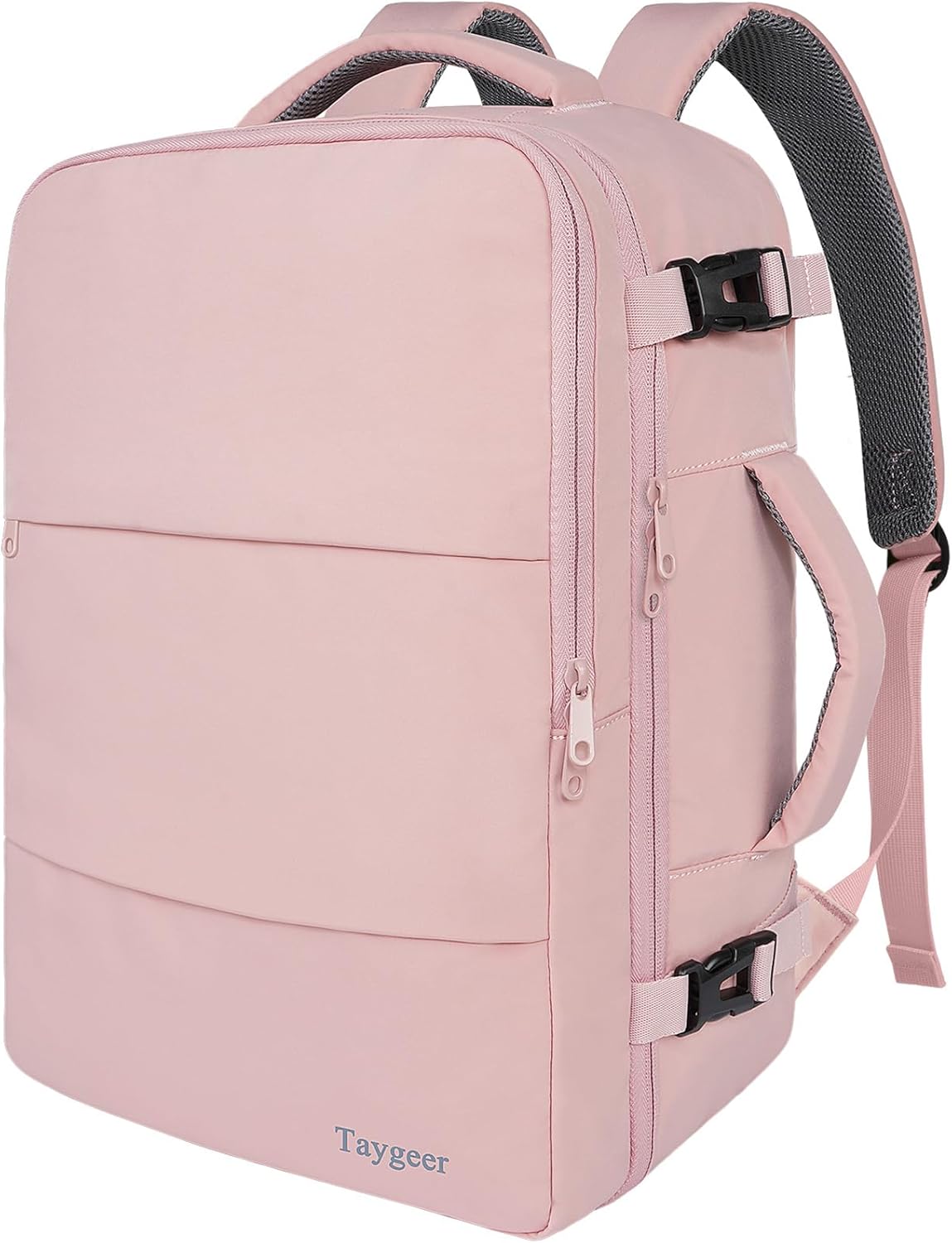
Last Updated on July 30, 2026 by Caleb Warren
Choosing a travel backpack for women is less about finding a bag labeled “women’s” and more about matching the pack to your body, airline, trip, and packing style. The right bag should fit your torso, stay within your airline’s exterior size limit, carry comfortably when loaded, and keep important items easy to reach without adding unnecessary weight.
Quick Answer
Choose a women’s travel backpack by checking four things first: your torso and hip measurements, the bag’s packed exterior dimensions, its empty weight, and how it feels with a realistic load. A 25–35L pack suits many light packers, while 35–40L offers more room—but liters alone never guarantee carry-on compliance.
Key Takeaways
- Fit comes first: torso length and hip-belt range matter more than your height or the gender label on the bag.
- Check dimensions, not just liters: every airline sets its own carry-on and personal-item limits.
- Test the pack loaded: use the weight you expect to carry and walk for at least 10–20 minutes.
- Balance features and weight: frames, hip belts, laptop sleeves, and extra pockets improve comfort or organization but make a bag heavier.
- Treat security features as deterrents: lockable zipper sliders and hidden pockets help, but no fabric backpack is theft-proof.
At a Glance
| Time Required | 20–30 minutes to measure, compare, load, and test |
| Difficulty | Easy |
| Tools Needed | Flexible tape measure, airline baggage page or sizer, and a realistic test load |
| Cost | Free to assess; backpack prices vary by materials, suspension, and features |
Disclosure: As an Amazon Associate I earn from qualifying purchases. Some links on this page are affiliate links, at no extra cost to you.
Why Choose a Women’s Travel Backpack?
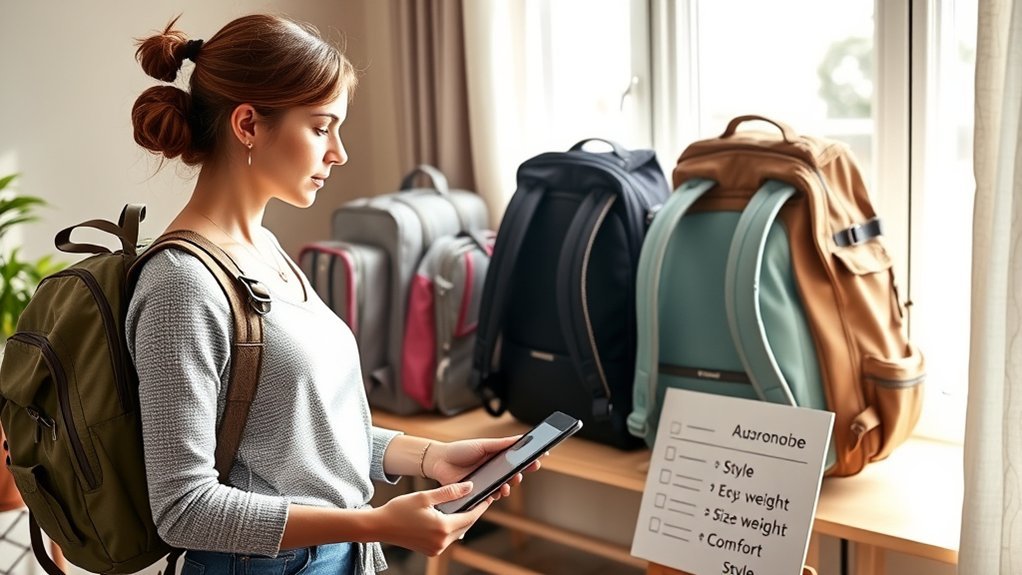
A women’s-specific travel backpack may use a shorter torso range, narrower shoulder spacing, curved shoulder straps, and a hip belt shaped for a more conical hip profile. Those design choices can improve comfort for some bodies, especially when a pack is heavy. However, body shapes vary, and a well-fitting unisex pack can be a better choice than a poorly fitting women’s model.
The best backpack is the one that matches your measurements and stays comfortable after loading. The REI backpack fit guide emphasizes that torso length—not overall height—is the key sizing measurement. Try both women’s and unisex options when possible rather than treating the label as a guarantee.
A backpack’s label tells you who it was designed for; a loaded fit test tells you whether it was designed for you.
Understanding Your Travel Needs
Start with the trip you take most often. A bag for weekend city breaks has different needs from one used for hiking, business travel, or long-term one-bag travel. Consider your usual trip length, climate, laundry access, electronics, mobility needs, and whether the pack must fit under a seat or only in an overhead bin.
Trip Duration Considerations
Capacity is a useful starting point, but it is not a fixed formula. Clothing size, cold-weather layers, camera gear, medication, and packing habits can change how much space you need.
- Under 25L: often suitable for day trips, overnight stays, or highly disciplined weekend packing.
- 25–35L: a flexible range for many two- to five-day trips, especially with light clothing or laundry access.
- 35–40L: useful for longer carry-on trips, colder climates, larger clothing, or extra tech.
- Over 40L: offers more space but is more likely to exceed an airline limit when fully packed.
Do not buy extra capacity “just in case” unless you need it. Unused space invites overpacking, and a larger bag is harder to maneuver on stairs, trains, and crowded streets.
Activity Level Assessment
Match the carrying system to how you will move. A structured pack with a frame sheet, load lifters, and a weight-bearing hip belt is valuable for long walks or heavier loads. A lighter pack with simple shoulder straps may be enough when you move mostly between a car, airport, and hotel.
- City and transit travel: prioritize compact dimensions, secure quick-access pockets, grab handles, and a luggage pass-through.
- Walking-heavy trips: prioritize torso adjustment, a supportive hip belt, ventilation, and stable compression straps.
- Business travel: look for a protected laptop compartment, understated styling, and easy document access.
- Outdoor use: consider abrasion resistance, weather protection, bottle pockets, and attachment points—but remember that many travel packs are not technical hiking packs.
Backpack Size and Capacity
Airlines regulate a bag’s outside measurements, not its advertised liter capacity. The TSA states that carry-on dimensions vary by airline, while the FAA advises travelers to check the airline before packing. A soft 40L backpack may fit one carrier’s sizer and fail another’s, especially when overstuffed.
Warning: Never assume “40L,” “flight approved,” or “carry-on size” guarantees acceptance. Check the exact height, width, depth, and weight limit for every airline on your itinerary, including regional and budget carriers.
Short Trip Considerations
For a short trip, choose the smallest pack that holds your real packing list. A 20–30L bag is easier to carry and store, but it may still be too tall to count as a personal item. Measure the packed bag at its widest points, including bulging pockets, handles, and rigid frames.
Long Journey Essentials
Long trips do not always require a larger backpack. Travelers with quick-dry clothing and regular laundry access can use the same 30–40L pack for a week or several months. If you need cold-weather layers, medical equipment, professional gear, or multiple pairs of shoes, a larger checked bag may be more practical than an overloaded carry-on backpack.
Keep the total weight in mind. Some international and budget airlines enforce carry-on weight limits even when the bag meets the size limit. A heavy empty backpack can use a large part of that allowance before you add clothing or electronics.
Optimal Backpack Dimensions
| Pack Category | Typical Use | Main Check |
|---|---|---|
| Under 25L | Day trips, overnight travel, minimal weekends | May still be too tall or deep for an under-seat limit |
| 25–35L | Most short carry-on trips and light one-bag travel | Compare packed dimensions with the airline’s sizer |
| 35–40L | Longer trips, extra layers, or more equipment | Watch depth, empty weight, and airline weight limits |
| Over 40L | Bulky gear or checked-bag travel | Carry-on compliance becomes less likely when packed |
Many large U.S. airlines publish a 22 x 14 x 9-inch carry-on limit, including Delta, but that is not a universal rule. Check each carrier directly, and confirm whether your ticket includes a full-size carry-on.
How to Measure for the Right Fit
A pack that matches your torso will usually feel better than one selected by height alone. Ask another person to help with the measurement for better accuracy.
- Find the C7 vertebra: tilt your head forward and locate the bony bump where your neck meets your shoulders.
- Find the iliac crest: place your hands on top of your hip bones with your thumbs pointing toward your spine.
- Measure your torso: stand straight while your helper measures from C7 down the spine to the imaginary line between your thumbs.
- Measure your hips: wrap the tape around the top of your hip bones, not your pants waist.
- Compare both numbers: use the manufacturer’s torso and hip-belt range for the exact model and size.
Brand size labels are not standardized. A “small” in one model can fit a different torso range than a “small” in another.
Comfort and Adjustability
Comfort depends on both fit and load. Test the backpack with 10–15 pounds or the actual weight you expect to carry. Loosen the straps before putting it on, then adjust in this order:
- Hip belt: center the padding over the top of your hip bones and tighten it until snug, not pinching.
- Shoulder straps: tighten until they wrap the shoulders without carrying most of the load.
- Load lifters: if the pack has them, pull gently so the pack sits closer to your upper back; do not overtighten.
- Sternum strap: place it at a comfortable chest height and tighten only enough to stabilize the shoulder straps.
Walk, climb stairs, bend, and reach while wearing the loaded pack. Stop if you feel numbness, sharp pain, restricted breathing, or severe pressure. Minor strap adjustments can solve small hot spots, but persistent discomfort usually means the shape or size is wrong.
Pro Tip: Wear the clothing you expect to travel in during the fit test. A pack that feels fine over a thick jacket may rub or sit differently over a thin shirt.
Must-Have Features for Organization
More pockets are not automatically better. Choose an organization layout that matches what you carry and lets you reach important items without opening the entire bag.
| Feature | Why It Helps | What to Check |
|---|---|---|
| Clamshell opening | Opens like a suitcase for easier packing | Zippers open far enough without spilling small items |
| Laptop compartment | Separates electronics from clothing | Correct device size, bottom suspension, and easy security access |
| Quick-access pocket | Keeps tickets, glasses, or earbuds handy | Avoid storing passports or wallets in exposed outer pockets |
| Internal compression | Controls shifting and bulging | Straps do not crush delicate items or block access |
| Bottle pocket | Keeps liquids away from electronics | Fits your bottle when the main compartment is full |
Note: Spare lithium batteries and power banks must travel in carry-on baggage, not checked baggage. An accessible protected pocket makes it easier to keep them with you if your backpack is gate-checked.
Materials, Weather Resistance, and Durability
“Water-resistant” and “waterproof” are not interchangeable. Most travel backpacks resist light rain but can leak through seams and zippers during a downpour. For wet destinations, use a rain cover or waterproof liner for clothing, documents, and electronics.
Inspect the areas that fail first: zipper tracks, shoulder-strap stitching, grab handles, bottom fabric, buckles, and mesh pockets. Higher-denier fabric can improve abrasion resistance, but fabric type, coating, construction, and repair support matter as much as a single material number.
For a lower-impact purchase, look for specific claims such as an exact recycled-content percentage, bluesign-approved materials, PFAS-free water-repellent treatment, replaceable parts, a repair program, or a strong warranty. Vague words such as “green” or “eco-friendly” are less useful without details.
Safety and Security Features
Lockable zipper sliders, hidden pockets, and inward-facing openings can discourage casual access, but they do not make a soft backpack theft-proof. A small travel lock can secure two compatible zipper pulls, yet the fabric and zipper can still be cut or forced.
- Keep your passport, cards, and primary phone in an internal pocket close to your body.
- Do not leave the backpack hanging from a chair or resting unattended in a public area.
- Use compression straps to reduce loose zipper pulls and exterior bulk.
- Store backup cards and emergency cash separately from your main wallet.
- Consider a tracker pocket for recovery support, but do not rely on a tracker to prevent theft.
RFID-blocking pockets may reduce unauthorized reading of compatible contactless chips at very close range, but they do not prevent common travel theft such as pickpocketing, bag snatching, or stolen phones. Prioritize physical control and sensible storage over marketing claims.
Style and Functionality
A travel backpack should work with your clothing and destinations, but function deserves equal weight. Dark or neutral colors can move easily between airports and business settings, while bright colors improve visibility. Light interiors make small items easier to find.
| Functionality | Style Consideration |
|---|---|
| Supportive harness and hip belt | Bulkier straps may look more technical |
| Clamshell opening and organization | Clean exterior panels create a polished look |
| Durable, coated fabric | Gloss and texture vary by coating |
| High-visibility color | Easy to spot but may show dirt or draw attention |
Extra Features That Indicate a Stand-Out Travel Backpack
Extra features earn their place only when they solve a real problem. Look for:
- A suspended laptop sleeve: keeps the device from striking the ground when the bag is set down.
- Stowable straps: protect the harness from conveyor belts if the bag must be checked.
- Useful compression straps: stabilize the load and help control depth.
- Multiple grab handles: make the bag easier to lift into bins or move through security.
- A luggage pass-through: secures the backpack to a rolling suitcase.
- Replaceable or removable hip belt: adds flexibility for lighter and heavier trips.
- Clear warranty and return terms: allow a realistic home fit test and provide support if hardware fails.
A feature can also be a drawback. Wheels add weight, rigid frames reduce compressibility, and dense organization panels take space away from the main compartment. Choose the simplest design that meets your needs.
How to Test a Backpack Before You Keep It
- Confirm the retailer allows returns after an indoor fit test and keep all tags attached.
- Pack your real clothing, toiletries, electronics, and shoes rather than towels or empty boxes.
- Measure the fully packed exterior at the widest points.
- Weigh the loaded bag and compare it with every airline on the itinerary.
- Adjust the torso, hip belt, shoulder straps, load lifters, and sternum strap.
- Walk for 10–20 minutes and climb stairs if available.
- Check for shoulder gaps, hip-belt slipping, neck pressure, lower-back pulling, and restricted arm movement.
- Open the laptop, document, and toiletry compartments while the bag is full to ensure access still works.
Repeat the test with a jacket on and off. If you are between sizes or cannot remove pressure points, compare another model rather than assuming the discomfort will disappear during travel.
Top Recommendations for Women’s Travel Backpacks
The following comparison uses current manufacturer specifications, not hands-on testing. Prices, colors, and availability can change. Published dimensions should still be checked against your airline and verified again after packing.
| Backpack | Published Specs | Best Match | Trade-Off |
|---|---|---|---|
| Osprey Fairview 40 | 40L; 21.7 x 13.8 x 9.1 in; 3.23 lb | Travelers wanting a women’s-specific adjustable harness and weight-bearing hip belt | Its published depth is slightly over a common 9-inch limit, so avoid overpacking and verify the airline sizer |
| tomtoc Navigator-T66 40L | 40L; about 20.47 x 12.99 x 9 in; about 2.65 lb | Budget-conscious travelers who want a clamshell opening and room for a large laptop | Less adjustable than a full travel suspension system; fit should be tested carefully |
| Bellroy Venture Travel Pack 26L | 26L; 21.7 x 13.8 x 6.3 in; 38.8 oz | Minimalist short trips and travelers who prefer a slimmer profile | The tall frame may not qualify as a personal item even though the volume is only 26L |
| Tortuga Pro Backpack 40L | 40L; 22 x 14 x 8 in; 4.4 lb | Longer trips, heavier loads, and users who value a height-adjustable harness | The heavy empty weight can be a disadvantage under strict airline weight limits |
| Aer Travel Pack 3 Small | 28L; 19 x 13 x 7.5 in; 3.79 lb | Compact urban travel, strong organization, and shorter exterior height | A compatible hip belt is optional and sold separately |
Use these models as comparison points rather than universal winners. A less expensive pack that fits your torso and airline can outperform a premium pack that does not.
Frequently Asked Questions
What is the average weight of a travel backpack for women?
There is no single reliable average. Current carry-on models in this guide range from about 2.4 to 4.4 pounds empty. Lightweight bags save airline weight allowance, while heavier bags often add frames, hip belts, padding, and organization.
How do I clean and maintain my travel backpack?
Follow the care label for the exact model. Empty and vacuum the pack, spot-clean with mild soap and lukewarm water, rinse away residue, and air-dry it completely out of direct heat. Do not use a washing machine, dryer, bleach, or harsh detergent unless the manufacturer specifically permits it.
Can I use a travel backpack for everyday use?
Yes, but a 35–40L travel bag may feel bulky for commuting. For daily use, check whether the bag compresses well, protects your laptop, fits under your desk or transit seat, and remains comfortable with a light load.
What is the best way to pack a travel backpack?
Place dense items close to your back and near the middle of the pack, keep fragile items protected, and use compression to stop shifting. Put documents, medication, and one essential clothing layer where you can reach them quickly. Weigh and measure the bag after packing.
Are eco-friendly travel backpack options available?
Yes. Look for measurable details such as recycled-content percentages, bluesign-approved fabrics, PFAS-free treatments, repair support, and replaceable components. Durability also matters because a bag that lasts for years may reduce replacement waste.
Is a 40L backpack always carry-on size?
No. Liter capacity describes internal volume, not the exact exterior shape. A 40L pack can exceed an airline’s height or depth limit, especially when overfilled. Compare the packed dimensions and weight with the operating airline’s current policy.
Do I need a women’s-specific backpack?
Not necessarily. Women’s-specific shaping can help people with shorter torsos, narrower shoulders, or more angled hips, but fit varies by body. Compare torso range, shoulder spacing, and hip-belt shape, then keep the model that feels best when loaded.
Conclusion
The right travel backpack is the one that fits your body, your packing list, and your airline—not simply the one with the most features or the strongest marketing. Measure your torso, compare packed exterior dimensions, and test a realistic load before committing. When two bags fit equally well, choose the lighter and simpler option that still protects your essentials and supports the way you travel.
Sources
- Transportation Security Administration: Carry-on size restrictions — confirms that cabin-bag dimensions vary by airline.
- Federal Aviation Administration: Carry-On Baggage Tips — supports checking the operating airline and fitting baggage in approved storage.
- REI Co-op: How to Size and Fit a Backpack — supports torso measurement, hip-belt placement, and adjustment order.
- Osprey: Backpack Sizing and Fit for Women — explains women’s-specific harness and hip-belt design.
- Transportation Security Administration: What Can I Bring? — confirms that spare lithium batteries and power banks belong in carry-on baggage.
- Osprey: How to Clean Your Backpack — supports gentle cleaning and complete air-drying.