
Last Updated on September 27, 2026 by Caleb Warren
How cold is too cold for an electric scooter? The answer depends on your scooter’s operating temperature, battery condition, and road surface. Cold weather reduces available power and range, while ice and slush can make riding unsafe even when the scooter operates normally. Understanding the difference between riding, charging, and storage limits helps you protect both yourself and your scooter.
Quick Answer
Many electric scooters have a minimum operating temperature of -10°C (14°F), but your model’s specifications determine its actual limit. Avoid riding on ice, snow, or slippery roads regardless of temperature. Most conventional lithium-ion scooter batteries should not be charged below 0°C (32°F). Cold weather can also significantly reduce range and acceleration.
Key Takeaways
- Operating, charging, and storage temperatures are separate specifications. A scooter may tolerate cold storage but prohibit charging at that temperature.
- Cold-related range loss is often temporary. Charging a battery while it is too cold creates a different risk that can cause lasting damage.
- An IP water-resistance rating does not guarantee safe winter riding or protect against every type of moisture exposure.
- Correct tire pressure, working mechanical brakes, and clear pavement matter more than simply staying above a temperature threshold.
Disclosure: As an Amazon Associate I earn from qualifying purchases. Some links on this page are affiliate links, at no extra cost to you.
How Cold Is Too Cold for an Electric Scooter?
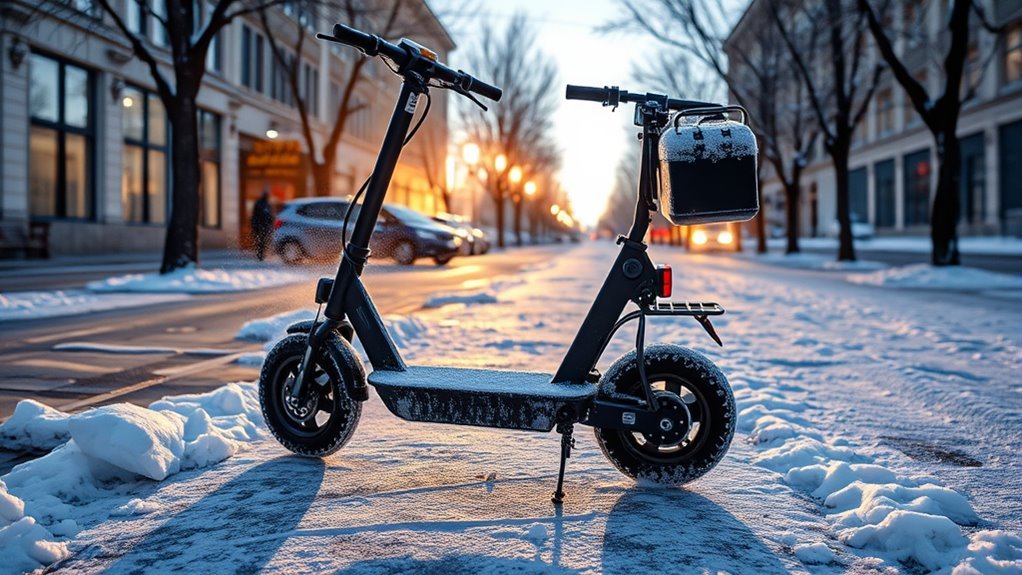
For many electric scooters, -10°C (14°F) is the lower operating limit. However, this is a manufacturer specification, not a guarantee that riding at that temperature is safe.
For example, the Segway Ninebot F25 specifications list an operating range of -10°C to 40°C (14°F to 104°F). Its permitted charging range is 0°C to 40°C (32°F to 104°F).
The Segway Ninebot E2 specifications also list a minimum operating temperature of -10°C, but its charging and storage limits differ.
These examples show why you should use your specific model’s manual rather than assume every scooter has the same limits.
| Temperature | Practical guidance |
|---|---|
| Above 10°C (50°F) | Generally favorable for battery performance when roads are dry. |
| 0°C to 10°C (32°F to 50°F) | Expect reduced range and check for frost or slippery surfaces. |
| -10°C to below 0°C (14°F to below 32°F) | Ride only if the manufacturer permits it and conditions are suitable. Do not charge a battery below its charging limit. |
| Below -10°C (14°F) | Outside the operating range of many common models. Do not ride unless your specific scooter is rated for the temperature. |
The road can become dangerous before the air reaches freezing. Shaded pavement, bridges, and untreated paths may contain ice even when nearby roads look clear.
Road conditions take priority over the temperature reading. If you cannot confirm that your route has reliable traction, choose another way to travel.
What Cold Weather Does to Electric Scooter Range?
Cold weather reduces the amount of energy a lithium-ion battery can deliver during a ride. It also increases electrical resistance inside the battery, which can reduce acceleration and available power.
The amount of range lost depends on battery temperature, scooter model, riding speed, hills, tire pressure, and battery age.
Battery Range Drop
Electric scooter range can fall by 20–40% in cold weather, although this estimate is not a guaranteed loss for every scooter or temperature.
Another commonly quoted estimate is a 10–20% range reduction for every 10°C (18°F) temperature drop. Actual results vary, so neither figure should replace your scooter’s real-world range history.
Below freezing, lithium-ion cells deliver energy less efficiently. Your battery indicator may also behave differently under load, especially when accelerating or climbing hills.
As the pack warms, some temporarily unavailable capacity may become usable again. This does not mean that every cold-weather range loss represents permanent battery damage.
For trip planning, compare your usual warm-weather range with what you actually achieve on colder rides.
If your scooter normally covers 20 miles and cold weather cuts its range by 30%, the remaining range would be approximately 14 miles. That is an illustration, not a prediction for your model.
Leave enough battery for the return trip rather than relying on the manufacturer’s advertised maximum range.
Slower Power Output
A cold battery may deliver less power to the motor. You can notice this as weaker acceleration, reduced hill-climbing ability, or a lower available top speed.
Battery voltage can also drop more noticeably under heavy load when the pack is cold.
| Temperature | Battery output | Possible ride feel |
|---|---|---|
| 20°C (68°F) | Normal | Responsive |
| 0°C (32°F) | Potentially lower | Softer acceleration |
| -10°C (14°F) | Further reduced | Possible sluggishness or power limiting |
These descriptions show the general trend, not measured performance for a particular scooter.
A scooter that accelerates normally indoors may behave differently after prolonged exposure to freezing air.
Avoid aggressive starts and plan routes that do not require maximum acceleration to merge safely with traffic.
If your scooter displays a temperature warning or limits power, stop and follow the manufacturer’s instructions.
How Cold Weather Affects Tires and Grip?
Cold weather can reduce tire pressure and make ordinary tire rubber less flexible. These changes affect handling, rolling resistance, and the tire’s ability to grip uneven pavement.
Snow, ice, wet leaves, painted markings, and metal surfaces create additional traction hazards.
Tire Pressure Drops
Air pressure decreases as temperature falls. As a general tire-industry guideline, pressure changes by approximately 1 PSI for every 10°F temperature change.
This relationship is explained in Michelin’s tire guidance. The exact change in a small scooter tire depends on its starting pressure and temperature.
Underinflated pneumatic tires flex more, increase rolling resistance, and can make steering less precise. They may also become more vulnerable to damage from potholes and sharp obstacles.
Check pressure with a suitable gauge while the tires are cold, then inflate them to your scooter manufacturer’s recommended value.
Do not deliberately lower pressure to improve snow traction unless your manufacturer specifically permits it. Low pressure cannot make ordinary scooter tires safe on ice.
Solid tires do not require inflation, but their grip can still change with temperature and road conditions.
Reduced Road Grip
Cold rubber may lose flexibility, reducing its ability to conform to the road surface. On wet or icy pavement, traction can deteriorate quickly.
Winter-specific tires may improve performance where compatible products exist. However, they do not eliminate the risk of slipping on ice.
| Road condition | Grip concern | Recommended action |
|---|---|---|
| Cold, dry pavement | Reduced rubber flexibility | Inspect tires and ride conservatively. |
| Wet pavement | Less predictable traction | Follow the manufacturer’s wet-weather restrictions. |
| Snow or slush | Wheel slip and hidden obstacles | Avoid riding. |
| Ice or black ice | Severe loss of traction | Do not ride. |
Black ice is especially dangerous because it can blend into dark pavement. Do not assume a road is safe simply because you cannot see snow.
Longer Braking Distance
Cold tires and slippery pavement can increase stopping distance. The difference depends on speed, tire condition, brake design, and the amount of available traction.
There is no reliable universal multiplier for electric scooter stopping distance on ice.
Keep your scooter upright while braking, apply the brakes progressively, and leave more space ahead than you would on a warm, dry road.
Abrupt braking can lock a wheel and cause a skid. Even scooters equipped with electronic braking features cannot overcome extremely poor tire grip.
Why Does Braking Get Riskier in Winter?
Winter braking becomes riskier because the tires may have less grip, moisture can affect braking components, and battery temperature can influence electronically controlled braking systems.
Mechanical disc or drum brakes and regenerative braking systems respond differently to cold conditions.
| Winter factor | Potential risk |
|---|---|
| Ice or wet pavement | Longer stopping distance and skidding |
| Wet or contaminated brake components | Reduced or inconsistent braking performance |
| Hardened tires | Reduced road grip |
| Cold battery | Possible changes to electronic or regenerative braking availability |
Regenerative braking uses the motor to slow the scooter while returning energy to the battery. Its availability depends on the scooter’s design and battery management system.
Do not assume regenerative braking will provide the same response under every battery condition.
Before riding, test your brakes at a very low speed on dry, level ground. If braking feels weak, uneven, or delayed, stop using the scooter until the problem is corrected.
What IP Rating Do You Need for Snow and Rain?
An IP rating describes an enclosure’s tested resistance to dust and water. It does not certify that an electric scooter is safe to ride through snow, ice, or flooded streets.
The rating follows IEC 60529. As explained in the IP protection rating guide, the first digit describes solid-particle protection, while the second describes water protection.
- IP54: Dust-protected construction with resistance to water splashes. It does not guarantee protection against immersion or prolonged winter exposure.
- IPX5: Protection against water jets under specified test conditions. The X means the rating does not state a solid-particle protection level.
- IPX6: Protection against more powerful water jets under specified test conditions. It does not automatically mean the scooter is suitable for immersion.
Check whether the published rating applies to the entire scooter or only a component, such as the battery pack.
Water-resistance ratings also do not guarantee protection against road salt, corrosion, damaged seals, or an uncovered charging port.
Warning: Do not ride through standing water, snow, or ice simply because your scooter has an IP rating. Follow the manufacturer’s restrictions. Never connect a charger while the scooter, battery, charging port, or charger is wet.
The Segway safety guidance specifically warns against riding in snow, rain, and slippery conditions. It also advises against charging wet equipment.
How Do You Prep an Electric Scooter for Winter?
Winter preparation starts with the battery, tires, brakes, and electrical connections. A short inspection can reveal problems before they affect your ride.
Use this checklist before a cold-weather trip:
- Check the operating temperature. Confirm that the air temperature is within your scooter’s permitted range.
- Inspect the battery. Look for damage, swelling, unusual odors, leakage, or warning messages.
- Check the tires. Inspect tread, sidewalls, and pneumatic tire pressure.
- Test the brakes. Confirm that mechanical brakes respond properly before entering traffic.
- Inspect the electrical components. Look for loose connectors, moisture, damaged wiring, or corrosion.
- Check visibility equipment. Test the headlight, rear light, brake light, and reflectors.
- Plan the route. Choose dry, cleared pavement and avoid routes with known ice or standing water.
If the battery has been stored in a cold environment, move the scooter to a suitable indoor location and allow the pack to warm naturally.
Ten to fifteen minutes may not be enough for a deeply chilled battery to reach a safe temperature. Battery size, starting temperature, and room temperature all affect warming time.
Do not use a hair dryer, heater, or other concentrated heat source to accelerate warming.
How Do You Ride an Electric Scooter Safely in Winter?
If your manufacturer permits cold-weather operation and the pavement is clear, ride at a conservative speed and avoid abrupt control inputs.
Cold weather does not change the basic balance requirements of an electric scooter, but reduced traction leaves less room for mistakes.
- Keep both hands on the handlebars and stand with your weight balanced between your feet.
- Accelerate gently instead of making sudden throttle inputs.
- Begin braking earlier than usual and keep the scooter upright while slowing down.
- Look ahead for frost, painted lines, metal plates, potholes, and surface changes.
- Reduce speed before turns rather than braking sharply while leaning.
- Wear a properly fitted helmet, gloves, weather-appropriate layers, and reflective clothing.
Choose footwear with secure grip on the deck. Gloves should keep your hands warm without preventing you from operating the throttle or brake levers.
Cold wind can also make exposed skin uncomfortable or numb. Wind chill describes the effect of moving cold air on people; it does not change the actual air temperature used in the scooter’s operating specification.
If your hands become numb, visibility deteriorates, or you can no longer control the scooter precisely, stop riding.
When Should You Not Ride an Electric Scooter?
Do not ride when the temperature is outside your scooter’s operating range or when road conditions prevent reliable traction.
Even a scooter rated for subfreezing operation cannot guarantee rider safety on ice or snow.
Skip the trip in these conditions:
- Black ice or untreated icy pavement: Small scooter tires can lose traction abruptly.
- Heavy snow or blizzard conditions: Visibility, steering, and braking become unreliable.
- Wet slush or standing water: Hidden obstacles and moisture intrusion create additional hazards.
- Strong wind: Gusts can affect balance and steering.
- Temperatures below the manufacturer’s minimum: Battery or electronic protection systems may limit or interrupt operation.
- Battery or brake faults: Warning messages, unusual noises, or inconsistent braking require attention before riding.
Wind chill below -15°C (5°F) can make exposed skin feel extremely cold, depending on wind speed and exposure. However, there is no universal wind-chill cutoff for every rider.
If the scooter has suffered a crash, moisture damage, or an unexplained electrical fault, arrange an inspection before returning it to service.
How Should You Store and Charge an Electric Scooter in Winter?
Store your electric scooter in a dry location within its specified storage temperature range. For everyday battery care, a stable indoor temperature around 15–25°C (59–77°F) is a practical choice when the manufacturer permits it.
Do not confuse storage limits with operating or charging limits. Some scooters tolerate colder storage temperatures than they permit during charging.
Before charging a scooter that has been exposed to freezing temperatures, allow the battery to warm naturally until it is within the manufacturer’s permitted charging range.
Many conventional lithium-ion scooter batteries must not be charged below 0°C (32°F).
Charging a battery while it is too cold can promote lithium plating, where metallic lithium forms on the battery’s internal electrode. This can reduce battery life and create safety concerns.
Warning: Never charge a frozen, damaged, swollen, leaking, or visibly wet battery. Stop using a battery that produces unusual heat, odors, smoke, or abnormal noises. Keep away from it and contact the manufacturer or a qualified service provider.
Follow this winter storage and charging routine:
- Choose a suitable storage location. Keep the scooter dry and away from direct heat, moisture, and prolonged outdoor exposure.
- Maintain the battery. Follow your manual’s recommended charge level and maintenance schedule during extended storage.
- Warm the battery naturally. Allow the pack to reach its permitted charging temperature before connecting power.
- Inspect the charging port. Confirm that it and the charger are completely dry.
- Use the approved charger. Avoid incompatible universal chargers or unapproved replacement batteries.
- Stay present while charging. Disconnect the charger when charging is complete.
- Clean the scooter after exposure. Remove dirt and road salt with a suitable cloth, then dry exposed surfaces and inspect for corrosion.
The U.S. Consumer Product Safety Commission advises owners to use approved charging equipment and remain present while charging. It also warns against charging while sleeping or away from home.
Do not charge near combustible materials or where a battery fire could block an exit.
Note: If your battery repeatedly refuses to charge after returning to its permitted temperature, do not bypass its protective systems. Contact the manufacturer or an authorized repair technician.
Frequently Asked Questions
Can Electric Scooters Be Left in the Cold?
Yes, electric scooters can be left in the cold for limited periods if the temperature remains within the manufacturer’s storage range. However, prolonged outdoor storage can expose the scooter to moisture and temperature changes. Store it in a dry location and allow the battery to warm before charging.
Is 40 Degrees Too Cold for Bike Riding?
No, 40°F (4°C) is not automatically too cold for bicycle riding. Wear suitable cold-weather clothing and check the road for frost or ice. For an electric scooter, also consider the manufacturer’s operating temperature and possible battery range reduction.
How Cold Is Too Cold for an E-Bike Battery?
An e-bike battery’s safe temperature depends on its manufacturer specifications. Many conventional lithium-ion batteries should not be charged below 0°C (32°F), although their permitted operating temperatures may be lower. Allow a cold battery to reach its approved charging temperature before connecting the charger.
How to Start a Scooter When It’s Cold?
Start by confirming that the scooter is within its permitted operating temperature. If the battery is extremely cold, allow it to warm naturally indoors. Check the battery indicator, tires, lights, and brakes before riding. Accelerate gently and stop if the scooter displays a temperature warning.
Conclusion
Cold weather affects electric scooter range, acceleration, tire grip, and braking. Many common models have a minimum operating temperature of -10°C (14°F), but your scooter’s specifications are the final authority.
Avoid icy or snowy roads, never charge a battery below its permitted temperature, and inspect your scooter before riding. When conditions are uncertain, choosing another way to travel protects both you and your equipment.
Sources
- Segway Ninebot F25 Specifications: Operating, charging, storage, and tire-pressure specifications.
- Segway Ninebot E2 Specifications: Model-specific operating, charging, storage, and IP ratings.
- Segway Safety Guidance: Riding restrictions, battery care, charging precautions, and maintenance.
- U.S. Consumer Product Safety Commission: Electric scooter riding and lithium-ion battery charging safety.
- Michelin Tire Guidance: Temperature-related pressure changes and cold-weather tire behavior.
- Axis Communications IP Rating Guide: IEC 60529 water and dust protection classifications.
