
Last Updated on July 24, 2026 by Daniel Globe
If you want movies that make Italy feel like part of the story, these ten films are a strong place to start. They take you from Rome’s busy streets and Venice’s canals to Tuscan hill towns, Sicilian squares, and the quiet countryside of Lombardy. The list includes romance, drama, comedy, mystery, and crime, with verified notes about where each production was actually filmed.
Quick Answer
Ten great movies filmed in Italy are The Talented Mr. Ripley, Roman Holiday, Under the Tuscan Sun, Letters to Juliet, Cinema Paradiso, Angels & Demons, The Italian Job, A Room with a View, The Great Beauty, and Call Me by Your Name.
Key Takeaways
- Rome appears in several films, but each director uses the city differently, from light romantic comedy to mystery and social satire.
- Tuscany is best represented by Under the Tuscan Sun and A Room with a View.
- Cinema Paradiso offers the strongest sense of small-town Sicilian life and community.
- Some famous screen locations were recreated. In particular, much of the apparent Vatican setting in Angels & Demons was produced with sets and visual effects.
Note: A movie can be set in Italy without every scene being filmed there. This guide focuses on films with meaningful Italian location work while identifying important recreations and substitute sets.
Disclosure: As an Amazon Associate I earn from qualifying purchases. Some links on this page are affiliate links, at no extra cost to you.
How These Movies Were Chosen
These films were selected for the way they use real Italian places, not simply because Italy appears briefly in the background. The list also balances well-known classics with modern films and includes different regions, genres, and moods. It is not a strict ranking, so the best choice depends on whether you want romance, suspense, comedy, nostalgia, or visual spectacle.
| Movie | Year | Main Italian Setting or Location | Best For |
|---|---|---|---|
| The Talented Mr. Ripley | 1999 | Procida, Ischia, Naples, Rome, and Venice | Psychological suspense and coastal scenery |
| Roman Holiday | 1953 | Rome | Classic romance and famous landmarks |
| Under the Tuscan Sun | 2003 | Cortona and the Tuscan countryside | Fresh starts and villa life |
| Letters to Juliet | 2010 | Verona and Tuscany | Light romance and literary travel |
| Cinema Paradiso | 1988 | Palazzo Adriano and Cefalù, Sicily | Nostalgia, friendship, and film history |
| Angels & Demons | 2009 | Rome, recreated Vatican spaces, and Caserta | Fast-paced mystery and religious art |
| The Italian Job | 2003 | Venice | Action and canal chases |
| A Room with a View | 1985 | Florence and Fiesole | Period romance and Renaissance Florence |
| The Great Beauty | 2013 | Rome | Art, nightlife, and social satire |
| Call Me by Your Name | 2017 | Crema and surrounding Lombardy | Summer romance and quiet countryside |
The strongest movies filmed in Italy do not use the country as wallpaper. Streets, coastlines, homes, and public squares shape how the characters behave and how the story feels.
The Talented Mr. Ripley on Italy’s Coast
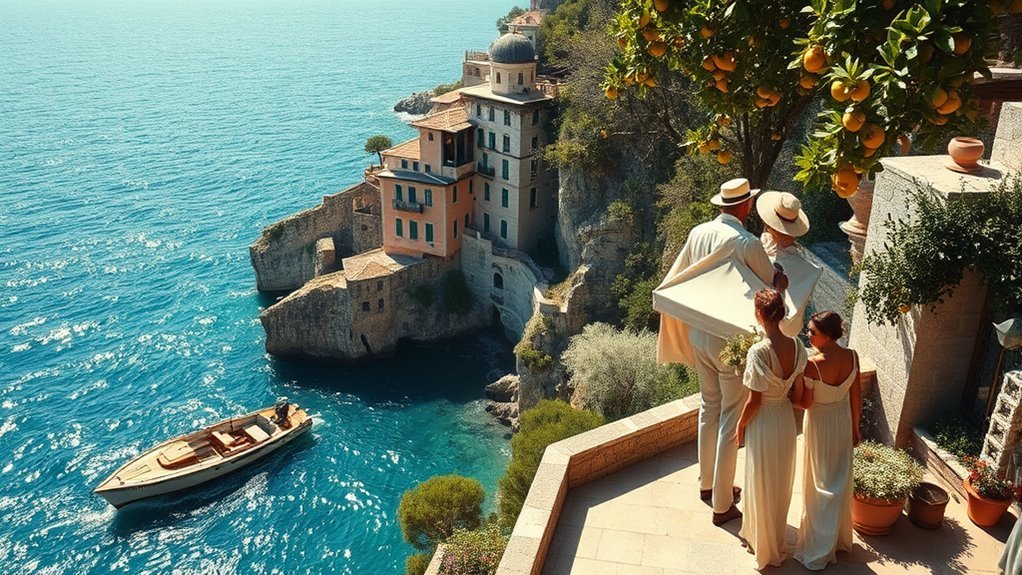
The Talented Mr. Ripley uses Italy’s beauty to create both attraction and unease. The 1999 film moves through coastal and urban locations including Procida, Ischia, Naples, Rome, and Venice. The fictional seaside world around Tom Ripley and Dickie Greenleaf looks relaxed and privileged, but the bright water and elegant streets hide growing jealousy and danger.
The film is sometimes connected with Positano because author Patricia Highsmith drew inspiration from time spent there. However, Positano should not be presented as the main coastal filming location for this adaptation. The production used several other Italian locations to create its fictional geography.
The late-1950s setting also gives the film its polished postwar style. Clothes, hotels, cafés, boats, and music all suggest a world in which wealth seems to offer freedom. Tom’s attempt to enter that world turns the scenery into part of the suspense.
Roman Holiday’s Iconic Rome Landmarks
Roman Holiday remains one of the clearest cinematic tours of Rome. Audrey Hepburn plays Princess Ann, who escapes her official duties and spends a day exploring the city with journalist Joe Bradley, played by Gregory Peck.
The Spanish Steps provide one of the film’s most recognizable meeting places. The Vespa ride passes through busy streets and around landmarks such as the Colosseum and Piazza Venezia. The Mouth of Truth supplies the famous scene in which Joe pretends that the ancient stone has bitten off his hand.
The Trevi Fountain area also appears in the princess’s journey, but not for a coin-toss scene. It is associated with the sequence in which she changes her appearance by having her hair cut. Later, the riverside gathering near Castel Sant’Angelo gives the film one of its liveliest scenes.
Official Lazio tourism information provides a useful route through the film’s Rome locations, including Via Margutta, the Spanish Steps, the Pantheon, the Colosseum, the Mouth of Truth, and Castel Sant’Angelo.
Under the Tuscan Sun’s Dreamy Villa Life
Under the Tuscan Sun follows a recently divorced writer who buys an old property in Tuscany and slowly builds a new life. The film was adapted from Frances Mayes’ memoir, although the screen story changes many details and creates a more conventional romantic plot.
- The damaged villa reflects the main character’s uncertain start and gives her recovery a physical form.
- Cortona’s streets, markets, hills, and nearby countryside make daily life feel open to change.
- Food, work, neighbors, and friendship keep the story connected to community rather than presenting renewal as a private fantasy.
Cortona locations include Piazza della Repubblica and Piazza Signorelli. A fountain seen in the film was added for the production and is not a permanent feature of the square.
The neglected villa shown in the movie was Villa Laura. The real Villa Bramasole associated with Frances Mayes had already been restored, so the production needed a different property to represent the renovation project. This distinction is useful for travelers trying to match the film with the real landscape.
Letters to Juliet in Verona
Letters to Juliet uses Verona’s connection with Shakespeare’s tragic romance as the beginning of a story about delayed love and second chances. Amanda Seyfried plays Sophie, a visitor who discovers an old letter and helps its writer search for a man she loved many years earlier.
The movie combines Verona’s literary tourism with a road trip through Tuscany. It is lighter and more sentimental than many films on this list, but it gives viewers an easy introduction to Juliet’s House, historic streets, rural estates, and the real tradition of sending letters to Juliet.
Verona’s Real Letters-to-Juliet Tradition
People have sent messages addressed to Juliet in Verona for decades. The nonprofit Juliet Club organizes volunteers who read and answer letters from around the world in Juliet’s name.
- The tradition began before the 2010 movie and was not invented for its plot.
- Letters can be sent by post, email, or through designated collection points.
- The film helped introduce the work of Juliet’s secretaries to a larger international audience.
The movie turns this real custom into a romantic mystery. In real life, the work is less dramatic but more personal, with volunteers responding to messages about love, loss, and relationships.
Juliet’s Balcony and the Film’s Verona
Juliet’s House, or Casa di Giulietta, is one of Verona’s most visited literary attractions. Its courtyard and balcony are linked with Shakespeare’s characters through tourism and tradition, not through proof that a historical Juliet lived there.
The film uses the site as a symbol of hope rather than as a history lesson. Verona’s stone streets, courtyards, and medieval buildings support that mood, while the later Tuscan scenes open the story into a wider search for a lost relationship.
Cinema Paradiso’s Sicilian Charm
Cinema Paradiso tells the story of Salvatore, a boy who develops a lifelong love of movies through his friendship with Alfredo, the projectionist at his village cinema. The story is set in the fictional Sicilian town of Giancaldo rather than directly in Bagheria.
Director Giuseppe Tornatore drew on memories of his own Sicilian upbringing, including his connection with Bagheria. Much of the movie, however, was filmed in Palazzo Adriano. Its Piazza Umberto I became one of the production’s central spaces, while Cefalù and other locations supplied additional coastal and town scenes.
- The village square shows how public life, religion, entertainment, and gossip overlap.
- Alfredo’s mentorship gives Salvatore a path beyond the limits of his childhood.
- The cinema becomes a shared space where the community experiences laughter, desire, censorship, and change.
The film’s emotional power comes from the connection between personal memory and a changing community. It is a good choice when you want an Italian movie rather than an international production that simply uses Italy as a backdrop.
Angels & Demons in Rome and Vatican City
Angels & Demons is set around Rome and Vatican City, but viewers should not assume that every sacred interior shown on screen was filmed in the real building. The production was denied permission to film inside the Vatican and in certain Roman churches.
Rome locations, large sets, visual effects, detailed reference photographs, and substitute interiors were combined to create the finished world. Some interior filming took place at the Royal Palace of Caserta, while recreated environments represented spaces such as St. Peter’s Square and the Sistine Chapel.
Vatican Landmarks on Screen
The story uses famous religious and historic sites as clues in Robert Langdon’s search. These include St. Peter’s Square, the Sistine Chapel, the Passetto di Borgo, Castel Sant’Angelo, Santa Maria del Popolo, and Santa Maria della Vittoria.
- St. Peter’s Square gives the story a large public stage.
- Rome’s churches connect the mystery with works by Bernini, Caravaggio, and other major artists.
- Castel Sant’Angelo supplies a fortress-like destination for the final part of the search.
The buildings and artworks are real, but the thriller’s secret history and Illuminati plot are fiction.
The Illuminati Mystery
The plot begins with the theft of an antimatter canister and the kidnapping of four cardinals during a papal conclave. Langdon follows a trail of symbols and artworks while trying to prevent an attack on Vatican City.
The film works best as fast-paced entertainment rather than as a reliable account of church history, science, or the historical Illuminati. Dan Brown’s fictional puzzle combines real locations and art with invented organizations, motives, and events.
How Rome Created the Sacred Backdrop
The production’s methods are part of what makes the movie interesting. Because access to important religious spaces was restricted, the filmmakers rebuilt and digitally extended major environments.
- Real Rome exteriors give the chase a recognizable geographic base.
- Sets and substitute buildings provide controlled interiors.
- Visual effects connect the separate elements into a convincing version of Vatican City.
This makes Angels & Demons a useful example of the difference between a story’s setting and its physical filming location.
The Italian Job’s Venice Heist
The 2003 version of The Italian Job begins in Venice before moving most of its story to the United States. The opening introduces a crew of thieves carrying out a carefully planned robbery, followed by a high-speed escape through the city’s waterways.
| Element | Effect |
|---|---|
| Opening heist | Introduces the crew’s planning and technical skill |
| Narrow canals | Creates a chase that could not happen in an ordinary city |
| Boat escape | Replaces the familiar car chase with fast movement across water |
The production required special permission for high-speed filming on the canals. Venice is therefore more than a decorative opening. Its restricted routes and unusual transport system shape how the robbery and escape can work.
Directed by F. Gary Gray, the film is a remake of the 1969 British movie. The newer version does not spend as much time in Italy as the original title may suggest, but its Venice sequence remains one of its most memorable parts.
A Room with a View in Florence
In A Room with a View, Florence challenges Lucy Honeychurch’s restricted Edwardian upbringing. Her first experiences in the city expose her to beauty, violence, attraction, and social behavior that do not fit the rules she has learned at home.
- Piazza della Signoria and the Loggia dei Lanzi provide the setting for a disturbing public incident that changes Lucy’s relationship with George Emerson.
- Santa Croce brings the characters into direct contact with Florence’s religious art and history.
- The hills around Fiesole give the story room to move beyond formal hotels, guided tours, and social expectations.
The building now operating as Hotel degli Orafi is connected with the pension scenes and the disputed room promised in the title. Florence is not simply presented as a romantic postcard. It interrupts Lucy’s controlled life and forces her to examine what she wants.
The film was adapted from E. M. Forster’s novel and remains an excellent choice for viewers who enjoy period drama, careful performances, and Renaissance settings.
The Great Beauty’s Rome After Dark
The Great Beauty presents a Rome of rooftop parties, private palaces, religious spaces, ancient monuments, and quiet early mornings. Jep Gambardella, an aging writer and social figure, moves through this world while questioning the life he has built.
His terrace faces the Colosseum, placing one of the world’s most famous monuments beside parties that feel both glamorous and empty. Other locations include the Fontana dell’Acqua Paola, Villa Giulia, the Baths of Caracalla, Palazzo Spada, the Aventine Hill, and several historic gardens and residences.
Director Paolo Sorrentino does not treat Rome as a simple collection of attractions. The camera moves between beauty, age, wealth, faith, performance, and loneliness. The result is slower and more demanding than a conventional travel movie, but it offers one of the richest modern portraits of the city.
The film won the Academy Award for best foreign-language film at the 2014 ceremony. It is best for viewers who want visual ambition, social satire, and reflection rather than a straightforward plot.
Call Me by Your Name in Northern Italy
Call Me by Your Name is set during the summer of 1983 and was filmed mainly in Lombardy. Crema and its surrounding countryside provide the quiet streets, villas, fields, rivers, and cycling routes that shape Elio and Oliver’s relationship.
- Crema: Piazza del Duomo and nearby streets give the characters public places to talk, cycle, and spend slow summer afternoons.
- The countryside: Rural roads and natural swimming spots make the relationship feel separate from ordinary schedules.
- Historic buildings: Villas, churches, and town squares connect the personal story with layers of Italian art and family history.
Although the original novel is associated with the Ligurian coast, director Luca Guadagnino moved the film’s setting inland to an area he knew well. That choice gives the movie a quieter and less familiar version of northern Italy.
The performances by Timothée Chalamet and Armie Hammer carry most of the emotional weight, while the warm weather and unhurried locations make each stage of the relationship feel temporary. The film is best for viewers who prefer intimate drama and restrained storytelling.
Frequently Asked Questions
What are the best movies that take place in Italy?
Strong choices include Roman Holiday, Cinema Paradiso, The Talented Mr. Ripley, A Room with a View, The Great Beauty, and Call Me by Your Name. The best option depends on whether you prefer classic romance, crime, nostalgia, art-house drama, or modern romance.
What movies should I watch before visiting Italy?
Watch Roman Holiday before visiting Rome, A Room with a View or Under the Tuscan Sun before Tuscany, Letters to Juliet before Verona, and Cinema Paradiso before Sicily. Treat them as inspiration rather than practical travel guides.
Is Robert De Niro Italian or Sicilian?
Robert De Niro was born in New York and is American. He has Italian ancestry through his father’s family, with documented roots in Ferrazzano in the Molise region. It is therefore more accurate to describe him as Italian-American than as Sicilian.
What is a good Italian movie to watch?
Cinema Paradiso is an accessible place to start. It combines family, friendship, community, memory, and a love of movies. For other Italian classics, consider films by Federico Fellini, Vittorio De Sica, Roberto Rossellini, or Luchino Visconti.
Which movie shows the most famous Rome landmarks?
Roman Holiday is the easiest choice for famous landmarks. Its route includes the Spanish Steps, the Colosseum area, the Mouth of Truth, Via Margutta, and Castel Sant’Angelo. The Great Beauty offers a deeper and less conventional view of Rome.
Were all of Angels & Demons’ Vatican scenes filmed inside Vatican City?
No. The production did not receive permission to film inside the Vatican or certain churches. Sets, visual effects, reference photography, Rome exteriors, and substitute locations such as the Royal Palace of Caserta were used to create many of the apparent Vatican scenes.
Sources
- Visit Venezia: Films Shot and Set in Venice: Filming-location information for The Talented Mr. Ripley and The Italian Job.
- Visit Lazio: Roman Holiday: Rome landmarks and scenes featured in the film.
- Visit Tuscany: Under the Tuscan Sun Locations: Cortona, Villa Laura, Villa Bramasole, and other production details.
- Juliet Club: About the Letters to Juliet: History of the real letter-answering tradition in Verona.
- Visit Sicily: Palazzo Adriano: The Sicilian village used as a principal set for Cinema Paradiso.
- Turismo Roma: Films of the 2000s: Production methods and recreated locations used in Angels & Demons.
Conclusion
These movies show how many different versions of Italy can exist on screen. Roman Holiday turns Rome into a place of temporary freedom, while The Great Beauty examines the same city through age, wealth, and regret. Tuscany supports stories of independence and romance, Sicily holds memory and community, and Venice becomes a setting for both elegance and action.
Start with Roman Holiday for famous landmarks, Cinema Paradiso for an Italian classic, The Talented Mr. Ripley for suspense, or Under the Tuscan Sun for relaxed travel inspiration. Whichever film you choose, pay attention to the streets, buildings, coastlines, and public spaces. In the best movies filmed in Italy, location is part of the story.
