

Last Updated on September 11, 2026 by Daniel Globe
Yes, colder objects usually emit radiation with longer peak wavelengths. As temperature decreases, an object’s thermal energy output drops and its strongest emission moves toward the infrared part of the electromagnetic spectrum. This relationship is described by Wien’s displacement law: hotter objects peak at shorter wavelengths, while cooler objects peak at longer wavelengths.
Quick Answer
When an object gets colder, its peak thermal radiation shifts toward longer wavelengths, usually into infrared. Hotter objects emit shorter wavelengths, which is why very hot materials can glow red, yellow, or blue-white while everyday objects mainly release invisible infrared radiation.
Key Takeaways
- Colder objects peak at longer wavelengths.
- Wien’s Law connects temperature with peak radiation wavelength.
- Most objects around room temperature emit mainly infrared radiation.
- Thermal cameras detect infrared energy that human eyes cannot see.
Disclosure: As an Amazon Associate I earn from qualifying purchases. Some links on this page are affiliate links, at no extra cost to you.
Why Cold Objects Emit Longer Wavelengths
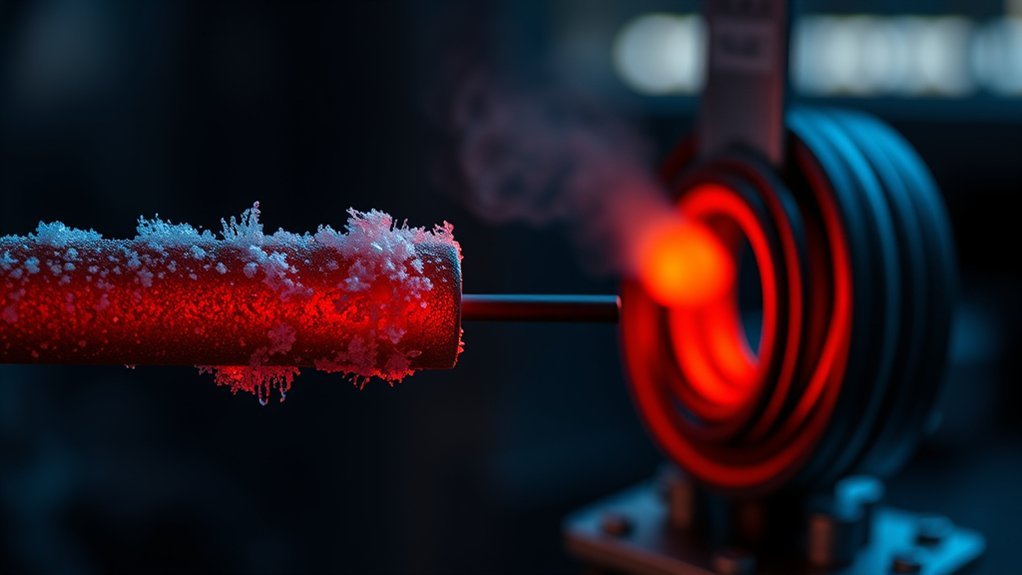
Cold objects emit longer-wavelength radiation because their thermal energy is lower. All objects above absolute zero release thermal radiation, but the wavelength where that radiation is strongest depends on temperature.
A room-temperature object near 300 K mainly emits infrared radiation, while a much hotter object such as the Sun, around 5800 K at its surface, peaks in visible light. As temperature rises, the peak moves toward shorter wavelengths.
What Wien’s Law Means in Plain English
Wien’s displacement law describes the connection between temperature and peak wavelength:
λmax = b / T
This means the peak wavelength decreases as temperature increases. A hotter object has its strongest emission at a shorter wavelength, while a colder object’s strongest emission moves toward longer wavelengths.
The law does not mean an object emits only one wavelength. Instead, every thermal emitter produces a range of wavelengths, with one area of the spectrum being strongest.
How Temperature Changes Light and Color
When an object becomes hot enough to glow visibly, its color changes as its peak emission shifts. Cooler glowing objects often appear red, while extremely hot objects can appear white or blue-white.
Cooling objects shift their strongest thermal emission toward longer wavelengths, often moving from visible light into infrared.
- Cooler objects emit less total thermal energy.
- Hotter objects peak at shorter wavelengths.
- Room-temperature objects mainly emit invisible infrared radiation.
- Very hot stars can produce visible and ultraviolet radiation.
Why Infrared Sits Beyond Visible Light

Infrared radiation sits just beyond the red end of visible light because its wavelengths are longer than those humans can see. Human eyes detect only a small part of the electromagnetic spectrum, while infrared sensors can detect thermal patterns outside visible vision.
| Region | What you notice |
|---|---|
| Visible red light | Longest wavelength humans can normally see |
| Infrared | Invisible radiation often detected as heat |
| Applications | Thermal cameras, astronomy, and temperature sensing |
Pro Tip: Thermal cameras do not see heat itself. They detect infrared radiation patterns and convert them into images showing temperature differences.
Where Temperature-Wavelength Shifts Matter Most
Temperature-wavelength relationships are useful anywhere scientists need to measure heat without direct contact.
- Infrared astronomy helps study cooler stars, planets, and dust clouds.
- Thermal imaging helps identify temperature differences in buildings, machines, and living things.
- Scientists use infrared measurements to study Earth’s atmosphere and surface temperatures.
- Engineers use thermal radiation principles in sensors and heating systems.
Frequently Asked Questions
How Does Temperature Affect Wavelengths?
Temperature affects the peak wavelength of thermal radiation. As an object gets hotter, its strongest emission shifts toward shorter wavelengths. As it cools, the peak shifts toward longer wavelengths.
Do Wavelengths Become Longer or Shorter?
Colder objects generally have longer peak wavelengths, while hotter objects have shorter peak wavelengths according to Wien’s displacement law.
Do Hotter Objects Have Shorter Wavelengths?
Yes. Hotter objects have shorter peak wavelengths because their thermal radiation shifts toward higher-energy parts of the electromagnetic spectrum.
Does Temperature Affect Wave Frequency?
Temperature changes the distribution of emitted radiation, which changes the peak frequency. It does not mean temperature directly changes the frequency of an individual photon after it has been emitted.
Conclusion
When objects get colder, their strongest thermal radiation shifts toward longer wavelengths. This is why cool objects around you mostly emit infrared instead of visible light. Wien’s Law gives scientists a simple way to connect temperature with radiation, helping explain everything from stars to thermal cameras.
Sources
- NASA Electromagnetic Spectrum — explains infrared radiation and the electromagnetic spectrum.
- Encyclopaedia Britannica: Wien’s Displacement Law — explains the temperature and wavelength relationship.
