
Last Updated on July 27, 2026 by Daniel Globe
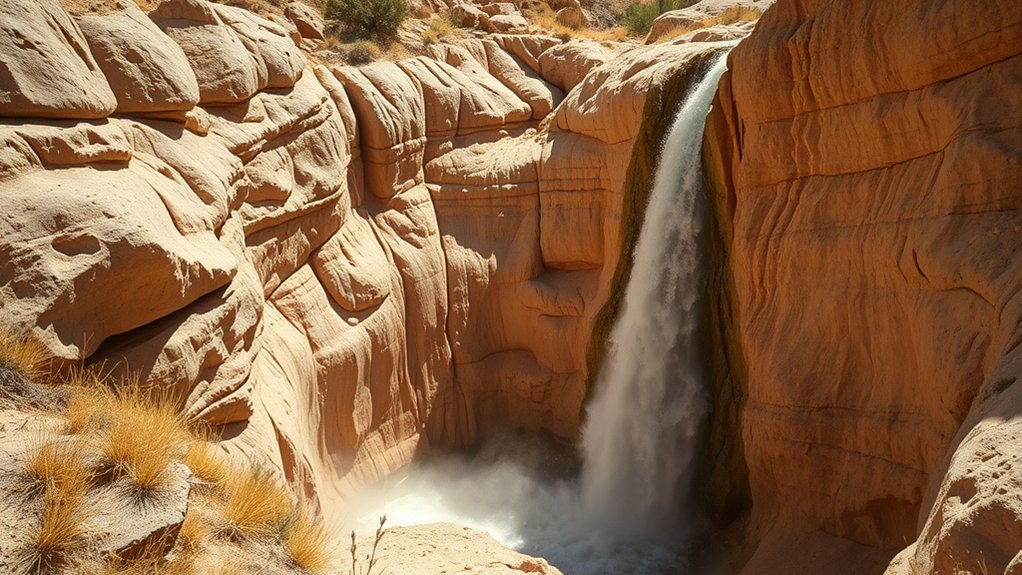
Dry Falls in Grant County, Washington, is a breathtaking Ice Age landmark and one of the most extraordinary geological features in North America. Standing on the precipice today, you look out over a stark, 3.5-mile-wide dry cliff face that once channeled a waterfall five times wider and roughly twice as tall as Niagara Falls. Carved by cataclysmic outburst floods from Glacial Lake Missoula, this ancient cataract complex remains a central highlight of Sun Lakes-Dry Falls State Park and the National Ice Age Floods Geologic Trail.
Quick Answer
Dry Falls is a 3.5-mile-wide, 400-foot-high dry cliff in Grant County, Washington. It marks the site of a colossal Ice Age waterfall carved roughly 15,000–20,000 years ago by catastrophic floods from Glacial Lake Missoula. Today, it serves as the dramatic centerpiece of Sun Lakes-Dry Falls State Park off State Route 17.
Key Takeaways
- At its peak, Dry Falls was five times wider than Niagara Falls with an estimated flow ten times greater than all modern rivers combined.
- Formed by repeated failures of the ice dam impounding Glacial Lake Missoula during the late Pleistocene epoch.
- Geologist J. Harlen Bretz proposed the controversial flood origin in 1923, which was validated decades later by Joseph Pardee’s research.
- The Dry Falls Visitor Center sits directly on the cliff edge, offering wide panoramic views and geologic exhibits.
- Access requires a Washington State Discover Pass for vehicle parking.
At a Glance: Visiting Dry Falls
| Location | Coulee City, Grant County, Washington (Hwy 17) |
| Best Time to Visit | Spring (April–May) & Autumn (September–October) |
| Pass Required | Washington State Discover Pass ($10 daily / $30 annual) |
| Key Activities | Scenic Overlook, Geology Exhibits, Hiking, Camping, Boating, Fishing |
Disclosure: As an Amazon Associate I earn from qualifying purchases. Some links on this page are affiliate links, at no extra cost to you.
What Is Dry Falls?
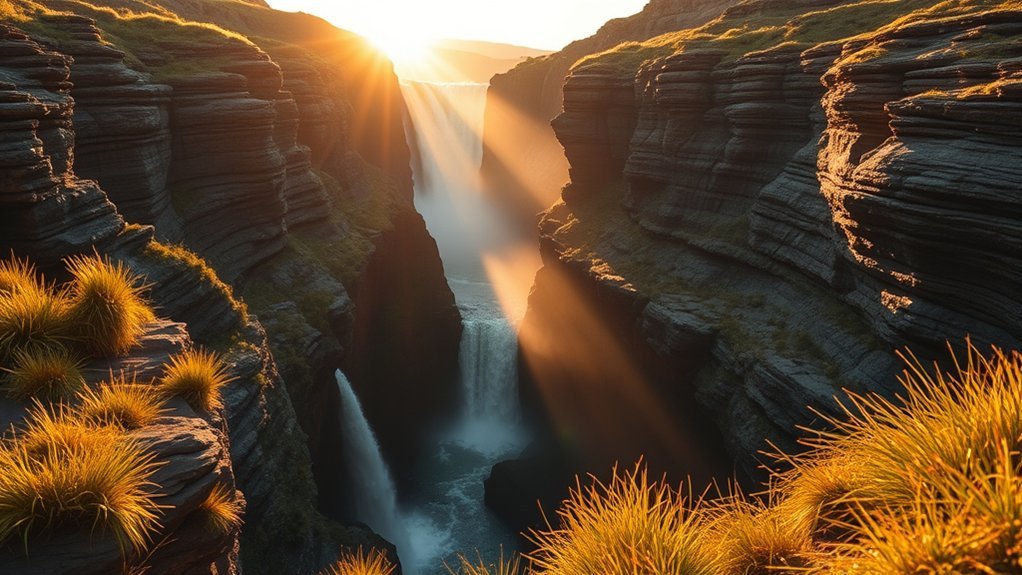
Dry Falls in Grant County, Washington, is a giant remnant of what was once among the largest waterfalls on Earth. Standing here, you’re looking at a landscape shaped by massive Ice Age floods from Glacial Lake Missoula roughly 15,000 to 20,000 years ago. Those floods carved cliffs, plunge pools, and a wide rock face through sheer hydraulic force. Dry Falls also shows headward erosion, where the waterfall’s edge migrated upstream as water cut deeper into the rock. That process reveals its geological significance: it records past climate, flood energy, and the sheer power of moving water to remake terrain. Today you can visit it in Sun Lakes-Dry Falls State Park and read the land like a history book.
Dry Falls Facts: Size, Height, and Scale
One of the most striking things about Dry Falls is just how massive it is. The cliff stretches 3.5 miles (5.63 km) across — about five times wider than Niagara Falls. Its waterfall dimensions also include a 400-foot (121 m) vertical drop, roughly twice the height of Niagara, which creates steep cliffs and deep plunge pools below. That scale helps explain why Dry Falls ranks among the largest waterfalls ever documented on Earth. Its geological significance is hard to miss: the site preserves a massive scar in the landscape and shows how extreme flood forces can reshape terrain in a matter of days or weeks rather than eons. Formed about 15,000 to 20,000 years ago, Dry Falls stands as a striking record of past environmental change and Earth’s capacity for rapid transformation.
How Ice Age Floods Formed Dry Falls
Dry Falls traces back to the cataclysmic Ice Age floods unleashed when ice dams on Glacial Lake Missoula repeatedly broke. Those torrents followed the Missoula Flood path at incredible speed, blasting over the edge and eroding the rock below. Over time, that relentless water carved the cliffs, plunge pools, and broad landscape visible today.
Catastrophic Ice Age Floods
Around 15,000 to 20,000 years ago, catastrophic Ice Age floods transformed this region when ice dams holding back Glacial Lake Missoula failed and released enormous torrents of water. The scale at Dry Falls is staggering: at its peak, the waterfall was roughly five times wider than Niagara Falls and carried about ten times the flow of all current rivers on Earth combined. When ice sheets blocked the Columbia River, overflow from Glacial Lake Missoula and Glacial Lake Columbia carved the cliffs and helped create Grand Coulee. These floods illustrate powerful headward erosion and the geological significance of sudden, catastrophic events in shaping landscapes over short timescales.
Missoula Flood Path
As the ice dams holding Glacial Lake Missoula repeatedly failed, huge floodwaters surged west at speeds up to 65 miles per hour and blasted through the Columbia Basin. This Missoula Flood path cut across the flood geography that once channeled water into a powerful route. Carrying an estimated ten times more water than all modern rivers combined, the floods reshaped the land fast. Water rushed through the Grand Coulee, forced the Columbia River into a new channel, and carved the cliffs now visible at Dry Falls — a 3.5-mile-wide ledge dropping 400 feet, plus coulees and plunge pools nearby.
Erosion Carved Dry Falls
The same Missoula Flood waters that blasted through the Columbia Basin also carved Dry Falls, stripping away rock with enough force to leave a 3.5-mile-wide cliff and a 400-foot plunge into basalt below. Torrents moving up to 65 miles per hour, with a flow roughly ten times greater than all current rivers combined, shaped the Grand Coulee and left bold geological formations.
- Massive plunge pools formed where water slammed down.
- Cliffs expose layers of basalt still visible today.
- The basin shows how fast Ice Age floods can reshape land.
- Interpretive trails help visitors read this dramatic landscape.
J Harlen Bretz and the Flood Theory
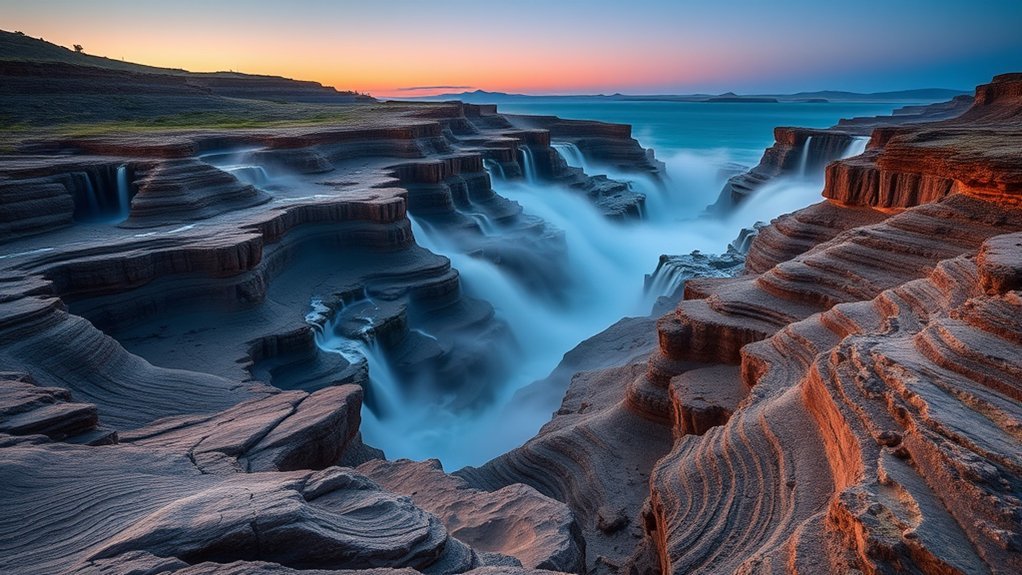
Geologist J. Harlen Bretz changed how scientists understand Dry Falls. In the 1920s, he studied the Grand Coulee landscape and found clues that didn’t fit slow, steady erosion. In 1923, he published a paper arguing that a huge glacial flood, not a river, had carved the basin — writing that the region’s features “cannot be interpreted in terms of ordinary river action.” That claim sparked lasting geological controversy: established geologists dismissed his thesis as an “outrageous hypothesis,” and Bretz was invited to defend it before the Geological Society in Washington, D.C. in 1927.
Note: The main sticking point for critics was that Bretz couldn’t point to a source of water large enough to explain the flooding.
That changed in 1940, when Joseph Pardee, a geologist studying Montana, presented findings confirming that Glacial Lake Missoula really had unleashed enormous floods, moving giant boulders and reshaping the land at speeds reaching 65 miles per hour. Bretz’s theory was eventually vindicated, and Dry Falls today stands as proof that catastrophic events can transform terrain in a geological instant. His work reshaped how geologists understand the power of sudden flood events in Earth’s history.
Sun Lakes-Dry Falls State Park History
The park’s story starts with its earlier Indigenous presence, then moves toward state park status in the 1920s and 1930s, expansion in the 1940s, and the opening of an interpretive center in 1966 that still anchors the visitor experience today.
Indigenous Origins
Long before Sun Lakes-Dry Falls State Park became a public destination, this landscape was part of the traditional territories of Sahaptian and Inland Salish peoples, including the Confederated Tribes of the Colville Reservation and the Yakama Nation.
- Root-gathering areas supported biscuitroot and bitterroot harvests.
- Traditional practices shaped seasonal movement and stewardship of the shrub-steppe.
- The 1855 Yakima Treaty of Camp Stevens ceded these lands under duress.
- Interpretive programs today aim to present this history with care and accuracy.
Visiting the park means walking through a place shaped by survival, knowledge, and resilience — not just scenery.
Park Expansion
State purchases to create the park ran from 1933 through 1972, assembled from parcels bought from the Bureau of Land Management, the Department of Natural Resources, and private landowners. In 1938, the Civilian Conservation Corps built rock walls and a lookout point at Dry Falls known as Vista House, along with a residence and water pump house. In 1945, Vic Meyers, then Washington’s lieutenant governor, joined the State Parks Committee and pushed to expand the park; more than 800 acres of private land — including former homestead property — were acquired in 1946. Further land withdrawals in 1949 tied the site together with Umatilla Rock and Deep Lake under the new name Sun Lakes State Park. Additional facilities followed over the following decades, including a group retreat center (1956) and resort buildings (1959), building toward the golf course, marina, and camping amenities visitors find today.
Interpretive Center
The Dry Falls Interpretive Center, built in 1965 and dedicated on May 15, 1966, gives visitors a clear look at the forces that shaped this dramatic landscape. Its glass curtain wall, designed by Kenneth W. Brooks, opens onto panoramic views of the cliffs and coulees. The center explains how Ice Age floods from Glacial Lake Missoula carved Dry Falls, and it credits J. Harlen Bretz, whose once-derided theory ultimately transformed the field of geology.
- Admission to the center is free
- A Discover Pass covers parking
- Exhibits cover both geology and human history
- Seasonal interpretive programs and ranger talks are offered
Best Dry Falls Views and Visitor Tips
For the best view of Dry Falls, head to the Dry Falls Interpretive Center, which overlooks the full 3.5-mile-wide cliff face. If you’re into scenic photography, aim for sunrise or sunset, when low light deepens shadows and brings out the rock’s texture. The visitor center’s exhibits also explain the geology behind the falls, so you’re not just looking — you’re learning how the landscape was shaped. Access is via Route 17 near Coulee City, and parking requires a Discover Pass. Don’t miss the large plunge pools at the base, which hint at the force that once carved this place. Bring water, wear sturdy shoes, and set aside enough time to take it all in.
Pro Tip: Visit early in the morning during mid-spring. Summer temps in the high-desert shrub-steppe frequently exceed 90°F (32°C), making morning hikes significantly more comfortable.
Things to Do Near Dry Falls
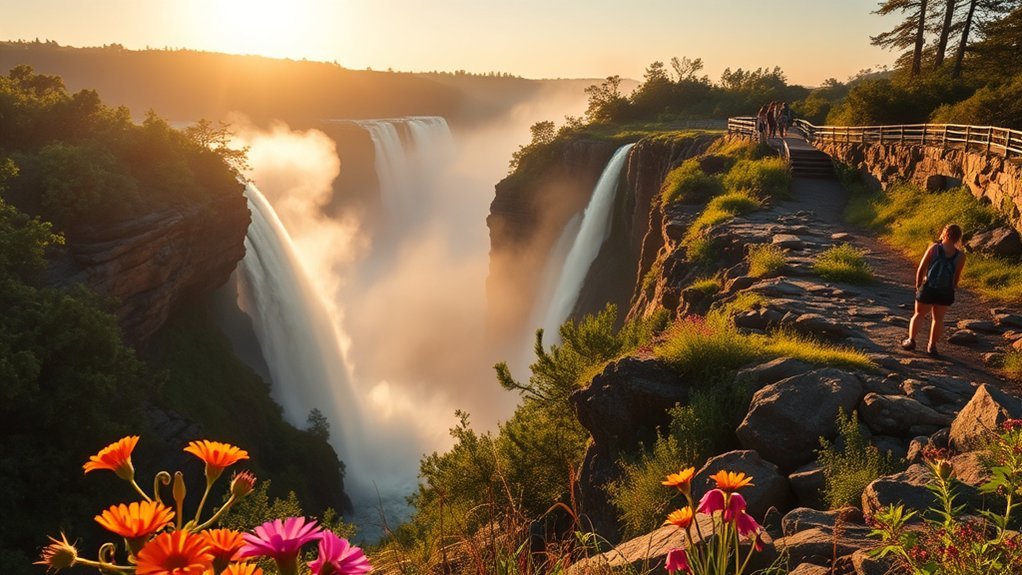
If you want to make a day of it, Dry Falls has plenty nearby to keep you busy. Cast a line at Dry Falls Lake, a popular fishing spot for fly fishing, with boat access to reach better water. For a cooler break, Deep Lake offers swimming and water access. For a steady walk, the Umatilla Rock trail is a roughly 5-mile round-trip route with wide views and easy footing. Sun Lakes State Park adds more options: swimming, mini-golf, and a marina for docking. Nearby campgrounds offer both standard and full-hookup sites for longer stays.
- Dry Falls Lake: fishing spots and boat access
- Deep Lake: swimming and water recreation
- Umatilla Rock trail: one of the best hikes nearby
- Sun Lakes State Park: marina, mini-golf, and swimming area
Warning: Deep Lake and surrounding plunge pools feature submerged basalt ledges and variable depths. Always use caution when swimming, avoid jumping from unmonitored cliffs, and watch out for rattlesnakes on exposed rock trails during warm weather.
At its peak, the ancient waterfall at Dry Falls carried an estimated ten times the flow of every river on Earth combined.
Frequently Asked Questions
What are some interesting facts about Dry Falls, Washington?
Dry Falls is 3.5 miles wide and 400 feet high, carved by Ice Age floods roughly 15,000 to 20,000 years ago. Visitors can explore its geological history, see plunge pools, and take in exhibits at the Dry Falls Interpretive Center.
What are 5 fun facts about Washington State?
Washington is home to Mount Rainier, the tallest peak in the contiguous U.S.; it operates one of the largest ferry systems in the country; it grows a large share of America’s apples; it has a strong coffee culture centered in Seattle; and the Olympic Peninsula holds some of the most diverse ecosystems in the country, from rainforest to alpine terrain.
What is Dry Falls known for?
Dry Falls is known for being the remnant of one of the largest waterfalls ever documented, with dramatic basalt cliffs and major geological significance. It’s a powerful record of Ice Age flooding rather than a current water source, and its carved basin can be explored today at Sun Lakes-Dry Falls State Park.
When did Dry Falls have water?
Dry Falls carried water during the Missoula Floods, roughly 15,000 to 20,000 years ago. Water flowed here repeatedly as ice dams on Glacial Lake Missoula failed, until the flooding ended and the falls dried out for good.
Conclusion
Dry Falls packs a remarkable amount of history, geology, and scenery into one stop. Standing at a cliff this massive, it’s easy to imagine the torrent that once thundered over it, and the Ice Age floods that carved this giant amphitheater. From sweeping overlooks to nearby trails, there’s plenty to see and do. For a destination that’s dramatic, surprising, and genuinely unforgettable, Dry Falls belongs on the list.
Sources
- National Park Service — Sun Lakes-Dry Falls State Park — site overview, Niagara comparison, and Ice Age Floods Trail designation
- Washington State Parks — Sun Lakes-Dry Falls State Park History — Bretz, Pardee, Vic Meyers, and interpretive center timeline
- Washington State Parks — Dry Falls geologic significance — waterfall dimensions and flood history
- Dry Falls (Wikipedia) — measurements and flood-speed data
- Sun Lakes-Dry Falls State Park (Wikipedia) — park construction and expansion history

