
Last Updated on September 11, 2026 by Daniel Globe
Hiking shoes should hold your heel and midfoot securely without squeezing your foot. The right pair gives your toes room to spread, stays in place on climbs and descents, and feels comfortable from the start. The checks below will help you compare sizes, widths, shoe shapes, socks, insoles, and lacing before you take a new pair onto the trail.
Quick Answer
Hiking shoes should feel snug through the heel and midfoot, but never tight. Leave about 3/8 to 1/2 inch—roughly a finger or thumb width—beyond your longest toe. Your heel should not slide, your toes should wiggle, and you should feel no pinching, numbness, rubbing, or downhill toe impact.
Key Takeaways
- Choose a secure heel and midfoot fit with enough space to wiggle and spread your toes.
- Fit the larger foot and wear the socks, insoles, or orthotics you plan to use while hiking.
- Test the shoes on flat ground, uphill, and downhill before buying them.
- Do not rely on break-in, thick socks, or tight lacing to correct the wrong length, width, or shoe shape.
- Choose low-, mid-, or high-cut footwear for terrain, protection, and load needs—not because collar height guarantees protection from ankle sprains.
At a Glance
| Time Required | About 20–30 minutes to compare and walk in several pairs |
| Difficulty | Easy, but careful comparison is important |
| Tools Needed | Hiking socks, planned insoles or orthotics, and an incline or fitting ramp when available |
| Cost | No cost to assess fit; footwear and optional insole prices vary |
Disclosure: As an Amazon Associate I earn from qualifying purchases. Some links on this page are affiliate links, at no extra cost to you.
How Should Hiking Shoes Fit?
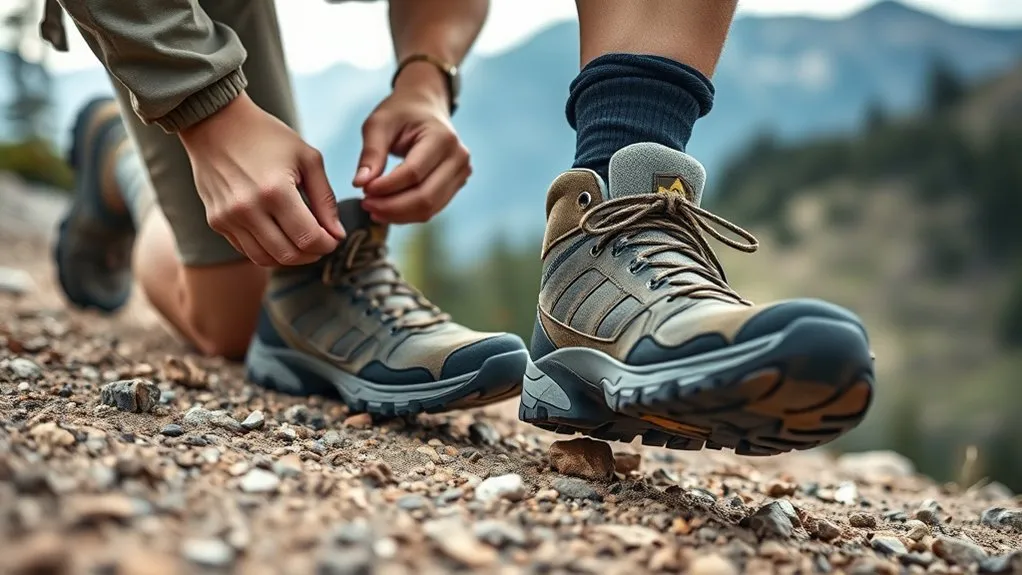
Hiking shoes should fit snugly through the heel and midfoot while leaving space around the toes. The American Orthopaedic Foot & Ankle Society’s FootCareMD guidance recommends about 3/8 to 1/2 inch between your longest toe and the end of a shoe. REI describes the ideal hiking fit as snug everywhere but tight nowhere, with room to wiggle your toes.
A good hiking fit holds your heel and midfoot in place while leaving roughly 3/8 to 1/2 inch beyond your longest toe.
Use these checks to judge the fit:
- Toe length: Your longest toe should not touch the front while standing or walking downhill.
- Toe-box width: Your toes should lie flat and spread naturally without rubbing the sides or top.
- Heel hold: Your heel should stay seated instead of lifting or rubbing with each step.
- Midfoot hold: The shoe should feel secure without lace pressure, tingling, or numbness.
- Flex point: The shoe should bend near the ball of your foot rather than pressing into your arch.
- Overall comfort: There should be no hot spots, pinching seams, or hard pressure points.
Pro Tip: Remove the insole and stand on it while wearing your hiking socks. You should see space beyond your longest toe, and the widest part of your foot should not spill over the insole’s edges. This quick check can reveal a length or width problem before you start walking.
Loose vs. Tight Hiking Shoes
Loose hiking shoes allow your foot to slide. That movement increases friction, makes your heel rub, and can drive your toes into the front of the shoe on descents. A loose shoe may also feel less controlled on roots, rocks, and side slopes.
Tight hiking shoes create a different set of problems. They can crowd your toes, press on the top or sides of your foot, and cause pain, tingling, or numbness. Tightness often becomes more noticeable after your feet warm up and swell during a hike.
Warning: Do not expect pain, numbness, toe impact, or severe heel rubbing to disappear during break-in. Those signs usually point to the wrong size, width, volume, or shoe shape. Stop wearing footwear that causes persistent numbness or sharp pain.
- A loose fit causes sliding, friction, and heel movement.
- A tight fit causes pressure, crowding, and possible numbness.
- A correct fit holds the heel without squeezing the forefoot.
- Your longest toe should have about 3/8 to 1/2 inch of clearance.
- Your toes should move freely without the whole foot sliding.
Find the Right Fit for Your Foot Shape
Shoe size is only a starting point. Hiking footwear also varies in width, toe-box shape, heel shape, arch length, and interior volume. A size 10 in one brand can fit differently from a size 10 in another, so choose the pair that fits rather than relying on the number printed on the box.
Check Length, Width, and Volume Separately
Length determines the space beyond your longest toe. Width determines whether the ball of your foot and toes sit comfortably across the shoe. Volume describes how much interior space surrounds the top and sides of your foot.
If the length feels correct but the sides pinch, try a wider width or a shoe built on a wider last. Do not automatically buy a longer size just to gain width; the extra length can allow your foot to slide forward. If the shoe feels roomy over the top of your foot even when properly laced, try a lower-volume model instead.
Note: Most people have one foot that is slightly larger than the other. Measure both feet while standing and fit the larger foot. You can fine-tune the smaller side with lacing when necessary.
Wide and Narrow Feet
If you have wide feet, look for a true wide size and a toe box that follows your foot’s shape. Your little toe and the ball of your foot should not push over the edge of the sole. If your feet are narrow or low-volume, look for a slimmer last and a heel cup that holds your foot without requiring painful lace tension.
Arches, Insoles, and Orthotics
High or flat arches do not automatically mean you need a strong insert. FootCareMD advises that symptom-free, symmetrical flat feet or high arches do not necessarily need support devices. Choose the level of support that feels comfortable and stable for you, and seek professional guidance when you have recurring pain or a diagnosed foot condition.
If you already use an orthotic, bring it to the fitting. An insert occupies space and may change the required width, depth, or volume. Remove the factory insole when the shoe is designed for a replacement footbed; do not stack thick inserts unless the footwear or medical provider specifically allows it.
Try On Hiking Shoes the Right Way
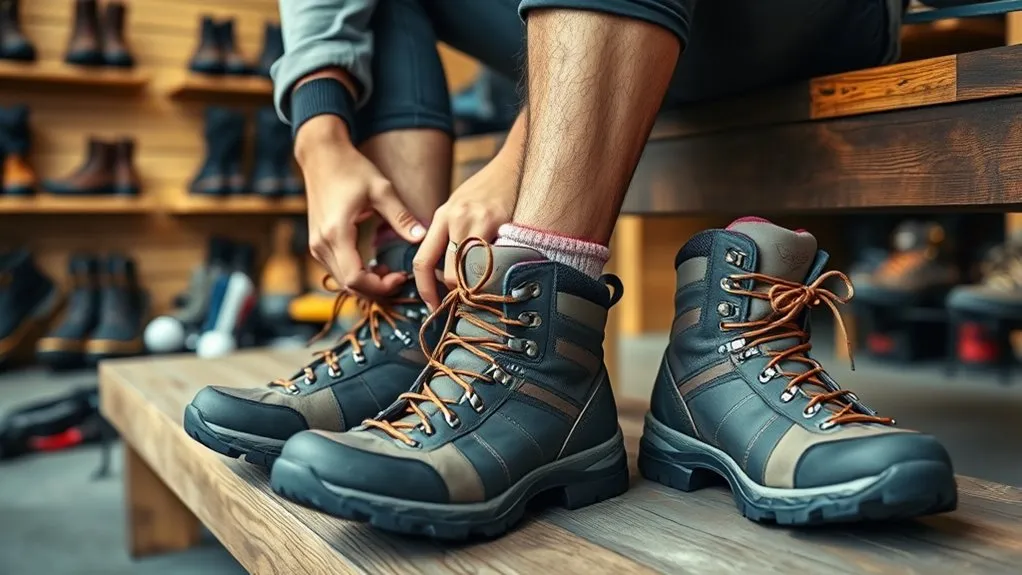
Set aside enough time to walk in several sizes, widths, or models. A shoe can feel comfortable while you are sitting but fail once your full body weight is on it. Use the following process to test the fit under more realistic conditions.
Best Time to Try Hiking Shoes
Try hiking shoes later in the day or after you have been active. Feet commonly become larger during daily activity, so a late-day fitting lowers the chance of choosing a pair that becomes too tight on the trail. This advice is included in both REI’s hiking-footwear fitting guide and FootCareMD’s shoe-fitting recommendations.
Wear Your Hiking Socks and Insoles
Wear the same sock thickness and material you plan to use while hiking. A padded sock takes up more space than a lightweight sock, while a liner-and-outer-sock system changes the shoe’s volume and heel hold. Do not choose an oversized shoe and plan to repair the fit with thicker socks later.
Bring any aftermarket insoles or prescribed orthotics. After placing them in the shoe, repeat every fit check because the insert may lift your heel, reduce toe-box depth, or change where the shoe contacts your arch.
Test-Walk the Shoes Step by Step
- Measure both feet while standing. Start with the size needed for the larger foot.
- Put on your hiking socks and planned footbeds. Fully loosen the laces before inserting your foot.
- Seat your heel. Tap the heel lightly against the floor and lace the shoe evenly without overtightening it.
- Check toe clearance. Confirm that your longest toe has about 3/8 to 1/2 inch of space.
- Walk on flat ground. Notice heel movement, rubbing, arch pressure, and how the shoe bends.
- Walk uphill. Your heel should remain seated without painful pressure across the instep.
- Walk downhill. Your toes should not strike the front, and your foot should not slide forward.
- Stay in the shoes for several minutes. Reject a pair if pressure, numbness, rubbing, or hot spots develop.
If one size is too short and the next size is too loose, try a different width or model. Footwear brands use different lasts, so another shoe may match your foot shape better even when its labeled size is the same.
Fix Heel Slip and Toe Jamming
Heel slip and toe jamming can sometimes be improved with lacing, but only when the shoe is already close to the correct fit. Lacing cannot repair a shoe that is too long, too short, too wide, or the wrong shape.
| Problem | Likely Cause | What to Try |
|---|---|---|
| Heel lifts slightly | Extra volume around the heel or instep | Use a heel-lock or surgeon’s-knot lacing method and retest on an incline. |
| Heel continues to slide | Shoe is too long, wide, or high-volume | Try a smaller, narrower, or lower-volume model. |
| Toes hit the front downhill | Insufficient length or foot sliding forward | Retest length, secure the heel, and compare a longer or better-shaped model. |
| Pressure on top of foot | Laces are tight or shoe volume is too low | Try window lacing. Change models if pressure remains. |
| Toes feel crowded | Toe box is too narrow, shallow, or short | Choose a wider or more foot-shaped toe box rather than relying on stretching. |
REI’s hiking-boot lacing guide recommends a surgeon’s knot for excess heel movement and window lacing for pressure on top of the foot. It also warns that lacing techniques are not a substitute for buying the correct fit.
Do Hiking Shoes Need to Be Broken In?
Flexible trail shoes and light hiking shoes may require little or no break-in. Stiffer leather boots, backpacking boots, and mountaineering footwear usually benefit from gradual wear before a long trip.
Begin indoors, then take short neighborhood walks. Progress to short trails and add your normal pack only after the footwear remains comfortable. Watch for rubbing at the heel, pressure around the toes, and pain along the arch or instep.
Break-in can soften materials and help you learn the best lacing tension. It cannot make a short shoe longer, create a wider toe box, change a poorly placed flex point, or correct a heel cup that does not match your foot.
Choose the Best Hiking Shoe Style
Match the footwear to the terrain, weather, pack weight, and protection you need. Collar height is only one feature. Sole stiffness, traction, cushioning, fit, upper material, and underfoot protection can matter just as much.
Low-Cut Trail Shoes
Low-cut trail shoes work well for maintained trails, day hikes, warmer weather, and lighter loads. They are often flexible, breathable, and quick to dry. Their lower collar allows free ankle movement, but it also provides less protection from debris, mud, and brush.
- Choose a sole with traction suited to your trail surface.
- Confirm that the heel remains secure without a high collar.
- Leave 3/8 to 1/2 inch beyond the longest toe.
- Check that the shoe bends near the ball of your foot.
- Use the intended hiking socks during the fitting.
Mid-Cut Ankle Support
Mid-cut footwear covers the ankle and may feel more secure on rough ground. The collar can keep out some dirt and small trail debris while offering more structure than a low-cut shoe. However, collar height alone should not be treated as guaranteed protection from ankle sprains.
| Feature | Practical Benefit | Best Use |
|---|---|---|
| Mid-cut collar | More coverage and a secure feel | Uneven or debris-covered trails |
| Secure heel and midfoot | Reduces unwanted movement inside the shoe | Day hikes and moderate backpacking |
| Moderately structured sole | More underfoot protection than many light shoes | Rocky or root-covered routes |
High-Cut Backpacking Boots
High-cut backpacking boots often combine a taller collar with a stiffer sole and more protective upper. They can be useful for rugged terrain, cold or wet conditions, and heavier loads. Their structure may feel supportive, but they are also heavier, warmer, and less flexible than most trail shoes.
- Choose sole stiffness that matches the terrain and pack weight.
- Use waterproof footwear when wet conditions justify the reduced breathability.
- Select insulation for cold environments rather than ordinary warm-weather hiking.
- Fit the boots with the socks you will actually wear.
- Make sure the heel stays secure while the toes remain free to move.
Do not choose a high-cut boot solely because you expect it to prevent an ankle sprain. A randomized footwear study found no significant sprain-rate difference between conventional high- and low-top shoes. Fit, traction, conditioning, previous injuries, terrain, and balance also affect stability.
When to Get Professional Fitting or Medical Help
Consider a professional footwear fitting if you cannot find a shoe that holds your heel without crowding your toes, if your two feet differ greatly in size, or if orthotics make most footwear uncomfortable.
Speak with a qualified medical professional when hiking repeatedly causes numbness, burning, weakness, persistent joint pain, severe arch pain, or recurring ankle instability. Those symptoms may require more than a different shoe or insole.
Frequently Asked Questions
Should hiking shoes be tight or looser?
They should be snug rather than tight or loose. Your heel and midfoot should stay secure, but your toes should have room to wiggle and about 3/8 to 1/2 inch of clearance beyond the longest toe.
What is the 3 shoe rule?
There is no recognized hiking-shoe fitting standard called the 3 shoe rule. The phrase is more commonly used for packing three types of footwear for travel. When fitting hiking shoes, it is still sensible to compare several sizes, widths, or models, but that is a shopping method rather than a formal rule.
Do I need hiking shoes for the Galápagos?
Sturdy walking shoes or lightweight hiking shoes with good tread are strongly recommended for rocky and uneven island trails. Waterproofing is optional and depends on the itinerary. Many trips also call for waterproof sandals or water shoes for beaches and wet landings, as explained in Celebrity’s Galápagos packing guidance.
Is it better to have loose shoes or tight shoes?
Neither. Loose shoes create sliding and friction, while tight shoes create pressure and crowd the toes. The correct fit holds the heel and midfoot comfortably without stopping your toes from moving.
Should hiking shoes be a half size larger?
Not automatically. Some hikers need a larger labeled size to gain enough toe clearance, but sizing varies by brand and model. Judge the actual fit: 3/8 to 1/2 inch beyond the longest toe, no downhill impact, and no excessive heel movement.
Should new hiking shoes feel tight at first?
No. Stiff boots may soften during break-in, but new footwear should not pinch, cause numbness, crowd your toes, or rub your heel severely. Break-in cannot correct the wrong length, width, volume, or toe-box shape.
Conclusion
Hiking shoes should feel secure without feeling restrictive. Aim for a stable heel, a comfortably held midfoot, 3/8 to 1/2 inch of space beyond your longest toe, and enough width for your toes to lie flat. Test both shoes with your hiking socks on flat ground and inclines. If a pair pinches, slips, or jams your toes, compare another size, width, or model rather than expecting the problem to disappear on the trail.
Sources
- REI: How to Choose Hiking Boots and Hiking Shoes — hiking-footwear fit, sock, orthotic, toe-room, and break-in guidance
- FootCareMD: 10 Points of Proper Shoe Fit — guidance from foot and ankle orthopaedic surgeons on toe space, heel slip, width, and fitting time
- FootCareMD: Five Things You Need to Question — evidence-based caution against unnecessary inserts for symptom-free flat feet or high arches
- REI: How to Lace Hiking Boots — surgeon’s-knot, window-lacing, and toe-relief techniques
- PubMed: High- Versus Low-Top Shoes for Ankle-Sprain Prevention — randomized evidence regarding shoe height and ankle-sprain rates
- Celebrity Cruises: Galápagos Know Before You Go — footwear recommendations for rocky trails, beaches, and wet landings

