
Last Updated on September 10, 2026 by Daniel Globe
Inflatable travel pillows often seem to lose air during airplane flights, leaving travelers wondering why their neck support suddenly softens mid-journey. While it may feel like your pillow is leaking, the primary cause is actually the change in aircraft cabin air pressure combined with temperature drops at high altitudes. Understanding how atmospheric changes affect sealed air bladders allows you to adjust your pillow correctly and maintain comfortable support throughout your flight.
Quick Answer
Yes, inflatable travel pillows frequently feel deflated during flights. As an airplane ascends, cabin pressure drops, causing air inside a fully inflated pillow to expand and escape through valve seals. Later, cold cabin air contracts the remaining gas, and increased cabin pressure during descent compresses it further, causing noticeable softening.
Key Takeaways
- The 70–80% Rule: Only inflate your travel pillow to about 75% capacity at ground level to leave room for altitude expansion.
- Temperature Drops: Chilly cabin air conditioning contracts the air inside your pillow, reducing internal pressure ($PV=nRT$).
- Descent Effects: Increasing atmospheric pressure as the plane lands compresses remaining air, making the pillow feel limp upon arrival.
- Material Choice: Thermoplastic Polyurethane (TPU) pillows with dual-seal valves resist air leakage far better than cheap PVC options.
At a Glance
| Time Required | 2 minutes (before takeoff & at cruise) |
| Difficulty | Easy |
| Tools Needed | Inflatable pillow with multi-stage valve |
| Key Concept | Boyle’s Law & Cabin Altitude Pressurization |
Disclosure: As an Amazon Associate I earn from qualifying purchases. Some links on this page are affiliate links, at no extra cost to you.
Do Inflatable Travel Pillows Deflate During a Flight?
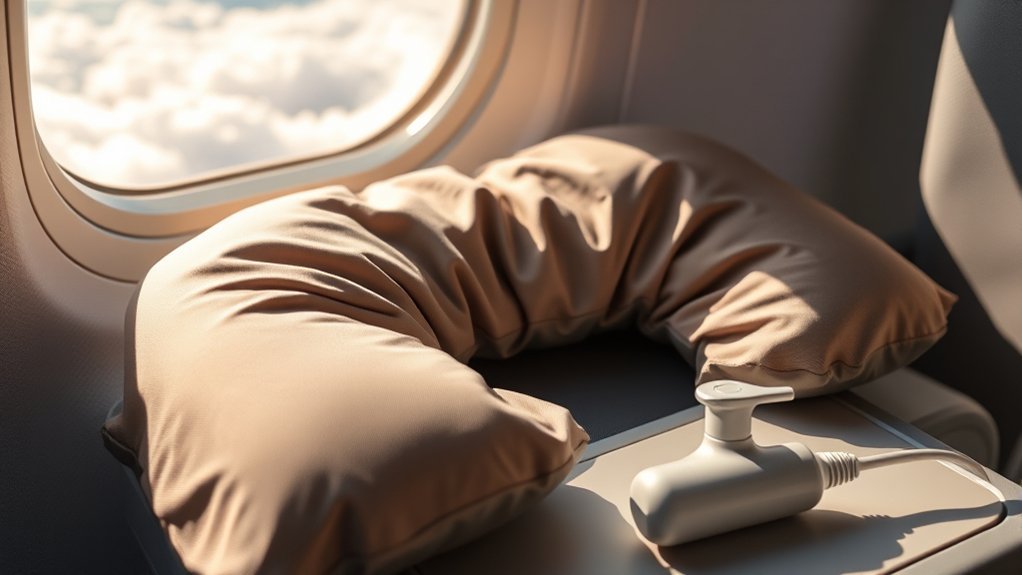
It is very common for inflatable travel pillows to feel softer or lose pressure during a flight. However, this loss of firmness is rarely caused by structural defects alone. Instead, it is the result of atmospheric physics inside pressurized aircraft cabins. Modern commercial airliners maintain cabin pressure equivalent to an elevation of 6,000 to 8,000 feet above sea level, as mandated by the Federal Aviation Administration (FAA).
Because the air surrounding your pillow changes pressure during ascent and descent, the relative pressure inside the pillow fluctuates continuously. Understanding how these environmental changes work enables you to take quick steps to maintain ideal neck support throughout your journey.
Why Do Inflatable Travel Pillows Deflate? The Physics Explained
To understand why air pillows lose firmness, it helps to look at the three main factors operating inside an airplane cabin:
According to Boyle’s Law ($P_1 V_1 = P_2 V_2$), when external pressure decreases, trapped gas expands. At cruising altitude, cabin pressure drops by approximately 25%, causing air inside a sealed pillow to expand significantly.
- Pressure Differentials & Valve Seepage: If you fully inflate your pillow at sea level before takeoff, the air inside expands as the plane climbs to cruising altitude. This high internal pressure forces air out through the microscopic seals of standard valves or triggers built-in safety release valves.
- Temperature Drops (Charles’s Law): Aircraft cabins are typically kept cool, often around 18°C–20°C (64°F–68°F). Cold air causes gas molecules to contract. As the air inside your pillow cools down mid-flight, its volume shrinks, leading to a softer feel.
- Descent Compression: When the aircraft descends for landing, cabin pressure increases back to ground-level standards. This rising ambient pressure compresses whatever air remains inside the pillow, leaving it noticeably deflated upon landing.
Warning: Never inflate your travel pillow to 100% capacity on the ground before takeoff. Over-inflation at sea level can strain plastic seams and permanently damage internal air bladders as cabin pressure drops during ascent.
How to Prevent Your Travel Pillow From Deflating
Preventing your pillow from losing support requires a few strategic adjustments before and during your flight:
1. Master Proper Inflation Techniques
The single most effective preventive step is partial inflation before takeoff. Inflate your pillow to only 70% to 80% capacity while on the ground. This deliberate under-inflation leaves ample room for the air to expand naturally as the aircraft reaches cruising altitude, preventing excessive pressure on the valve seals.
2. Monitor and Adjust Air Pressure at Cruising Altitude
Once the seatbelt sign turns off at cruising altitude, test your pillow’s firmness. If it feels too stiff from air expansion, bleed off a small amount of air using the micro-adjust button on your valve. If cold cabin temperatures have softened it, add one or two breaths to restore your preferred level of neck support.
Pro Tip: Look for travel pillows constructed with Thermoplastic Polyurethane (TPU) rather than Polyvinyl Chloride (PVC). TPU materials remain flexible at cold cabin temperatures and hold air seals much more effectively under pressure shifts.
Key Features of a Quality Travel Pillow
When selecting an inflatable travel pillow designed to handle cabin pressure fluctuations, prioritize these engineering features:
Ergonomic Design & Cervical Support
A high-quality pillow should feature an ergonomic shape—such as a raised rear neck contour or chin support flaps—that keeps your head aligned in a neutral position. Proper alignment reduces the need for maximum inflation pressure, keeping you comfortable even if minor air volume changes occur.
Dual-Sealed Adjustable Valves
Inexpensive press-fit valves easily pop open under pressure. Modern travel pillows incorporate multi-stage, quick-deflate valves with one-way silicone seals. According to specifications from aviation gear engineers, dual-seal valves prevent micro-seepage even when internal pressure rises during climb.
The Importance of Testing Your Pillow Before Travel
Before packing for a long-haul trip, conduct a home inflation test to ensure your pillow does not have manufacturing defects or micro-punctures:
- Inflate the pillow fully at home and seal the valve tightly.
- Place a light weight (such as a heavy book) on top of the pillow.
- Leave it overnight for 8 to 12 hours.
- If the pillow loses significant firmness overnight at constant room temperature, it has a slow valve leak or seam puncture that requires repair or replacement.
How to Store Your Pillow Properly During Flights
Proper storage during flight protects your pillow’s valves from dust, lint, and accidental puncture. When not in use, fully open the quick-release valve, roll the pillow smoothly from the end opposite the valve to expel all air, and store it in its dedicated breathable travel pouch. Avoid jamming an inflated pillow into overcrowded overhead bins, where sharp luggage zippers can cause micro-tears.
Other Comfortable Travel Pillow Options
If managing air pressure adjustments feels inconvenient, consider non-inflatable alternatives that offer stable neck support without pressure concerns:
- Compressible Memory Foam Pillows: These offer consistent ergonomic support unaffected by cabin pressure, though they take up slightly more carry-on space.
- Internal Support Wraps (e.g., Trtl Pillow): Utilize an internal plastic rib structure covered in soft fleece to hold your neck upright without relying on air or foam.
- Hybrid Foam-Inflatable Pillows: Feature a thin memory foam outer layer over an inflatable core, combining compact packability with cushioned comfort.
Common Complaints About Travel Pillow Deflation
Travelers frequently report frustration with inflatable neck pillows. Understanding these common pain points helps set realistic expectations:
| Issue | Root Cause | Solution |
|---|---|---|
| Pillows feel rock-hard during climb | Full ground inflation expanding at high altitude | Inflate to only 75% before takeoff |
| Gradual air loss mid-flight | Cold cabin temperature contracting air volume | Add 1–2 top-up breaths at cruise altitude |
| Pillow goes limp upon landing | Descent pressure compressing internal air | Normal physics; deflate and pack into pouch |
Choosing the Best Travel Pillow: What You Need to Know
When shopping for a travel pillow, look for models made with high-density TPU fabrics, leak-proof push-button valves, and removable, machine-washable covers for optimal hygiene during frequent travel.
Frequently Asked Questions
Can I use a travel pillow if I’m allergic to certain materials?
Yes. Choose travel pillows labeled as hypoallergenic and constructed with non-toxic TPU or TPU-coated plush fabrics rather than cheap PVC plastics, which can off-gas chemical odors.
Are inflatable travel pillows machine washable?
Inflatable air bladders should never be placed in a washing machine. However, quality travel pillows feature removable fabric covers that are fully machine washable on a gentle cycle.
How do I repair a small leak in my travel pillow?
Locate the leak by submerging the inflated pillow in water and looking for air bubbles. Once dried, apply a TPU/PVC repair patch or flexible polyurethane adhesive over the hole and let it cure for 12 hours.
What is the best way to pack an inflatable travel pillow?
Deflate the pillow completely, open the valve fully, and roll it tightly from the bottom toward the valve to remove trapped air. Secure it inside a breathable storage sack to prevent punctures.
Can I use my travel pillow on a train or bus?
Absolutely. Ground transport does not experience cabin altitude pressure drops, so your pillow will maintain consistent firmness throughout the entire road or rail journey.
Conclusion
While changes in airplane cabin air pressure can make an inflatable travel pillow feel like it is constantly deflating, understanding the physics behind altitude expansion, cold temperature contraction, and descent pressure makes managing your comfort simple. By inflating your pillow to roughly 75% capacity before takeoff, choosing TPU materials with leak-proof valves, and making quick micro-adjustments at cruising altitude, you can ensure a comfortable, supportive flight every time you travel.
Sources
- Federal Aviation Administration (FAA) — Commercial Aircraft Cabin Pressurization Standards
- Boeing Commercial Airplanes — Environmental Control System Performance & Cabin Altitude Specifications
- National Institute of Standards and Technology (NIST) — Ideal Gas Law, Boyle’s Law, and Pressure Physics
