
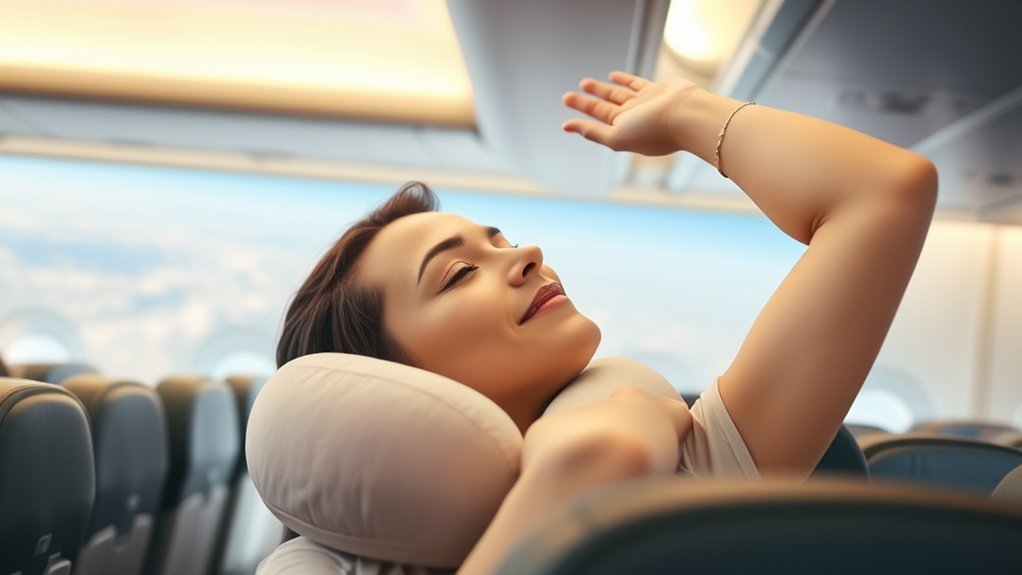
Last Updated on September 10, 2026 by Daniel Globe
Long flights can leave your neck, shoulders, back, and legs feeling stiff. Gentle travel pillow stretching exercises may make your seat more comfortable and remind you to change position regularly. The pillow is optional support, not a medical device, and every movement should stay slow, controlled, and pain-free. You should also follow the seat-belt sign and all crew instructions.
Quick Answer
Use your travel pillow as light support while performing gentle neck tilts, shoulder rolls, upper-back stretches, ankle pumps, and leg movements. Move briefly every 30 to 60 minutes and walk every 1 to 2 hours when permitted. Stop if you develop pain, dizziness, weakness, numbness, or unusual shortness of breath.
Key Takeaways
- A travel pillow can provide comfort and positioning support, but it should not be used to force a stretch.
- Keep neck movements gentle and avoid pushing your head, neck, or knee against the pillow.
- Brief seated movements and regular walking can help counter prolonged immobility during long trips.
- Stay seated and buckled whenever the seat-belt sign is on or the crew asks passengers to remain seated.
- Travelers with blood-clot risk factors should ask a healthcare professional whether additional precautions are appropriate.
At a Glance
| Time Required | About 3 to 5 minutes per movement break |
| Difficulty | Easy, with gentle and controlled movements |
| Tools Needed | Travel pillow, although most exercises can be performed without one |
| Cost | $0 if you already have a pillow |
Disclosure: As an Amazon Associate I earn from qualifying purchases. Some links on this page are affiliate links, at no extra cost to you.
Why Travel Pillow Stretching Exercises Matter for Comfort
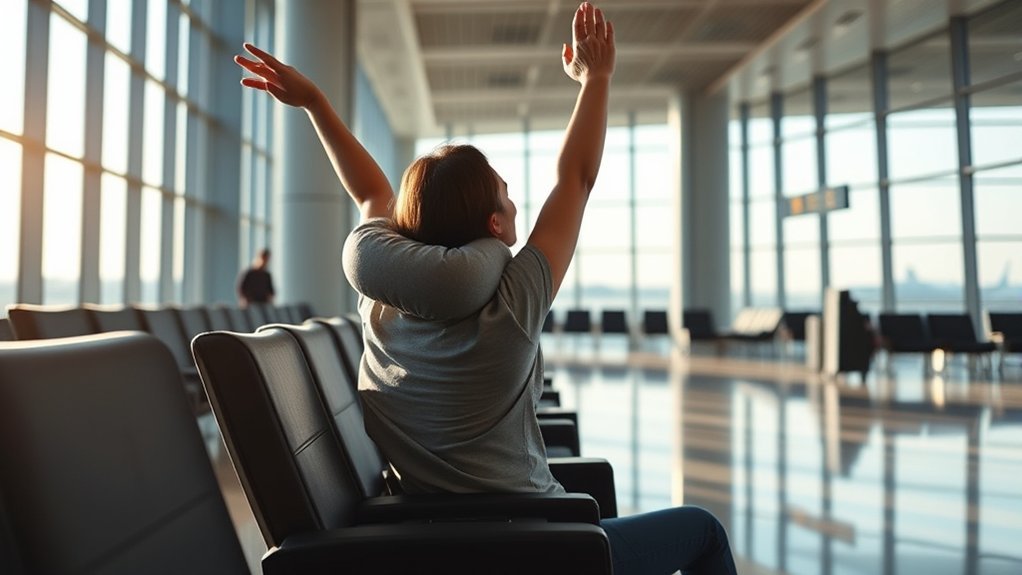
Sitting in a cramped airplane seat for several hours can make your neck, shoulders, back, hips, and legs feel tight. A travel pillow may provide a comfortable contact point behind your neck or lower back while you make small position changes.
The main benefit comes from moving regularly, not from the pillow itself. According to the Centers for Disease Control and Prevention, prolonged immobility during trips lasting more than four hours can contribute to blood-clot risk, especially in people who have additional risk factors. Moving your legs, exercising your calf muscles, and walking periodically can help maintain blood flow.
The best in-flight routine combines gentle upper-body stretches with frequent ankle and calf movements. A travel pillow is a comfort aid, not a substitute for regular movement.
Benefits of Using a Travel Pillow for Stretching Exercises
A travel pillow can make some seated movements more comfortable by filling an empty space behind your neck or lower back. It may also help you notice when your head is dropping forward or when your lower back has lost contact with the seat.
Possible practical benefits include:
- Comfortable neck support: The pillow can support the natural space behind your neck while you rest between movements.
- A posture reminder: Light contact with the pillow can remind you to sit tall instead of collapsing forward.
- Lower-back cushioning: A soft pillow placed behind your lower back may make an upright seated position more comfortable.
- Arm support: You can hold the pillow lightly against your chest during shoulder or upper-back stretches.
- Reduced pressure from the seat: The pillow may cushion a firm headrest or seatback, depending on its shape and thickness.
Note: A travel pillow has not been proven to correct spinal alignment, prevent injury, or prevent a blood clot. Its role in this routine is limited to comfort and light positioning support.
Before You Start: Safety Check and Seat Setup
Set up your seat before beginning. Small adjustments can make each movement safer and easier.
- Place both feet flat on the floor when space allows.
- Move bags and loose items away from your feet.
- Sit with your hips toward the back of the seat.
- Relax your shoulders instead of lifting them toward your ears.
- Position the pillow so it supports you without pushing your chin toward your chest.
- Keep your seat belt low and snug while seated.
- Check the seat-belt sign before standing or entering the aisle.
Warning: Do not perform these exercises through sharp pain. Stop if you feel dizzy, faint, numb, weak, unusually short of breath, or unwell. Ask a healthcare professional before traveling if you have a recent neck, back, hip, or shoulder injury; recent surgery; a history of blood clots; limited mobility; or another condition that could affect exercise safety.
How to Perform Neck Stretches With Your Travel Pillow
Neck stretches should feel mild and controlled. The pillow can support your resting position, but it should not press your head sideways or add resistance. The Mayo Clinic recommends keeping neck stretches gentle rather than forcing the movement.
Proper Pillow Placement
Place the pillow around or behind your neck according to its design. Your head should remain near a neutral position, with your ears roughly above your shoulders. If the pillow pushes your head forward or forces your chin down, loosen it, rotate it, or remove it.
| Movement | Safe Pillow Use |
|---|---|
| Neck Tilt | Let the pillow support your neck between repetitions. Do not press your head into it. |
| Seated Forward Reach | Place the pillow behind your lower back if it helps you begin from an upright position. |
| Shoulder Stretch | Hold the pillow loosely against your chest while relaxing your shoulders. |
| Figure 4 Stretch | Rest your forearms on the pillow if comfortable. Do not push your raised knee downward. |
| Lower-Back Support | Place a small pillow behind your waist without creating an exaggerated arch. |
Gentle Neck Tilts
- Sit upright and look straight ahead.
- Relax both shoulders.
- Slowly move your right ear toward your right shoulder without lifting the shoulder.
- Stop when you feel a mild stretch along the left side of your neck.
- Hold for 10 to 20 seconds while breathing normally.
- Return to the center and repeat on the other side.
Complete one or two repetitions per side. The movement should remain within a comfortable range. Do not pull your head down with your hand or pillow.
Forward Neck Stretch
- Sit tall with your shoulders relaxed.
- Slowly lower your chin toward your upper chest.
- Stop when you feel a light stretch along the back of your neck.
- Hold for 10 to 20 seconds.
- Return to a neutral position without throwing your head backward.
Breathe naturally throughout the stretch. If the pillow pushes your head forward before you begin, reposition or remove it.
Chin Tucks
A chin tuck is a small movement that can help you reset after looking down at a phone or tablet.
- Look straight ahead.
- Keep your eyes level.
- Draw your chin gently backward, as though making a small double chin.
- Do not tilt your head up or down.
- Hold for 3 to 5 seconds, then relax.
- Repeat 5 times.
Pro Tip: Use a small range of motion. A gentle stretch that you can control is more appropriate in a cramped seat than a deep or forceful stretch.
Shoulder Rolls: Easy Moves With Your Travel Pillow
Shoulder rolls are easy to perform without disturbing nearby passengers.
- Sit upright with your hands resting on your thighs or pillow.
- Lift your shoulders gently toward your ears.
- Move them backward and then down in a slow circle.
- Complete 5 to 10 backward rolls.
- Reverse the direction for another 5 to 10 rolls if comfortable.
Keep the movement smooth and avoid forcefully squeezing or shrugging. You can also hold the travel pillow loosely against your torso to support your forearms.
Effective Upper Back Stretches Using a Travel Pillow
Upper-back movements can help break up the rounded posture that often develops while reading, watching a screen, or sleeping in a seat.
Shoulder-Blade Squeeze
- Sit tall with your arms relaxed.
- Draw your shoulder blades gently toward each other.
- Keep your shoulders down rather than lifting them.
- Hold for 3 to 5 seconds.
- Relax and repeat 5 to 10 times.
Upper-Back Reach
- Hold the travel pillow lightly in front of your chest.
- Extend your arms forward without locking your elbows.
- Allow your upper back to widen slightly.
- Keep your chin level and your lower back supported.
- Hold for 10 to 15 seconds, then relax.
Seated Torso Twist
- Place both feet on the floor.
- Sit upright and place your hands lightly on your thighs.
- Turn your chest slowly to the right without forcing your neck.
- Hold for two or three comfortable breaths.
- Return to the center and repeat on the left.
Keep the movement small if the seat is narrow. Do not twist against the armrest or pull yourself deeper into the stretch.
Incorporating Deep Breathing Exercises for Relaxation
Slow breathing may help you feel calmer during delays, turbulence, or general flight anxiety. It does not replace medical treatment, and it is not a proven cure for jet lag.
Breathing Techniques Overview
Try this simple pattern:
- Rest your hands on your lap or travel pillow.
- Inhale gently through your nose for about four counts.
- Exhale slowly through your nose or mouth for about four to six counts.
- Continue for three to five comfortable cycles.
- Return to normal breathing.
You do not need to hold your breath. The American Heart Association advises stopping controlled breathing exercises if they make you dizzy or lightheaded. People with heart or lung conditions should ask a healthcare professional whether a structured breathing technique is appropriate.
Benefits of Deep Breathing
Slow, controlled breathing can support relaxation and give you a quiet point of focus. Pairing it with relaxed shoulders and a comfortable seated posture may also help you notice and release unnecessary muscle tension.
Avoid claims that deep breathing will increase brain oxygen, prevent blood clots, or cure jet lag. Its most appropriate role here is stress management.
How to Maximize Your Travel Pillow for Stretching
Use the pillow as a cushion or positioning aid rather than as exercise equipment. It should not increase the force applied to your joints.
- For neck support: Adjust it so your head does not drop sharply forward or sideways while resting.
- For lower-back support: Place it behind your waist if the seat leaves an uncomfortable gap.
- For arm support: Hold it on your lap to support your forearms while relaxing your shoulders.
- For a seated figure 4: Place one ankle over the opposite thigh only if you have enough room and no hip or knee discomfort. Use the pillow under your forearms, not to press the knee down.
- For a forward reach: Keep the pillow behind your lower back as a reminder to begin from an upright position.
Do not use the pillow to pull your head, press on your neck, force a spinal twist, or deepen a stretch through pain.
Additional Tips for Staying Relaxed While Flying
- Change position regularly: Even small shifts can reduce the discomfort of staying in one posture.
- Keep the area under your seat clear: This gives your feet and ankles room to move.
- Use an aisle seat when practical: It may make periodic walking easier.
- Drink according to thirst and personal needs: Hydration is reasonable for comfort, but current evidence does not show that drinking extra water by itself prevents travel-related blood clots.
- Limit excessive alcohol: Alcohol may affect hydration, sleep quality, judgment, and your willingness to move.
- Use headphones carefully: Noise-reducing headphones may help you relax, but keep the volume low enough to hear announcements.
- Keep your seat belt fastened: Unexpected turbulence can occur even when the sky looks clear.
Other In-Flight Exercises for Comfort Beyond the Travel Pillow
Your lower legs need movement too. The CDC recommends exercising the calf muscles during long trips. These movements require little space and do not depend on a travel pillow.
Seated Leg Extensions
- Sit upright with both feet on the floor.
- Slowly straighten one knee until the lower leg moves forward.
- Do not force the knee completely straight if space is limited.
- Hold for 2 to 5 seconds.
- Lower the foot and repeat with the other leg.
- Complete 5 to 10 repetitions per side.
This exercise may reduce stiffness and keep the leg muscles active, but it cannot guarantee protection from DVT.
Ankle Pumps, Heel Raises, and Toe Raises
- Keep your toes on the floor and lift both heels.
- Lower your heels and repeat 10 times.
- Keep your heels on the floor and lift your toes.
- Lower your toes and repeat 10 times.
- Finish by making small ankle circles in each direction.
These movements activate the calf and lower-leg muscles without requiring you to leave your seat.
Neck and Shoulder Relief
Combine one gentle neck tilt on each side with 5 shoulder rolls and 5 shoulder-blade squeezes. Keep your head controlled and avoid full, forceful circles. Repeat the sequence during longer periods of sitting if it remains comfortable.
Best Practices for Staying Comfortable During Your Flight
- Perform a one- to three-minute seated movement break every 30 to 60 minutes.
- Stand or walk every 1 to 2 hours when the seat-belt sign is off and the crew permits it.
- Move your ankles and calf muscles more often if you have been sitting still.
- Keep every stretch mild and controlled.
- Do not bounce, pull, or use the pillow to force a joint farther.
- Keep your seat belt fastened whenever you are seated.
- Stop any movement that causes pain, dizziness, tingling, numbness, weakness, nausea, or unusual symptoms.
- Speak with a healthcare professional before travel if you may have an increased blood-clot risk.
Note: The exact timing is flexible. You do not need a long workout in the cabin. Frequent, brief movements are usually more practical than one extended stretching session.
A Simple Five-Minute In-Flight Stretching Routine
- 30 seconds: Sit upright, adjust your pillow, and relax your shoulders.
- 30 seconds: Perform gentle neck tilts, one on each side.
- 30 seconds: Complete 5 chin tucks.
- 45 seconds: Perform 5 to 10 shoulder rolls and 5 shoulder-blade squeezes.
- 45 seconds: Complete a gentle upper-back reach and one small torso twist per side.
- 60 seconds: Perform 10 heel raises and 10 toe raises.
- 60 seconds: Complete 5 seated leg extensions per side.
- 30 seconds: Finish with three slow, comfortable breaths.
You can shorten this routine when the cabin is busy. Ankle pumps, shoulder rolls, and chin tucks are easy options when you have very little room.
DVT Risk, Warning Signs, and Medical Advice
Anyone can experience a blood clot, but most travel-associated clots occur in people with one or more additional risk factors. These may include:
- A previous DVT or pulmonary embolism
- Recent surgery, injury, or hospitalization
- Active cancer or recent cancer treatment
- Pregnancy or the postpartum period
- Use of estrogen-containing contraceptives or hormone therapy
- An inherited clotting disorder or family history of clots
- Older age
- Overweight or obesity
- Limited mobility, including a leg cast
- Certain long-term heart, lung, or metabolic conditions
If you have increased risk, speak with a healthcare professional before a long trip. Some travelers may benefit from properly fitted graduated compression stockings or prescribed medication, but these decisions should be individualized. Do not start aspirin or an anticoagulant for travel on your own.
Warning: Seek prompt medical care for unexplained swelling, warmth, redness, discoloration, pain, or tenderness in one leg or arm. Sudden trouble breathing, chest pain that worsens with a breath or cough, coughing blood, a rapid or irregular heartbeat, lightheadedness, or fainting may indicate a pulmonary embolism and requires emergency medical attention.
Frequently Asked Questions
Can I use any pillow for these stretching exercises?
You can use a travel pillow, small cushion, folded sweater, or no pillow at all. Choose something soft enough for comfort but firm enough to stay in place. It should not push your head forward, restrict breathing, or force a joint into a deeper stretch.
How often should I perform these stretches during a flight?
Try a brief seated movement break every 30 to 60 minutes. When the seat-belt sign is off and the crew permits it, stand or walk about every 1 to 2 hours. You can perform ankle pumps and calf contractions more frequently because they require little space.
Are there any risks or contraindications for these exercises?
Yes. Speak with a healthcare professional before trying the routine if you have a recent injury or operation, severe osteoporosis, unstable heart or lung disease, significant balance problems, a recent blood clot, or restrictions from your clinician. Stop immediately if a movement causes sharp pain, dizziness, weakness, numbness, tingling, nausea, or other unusual symptoms.
Can children perform travel pillow stretching exercises safely?
Older children may perform simple, age-appropriate movements under adult supervision if they are comfortable and able to follow instructions. Never force a child’s neck or limbs. Children should remain properly restrained, and movement should stop whenever the seat-belt sign is on or the crew requests that passengers remain seated.
What are alternative exercises if I forget my travel pillow?
The pillow is optional. You can perform chin tucks, shoulder rolls, shoulder-blade squeezes, ankle pumps, heel raises, toe raises, calf contractions, and small seated torso turns without one. A folded sweater can provide light lower-back support if needed.
Can travel pillow stretches prevent a blood clot?
No exercise can guarantee that a blood clot will not occur. Regular leg movement, calf exercises, and periodic walking are reasonable ways to reduce prolonged immobility. Travelers with additional risk factors should ask a healthcare professional whether compression stockings or another preventive measure is appropriate.
Should I stretch or walk during turbulence?
No. Remain seated with your seat belt fastened whenever the seat-belt sign is on or the crew directs passengers to sit. You may resume gentle seated movements or aisle walking only when conditions are safe and the crew permits it.
Conclusion
Travel pillow stretching exercises can make a long flight feel less restrictive when you use the pillow as light support and keep every movement gentle. Combine neck and shoulder stretches with frequent ankle, calf, and leg movements. Walk periodically when permitted, stay buckled while seated, and never stretch through pain or dizziness. Most importantly, remember that comfort exercises support movement but do not replace medical advice or individual blood-clot precautions.
Sources
- Centers for Disease Control and Prevention: Understanding Your Risk for Blood Clots With Travel — long-distance travel risks, preventive movement, risk factors, and symptoms
- CDC Yellow Book: Deep Vein Thrombosis and Pulmonary Embolism — current evidence on mobility, hydration, compression stockings, and preventive treatment
- Federal Aviation Administration: Turbulence Safety — seat-belt and crew-instruction guidance
- Mayo Clinic: Neck Stretches — gentle neck-tilt technique
- American Heart Association: Stress Management and Deep Breathing — relaxation techniques and breathing precautions
- Frimley Health NHS Foundation Trust: Head, Neck and Shoulder Stretches — advice to stop exercises for pain, discomfort, or dizziness
