

Last Updated on July 24, 2026 by Caleb Warren
Navigating travel in a wheelchair requires thoughtful preparation, and selecting the right travel pillow is fundamental for maintaining spinal alignment, preventing neck fatigue, and ensuring overall journey comfort. Unlike standard airline or car travel where passengers can lean against side walls, wheelchair users rely on targeted cervical support that integrates seamlessly with their chair’s seating system and headrest without causing forward chin displacement.
Quick Answer
The best travel pillow for wheelchair users is an ergonomic, high-density memory foam or dual-chamber inflatable pillow featuring 360-degree lateral support and a ultra-thin rear profile. To prevent forward head slump and airway compromise, position the pillow to keep your chin parallel to your lap, and anchor it directly to the wheelchair frame or headrest posts using adjustable quick-release straps.
Key Takeaways
- Prioritize Flat/Thin Back Profiles: Bulky pillow backs push the head forward off the backrest, causing severe neck strain and posture collapse.
- Prevent Chin-Drop: Choose wrap-around or chin-supporting designs that keep upper airways fully open during rest.
- Anchor to Wheelchair Frame: Use integrated webbing straps or carabiners to lock the pillow onto headrest posts so it cannot drop into the wheels.
- Adapt for Tilt & Recline: Readjust pillow firmness whenever using tilt-in-space power seating to account for gravity shifts.
At a Glance: Wheelchair Pillow Setup
| Adjustment Time | 2–5 Minutes |
| Setup Difficulty | Easy (Self or Assistant Supported) |
| Key Tools Needed | Buckle straps, carabiner clip, travel compression pouch |
| Primary Benefit | Cervical stability, airway maintenance, and pressure distribution |
Disclosure: As an Amazon Associate I earn from qualifying purchases. Some links on this page are affiliate links, at no extra cost to you.
Choosing the Right Travel Pillow for Optimal Comfort and Support
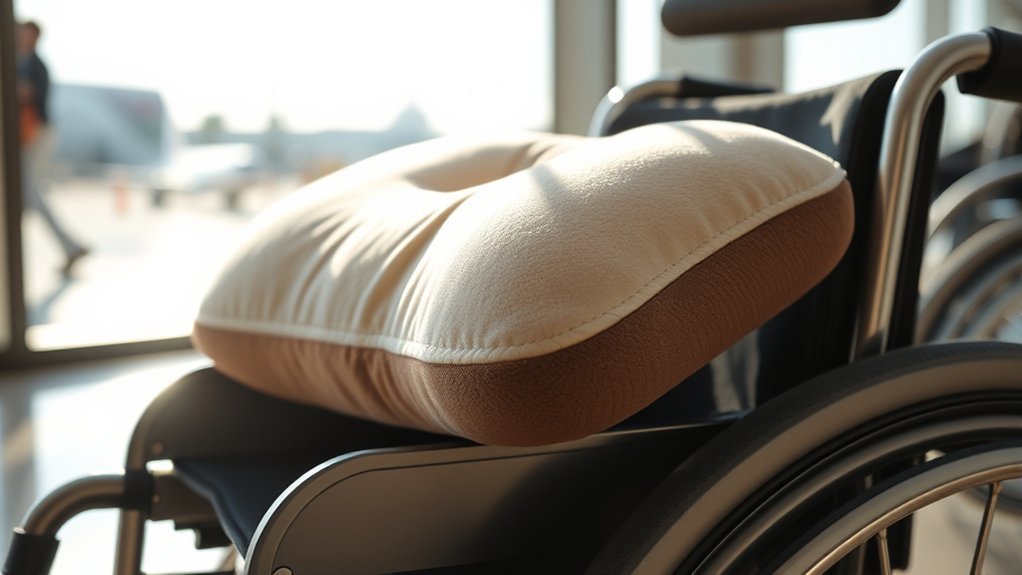
Selecting a travel pillow specifically tailored for wheelchair transit requires focusing on cervical column support and seating integration. Standard off-the-shelf U-shaped pillows often possess thick rear padding designed for recessed airline seats. In a wheelchair—where backrests are flatter and firmer—thick padding pushes the head forward, leading to severe cervical strain and posture collapse.
High-density viscoelastic memory foam offers exceptional contouring capabilities, distributing pressure evenly across the neck muscles. Alternatively, dual-chamber inflatable pillows allow precise air density adjustments. When evaluating travel pillow designs, prioritize options with flat or narrow rear sections combined with elevated lateral side cushions to prevent head tilting during transit.
“Maintaining neutral head positioning in wheelchair seating reduces cervical disc pressure and preserves clear upper airway geometry during prolonged transit.”
Essential Features of Travel Pillows for Wheelchair Users
Key features must go beyond simple softness to provide structural, biomechanical benefits tailored to non-ambulatory travel.
Ergonomic Design Considerations
Ergonomic travel pillows maintain proper spinal alignment by supporting the cervical lordosis (the natural inward curve of the neck). Look for contoured designs that accommodate high-back wheelchair seating, custom headrest hardware, or head support brackets without creating awkward pressure points.
| Key Feature | Biomechanical Benefit |
|---|---|
| Thin/Flat Rear Profile | Prevents forward head propulsion and maintains backrest contact |
| Elevated Lateral Supports | Restricts lateral neck flopping during turns or sudden stops |
| Integrated Frame Straps | Anchors pillow to push handles or headrest posts for stability |
| Breathable Cover Fabric | Dissipates heat accumulation during long trips in warm climates |
Adjustable Firmness Options
Customizing firmness allows you to fine-tune support according to your muscle tone and seating angle. Inflatable pillows utilizing Thermoplastic Polyurethane (TPU) bladders allow on-the-fly pressure adjustments. Alternatively, memory foam pillows with removable internal foam shims let users customize height and density.
Pro Tip: Attach your travel pillow directly to the wheelchair push handles or headrest posts using a quick-release webbing strap or carabiner. This prevents the pillow from shifting or dropping onto the wheels when navigating airport terminals or transfer points.
Portable and Lightweight Features
Weight and packability are crucial for wheelchair travel. Compact, collapsible pillows reduce baggage bulk and can be stowed quickly in back-of-chair pouches or side bags.
| Material Type | Pros & Best Use Case | Trade-Offs |
|---|---|---|
| Viscoelastic Memory Foam | Maximum pressure relief, high stability, excellent for low neck muscle tone | Slightly heavier, larger packed size |
| TPU Inflatable Bladder | Ultra-lightweight, packs down to pocket size, instantly adjustable firmness | Less dampening against road vibrations |
| Microbead Fill | Flexible shifting shape, cool temperature feel | Lower structural firmness over time |
Proper Travel Pillow Usage Tips
Positioning and securing your pillow correctly ensures safety, posture control, and comfort during your journey.
Proper Pillow Positioning
Place the pillow so that it fills the gap between your cervical curve and the wheelchair backrest. The chin should remain parallel to the lap, avoiding forward tilting or backward extension.
Warning: Avoid travel pillows that force the head forward into a chin-to-chest posture. For wheelchair users with reduced neck muscle tone, forward chin drop can compromise airway opening and cause swallowing difficulties during movement. Always verify that your neck remains in a neutral vertical position.
| Pillow Profile Height | Recommended User Fit & Seating Integration |
|---|---|
| Low Profile (2–3 inches rear) | Ideal for high-back wheelchairs with rigid sling or solid contoured backrests |
| Medium Profile (3–4 inches rear) | Standard height for tilt-in-space or semi-reclined manual wheelchairs |
| High Profile (4+ inches rear) | Best suited for open-back chairs or users requiring deep cervical cavity filling |
Adjusting Pillow Firmness
Follow these practical steps to fine-tune your travel pillow’s firmness and stability during transit:
- Inflatable Micro-Adjustments: Inflate the bladder fully, place it behind your neck while seated in your wheelchair, and slowly release air until your head rests back against the headrest without pushing your neck forward.
- Tensioning Straps: Fasten the front toggle or buckle straps tightly enough to support the jawline without constricting the throat.
- Dynamic Position Re-evaluation: Re-check pillow position whenever changing wheelchair tilt angles, as gravitational load on the spine changes significantly when reclined.
Note: If your wheelchair features a tilt-in-space or reclining backrest, adjust your travel pillow firmness after tilting. Tilting shifts weight distribution toward the backrest, altering cervical support requirements compared to an upright 90-degree position.
How to Maintain Proper Neck Alignment With a Travel Pillow
Maintaining neutral neck alignment requires continuous attention to posture and seating geometry. Aligning the earlobes directly over the shoulders keeps the cervical spine in a biomechanically neutral state. Periodically check that your pillow has not shifted downward behind your upper thoracic back, which causes the neck to hyperextend backwards.
Combining proper pillow selection with periodic active or passive neck range-of-motion adjustments helps reduce muscle tightness during long trips.
What Not to Do With Your Travel Pillow
Avoiding common pillow mistakes prevents pain, posture fatigue, and safety hazards during travel:
- Do not place thick padding directly behind the upper head: This pushes the head forward into cervical kyphosis, stressing the lower neck joints.
- Do not use overly soft, unstructured pillows for low muscle tone: Excessively soft foam collapses under weight, offering zero lateral support against bumpy terrain.
- Do not leave the pillow unanchored during transit: Unsecured pillows can slip behind back cushions or fall onto the wheels or floor during movement.
Enhancing Your Travel Experience With Comfort Tips
Integrating your travel pillow into a broader travel comfort plan ensures smoother journeys. Pair your pillow with breathable lap blankets, gel seat cushion overlays, and scheduled hydration breaks. Taking brief rests every 60–90 minutes to adjust your seating position, re-tilt power chairs, or perform gentle shoulder rolls helps maintain circulation and overall travel comfort.
Frequently Asked Questions
Can I use my travel pillow for daily wheelchair outings?
Yes. Portable travel pillows work well for daily outings, medical appointments, and transit in accessible vans. Make sure the pillow does not interfere with custom headrest hardware or seat positioning accessories.
How do I clean my inflatable travel pillow?
Remove the outer fabric cover and machine wash it in cold water on a gentle cycle. Wipe down the inner TPU air bladder using a soft cloth dampened with warm water and mild soap. Allow both components to air dry completely before reassembling to prevent mildew growth.
Are travel pillows suitable for children in wheelchairs?
Yes, provided the pillow is sized specifically for pediatric proportions. Adult travel pillows are too thick and can push a child’s head forward into an unsafe chin-on-chest position. Always consult a pediatric occupational therapist or seating specialist before introducing new postural supports.
What is the best way to pack my travel pillow?
For memory foam pillows, compress them into dedicated zippered travel sacks. For inflatable models, fully open the air valve, roll the bladder tightly from tail to valve to expel all air, and store it in a compact pouch. Attach the pouch to your wheelchair frame using a carabiner clip for quick access.
Can I customize the firmness of my travel pillow?
Yes. Inflatable TPU pillows allow precise firmness adjustments by adding or releasing small amounts of air via micro-adjust valves. Memory foam options often feature removable internal foam layers to customize profile height and firmness.
Conclusion
Investing in the right travel pillow transforms long journeys for wheelchair users by offering crucial cervical support, preventing fatigue, and preserving proper alignment. By selecting low-profile rear designs, prioritizing airway safety, and securely anchoring the pillow to your wheelchair frame, you can enjoy pain-free, comfortable travels wherever your journey leads.
Sources
- Rehabilitation Engineering and Assistive Technology Society of North America (RESNA) — Wheelchair seating and postural support clinical standards
- United Spinal Association — Wheelchair travel ergonomics and accessible transit posture guides
- Paralyzed Veterans of America (PVA) — Clinical practice guidelines for preserving upper limb and spinal health
- National Institutes of Health (PubMed) — Cervical spine positioning research and upper airway maintenance studies
