
Last Updated on September 27, 2026 by Caleb Warren
Electric scooter commuting can make your daily trip to work simpler, especially when you have a short route with safe bike lanes. However, choosing a suitable scooter involves more than checking its advertised range and top speed. You need to consider your actual travel distance, local laws, hills, weather, charging options, and where you will store it at work.
Quick Answer
Yes, you can commute to work on an electric scooter if local laws permit it and your route is suitable. Choose a model with enough tested range for your round trip, reliable brakes, appropriate weather protection, and manageable weight. Prioritize protected bike lanes and legal riding speeds rather than maximum performance.
Key Takeaways
- Advertised battery range may differ considerably from what you achieve on your actual route.
- A scooter’s maximum speed does not determine how fast you may legally ride.
- Suspension, pneumatic tires, and reliable brakes matter more than extreme top speed for daily commuting.
- Water-resistance ratings do not make a scooter suitable for flooding or every weather condition.
- Secure workplace storage and access to an approved charging location can make commuting much easier.
Disclosure: As an Amazon Associate I earn from qualifying purchases. Some links on this page are affiliate links, at no extra cost to you.
Can You Commute by Electric Scooter?
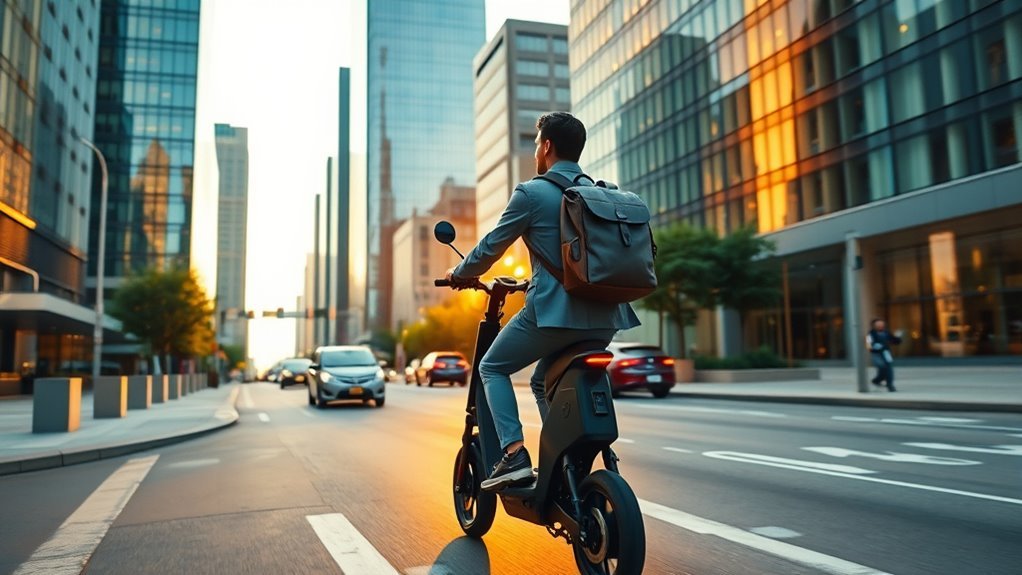
Yes, an electric scooter can work well for commuting, particularly for short urban trips and connections to public transportation. The first question is whether your entire route allows scooter use.
Check the roads, bike lanes, intersections, and parking facilities between home and work. A slightly longer route through protected bike lanes may be more suitable than a shorter route beside fast-moving vehicles.
In the United States, rules differ by state and city. For example, New York City permits electric scooters in bike lanes and on streets with posted speed limits of 30 mph or less. Riders must not exceed 15 mph, and sidewalk riding is prohibited.
Under California’s motorized scooter regulations, the riding speed limit is also 15 mph. Riders need a valid driver license or instruction permit and must wear a properly fitted bicycle helmet.
Outside the United States, the rules can be very different. In the UK, privately owned electric scooters cannot legally be ridden on public roads, pavements, or in parks. The UK government’s electric scooter guidance permits approved rental scooters in designated trial areas under specific conditions.
Legal access, safe infrastructure, and storage at your destination should determine whether electric scooter commuting is realistic for you.
How Far Should Your Electric Scooter Go?
Your scooter should have enough usable battery range to complete your entire commute with some capacity left over. If you cannot recharge at work, calculate the full distance from home to work and back.
Do not choose a scooter whose advertised maximum range barely matches that distance. Hills, wind, temperature, rider weight, and riding speed can all reduce the distance available from a charge.
Daily Commute Range
For many commuting routes, a scooter with approximately 15–40 miles of usable range may be suitable. The correct target depends on how far you actually travel and whether you can recharge at your destination.
The following figures are practical planning categories, not universal commuting distances or guaranteed scooter performance.
| Range need | Practical target |
|---|---|
| Short commute | 15–20 miles of usable range |
| Moderate commute | 20–30 miles of usable range |
| Longer commute | 30–40 miles or more |
| Extra margin | Allowance for hills, wind, cold weather, and detours |
| Best practice | Choose tested range above your actual round-trip distance |
For example, if your commute is 10 miles each way, you need enough battery capacity to cover the 20-mile round trip without relying on the scooter’s maximum advertised figure.
If your trip is 35 miles each way, you are planning for approximately 70 miles of daily travel. That is a demanding distance for many commuter scooters and may require reliable workplace charging or another form of transportation.
Real-World Battery Distance
Real-world battery range can be substantially lower than a manufacturer’s maximum claim. Advertised figures are often measured under favorable conditions, such as steady speeds, level surfaces, and moderate temperatures.
Your actual result depends on several factors:
- Rider weight: A heavier rider and additional cargo increase the energy needed to move.
- Terrain: Climbing hills uses more battery power than riding on level pavement.
- Speed: Fast riding generally consumes more energy than steady, moderate riding.
- Weather: Headwinds and low temperatures can reduce usable range.
- Maintenance: Incorrect tire pressure and dragging brakes reduce efficiency.
- Battery condition: An aging battery may provide less usable capacity than a new one.
Models with larger battery packs, such as the VMAX VX2 Pro GT, are worth considering for longer journeys. However, compare independent range testing under similar conditions before treating any advertised distance as guaranteed.
Pro Tip: Before relying on a scooter for work, ride your complete commuting route on a non-workday. Record the distance, battery percentage, remaining range, and time required. Repeat the test with your usual work bag and preferred riding mode.
What Speed Do You Need for Your Route?
A commuter scooter should have enough performance for your route without exceeding the legal speed limit. For many urban trips, a model capable of approximately 15–20 mph provides useful performance, but some jurisdictions impose lower riding limits.
A scooter with a 24 mph top speed is not necessarily legal to ride at that speed on public roads.
For example, the NIU KQi 300X has a manufacturer-listed maximum speed of 23.6 mph, while the VMAX VX5 Pro is rated for approximately 17 mph in its US configuration. Those specifications describe vehicle capability, not permission to travel at those speeds.
Consider these factors when choosing your speed requirements:
- Protected bike lanes: Prioritize controlled riding and safe stopping distances.
- Shared paths: Slow down around pedestrians, cyclists, and other users.
- Busy intersections: Allow enough time for turning vehicles and sudden stops.
- Hilly routes: Check whether the scooter can maintain useful performance uphill.
- Legal limits: Make sure the scooter’s classification and operating speed comply with local regulations.
Do not buy a faster scooter simply to match automobile traffic. Roads with high vehicle speeds may be unsuitable for stand-up scooter commuting unless there is a protected, legally accessible route.
Best Electric Scooters for Work Commutes
The right commuter scooter depends on whether you value portability, longer battery range, or comfort on uneven pavement. The following models from the original comparison illustrate those different priorities.
NIU KQi 100F: This model is designed around compact storage and short trips. According to the official NIU KQi 100F specifications, it weighs 38.8 lbs, has a 243 Wh battery, and offers up to 18 miles of advertised range.
Its folding handlebars reduce its stored width, making it useful where storage space is limited. However, the original article’s reported 11.4-mile tested range shows why commuters should not rely on the advertised maximum for their daily journey.
NAVEE GT3 Pro: The manufacturer’s GT3 Pro specifications list a 477.36 Wh battery, front and rear suspension, 10-inch tubeless tires, and IPX5 water resistance.
Its US configuration has a listed maximum speed of 32 km/h, approximately 20 mph. The manufacturer advertises a maximum range of 60 km under specified low-speed testing conditions. The original article’s reported 23.3-mile test result is a more conservative reference for planning, although your results may differ.
NIU KQi 300X: The official KQi 300X product information lists a 500W rated motor, 608.4 Wh battery, 23.6 mph maximum speed, and up to 37.3 miles of advertised range.
Its hydraulic front suspension, tubeless tires, and front and rear disc brakes make it worth comparing for longer urban routes with uneven pavement.
VMAX VX2 Pro GT: The US manufacturer specifications list a 768 Wh battery for the GT configuration, up to 37 miles of advertised Eco-mode range, approximately 24 mph maximum speed, and IPX6 water resistance.
The original article reports 39.6 miles in independent testing, but that figure should not be treated as a guaranteed commuting range. This model also lacks suspension, so its longer-range capability involves a comfort trade-off on rough streets.
The Nami Burn E Max is another performance-oriented model mentioned in the original article. Its size, power, weight, and possible legal restrictions make it a different proposition from a conventional city commuter.
Compare the complete specifications, not just the highest speed or range number. Manufacturer claims and independent tests should be labeled separately because their testing conditions may differ.
Which Electric Scooter Features Matter Most?
Reliable braking, suitable tires, adequate battery capacity, and a secure folding system are among the most useful features for daily commuting. Suspension and weather protection become more important when your route includes rough roads or occasional wet conditions.
Use this checklist when comparing models:
- Battery: Enough usable range for your journey with reserve capacity.
- Brakes: Predictable stopping performance and accessible replacement parts.
- Tires: Pneumatic tires provide cushioning, while tubeless designs can simplify some puncture repairs.
- Suspension: Front or dual suspension can reduce vibration on uneven pavement.
- Lighting: A useful headlight, visible rear light, and appropriate reflectors.
- Weather protection: A manufacturer-stated IP rating and clear water-exposure guidance.
- Portability: Manageable weight and folded dimensions for your home, office, and transit connections.
- Weight capacity: Enough allowance for your body weight and belongings.
- Parts availability: Access to suitable tires, brake components, and manufacturer-supported battery replacements.
Also consider handlebar height, deck space, grip comfort, and the quality of the folding latch. A scooter that feels uncomfortable after a short test ride may become frustrating when used every workday.
Solid tires can reduce puncture-related maintenance, but they generally provide less cushioning than pneumatic tires. On rough surfaces, that difference may increase vibration and rider fatigue.
How Hills and Traffic Affect Scooter Choice
Steep hills and heavy traffic can make a scooter unsuitable even when its advertised range is sufficient. Match its climbing ability to your steepest regular hill and choose a route that keeps you away from unnecessary conflicts with fast-moving traffic.
Motor performance depends on several factors, including rated power, peak power, controller settings, rider weight, and battery condition.
A higher-wattage motor may offer better acceleration or climbing ability, but wattage alone does not tell you how well a scooter performs on your particular hill.
For example, the VMAX VX5 Pro manufacturer’s specifications list a 400W rated motor, 840W peak power, and climbing capability of up to 25% under its test conditions.
That does not mean it will maintain its maximum speed on a long 25% grade with every rider.
If your commute includes steep or repeated climbs:
- Compare sustained climbing performance rather than relying only on peak motor wattage.
- Check the manufacturer’s payload limit, including the weight of your work bag.
- Consider whether stronger braking and suspension are needed for the descent.
- Remember that uphill riding reduces available battery range.
- Use a less demanding route when the scooter cannot safely maintain control or progress.
Warning: Do not attempt to match vehicles traveling at 45–65 mph on a stand-up electric scooter. High-speed roads may prohibit scooters and create serious collision risks. Use protected infrastructure or an alternative route.
Why Battery Size and Voltage Matter for Commuting
Battery capacity affects how far you can travel, while voltage helps determine how the electrical system delivers power. You should consider both, along with motor and controller specifications, rather than assuming that a higher voltage automatically means a better scooter.
For commuting, usable battery capacity is especially important because you need predictable performance throughout the journey.
Battery Capacity
Battery capacity is commonly measured in watt-hours, abbreviated Wh. A higher Wh figure generally means more stored energy, although the actual distance you can travel also depends on efficiency and riding conditions.
Examples from the scooters discussed here include:
- NIU KQi 100F: 243 Wh.
- NAVEE GT3 Pro: 477.36 Wh.
- NIU KQi 300X: 608.4 Wh.
- VMAX VX2 Pro GT: 768 Wh.
These figures help explain why some scooters are designed for short trips while others support longer journeys. However, battery size does not establish range by itself.
A larger pack also adds weight, which matters if you need to carry the scooter upstairs or load it into a vehicle.
Charging time is another practical consideration. Confirm that the battery can be recharged during your available charging window and that your workplace allows scooter charging.
Voltage Performance
Voltage describes the electrical potential of the battery system. A 48V scooter can support strong motor performance, but voltage alone does not determine acceleration, torque, or efficiency.
The motor, controller, gearing, battery capacity, and current limits all influence how much usable power reaches the wheel.
For example, the NIU KQi 100F uses a 48V electrical system with a 300W rated motor. The KQi 300X also uses a 48V system but has a 500W rated motor and a larger battery.
These scooters therefore have different performance capabilities despite sharing the same nominal voltage.
When evaluating a scooter for hills, compare its complete powertrain and actual climbing performance. Avoid treating voltage as a shortcut for choosing between models.
Range Consistency
Range consistency means being able to complete your usual trip without unexpected reductions in performance. Battery charge level, age, temperature, and riding conditions influence that reliability.
Some scooters reduce available power as the battery becomes depleted. Others maintain a steadier response until the battery management system limits output.
To make your commuting range more predictable:
- Use a consistent riding mode when comparing battery consumption.
- Monitor the remaining charge after your regular journey.
- Keep the tires inflated according to the manufacturer’s instructions.
- Account for additional energy use during cold weather and uphill travel.
- Maintain access to a suitable charging location when your route approaches the scooter’s tested range.
If you regularly finish your commute with very little battery remaining, consider a shorter route, workplace charging, or a scooter with greater usable capacity.
What Weather Protection Do You Need?
For electric scooter commuting in wet weather, choose a model with documented water resistance and suitable tires, then follow the manufacturer’s riding restrictions. No IP rating makes a scooter safe for every rainstorm, flooded road, or slippery surface.
IP ratings describe protection against water and, where specified, solid particles.
For example:
- IPX5: Protection against water jets under specified test conditions, with no stated solid-particle rating.
- IPX6: Protection against more powerful water jets under specified test conditions.
- IP65: A dust-tight enclosure with protection against water jets under specified test conditions.
These classifications describe tested enclosure protection. They do not mean you can submerge the scooter or ignore the manufacturer’s restrictions.
The NAVEE GT3 Pro carries an IPX5 rating, while the VMAX VX2 Pro has an IPX6 rating.
If your scooter will encounter occasional rain, consider the following equipment:
- A waterproof jacket and suitable rain pants.
- Footwear with reliable grip.
- Fenders or mudguards to reduce road spray.
- Working front and rear lights.
- Pneumatic tires in good condition.
- A secure, dry place to store the scooter after arriving.
Many commuter scooters use tires around 9–10.5 inches rather than the 20-inch wheels suggested in the original article. Tire condition, tread, surface conditions, and appropriate riding speed matter more than simply choosing the largest available wheel.
Warning: Avoid riding through standing water, flooded streets, ice, and heavy storms. Water resistance does not guarantee traction, braking performance, or protection from electrical damage. Never charge a wet scooter or battery.
How to Make Electric Scooter Commuting Safer
Safe commuting starts with protective equipment, predictable riding, and regular inspections. A scooter’s braking and electrical systems need to work properly every time you leave home.
The US Consumer Product Safety Commission’s micromobility guidance recommends wearing a helmet, checking the scooter before riding, following traffic laws, and keeping both hands on the handlebars.
Use this pre-ride checklist:
- Check the tires for damage and proper inflation.
- Test the front and rear braking systems.
- Confirm that the folding mechanism is fully locked.
- Check the throttle and steering for unusual movement.
- Test the headlight, rear light, and turn signals if fitted.
- Check the battery charge and look for visible damage.
- Secure your belongings in a suitable bag without obstructing the handlebars.
During the ride, keep a safe distance from other road users. Slow down before intersections, driveways, potholes, and uneven surfaces.
Avoid abrupt steering, sudden acceleration, and unnecessary high-speed riding. Never carry a passenger on a scooter designed for one person.
Battery and Charging Safety
Battery safety is especially important when you charge a scooter at home or work. Buy equipment from reputable manufacturers and look for appropriate independent electrical safety certification.
The CPSC identifies UL 2272 as an important electrical safety standard for personal e-mobility devices.
Follow these charging precautions:
- Use the charger supplied or specifically approved by the manufacturer.
- Do not charge while sleeping or when nobody is present.
- Keep the scooter away from combustible materials and emergency exits.
- Do not use a battery that shows swelling, unusual heat, leaking, or physical damage.
- Never install an incompatible replacement battery or charger.
- Follow the manufacturer’s charging instructions and disconnect the charger when charging is complete.
Certification reduces electrical safety risks, but it does not eliminate the need for proper handling and maintenance.
Note: If you notice battery swelling, smoke, unusual odors, or excessive heat, stop using the scooter. Keep clear of the device and contact emergency services if a fire develops. Have electrical or mechanical problems assessed by a qualified repair professional.
Which Electric Scooter Fits Your Daily Trip?
The most suitable electric scooter is the one that matches your actual travel conditions rather than the model with the most impressive specifications. Compare your daily distance, route surface, carrying needs, weather exposure, and charging access before purchasing.
The following examples illustrate how different specifications support different commuting needs.
| Factor | Example |
|---|---|
| Range | VMAX VX2 Pro GT: up to 37 miles advertised in Eco mode |
| Speed | NAVEE GT3 Pro: 32 km/h maximum in US configuration |
| Weight | NIU KQi 100F: 38.8 lbs |
| Weather | VMAX VX2 Pro GT: IPX6 water resistance |
| Hills | VMAX VX5 Pro: up to 25% claimed climbing ability |
Before making your final choice, answer these questions:
- How long is your round trip? Choose sufficient tested battery range, allowing for less favorable conditions.
- Where can you legally ride? Make sure the scooter and intended route comply with local requirements.
- How steep are your hills? Compare actual climbing capability and braking performance.
- Will you carry the scooter? Check its complete weight and folded dimensions.
- Where will you store it? Confirm that your workplace provides a suitable location.
- Can you charge safely? Consider charging time, workplace rules, and access to a manufacturer-approved charger.
- What happens when conditions change? Have an alternative travel option for severe weather or mechanical problems.
Commuting costs also deserve consideration. Electricity use is generally modest compared with operating a car, but ownership costs include the scooter, replacement tires, brakes, battery wear, protective equipment, and possible repairs.
Compare those ongoing costs with your existing transportation expenses rather than assuming that every scooter will save the same amount.
Frequently Asked Questions
Is an Electric Scooter Good for Commuting?
Yes, an electric scooter can be a practical commuting option for short urban journeys with suitable riding infrastructure. It may reduce transportation expenses and produce no direct exhaust emissions while riding. However, route safety, legal access, weather conditions, storage, and adequate battery range determine whether it works for your daily needs.
Are Scooters Good for Autistic Kids?
Scooter activities may help some autistic children practice balance, coordination, and movement, depending on their individual abilities and sensory needs. Choose age-appropriate equipment and provide suitable supervision and protective gear. A child’s needs should guide the activity, and adult commuter scooters are not appropriate substitutes for equipment designed for children.
What Electric Scooter Can Go 30 Miles an Hour?
High-performance models such as the Dualtron Thunder 3 are designed for speeds exceeding 30 mph. However, a scooter’s mechanical capability does not determine its legal road classification. High-speed models also demand greater attention to braking, protective equipment, and riding conditions. Check the exact model specifications and local regulations before purchasing.
What Happens if I Get Caught on My Electric Scooter?
The consequences depend on your location and the specific violation. Riding where scooters are prohibited, exceeding speed limits, or failing to meet equipment requirements may result in warnings, fines, or other penalties. Some jurisdictions also permit scooter seizure. In the UK, illegal public use of a privately owned scooter may lead to fines, licence penalty points, or impoundment.
Can You Charge an Electric Scooter at Work?
Yes, if your employer permits it and provides a suitable charging location. Use only the manufacturer-approved charger and follow workplace electrical safety requirements. Never block exits or leave the scooter charging unattended. Workplace charging can extend your practical commuting range, but it should not replace proper battery and route planning.
Conclusion
Electric scooter commuting can be a useful alternative to driving or public transportation when your route, local laws, and daily distance make it practical.
Choose a scooter with sufficient usable range, reliable brakes, appropriate weather protection, and manageable weight. Before relying on it for work, test your complete route, arrange safe storage and charging, and make sure you have another transportation option when conditions are unsuitable.
Sources
- New York City Department of Transportation: Electric scooter speed limits, bike-lane access, and sidewalk restrictions.
- California Highway Patrol: Motorized scooter operating rules, helmet requirements, and licensing.
- UK Government: Rules for privately owned and approved rental electric scooters.
- NIU KQi 100F: Manufacturer specifications for weight, battery capacity, range, and performance.
- NAVEE GT3 Pro: Manufacturer specifications for battery, speed, suspension, tires, and water resistance.
- NIU KQi 300X: Manufacturer specifications for motor power, range, battery capacity, and braking.
- VMAX VX2 Pro: Manufacturer specifications for the GT battery, advertised range, speed, and water resistance.
- VMAX VX5 Pro: Manufacturer specifications for motor output, climbing capability, and performance.
- US Consumer Product Safety Commission: Scooter riding precautions, inspections, and lithium-ion battery charging safety.
- CPSC Electrical Safety Standards Guidance: UL 2272 and electrical safety requirements for personal e-mobility devices.