
Last Updated on September 10, 2026 by Daniel Globe
You generally can’t drive an electric scooter on the highway because most models cannot meet the minimum speed, lighting, mirror, and stability requirements that highway laws demand. Many states also bar scooters from interstates and expressways outright. High-speed traffic greatly increases your collision risk, and a small scooter leaves you exposed. You should use local roads, bike lanes, or permitted multi-use paths instead. If you want the full legal and safety picture, the details below matter.
Quick Answer
No. Standard electric scooters can’t legally or safely use highways or interstates. Most states cap street-legal e-scooters at speeds far below highway minimums (often 15-20 mph vs. 40-55 mph), and controlled-access freeways ban them outright, same as bicycles and pedestrians.
Key Takeaways
- Electric scooters almost never meet the speed and equipment standards highways require.
- State law often uses “highway” to mean any public road — not just interstates — so check your local speed-limit rule, commonly 25-35 mph.
- Controlled-access freeways and interstates ban e-scooters everywhere, regardless of speed limit.
- Gas-powered scooters and mopeds over 50cc follow entirely different rules than electric scooters — don’t confuse the two.
- Bike lanes, multi-use paths, and posted-35-mph-or-under streets are your legal, safer options.
Disclosure: As an Amazon Associate I earn from qualifying purchases. Some links on this page are affiliate links, at no extra cost to you.
Why Electric Scooters Can’t Use Highways
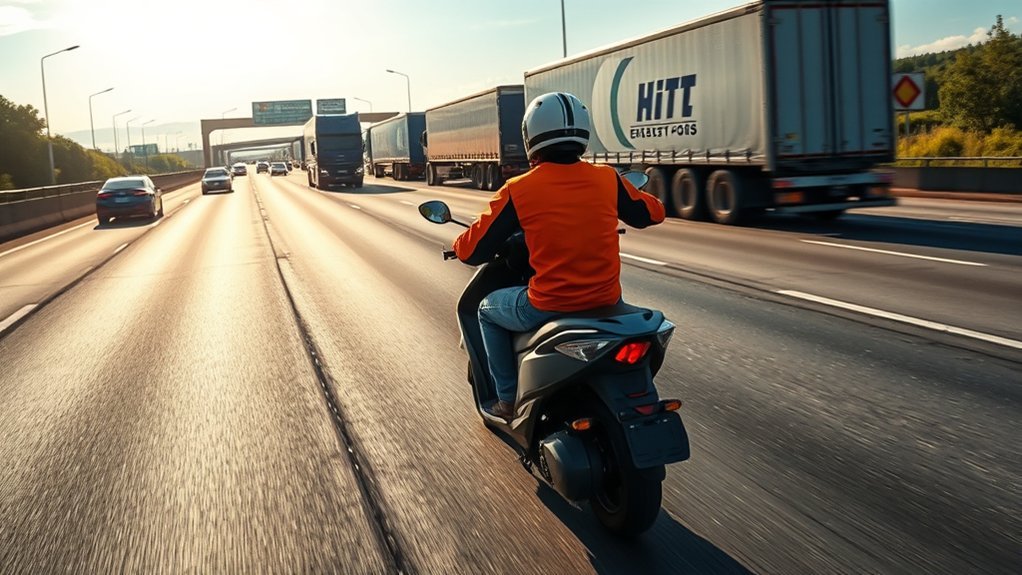
Electric scooters generally cannot be used on highways because they aren’t capable of meeting the practical speed thresholds most controlled-access roads require — commonly 40 to 55 mph sustained — while most consumer e-scooters top out around 15 to 20 mph. That puts you well outside the pace of traffic on a freeway or interstate. Regulators treat your scooter as a non-highway vehicle because its design doesn’t support the pace, stability, or protective margin that high-speed corridors demand. The speed gap between you and motor vehicles increases collision risk and undermines scooter safety. Many states expressly bar scooters from interstates and limited-access expressways, and separately, gas-powered mopeds and motor scooters under 50cc/30 mph typically can’t meet highway requirements either. Your practical forum for urban mobility is the city street, not the freeway — on lower-speed roads you get far more control and far less risk.
Note: State law often defines “highway” as any public road, not just a freeway or interstate. A rule like “scooters may use highways posted 35 mph or less” is talking about ordinary streets — it is not permission to enter an on-ramp. Interstates and other controlled-access roads are banned for scooters separately and completely, no matter their speed limit.
Which Scooters Are Highway Legal?
“Highway legal” in the true freeway/interstate sense generally means a vehicle registered and equipped as a motorcycle or moped — a completely different vehicle class than a stand-up electric scooter. These are gas- or electric-powered two-wheelers with an engine displacement (or equivalent output) well above what any consumer electric scooter carries, full lighting, mirrors, and turn signals, capable of sustaining 45 mph or more. A standard electric scooter — even a fast one — doesn’t fall into this category and isn’t treated as one under state law. Electric scooters are instead classified alongside bicycles: Florida, for example, defines “motorized scooters” and caps them at 20 mph under Florida Statute §316.2128, giving riders the same rights and duties as bicyclists — not access to higher-speed roads. If your device is a genuine 150cc+ gas scooter or moped built and titled as a motorcycle, it may qualify for some faster roads in certain states, but that requires registration, insurance, and a motorcycle license or endorsement, exactly as with any motorcycle.
Which Laws Restrict Scooter Highway Use?
You’ll find that state highway restrictions bar electric scooters from roads where the posted speed exceeds what a scooter can safely match, and separately exclude scooters from interstates and other controlled-access roads outright. Registration and licensing rules for genuinely highway-legal two-wheelers add another layer most electric scooters simply can’t satisfy.
State Highway Restrictions
State laws generally restrict electric scooters to roads with lower posted speed limits, since most scooters can’t safely mix with faster traffic. Rules vary meaningfully by state:
- Texas permits motor-assisted scooters only on streets posted 35 mph or less, under Transportation Code §551.352; a scooter may cross a faster road at an intersection but can’t ride along it. Minimum age and helmet rules are largely set at the city level, not statewide.
- Florida treats electric motorized scooters like bicycles, capped at 20 mph, with riders required to be at least 16. There is no provision allowing electric scooters onto 55 mph roads — that claim conflates e-scooters with unrelated gas moped/motorcycle rules.
- California, Colorado, Massachusetts, and New York are among the states that bar scooters from highways, expressways, and limited-access roads entirely, since most models can’t reach a safe merging speed.
Local ordinances can add further restrictions on top of state law — Austin, Dallas, and Houston, for example, each layer curfews, no-ride zones, or additional age rules onto the Texas statewide 35 mph baseline. Always check your city’s rules in addition to state law.
Minimum Speed Rules
Controlled-access highways are designed around sustained merging speeds, commonly in the 40-55+ mph range, so traffic can flow without stopping. Most electric scooters can’t safely and consistently hold that pace, especially on an incline, which is a core reason these roads exclude them — separate from any posted-speed-limit rule on ordinary streets. That speed differential is also why authorities treat scooters similarly to bicycles and pedestrians: all three are barred from the same controlled-access roads for the same reason.
Registration And Licensing
Registration and licensing rules keep most electric scooters off any road built for genuine highway-legal traffic, because that category is reserved for vehicles registered as motorcycles or mopeds, insured, and operated by a rider holding the matching license or endorsement. A standard electric scooter doesn’t meet that vehicle definition in the first place — most states, including Texas and Florida, explicitly exempt personally owned electric scooters from registration, insurance, and licensing requirements, precisely because they’re classified with bicycles rather than motor vehicles. That exemption is a trade-off: it keeps entry easy, but it’s also the reason electric scooters don’t qualify for higher-speed roads.
Why Scooters Are Less Safe on Highways?
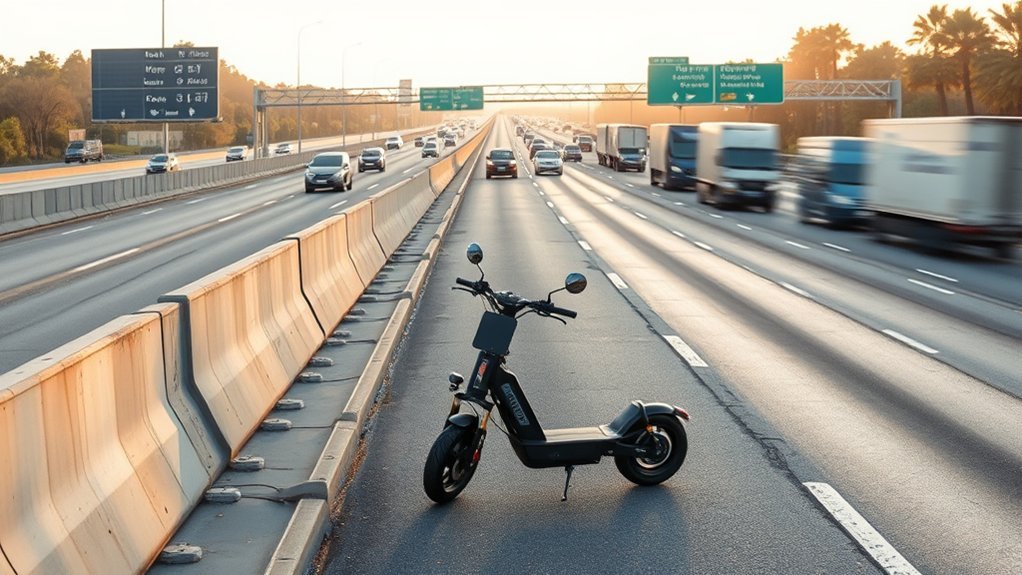
Scooters are less safe on highways because their design and operating limits aren’t suited to high-speed traffic. You face a profound speed disparity, since most electric scooters top out at 15-20 mph while highway traffic often moves at 40-55 mph or more. That gap leaves you exposed, unstable, and unable to match the lawful flow of vehicles around you. Their lightweight frames and small wheels reduce stability, especially with wind, pavement imperfections, or sudden maneuvers. You also face a visibility problem: your smaller profile makes it harder for drivers to spot you at distance or at speed. Because highways mix large, fast vehicles in close proximity, any error can become catastrophic, and a scooter offers no structural protection, so you absorb a collision’s force directly.
A vehicle traveling 20 mph slower than surrounding traffic isn’t just inconvenient for other drivers — it’s one of the clearest predictors of a high-speed rear-end collision.
Where Should You Ride Instead?
You should ride on local roads with posted speed limits under 35-45 mph (check your state’s exact threshold), where your scooter can usually operate lawfully with far less exposure to fast traffic. Use dedicated bike lanes and, where permitted, multi-use paths, since they provide safer separation from motor vehicles. If a direct route isn’t available, look for parallel routes or detours, and use navigation apps to identify scooter-friendly paths that avoid highways.
Safer Lower-Speed Roads
Electric scooters are generally better suited to roads with speed limits under your state’s threshold (35 mph in Texas, for example), where they can travel without being exposed to faster, more hazardous traffic. Parallel roads running alongside a highway often give you a lawful, lower-speed alternative, and urban business corridors may also permit scooter travel. Navigation apps can help you identify these calmer corridors and avoid high-speed exposure, giving you more control over your ride with less conflict from motor vehicles.
Bike Lanes And Paths
When highways are off-limits or unsafe, designated bike lanes and multi-use paths are the proper alternative for electric scooter riders. Bike lanes separate you from fast vehicles, while multi-use paths let you travel alongside bicycles in a more controlled environment. Still, verify local rules — some cities permit scooters on bike paths only, and others restrict sidewalk or path access further. If a lane or path exists, use it; if not, choose the lowest-speed street the law allows.
Parallel Routes And Detours
Instead of entering a highway, ride on parallel roads, local streets, or county routes that run alongside it, provided the posted speed limit is within your state’s allowed threshold and local law permits scooter travel there. These routes keep you lawful, visible, and free from unsafe highway speeds.
- Choose dedicated bike lanes when they connect your route.
- Use multi-use paths in cities to reduce exposure to traffic.
- Verify that every segment allows scooters and stays within your state’s speed threshold.
Pro Tip: Before a longer ride, check your city’s specific ordinance in addition to state law — many cities add curfews, no-ride zones, or lower local speed thresholds on top of the statewide baseline.
Can You Modify a Scooter for Highway Use?
In practice, you can’t turn a standard electric scooter into a genuinely highway-legal vehicle — what “modification” actually means here is building or buying an entirely different vehicle class: a registered moped or motorcycle. That means an engine or motor output well above a typical e-scooter’s, a full lighting package with mirrors and turn signals, frame and brake standards built for higher speeds, registration as a motorcycle, insurance, and a valid motorcycle license or endorsement. Even then, approval isn’t guaranteed everywhere, and you shouldn’t assume a converted scooter has the stability or protective structure of a purpose-built motorcycle. If you want legitimate higher-speed, longer-range mobility, a licensed moped or motorcycle is the honest path — not an aftermarket electric scooter conversion.
Warning: Riding an unmodified electric scooter on a highway or interstate — even briefly, even to cross — exposes you to both legal penalties and a serious risk of a high-speed collision. Don’t treat an on-ramp as a shortcut.
What Happens If You Ride on a Highway Illegally?
If you ride an electric scooter on a highway in violation of state law, you may face fines, citations, and other penalties. Law enforcement can stop you, demand identification, and issue a citation. Depending on your state, this can also affect your driving record. These legal consequences exist because many states prohibit scooters on high-speed roads.
- Your insurer may deny coverage if you crash while violating traffic rules.
- Your liability exposure may increase if another driver or passenger is harmed.
- The speed differential puts you at greater risk of severe injury or death.
A highway is built for faster traffic, not for vulnerable scooters. If you want reliable, lawful mobility, know your state’s rules and stay off prohibited roads.
Frequently Asked Questions
What happens if you get caught riding an electric scooter on a highway?
You’ll likely be cited and fined, and officers may check registration, insurance, and licensing where those apply. Repeat violations can bring higher penalties, and you could lose riding privileges in some cities.
Can an electric scooter go on the freeway?
No. Controlled-access freeways and interstates ban electric scooters everywhere, the same way they ban bicycles and pedestrians — regardless of your scooter’s top speed or your state’s street rules.
Do you need a license to ride an electric scooter in Louisiana?
Yes, Louisiana requires a valid driver’s license or learner’s permit to ride an electric scooter. Riders under 18 must wear a helmet, and local rules may add further requirements.
How fast can you ride a scooter on the road?
You can ride only as fast as your scooter’s local speed limits and your scooter’s own capability allow — typically 15-20 mph. For road safety, don’t exceed posted limits or the classification speed cap for your device.
Does “highway” in scooter law mean the freeway?
Usually not. Many state statutes use “highway” as a legal term for any public road, including ordinary streets. A rule allowing scooters on “highways posted 35 mph or less” refers to city streets — controlled-access freeways and interstates are banned separately and completely.
Conclusion
To summarize, you generally can’t take an electric scooter onto a true highway, freeway, or interstate — most models lack the speed, power, and safety equipment required, and riding there can expose you to fines and serious injury. On ordinary streets, your state’s posted-speed-limit rule (often 25-35 mph) governs where you can legally ride, so check that threshold rather than assuming “highway” means freeway. For example, riding a 20 mph scooter onto a 65 mph freeway creates an obvious, avoidable hazard. Stick to bike lanes, city streets, and designated paths instead — and verify your city’s specific ordinance before you go.
Sources
- Texas Transportation Code §551.352 — the statewide 35 mph rule and scope for motor-assisted scooters in Texas.
- Florida Department of Highway Safety and Motor Vehicles — official classification and speed cap for motorized scooters vs. mopeds and motorcycles in Florida.
- Electric Scooter Laws by State — a state-by-state comparison of speed limits, highway restrictions, and local variation.

