
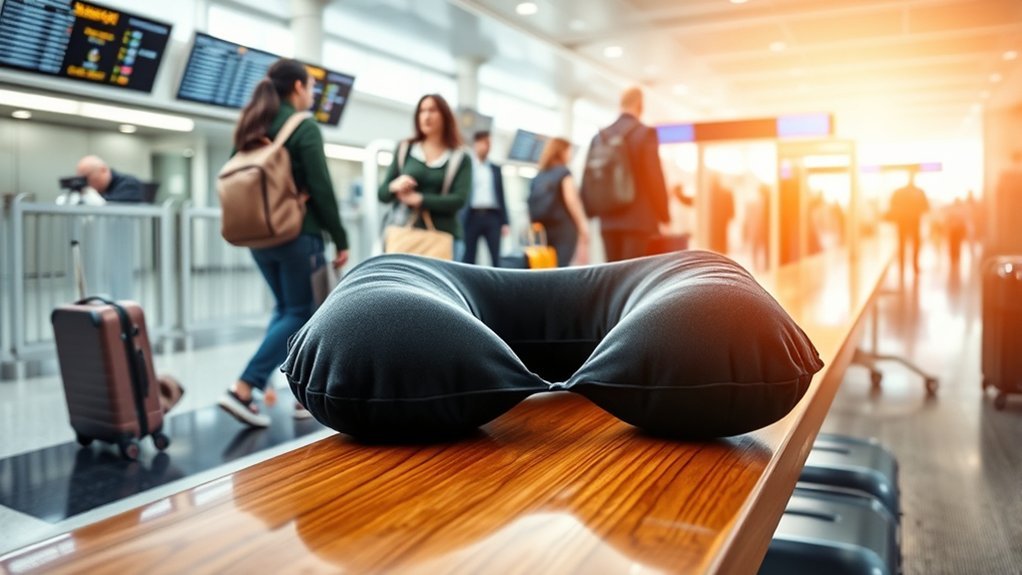
Last Updated on July 29, 2026 by Caleb Warren
An inflatable travel pillow is usually easy to bring through airport security and pack for a flight. The important distinction is its size and purpose: a small neck pillow is different from an inflatable footrest, seat extender, or child bed. Airline rules—and the cabin crew’s instructions—control how and when you may use it.
Quick Answer
Yes. TSA allows pillows in carry-on and checked bags, and a compact inflatable neck pillow is generally acceptable onboard. However, the airline decides whether a separately carried pillow counts toward your baggage allowance. Larger inflatable footrests, seat extenders, and child beds may be restricted or banned. Follow crew instructions and keep aisles and exits clear.
Key Takeaways
- A small inflatable neck pillow is normally allowed through U.S. airport security.
- A separate pillow may count toward your airline’s cabin-baggage allowance, so packing it inside your personal item is safest.
- Inflatable footrests, seat extenders, and child beds face stricter rules than neck pillows and may be prohibited.
- Keep your seat belt fastened, do not block the aisle or safety equipment, and follow the cabin crew’s instructions.
At a Glance
| Security Screening | TSA permits pillows in carry-on and checked bags; the final screening decision remains with the officer. |
| Lowest-Risk Option | A compact inflatable neck or lumbar pillow that stays within your seat area. |
| Best Packing Method | Deflate it and place it inside your personal item or carry-on bag. |
| Main Restriction | It must not obstruct an aisle, exit, another passenger, seat movement, or access to safety equipment. |
Disclosure: As an Amazon Associate I earn from qualifying purchases. Some links on this page are affiliate links, at no extra cost to you.
Can You Bring an Inflatable Travel Pillow on a Plane?
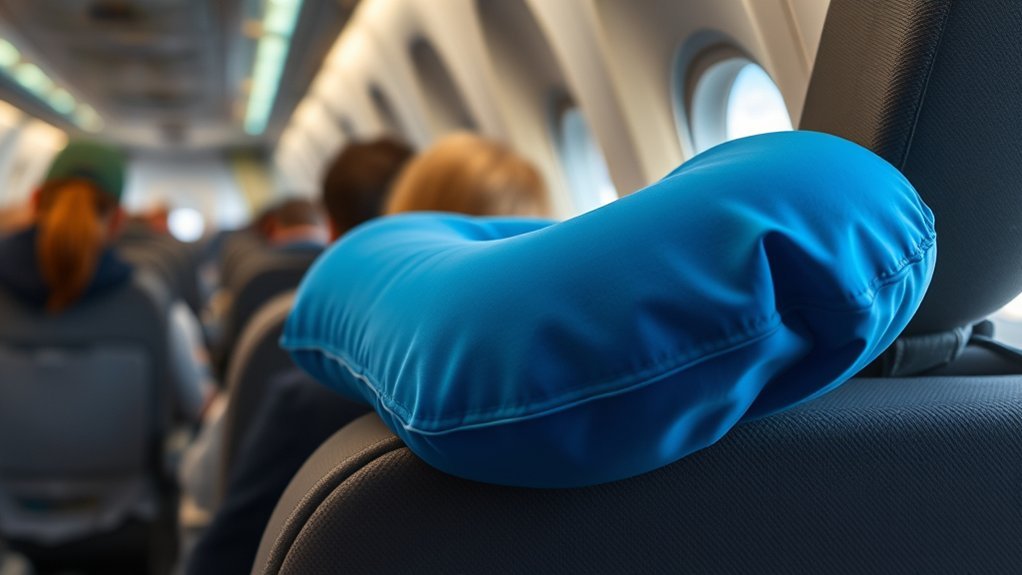
Yes, in most cases you can bring a compact inflatable travel pillow on a plane. The Transportation Security Administration lists pillows as allowed in both carry-on and checked bags. That answers the airport-security question, but it does not guarantee that every airline will treat a separately carried pillow as a free extra item.
Your airline controls cabin-baggage limits and onboard use. A small neck pillow that fits inside your bag is the simplest option. A large inflatable cushion that fills the footwell, bridges two seats, or turns a seat into a bed may be restricted even when security allows you to carry it through the checkpoint.
Note: “Allowed through security” and “allowed to use in the cabin” are separate questions. TSA screens the item; the airline and cabin crew decide how it may be carried and used onboard.
When Can You Use an Inflatable Pillow During a Flight?
There is no single rule that requires every small inflatable neck pillow to remain deflated whenever the seat-belt sign is on. The safer rule is to keep the pillow within your seat area, remain properly belted, and stow it whenever a crew member asks. Larger devices usually face stricter restrictions during taxi, takeoff, landing, and turbulence.
| Phase of Flight | Practical Guidance |
|---|---|
| Boarding, taxi, takeoff, and landing | Keep loose items secured. A small neck pillow may be acceptable if it does not affect the seat belt or safety position, but larger cushions and seat extenders normally must be stowed if the airline permits them at all. |
| Cruise | Use a compact pillow within your seat space. Use any footrest, child bed, or seat-extension device only when the operating airline specifically permits it. |
| Turbulence or crew instruction | Fasten your seat belt and stow the pillow or device if instructed. Cabin-crew directions take priority over general guidance. |
U.S. carry-on rules require baggage to be secured for takeoff and landing, and the FAA advises travelers to check the operating airline’s carry-on rules because airline limits may be stricter. A neck pillow worn around your neck may be treated differently from a loose, floor-level inflatable device, so ask the crew when the policy is unclear.
What Airline Policies Should You Know About Inflatable Travel Pillows?
Airline policies vary by device, aircraft, cabin, and seat location. Before flying, separate the issue into three parts:
- Security: Can the item pass through the airport checkpoint?
- Baggage allowance: Does a separately carried pillow count as a personal item or cabin bag?
- Onboard use: May you inflate or position it at your seat?
Official airline rules show why broad statements are risky:
- Qantas prohibits devices that attach to seats, sit between seats, or block access, including inflatable cubes, bed boxes, and leg hammocks.
- British Airways permits only listed child comfort aids and applies seat-location and cabin restrictions.
- Singapore Airlines allows qualifying child convertible beds under detailed conditions, including stowage during taxi, takeoff, and landing.
- Emirates does not permit leg rests or seat-extension devices to be used onboard.
Warning: Do not assume that a product advertised as a “flight bed,” “seat extender,” or “airplane footrest” is approved by your airline. A product claim, an “airline-friendly” label, or a reference to IATA is not a substitute for the operating airline’s written policy.
Types of Travel Pillows Permitted on Airlines
The type and size of the pillow matter more than whether it contains air.
- Inflatable neck pillow: Usually the least complicated choice because it stays close to your body and packs down small.
- Inflatable lumbar pillow: Often acceptable when it stays behind your lower back and does not interfere with the seat belt, seat controls, or the passenger behind you.
- Standard pillow or pillow-blanket combination: Usually allowed as an ordinary soft item, but it may count toward the airline’s cabin-baggage limit if carried separately.
- Inflatable footrest or seat extender: Frequently restricted because it occupies the footwell, can block movement, or may affect access to the aisle.
- Inflatable child bed: Airline-specific. Some carriers approve certain designs in selected seats, while others prohibit them.
- Medical or positioning cushion: Contact the airline’s accessibility team before travel if the cushion is needed for a disability or medical condition, especially when it is large or must remain in place during takeoff and landing.
Do not rely on a general product description. Check the airline operating the flight, including each carrier on a codeshare or connecting itinerary.
How to Use Inflatable Travel Pillows for Maximum Comfort
- Start with less air. Inflate the pillow until it supports you without pushing your head forward or forcing your shoulders up.
- Position it for your sleeping direction. If your head tends to fall forward, rotate the thicker section toward the front or side, if the design allows.
- Keep the seat belt usable and visible. The pillow should not sit under the lap belt or prevent you from fastening it.
- Stay inside your seat space. Do not let the pillow extend into the aisle or press against another passenger.
- Adjust after the cabin settles. If the pillow feels firmer during the flight, release a small amount of air rather than tolerating pressure.
- Clean contact surfaces. Follow the care label, wipe the outer cover when appropriate, and let it dry before packing.
Pro Tip: Test the pillow at home in a chair similar to an airline seat. A pillow that feels comfortable when lying down may push your neck forward when you are sitting upright.
Safety and Comfort Concerns With Inflatable Travel Pillows
A compact neck pillow is a low-risk comfort item when used sensibly, but several problems can arise:
- Blocked movement: Oversized cushions can make it harder for you or another passenger to reach the aisle.
- Seat-belt interference: A pillow should never stop the lap belt from fitting low and secure across your hips.
- Overinflation: Too much air can make the pillow rigid, push your head forward, or strain the valve and seams.
- Heat and moisture: Plastic air chambers and nonbreathable covers can feel warm. A removable fabric cover may improve comfort.
- Leaks: A weak valve or puncture can leave the pillow flat. Carry a small manufacturer-approved repair patch if the product includes one.
- Material sensitivity: Check the label if you are sensitive to latex, PVC odors, adhesives, or cleaning products.
The article’s “CO2 buildup” claim is not supported by a cited source. The practical safety rule is to keep your nose and mouth uncovered and avoid any position that restricts normal breathing.
How to Prepare for Flying With an Inflatable Travel Pillow
A few checks before departure can prevent a gate or cabin dispute.
Check Airline Regulations
Review the operating airline’s cabin-baggage and onboard comfort-device pages. Search for terms such as “comfort device,” “seat extender,” “inflatable bed,” “footrest,” and “child bed.” If the policy is unclear, ask the airline whether your exact device may be used, whether it counts as baggage, and whether seat-location restrictions apply. Save the written response or policy page on your phone, but remember that the cabin crew has the final say during the flight.
Packing Tips for Travel
- Deflate the pillow fully and close the valve cap.
- Place it inside your personal item or carry-on instead of clipping it outside the bag.
- Keep it near the top so you can remove it without unpacking the aisle-side floor area.
- Pack the removable cover separately if it is damp.
- Do not bring a bulky electric inflator unless you have checked both battery and airline rules.
Keeping the pillow inside your allowed bag reduces the chance that a gate agent will treat it as an extra cabin item. The FAA recommends confirming both the number and size of permitted carry-on items with the airline.
Inflating and Deflating Guidelines
Inflate the pillow quietly at your seat after boarding or during cruise, depending on the airline’s instructions and the device type. Do not stand in the aisle to inflate it. Stop before the pillow becomes hard, then close the valve securely. Deflate it early enough to stow it before landing if the crew requests that it be put away.
For a child bed or larger comfort device, follow the airline’s exact timing rules. For example, Singapore Airlines requires approved convertible beds to be stowed during taxi, takeoff, and landing, while other airlines prohibit similar devices completely.
What to Do if the Crew Does Not Allow It
Deflate and stow the item without arguing. The crew may be applying an aircraft-specific rule, responding to turbulence, or protecting access to the aisle and safety equipment. Use the pillow as a compact neck or lumbar cushion only if the crew approves that alternative. After the flight, contact the airline for written clarification before using the device again.
Troubleshooting Leaks and Overinflation
- The pillow feels too firm: Release a small amount of air and reseal the valve.
- The valve whistles or leaks: Check that the plug is fully seated and that no fabric is trapped in the seal.
- The pillow slowly deflates: Stop using it as structural support. Inspect it after the flight and repair it only according to the manufacturer’s instructions.
- It will not fit in your seat area: Deflate and stow it. Do not wedge it between seats or into the aisle.
Sources
- Transportation Security Administration: Pillows — confirms that pillows may be packed in carry-on and checked bags.
- Federal Aviation Administration: Carry-On Baggage Tips — explains under-seat stowage, carry-on safety, and the need to check airline-specific limits.
- Qantas: Carry-On Baggage Allowances — lists prohibited inflight accessories that can block seats, aisles, or emergency equipment.
- British Airways: Family Seating and Comfort Aids — provides device-specific approval and seat-location rules.
- Singapore Airlines: Travelling With Children — gives detailed requirements for inflatable child beds and convertible cushions.
- Emirates: Special Assistance and Requests — explains its prohibition on leg rests and seat-extension devices.
Frequently Asked Questions
Do inflatable travel pillows count as personal items or carry-ons?
There is no universal answer. TSA allows pillows through security, but each airline decides how many cabin items you may carry. A pillow packed inside your personal item does not create an extra piece. A pillow carried separately may be counted as part of your allowance.
Can I inflate my travel pillow during the flight?
Usually, yes, for a compact neck or lumbar pillow that stays within your seat area. Larger inflatable beds, footrests, and seat extenders may be limited to cruise or prohibited entirely. Follow the operating airline’s policy and any instruction from the cabin crew.
Are there size restrictions for travel pillows on planes?
Airlines rarely publish a separate size limit for ordinary neck pillows. The pillow still has to fit within your seat area or cabin-baggage allowance. Large devices that fill the footwell, bridge seats, or block access face much stricter restrictions.
Can I bring a pillow with a built-in blanket?
Usually, yes. Treat it as a soft comfort item and keep it within your baggage allowance. It must not trail into the aisle, cover safety equipment, or interfere with your seat belt.
What materials are used in inflatable travel pillows?
Materials vary by product. The air chamber may use PVC or thermoplastic polyurethane, while the outer surface may use polyester, nylon, flocked fabric, or a removable textile cover. Check the manufacturer’s label for latex, cleaning instructions, and temperature limits.
Can I use an inflatable footrest or airplane bed?
Only when the operating airline specifically allows that device. Some airlines approve selected child beds in certain seats, while others ban inflatable cubes, leg rests, and seat extensions. Never use one in an exit row or where it blocks access.
Can a child use an inflatable pillow or bed?
A child may use a small pillow if the seat belt still fits correctly. Inflatable child beds are airline-specific and may require a separate seat, an approved seating position, and stowage during taxi, takeoff, landing, or turbulence.
Conclusion
You can normally bring a compact inflatable travel pillow on a plane, especially when it is deflated and packed inside your cabin bag. The key is to distinguish a simple neck pillow from a footrest, seat extender, or child bed. Check the operating airline’s rules, keep the aisle and safety equipment clear, remain properly belted, and follow the cabin crew’s instructions.
