
Last Updated on July 27, 2026 by Caleb Warren
An inflatable travel pillow gives you adjustable neck or head support without taking up much room in your bag. Unlike memory-foam or fiber-filled pillows, it uses an air bladder that can be made softer or firmer in seconds. The best design depends on how you sleep, how much support you need, and whether you’re using it upright on a flight or lying down while camping.
Quick Answer
An inflatable travel pillow is an air-filled neck or head pillow designed to pack down small and let you adjust firmness. U-shaped models work best for upright travel, while flatter rectangular designs suit lying down. Choose one based on fit, valve quality, washable materials, and how much space you have in your luggage.
Key Takeaways
- U-shaped inflatable pillows are designed mainly for upright travel, while flatter pillows work better when you can lie down.
- Firmness is adjustable, so you can release a little air if the pillow feels too tall, hard, or restrictive.
- PVC and TPU are families of materials, not single formulas. Check product-specific chemical and care information rather than assuming one material is always safer or more durable.
- Airline baggage rules vary, and an inflated pillow can feel firmer after takeoff as cabin pressure changes.
- A secure valve, comfortable fit, washable surface, and reliable seams matter more than marketing claims about a particular pillow material.
Disclosure: As an Amazon Associate I earn from qualifying purchases. Some links on this page are affiliate links, at no extra cost to you.
What Is an Inflatable Travel Pillow and How Does It Work?

An inflatable travel pillow contains a flexible, air-tight bladder connected to a valve. You add air until the pillow reaches the height and firmness you want, then release the air when you’re ready to pack it away.
The bladder may be made from materials such as PVC or thermoplastic polyurethane (TPU). Some models add a polyester, nylon, or other soft outer layer so the plastic bladder does not sit directly against your skin. For example, Sea to Summit’s current Aeros Premium Traveller uses a TPU bladder with polyester and nylon exterior fabrics.
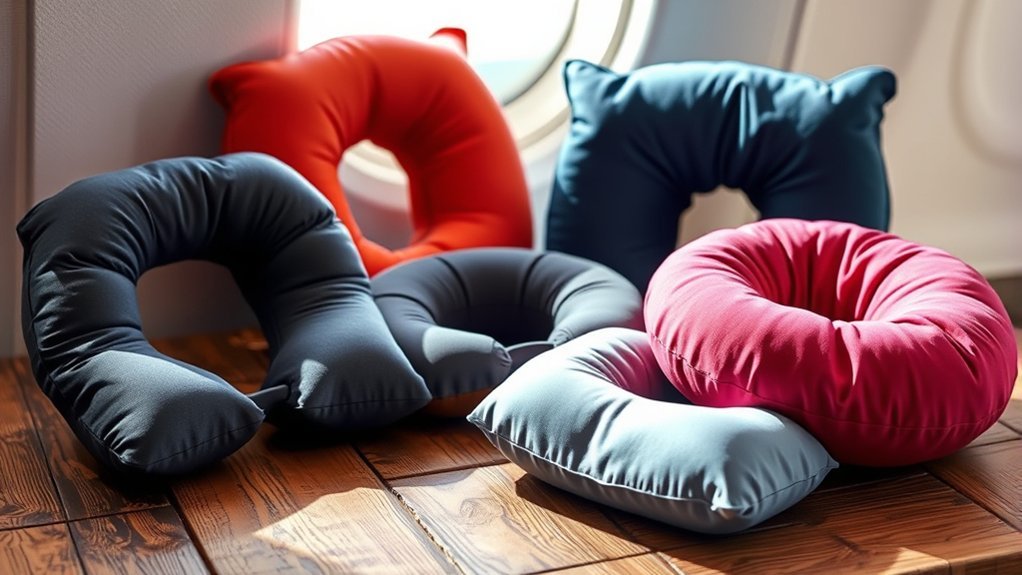
Two shapes are especially common. A U-shaped pillow wraps around the sides of the neck and is intended mainly for upright seating. A rectangular or contoured camping-style pillow supports the head more like a small bed pillow when you can lie flat.
Note: Do not assume that every TPU product is plasticizer-free or that every PVC product uses the same additives. The EPA notes that phthalates are commonly used as plasticizers in PVC products, while TPU formulations also vary. BASF, for example, documents a TPU grade that contains a plasticizer. If chemical composition matters to you, look for a product-specific phthalate statement, material disclosure, or certification.
Top Benefits of Using an Inflatable Travel Pillow for Travelers
The main advantage of an inflatable travel pillow is adjustability without much packing bulk. Depending on the design, it can offer several practical benefits:
- Compact storage: The air can be removed almost completely, allowing many models to fit into a small pouch.
- Adjustable firmness: Add air for more structure or release some for a softer, lower fit.
- Low weight: Many inflatable designs use little material compared with full-size foam pillows.
- Easy surface cleaning: Smooth bladders and removable or washable outer fabrics can be easier to maintain when the manufacturer’s care directions are followed.
- Different shapes for different positions: Neck-wrap designs suit upright seating, while rectangular designs work better for tents, hammocks, and other lying positions.
Support can improve comfort when a pillow fits you well, but avoid treating an inflatable neck pillow as a medical device. Research on cervical-support pillows suggests that pillow shape and support can affect comfort and neck symptoms, but those studies do not prove that every inflatable travel pillow prevents neck pain or improves sleep. One comparative study of neck-support pillows found that users’ responses depended strongly on pillow shape and consistency.
Choosing the Right Inflatable Travel Pillow for Your Needs
Start with your normal travel position. A pillow that works well against an airplane headrest may feel completely wrong in a tent, so fit and shape should come before material buzzwords.
Choose the Right Shape and Height
- U-shaped neck pillow: Best for upright airplane, train, or passenger-seat use when you want side support around the neck.
- Front-support or wraparound design: Useful if your head tends to fall forward while you sleep.
- Rectangular or contoured pillow: Better for camping, hotels, hammocks, or other situations where you can lie down.
- Low rear section: Helpful in seats with thick headrests because excessive padding behind the neck can push your head forward.
When fitted correctly, the pillow should support your head without forcing your chin sharply upward, pressing into your jaw, or lifting your shoulders. If the pillow feels too tall, releasing a small amount of air is usually better than wearing it fully inflated.
Check the Bladder and Cover Materials
Look for clear material information from the manufacturer. TPU is commonly used in lightweight inflatable products and is valued for properties such as flexibility, wear resistance, and tear resistance. BASF lists abrasion resistance, tensile strength, and tear resistance among common TPU characteristics, but actual durability still depends on the specific formulation, film thickness, seams, and construction.
For a pillow that touches your face and neck, also look at the outer fabric. A soft removable cover can feel better against the skin, while an integrated shell may be simpler and lighter. Either design can work well if it is easy to clean.
Inspect the Valve and Seams
The valve should be easy to close completely, easy to adjust without dumping all the air, and positioned where it does not press into your neck or face. A one-way or multi-function valve can make inflation and fine adjustment easier, but valve quality matters more than the marketing name used for the mechanism.
Also inspect welded seams and corners. Those areas take much of the stress when the pillow is squeezed, packed, or overinflated.
Consider Packed Size and Weight
Inflatable pillows can become extremely compact, but specifications vary. As a real-world example, the current Sea to Summit Aeros Premium Traveller is listed at 3.3 ounces packed and 4 × 3 × 2 inches in its pouch. That shows how small an inflatable model can be, but it should not be treated as a category-wide standard.
Inflatable vs. Memory Foam and Other Travel Pillows
| Type | Best Features | Main Tradeoff |
| Inflatable | Very compact, lightweight, adjustable firmness | Can leak or feel less cushioned; firmness changes with air level |
| Memory Foam | Soft contouring and consistent feel | Bulkier and usually less adjustable |
| Fiber or Microbead | Soft feel and simple construction | Often bulkier and may provide less structured support |
Choose an inflatable pillow when packing space and adjustable firmness are priorities. Choose foam or another filled design when you prefer a fixed, cushioned feel and do not mind carrying more bulk.
How to Inflate, Fit, and Deflate an Inflatable Travel Pillow
- Open the valve fully. Make sure there is no fabric or debris blocking the opening.
- Inflate gradually. Stop before the pillow becomes rigid.
- Position it in your normal sleeping posture. For a neck pillow, sit back against the actual seat or headrest you will be using.
- Fine-tune the firmness. Release a small amount of air if the pillow pushes your head forward, presses into your jaw, or feels too hard.
- Close the valve completely. Check that the cap or closure is seated evenly.
- To pack it, open the valve and roll gently toward the valve. Avoid violently squeezing or twisting the bladder.
- Let it dry before long-term storage. Moisture trapped in a pouch can create odor and mildew on fabrics.
Pro Tip: Do not automatically inflate a neck pillow to its maximum size. Start slightly soft and add air only if your head still lacks support. A pillow that is too firm can feel taller than you need and may push your head away from the seat.
When’s the Best Time to Use Your Inflatable Travel Pillow?
Inflatable pillows are most useful when you want extra support without dedicating much luggage space to a full-size pillow.
The most useful inflatable pillow is one that fits your body when partially inflated—not simply the model that becomes firmest.
- Long flights: A fitted neck pillow can support the head when you are resting upright for several hours.
- Road trips: Useful for passengers who want to nap in an upright seat. Drivers should not use a pillow in a way that restricts normal head movement or interferes with driving.
- Camping trips: A rectangular inflatable pillow can provide head support while taking up very little room in a backpack.
- Layovers: Easy to unpack for a short rest and deflate again before boarding.
Do Inflatable Travel Pillows Count as a Personal Item?
Do not assume a separate pillow is automatically exempt from an airline’s baggage allowance. The FAA advises passengers to check their airline’s rules for the number and size of carry-on items. A compact pillow stored inside your existing bag avoids most uncertainty.
Once onboard, follow the crew’s instructions about where the pillow can be used or stored, especially during taxi, takeoff, landing, or an emergency.
Why Can an Inflatable Pillow Feel Firmer After Takeoff?
Air pressure in a commercial aircraft cabin is lower at cruise than it is at sea level. The FAA notes that passenger jets are normally pressurized to a cabin altitude that can approach about 8,000 feet. According to NASA’s explanation of Boyle’s Law, the volume of a confined gas tends to increase as surrounding pressure decreases when other conditions are held roughly constant.
In practice, a flexible inflatable pillow may therefore feel firmer after the aircraft climbs. Leave a little give in the pillow at the gate and adjust the valve after takeoff if necessary.
Tips for Maximizing Comfort With Your Inflatable Travel Pillow
Position the pillow so it supports the parts of your head and neck that tend to move when you fall asleep. The goal is support without forcing your neck into an awkward angle.
| Tip | Action | Benefit |
|---|---|---|
| Pillow Positioning | Place it snugly where your head naturally needs support | Limits unsupported head movement |
| Firmness Adjustment | Add or release air in small amounts | Matches the pillow height to your body |
| Rear Thickness | Avoid excessive bulk behind your neck against a thick headrest | Helps prevent your head from being pushed forward |
| Combine Accessories | Use with an eye mask and earplugs when appropriate | Reduces light and noise distractions |
| Storage | Fully deflate and dry before long-term packing | Reduces odor and stress on the bladder |
If a U-shaped pillow keeps sliding, try slightly less air or adjust the closure if your model has one. If it pushes your head forward, rotate it only if the manufacturer’s design allows that position comfortably, or choose a model with a thinner rear section.
Warning: Avoid overinflating the pillow until it feels rigid. Excess pressure puts more stress on seams and the valve, and an already-hard pillow may become firmer as cabin pressure drops during a flight. Inflate only enough to support you comfortably and readjust when needed.
How to Clean and Store an Inflatable Travel Pillow
Cleaning instructions depend on how the pillow is built. Some models have removable covers, while others combine the fabric and bladder into one unit.
- Check the care label first. Do not assume the entire pillow can go in a washing machine.
- Removable cover: Wash it using the temperature and cycle specified by the manufacturer.
- Integrated inflatable pillow: Hand washing is often safer when the manufacturer permits it. Sea to Summit, for example, recommends warm water, gentle hand washing, and air drying for its Aeros Premium Traveller.
- Valve area: Keep lint, sand, and debris away from the sealing surfaces.
- Dry completely: Do not seal a damp pillow in its storage pouch for an extended period.
- Avoid harsh cleaners: Solvents, bleach, and aggressive chemicals may damage coatings, adhesives, fabrics, or printed surfaces unless the manufacturer specifically approves them.
Inflatable Travel Pillow Troubleshooting
The Pillow Slowly Loses Air
First, reinflate it and make sure the valve is fully seated. Gently squeeze the pillow while listening around the valve and seams. If it continues to soften, inspect the bladder for a small puncture. Use only a repair method or patch that the manufacturer recommends for that material.
The Pillow Feels Too Hard
Release a small amount of air rather than forcing your neck against a rigid pillow. On an aircraft, recheck the firmness after the cabin has pressurized because the pillow may feel different from how it felt at the gate.
The Pillow Pushes Your Head Forward
This usually means the rear section is too thick for the seat or the pillow is overinflated. Reduce the air level. If the problem remains, a design with a thinner back panel may fit that seat better.
The Valve Leaks
Check for dust, fibers, or a folded seal around the valve. If the valve body is cracked, permanently distorted, or separating from the bladder, replacement is usually safer than relying on an improvised repair.
When Should You Replace an Inflatable Travel Pillow?
There is no universal lifespan. Replace it when it can no longer hold air reliably or when you see cracking, sticky or peeling material, seam separation, repeated punctures, or permanent valve damage. A pillow that fails during normal use is no longer providing dependable support, regardless of its age.
Frequently Asked Questions
Can inflatable travel pillows be washed or cleaned easily?
Usually, but the correct method depends on the model. Wash a removable cover according to its care label. For an integrated inflatable pillow, follow the manufacturer’s instructions; many are better suited to gentle hand washing and air drying than machine washing. Make sure the pillow is completely dry before storing it.
How long do inflatable travel pillows typically last?
There is no reliable universal lifespan because materials, seam construction, valves, storage conditions, and frequency of use vary widely. Keep using the pillow while it holds air reliably and the bladder, seams, and valve remain in good condition. Replace it if you find persistent leaks, cracking, delamination, or valve damage.
Are there any safety concerns with using inflatable travel pillows?
The main practical concerns are overinflation, poor fit, damaged seams or valves, and hygiene. Use only enough air for comfortable support, inspect the pillow for damage, follow its care instructions, and check product-specific material disclosures if chemical composition is important to you.
Can inflatable travel pillows be used for outdoor activities?
Yes. Their low packed volume makes rectangular inflatable pillows especially useful for camping, backpacking, hammocks, and car camping. Choose a design intended for lying down rather than assuming an upright U-shaped neck pillow will work like a conventional bed pillow.
What materials are commonly used in inflatable travel pillows?
Inflatable bladders may use TPU, PVC, or other flexible polymer constructions, while exterior fabrics commonly include polyester or nylon. Material names alone do not tell you the complete chemical formulation or durability, so check the specific manufacturer’s specifications and safety information.
Should I fully inflate a travel pillow before a flight?
Usually not. Inflate it only until it provides comfortable support. A slightly soft pillow is easier to fine-tune, and it may feel firmer after takeoff as cabin pressure changes. Release a little air if it becomes too hard or begins pushing your head into an awkward position.
Does an inflatable pillow count as a carry-on or personal item?
That depends on the airline. Cabin-baggage allowances are set by individual carriers, so a separate pillow should not automatically be assumed to be exempt from the item limit. Packing a deflated pillow inside your existing carry-on or personal item is the simplest way to avoid uncertainty.
Can a leaking inflatable travel pillow be repaired?
Sometimes. A small puncture in the bladder may be repairable if the manufacturer provides or recommends a compatible patch system. Valve cracks, seam separation, or widespread material deterioration are harder to repair reliably and are usually signs that the pillow should be replaced.
Conclusion
An inflatable travel pillow is most useful when you want compact packing and the ability to adjust your support instead of accepting one fixed firmness. Match the shape to how you sleep, use only enough air to support your head comfortably, and pay attention to valve quality, rear thickness, washable surfaces, and product-specific material information.
For flights, remember that cabin pressure can change how firm the pillow feels and that baggage rules vary by airline. With sensible inflation, regular cleaning, and occasional checks for leaks or seam damage, an inflatable pillow can be a practical option for flights, passenger road trips, layovers, camping, and other travel where space is limited.
Sources
- Federal Aviation Administration: Carry-On Baggage Tips — supports airline-specific carry-on limits and cabin-stowage guidance.
- U.S. Environmental Protection Agency: Phthalates — explains the use of phthalates as plasticizers, particularly in PVC products.
- BASF: Elastollan TPU Technical Data Sheet — demonstrates that TPU formulations can vary and that some grades contain plasticizer.
- Sea to Summit: Aeros Premium Traveller Pillow — provides a current real-world example of TPU bladder construction, packed dimensions, valve design, and hand-washing instructions.
- NASA Glenn Research Center: Boyle’s Law — supports the explanation of how lower surrounding pressure can affect a confined volume of air.
- PubMed: Neck Support Pillows — A Comparative Study — supports the cautious discussion of pillow shape, consistency, comfort, sleep, and neck-support effects.
