

Last Updated on September 27, 2026 by Caleb Warren
Can you bring an electric scooter inside a store? The answer depends on whether you’re riding it for recreation, carrying it as personal property, or using it because of a mobility disability. Stores can set safety rules for recreational scooters, but federal accessibility laws provide important protections for mobility devices.
Quick Answer
You can bring an electric scooter inside a store if its policy allows it, but don’t assume you can ride a recreational scooter through the aisles. Some stores permit folded scooters as personal property. If you use a scooter because of a mobility disability, the Americans with Disabilities Act (ADA) provides additional access protections.
Last checked: September 28, 2026. Legal provisions and key facts were verified against official sources.
Key Takeaways
- Carrying a folded scooter and riding one indoors are different activities. A store may allow one but prohibit the other.
- The ADA recognizes both traditional mobility devices and other power-driven mobility devices used because of a disability.
- A recreational scooter doesn’t automatically gain ADA protection simply because its owner wants to bring it indoors.
- Permission to ride on a public sidewalk doesn’t automatically extend to a private store.
Disclosure: As an Amazon Associate I earn from qualifying purchases. Some links on this page are affiliate links, at no extra cost to you.
Can You Bring an Electric Scooter Inside a Store?
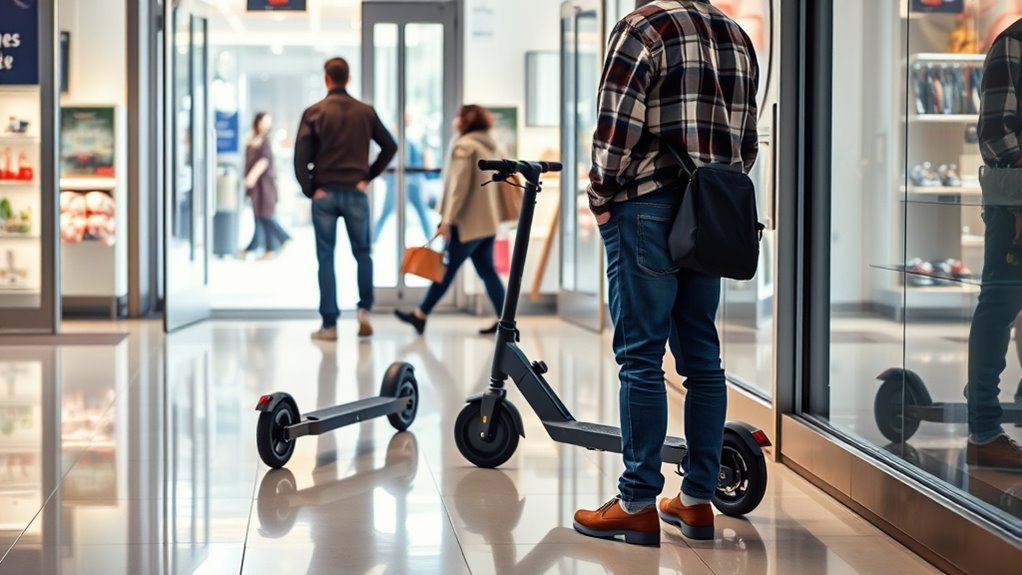
You may be able to bring your electric scooter inside a store, but permission depends on how you intend to use it. Riding, pushing, carrying, and using a mobility aid are different situations.
For recreational scooters, the practical rule is to obtain permission before entering. A store may allow a compact, folded scooter while restricting an unfolded scooter or prohibiting indoor riding.
| How you bring the scooter | What generally applies |
|---|---|
| Riding a recreational scooter | Requires the store’s permission and compliance with its safety rules. |
| Carrying a folded scooter | May be permitted as personal property if it doesn’t create an obstruction. |
| Pushing a powered-off scooter | Still subject to store permission and available space. |
| Using a scooter for disability-related mobility | Protected under applicable ADA mobility-device rules, subject to the relevant legal safety standards. |
The U.S. Department of Justice explains these distinctions in its official guidance on mobility devices. A store’s general restriction on recreational scooters doesn’t automatically determine whether someone using a device because of a disability may enter.
Why Do Stores Ban Electric Scooters?
Stores restrict recreational electric scooters mainly because of collision risks, limited space, and concerns about customer safety. Narrow aisles, shopping carts, product displays, and crowded checkout areas can make riding difficult.
A sudden turn or stop may cause a collision or damage merchandise. An unfolded scooter left unattended can also obstruct a walkway or create a tripping hazard.
Businesses may therefore establish rules covering:
- Whether recreational scooters can be ridden indoors.
- Whether customers may carry or push scooters through the store.
- Where scooters can be stored without blocking customers.
- Whether scooters must remain outside the building.
Stores also consider potential liability if someone is injured. However, a business must distinguish its general recreational-scooter policy from its legal obligations toward customers using mobility devices because of a disability.
Which Stores Let Electric Scooters Inside?
There is no single nationwide store policy covering every recreational electric scooter. Even within a retail chain, practical arrangements may depend on the location, available space, and the type of scooter.
For Walmart and Target, don’t assume that permission at one location establishes the policy everywhere. Ask whether the store allows recreational scooters to be carried, pushed, or stored indoors.
The same approach applies to grocery retailers such as Kroger and Whole Foods. A crowded location may have different practical limitations from a larger store with more open space.
Do not treat an in-store mobility cart as permission to ride your own recreational scooter. These are different devices serving different purposes.
Some stores provide electric mobility carts for shoppers who need assistance. Availability may vary, and a cart may already be in use when you arrive.
What Does the ADA Say About Mobility Scooters?
The Americans with Disabilities Act protects people who use mobility devices because of disabilities. For public-facing businesses, the relevant federal requirements appear in Title III of the ADA.
These protections don’t depend solely on whether a device resembles a traditional wheelchair. The regulations distinguish devices designed primarily for disability-related mobility from other powered devices used for that purpose.
ADA Mobility Rights
Stores must generally permit people with mobility disabilities to use wheelchairs and other recognized mobility aids in areas open to pedestrian use.
This includes qualifying electric mobility scooters designed primarily for people with mobility disabilities.
A retailer cannot simply replace this legal requirement with a blanket rule against all powered devices. The ADA also recognizes that people with disabilities may choose different mobility aids to meet their needs.
A customer’s own qualifying mobility scooter may therefore receive protection even when the retailer also provides shopping carts or other mobility equipment.
OPDMD Classification Rules
The ADA recognizes another category called an Other Power-Driven Mobility Device (OPDMD). This covers certain powered devices used by people with mobility disabilities that aren’t classified as wheelchairs.
Examples in Department of Justice guidance include Segways and golf carts. A recreational-style electric scooter used because of a mobility disability may also fall within this category, depending on its characteristics and use.
The distinction is important:
- Wheelchair category: Devices designed primarily for disability-related mobility, including qualifying electric mobility scooters.
- OPDMD category: Other powered devices used by individuals with mobility disabilities for transportation.
- Recreational use: Riding a scooter for convenience or enjoyment alone doesn’t create disability-related ADA access rights.
The ADA does not classify these devices using the article’s former Class 1 medical scooter and Class 2 OPDMD labels.
Store Accommodation Standards
Under 28 CFR §36.311, public accommodations must make reasonable policy modifications for people using OPDMDs unless they can demonstrate that the relevant class of devices cannot operate within legitimate safety requirements.
Businesses must consider the following factors when assessing a device:
- Its type, size, weight, dimensions, and speed.
- The amount of pedestrian traffic.
- The building’s layout, available space, and operating characteristics.
- Whether appropriate safety rules could permit its use.
- Any applicable environmental risks or federal land-management restrictions.
For example, a store may establish a pedestrian-speed limit or restrict access to a particular narrow area when justified by actual safety conditions.
Safety requirements must be based on real risks, not assumptions or stereotypes about people with disabilities.
For an OPDMD, staff may request credible assurance that the device is used because of a mobility disability. A verbal statement generally satisfies this requirement unless contradicted by observable facts.
Staff cannot demand details about the nature or extent of your disability.
If a particular OPDMD cannot safely be accommodated, the store should provide an alternative way to access its services when possible.
Note: If you believe a store has improperly denied disability-related access, ask for its accommodation policy and the specific reason for the restriction. An ADA specialist or qualified local attorney can explain how the applicable rules affect your situation.
Do State Laws Change Scooter Access in Stores?
Yes. State and local laws can affect scooter operation, parking, and disability access. However, permission to ride an electric scooter on a public street or sidewalk doesn’t automatically authorize riding it inside a private store.
California, New York, and Texas may have additional state or local requirements. Their rules should be considered alongside the federal ADA rather than treated as blanket permission or prohibition for every retailer.
Florida provides a useful example of the distinction between public riding rules and store access.
Under the 2026 Florida Statutes, §316.2128, operators of motorized scooters and micromobility devices generally have bicycle-related rights and duties, subject to the statute’s exceptions.
The law also allows local governments to regulate scooter operation on streets, highways, sidewalks, and sidewalk areas within their jurisdiction.
These public traffic provisions do not establish a general right to ride a recreational electric scooter through a private shop.
Disability-related access is a separate issue governed by applicable federal and state accessibility requirements.
How Do You Ask a Store About Scooter Rules?
The simplest approach is to ask about the exact activity you intend to perform. A question about bringing a scooter inside may receive a different answer from a question about carrying it folded.
Call Ahead First
Call the store before traveling there, especially if your scooter is large or difficult to fold.
Ask these four questions:
- Can I bring my personal electric scooter inside?
- May I carry it folded if indoor riding isn’t allowed?
- Is there a designated scooter parking or storage area?
- What accommodations are available if I use it because of a mobility disability?
If you need the scooter for mobility, explain that purpose without feeling obligated to disclose your diagnosis.
You can also ask whether an electric shopping cart is available, whether staff can assist, or whether the store offers another suitable arrangement.
Check Posted Signage
Look for scooter-related notices near the entrance. Signs may distinguish between riding restrictions, vehicle storage, and restrictions on bringing large personal items indoors.
Pay attention to wording. A sign prohibiting riding doesn’t necessarily answer whether you may carry a folded scooter.
Likewise, a general sign restricting scooters doesn’t remove a business’s obligations under applicable disability-access laws.
If the wording is unclear, request clarification before entering.
Ask Staff Politely
If you arrive without knowing the policy, stop near the entrance and speak with a staff member.
For recreational use, you might say:
May I bring my scooter inside if I switch it off and carry it folded? I won’t ride it or leave it blocking an aisle.
If staff decline, ask whether a manager can clarify the policy or identify approved storage.
For disability-related use, explain that the scooter is your mobility device and ask about the applicable accommodation policy.
If you believe an access decision violates the ADA, the Department of Justice provides official guidance on filing an ADA complaint.
How Can You Store an Electric Scooter Outside Safely?
If your scooter must remain outside, choose a permitted parking spot and secure it to a sturdy, immovable object. A designated scooter area or suitable bicycle rack is preferable when available.
Follow these steps:
- Choose an approved location. Confirm that scooter parking is permitted and the space doesn’t belong to another business.
- Switch off the scooter. Make sure it cannot accidentally accelerate or roll away.
- Secure the frame. Use a suitable high-quality lock through a secure structural part and around the parking fixture.
- Protect removable accessories. Take easily detachable valuables with you.
- Check the surroundings. Keep the scooter upright and avoid obstructing entrances, curb ramps, or walkways.
If your model has a removable battery, follow its manufacturer’s handling instructions. Only remove it when the design permits safe removal.
A compatible GPS tracker may provide another layer of theft protection, but it doesn’t replace a physical lock.
Warning: Never leave a scooter blocking an accessible route, emergency exit, doorway, or fire equipment. These obstructions can prevent people from moving safely through the area.
The San Francisco Municipal Transportation Agency’s scooter parking guidance illustrates safe placement around bicycle racks and the importance of keeping pedestrian routes clear. Follow the rules that apply to your own location.
What Are the Best Alternatives If Scooters Aren’t Allowed?
If a store doesn’t permit your recreational scooter indoors, choose an alternative that fits the scooter’s size, your shopping needs, and the available facilities.
- Fold and carry it: Ask permission to bring a compact scooter inside as personal property.
- Use designated parking: Secure the scooter outside when suitable parking is available.
- Ask about storage: Some locations may have an approved area where staff can direct you.
- Use curbside pickup: Collect your order without bringing the scooter into the shopping area.
- Choose another transport option: Public transportation may be practical for some trips, subject to its own scooter and battery rules.
If you use a scooter because of a mobility disability, discuss accommodation options rather than assuming you must abandon your own device.
Depending on the circumstances, appropriate alternatives may include access with your qualifying device, a suitable mobility cart, staff assistance, or another way to obtain the store’s services.
Frequently Asked Questions
Can You Take an Electric Scooter in a Store?
Yes, if the store allows your recreational scooter or it qualifies for protection under applicable mobility-access rules. Permission to bring a scooter inside does not necessarily mean you can ride it. Ask whether you must fold, carry, or store it.
Does Target Allow Electric Scooters Inside?
Ask your specific Target location whether it permits recreational electric scooters indoors. Do not assume that riding, pushing, and carrying a folded scooter are treated identically. Disability-related mobility devices are subject to applicable ADA requirements.
What Are the Rules for Electric Scooters in Florida?
Florida Statutes §316.2128 generally gives operators of motorized scooters and micromobility devices bicycle-related rights and duties, with specified exceptions. Local governments may regulate their operation on public streets and sidewalks. These rules do not automatically authorize indoor riding in private stores.
Can You Take a Scooter Into a Shop?
You may take a scooter into a shop when its policy permits your intended use. Switching off the motor or pushing the scooter does not automatically guarantee entry. Ask staff about carrying, parking, and mobility-related access arrangements.
Can You Carry a Folded Electric Scooter Into a Store?
You can carry a folded electric scooter indoors if the store permits it. Keep the scooter switched off and under your control. Do not place it where it could block a walkway, checkout lane, or emergency exit.
Can a Store Ask for Proof That You Need a Mobility Scooter?
A store may request credible assurance that an OPDMD is used because of a mobility disability. A verbal statement generally satisfies this requirement unless contradicted by observable facts. Staff cannot require you to explain the nature or extent of your disability.
Conclusion
Bringing an electric scooter inside a store depends on its intended use, the retailer’s rules, and any applicable disability-access protections.
For recreational trips, ask about carrying or storing your scooter before entering. If you use it for mobility, understand the ADA protections that may apply to your device.
When indoor access isn’t permitted, choose a suitable parking or shopping alternative without compromising pedestrian safety or accessibility.
Sources
- U.S. Department of Justice — ADA Mobility Device Guidance: Wheelchair and OPDMD definitions, mobility-device access, and accommodation principles.
- U.S. Department of Justice — ADA Title III Regulations: Legal requirements under 28 CFR §36.311, safety assessments, and credible assurance.
- Florida Legislature — Florida Statutes §316.2128: Motorized scooter and micromobility rules, including local regulatory authority.
- San Francisco Municipal Transportation Agency — Mobility Device Parking Guidelines: Scooter parking practices and pedestrian-access protection.
- U.S. Department of Justice — File an ADA Complaint: Official guidance for reporting possible disability-related access violations.
