
Last Updated on September 27, 2026 by Caleb Warren
Can you bring an electric scooter on a plane? Sometimes, but most recreational e-scooters face strict battery restrictions, and some airlines prohibit them entirely. Before packing yours, you need to confirm its battery capacity, the airline’s acceptance policy, and whether the scooter qualifies as ordinary baggage or a disability mobility aid.
Quick Answer
You can bring a recreational electric scooter on a plane only if the airline accepts it and its battery meets aviation safety limits. Batteries up to 100 Wh generally meet the standard limit; those over 100 Wh through 160 Wh require airline approval. Larger batteries are prohibited under ordinary recreational-device rules. Disability mobility aids follow different requirements.
Key Takeaways
- Meeting the battery limit does not guarantee acceptance. Airlines may prohibit recreational electric scooters regardless of battery size.
- Removed lithium batteries must travel in carry-on baggage, with their terminals protected against short circuits.
- Battery capacity is measured in watt-hours (Wh), not motor power in watts (W).
- A scooter used as a disability mobility aid may qualify for different battery allowances and baggage protections.
Disclosure: As an Amazon Associate I earn from qualifying purchases. Some links on this page are affiliate links, at no extra cost to you.
Can You Bring an Electric Scooter on a Plane?
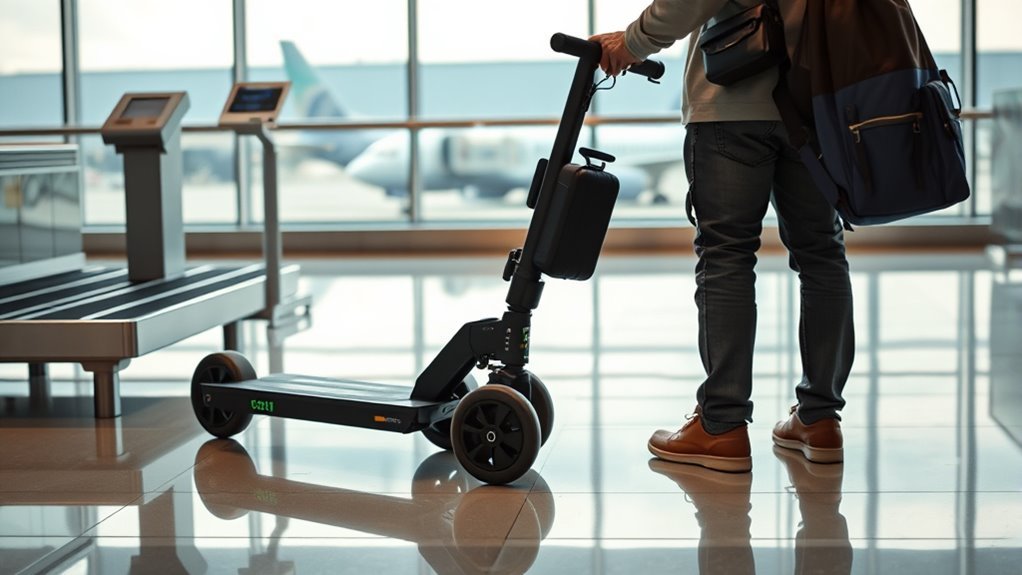
A recreational electric scooter may travel as baggage when its battery meets aviation limits and the airline specifically accepts the device. However, many everyday e-scooters have batteries that exceed the passenger baggage allowance.
The FAA’s recreational vehicle guidance explains that airlines can refuse these devices even when they meet the standard battery limits.
For example, American Airlines prohibits lithium-ion battery-powered personal transportation devices, including small electric scooters, in both carry-on and checked baggage.
Its restricted items policy makes clear that meeting a battery threshold does not override an airline-wide prohibition.
Before booking, establish three things:
- Whether the airline accepts your exact type of recreational scooter.
- Whether its battery capacity falls within the permitted range.
- Whether the assembled or folded scooter meets the airline’s baggage requirements.
Get confirmation for every operating airline on your itinerary, including connecting flights.
Check Your Scooter’s Battery Wh
Your scooter’s battery capacity is usually the deciding technical factor. Airlines use watt-hours (Wh) to measure stored electrical energy, so motor power alone cannot establish whether your scooter is eligible.
Find the battery specifications before contacting the airline.
Battery Watt-Hour Rating
Check the battery label, manufacturer’s manual, or official product specifications for its watt-hour rating.
If the label lists voltage and amp-hours instead, calculate capacity using this formula:
Watt-hours (Wh) = Volts (V) × Amp-hours (Ah)
If the capacity is listed in milliamp-hours (mAh), divide that figure by 1,000 to convert it to amp-hours before multiplying.
For example, the FAA identifies a 36 V, 4.4 Ah battery as having a capacity of 158.4 Wh.
That battery falls within the range requiring airline approval under ordinary passenger battery rules. It is not automatically accepted simply because it is below 160 Wh.
Also distinguish between:
- Motor wattage: The motor’s power rating, expressed in watts.
- Battery capacity: The energy stored in the battery, expressed in watt-hours.
A scooter advertised with a powerful motor may still have a different battery capacity. Always use the battery’s actual specifications.
Airline Wh Limits
Under ordinary recreational-device rules, the standard lithium-ion battery limit is 100 Wh. Batteries exceeding 100 Wh but not exceeding 160 Wh require airline approval.
Use this comparison before planning your trip.
| Battery capacity | General passenger rule | What it means for your scooter |
|---|---|---|
| Up to 100 Wh | Within the standard battery allowance. | The airline must still accept the scooter itself. |
| Over 100 Wh through 160 Wh | Airline approval required. | Obtain approval for the device and its battery before travel. |
| Over 160 Wh | Prohibited under ordinary recreational-device baggage rules. | The battery cannot accompany you as ordinary passenger baggage. |
These are battery safety thresholds, not a guarantee that your airline will transport a scooter.
Removable Battery Rules
A removable battery can make packing easier, but removing it does not automatically make the scooter acceptable for air travel.
The battery must still meet the applicable capacity limit, and the airline must accept both the battery and the scooter frame.
The FAA’s lithium battery guidance requires spare or removed lithium batteries to travel in carry-on baggage rather than checked baggage.
Important handling rules include:
- Protect the exposed terminals against contact with metal objects.
- Use the original packaging, an individual protective pouch, or another suitable battery case.
- Keep the battery protected against physical damage.
- Remove it from your carry-on if that bag must be checked at the gate.
Warning: Do not attempt to fly with a damaged, swollen, overheating, or unsafe recalled lithium battery. Do not modify, dismantle, or split a battery pack to bypass its capacity rating. A battery-free scooter frame may still be refused under an airline’s device policy.
Know the Airline’s Size and Weight Rules
Even an approved scooter must fit the airline’s applicable baggage limits. Check its folded dimensions, packed weight, and any special handling requirements.
Many travelers encounter standard baggage measurements such as 22 × 14 × 9 inches for carry-on luggage or 62 linear inches for checked baggage.
However, these are not universal scooter allowances. Special equipment rules, aircraft limitations, and airline-specific restrictions may override ordinary baggage dimensions.
Measure the packed scooter using:
- Length, including any exposed wheels or handles.
- Width at its widest point.
- Height after folding or disassembly.
- Total packed weight, including its case and accessories.
For checked baggage, linear dimensions mean length plus width plus height.
Do not assume that paying an oversized baggage fee makes a prohibited battery-powered device acceptable.
Remove the Battery Before You Fly
If your airline accepts the scooter and requires battery removal, follow the manufacturer’s removal instructions. A battery that is properly installed and protected may be treated differently from a spare battery.
Never force a battery out of a scooter designed with a non-removable pack.
Battery Removal Steps
Use the following process only when your scooter has a manufacturer-approved removable battery.
- Turn off the scooter. Make sure it cannot activate accidentally.
- Disconnect the battery. Follow the manufacturer’s instructions for releasing its connector or locking mechanism.
- Remove the battery carefully. Avoid pulling on wiring or damaging the housing.
- Protect the terminals. Use suitable terminal covers or insulating tape where appropriate.
- Pack the battery separately. Place it in protective packaging that prevents movement and contact with metal objects.
- Keep its specifications accessible. Carry the battery label information and any airline approval.
Do not continue if you notice swelling, exposed wiring, damaged connectors, or unusual heat.
Cabin Packing Rules
Removed lithium batteries must remain in the aircraft cabin when accepted under the applicable passenger battery rules.
A protective battery pouch or suitable case helps prevent accidental damage and short circuits. A fire-resistant bag may provide additional protection, but it does not replace proper packaging or airline approval.
The FAA’s portable electronic device guidance also explains that devices containing batteries should generally travel in carry-on baggage.
When an approved device must travel in checked baggage, it must be completely switched off and protected against damage and accidental activation.
Keep your battery accessible during travel. If it becomes hot, expands, smokes, or shows other signs of failure onboard, alert the flight crew immediately.
Pack Your Scooter for Air Travel
Once the airline confirms acceptance, protect the scooter against movement and impact during handling. A sturdy, padded case can help protect its frame, controls, and exposed components.
Prepare it in this order:
- Clean dirt and debris from the scooter.
- Fold the handlebars and frame according to the manufacturer’s instructions.
- Secure loose components so they cannot swing or unfold.
- Remove detachable accessories that could break during handling.
- Pack the approved battery separately if required.
- Place the scooter inside its protective case.
- Attach your name and contact information to the case.
Check that the scooter cannot switch on accidentally while packed.
Keep a copy of your airline’s approval and the scooter’s battery specifications with your travel documents.
Pro Tip: Photograph the scooter, battery label, and packed case before departure. These records can help airline staff identify the equipment and document its condition if damage occurs.
Tell the Airline at Least 48 Hours Ahead
Contacting the airline at least 48 hours before departure is a useful planning precaution, but it is not a universal requirement for every recreational scooter.
The important step is obtaining confirmation before relying on the scooter as part of your travel plans.
Advance Notice Requirements
Advance notice rules depend on the device, airline, and type of assistance requested.
For disability-related equipment, the U.S. Department of Transportation explains that airlines generally cannot require advance notice simply because a passenger has a disability.
However, its advance travel guidance identifies specific situations where up to 48 hours’ notice may be required, including transporting a powered wheelchair on an aircraft with fewer than 60 seats.
For a recreational scooter, contact the airline before purchasing a nonrefundable ticket.
Ask whether advance approval, special baggage handling, or supporting documents are required.
Airline Approval Process
Give the airline enough information to identify your exact scooter and battery configuration.
Provide:
- Manufacturer and model name.
- Battery chemistry and watt-hour capacity.
- Whether the battery is removable.
- Folded and packed dimensions.
- Total packed weight.
- Any manufacturer transport or battery safety documentation requested.
Ask the airline to confirm whether it accepts the scooter as cabin baggage, checked baggage, or not at all.
Also ask whether the battery must remain installed or be removed.
Request written confirmation when possible. A verbal statement from an employee may not resolve a disagreement about a restricted item at check-in.
Are Disability Mobility Scooters Subject to the Same Rules?
No. A scooter used as a disability mobility aid may qualify for different aviation rules than a recreational stand-up scooter.
The distinction matters because applying the recreational 160 Wh limit to every mobility device would be misleading.
The FAA’s wheelchair and mobility device guidance describes separate requirements for lithium-ion-powered mobility aids.
For devices without adequate built-in battery protection, the battery generally must be removed. In that situation:
- The removed battery must not exceed 300 Wh.
- It must travel in carry-on baggage.
- Its terminals must be protected against short circuits.
- The airline must be informed of the battery’s location.
The FAA also permits one spare battery not exceeding 300 Wh or two spare batteries not exceeding 160 Wh each, subject to the applicable mobility-device requirements.
Where the device adequately protects its installed battery, different handling provisions apply. Battery removal is not always necessary.
The airline must determine the appropriate handling procedure for the specific equipment.
Do not assume that calling a recreational scooter a mobility aid changes its classification. The device’s actual use and applicable accessibility rules matter.
What TSA Will Check on Your Scooter
TSA screening and airline acceptance are separate requirements. Passing through airport security does not guarantee that an airline will transport your scooter.
For an approved device, security personnel may inspect the frame, battery, and associated equipment.
Prepare for screening by:
- Keeping the scooter folded and secured.
- Making the battery label available for inspection.
- Keeping any required airline approval accessible.
- Following officers’ instructions if additional screening is needed.
TSA officers may determine whether an item is allowed through a security checkpoint. Airline staff separately determine whether the scooter meets their carriage requirements.
Do not attempt to conceal a removed battery inside checked luggage.
Taking an E-Scooter on International Flights
International travel requires checking the rules for every airline and country involved in your journey.
The International Air Transport Association (IATA) provides dangerous goods guidance used across international aviation. Its rules distinguish ordinary small battery-powered vehicles from disability mobility aids.
The IATA passenger guidance explains that small recreational vehicles are treated as portable electronic devices rather than automatically qualifying as mobility aids.
Before international travel, confirm:
- The operating airline’s recreational scooter policy.
- Battery capacity and approval requirements.
- Any restrictions imposed by connecting airlines.
- Applicable destination import and transport rules.
- Whether you may legally ride the scooter at your destination.
A scooter accepted on your outbound flight may not be accepted on your return journey if a different airline operates that flight.
Keep the battery specifications and transport approval available throughout the trip.
How to Avoid Airline Fees and Damage
There is no universal scooter transportation fee. Charges depend on whether the airline accepts the device, how it classifies the item, and the applicable baggage allowance.
Oversized or overweight baggage charges may apply to approved recreational equipment.
The U.S. Department of Transportation’s baggage fee guidance explains that airlines must make their baggage fees available to passengers.
It also confirms that airlines cannot charge a baggage fee for an assistive device covered by the applicable disability rules.
To reduce avoidable costs and damage:
- Confirm acceptance before buying additional baggage.
- Measure and weigh the complete packed scooter.
- Use protective packaging for the frame and accessories.
- Keep documentation showing its condition before departure.
- Check whether your travel insurance covers damage or loss.
Do not assume that an ordinary travel insurance policy covers an electric scooter. Review the policy’s exclusions and equipment limits.
If Your Scooter Can’t Fly, Try These Alternatives
If your scooter exceeds the passenger battery allowance or your airline prohibits it, consider renting or arranging separate transport instead.
Practical alternatives include:
- Renting a scooter: Choose a short-term rental at your destination when available.
- Using a subscription service: Consider this for a longer stay where such services operate.
- Buying locally: Compare the full purchase and resale cost with rental charges.
- Booking a guided scooter tour: Use a provider that supplies suitable equipment.
- Shipping separately: Ask a qualified carrier whether it accepts your scooter and battery configuration.
Lithium batteries are regulated dangerous goods when shipped commercially. They cannot simply be mailed or sent by ordinary freight without checking the applicable requirements.
IATA’s lithium battery shipping guidance explains the additional packaging, labeling, and transport requirements.
If you need mobility assistance during your trip, arrange appropriate accessible transport rather than relying on an unapproved recreational scooter.
Frequently Asked Questions
How Do You Take an Electric Scooter on a Plane?
First, confirm that your airline accepts recreational electric scooters. Check the battery’s watt-hour rating, obtain approval when required, and follow the manufacturer’s packing instructions. If the airline requires battery removal, protect the terminals and carry the approved battery in the cabin.
How Much Does It Cost to Fly With an Electric Scooter?
There is no standard fee for transporting a recreational electric scooter. An accepting airline may apply checked baggage, oversized baggage, or overweight charges. Eligible disability assistive devices are not subject to ordinary baggage fees under U.S. disability air travel rules.
Does TSA Allow Electric Scooters?
TSA may permit an eligible scooter through security screening, but airline acceptance and FAA battery restrictions still apply. Some airlines prohibit recreational electric scooters entirely. A security screening decision does not override an airline’s baggage policy.
Can You Take a Lithium Battery Scooter on a Plane?
Yes, if the airline accepts the device and its battery meets the applicable limits. The ordinary threshold is 100 Wh, with airline approval required above 100 Wh through 160 Wh. Recreational devices with batteries exceeding 160 Wh are prohibited as ordinary passenger baggage.
Can You Fly With an Electric Scooter if You Remove the Battery?
Removing the battery does not guarantee that the scooter can fly. The airline must still accept the battery-free frame, and the removed battery must meet its own passenger baggage requirements. A battery exceeding the ordinary 160 Wh limit cannot accompany you as regular passenger baggage.
Can You Check an Electric Scooter With the Battery Installed?
An approved recreational scooter may travel with its battery installed when the airline permits that configuration and all applicable safety conditions are met. The device must be switched off and protected against damage and accidental activation. Removed or spare lithium batteries must travel in carry-on baggage.
Conclusion
You can bring an electric scooter on a plane only when its battery meets the applicable safety limits and the airline accepts the device. Check the battery’s Wh rating, confirm the airline’s policy, and follow its packing instructions before departure.
If your recreational scooter cannot fly, arrange a rental or compliant shipping option instead. If it is a disability mobility aid, use the separate mobility-device rules rather than ordinary recreational scooter limits.
Sources
- Federal Aviation Administration — Portable Recreational Vehicles: Recreational scooter acceptance, battery thresholds, and transport conditions.
- American Airlines — Restricted Items: Carrier restrictions on lithium-ion-powered personal transportation devices.
- Federal Aviation Administration — Lithium Batteries: Battery capacity limits, removable battery handling, and terminal protection.
- Federal Aviation Administration — Portable Electronic Devices: Carry-on and checked baggage safety requirements.
- Federal Aviation Administration — Wheelchairs and Mobility Devices: Disability mobility aid battery allowances and handling requirements.
- U.S. Department of Transportation — Travel Tips for Persons With Disabilities: Advance notice requirements and mobility equipment arrangements.
- U.S. Department of Transportation — Buying a Ticket: Airline baggage fee disclosures and assistive device fee protections.
- International Air Transport Association — Dangerous Goods Guidance for Passengers: International battery transport rules and recreational vehicle classification.
- International Air Transport Association — Shipping Lithium Batteries: Dangerous goods shipping, packaging, labeling, and documentation requirements.

